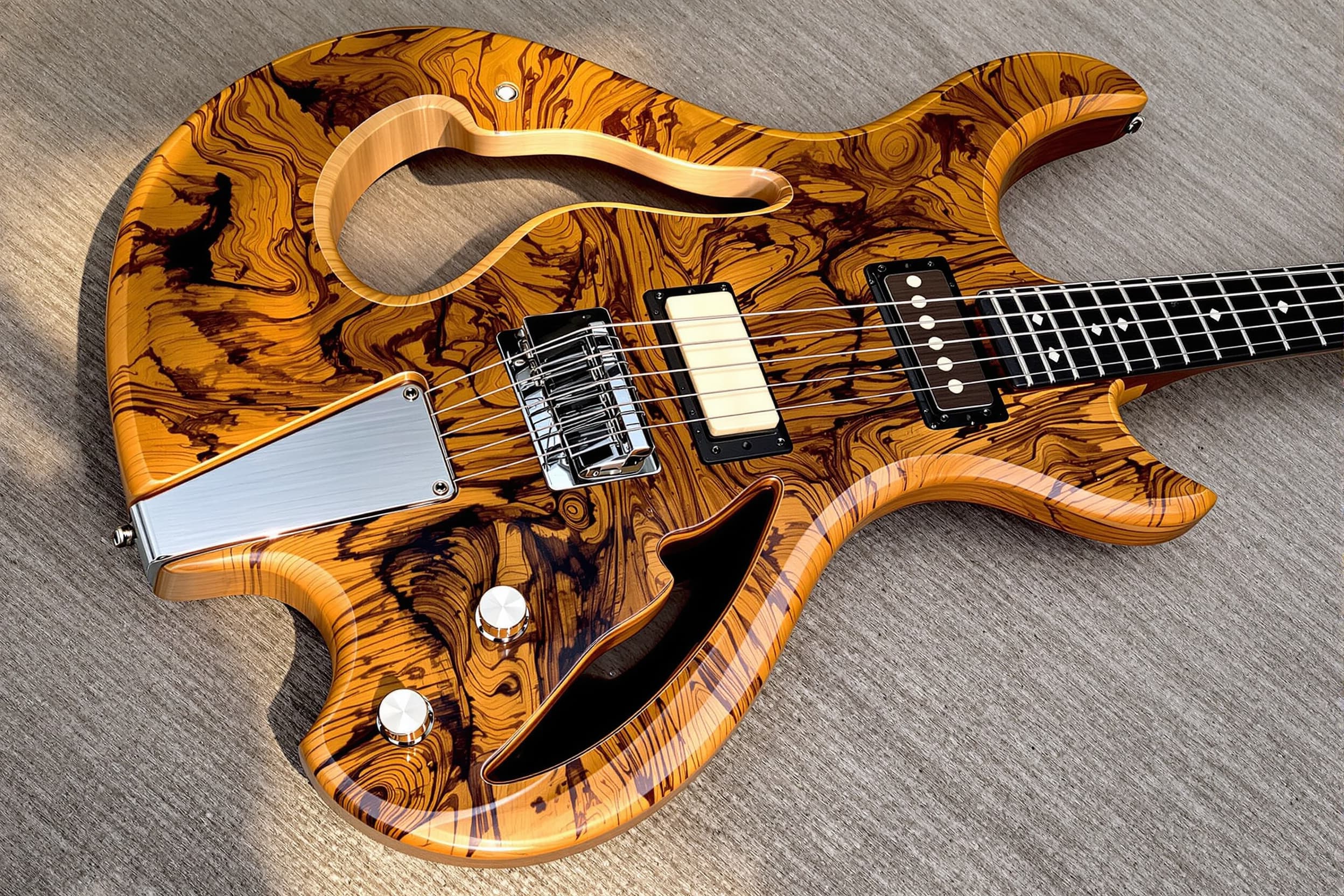
A custom-built 7-string electric guitar with fanned frets (25"-26" multiscale), headless design, hand-wound pickups with active circuitry, and LED-powered fiber optic side dots. Features laminated neck construction (maple/padauk/sapele), pau ferro fretboard, black limba body, and ergonomic arm/belly carves for enhanced playability.
Bottom line
Custom guitar manufacturing sits at the intersection of precision CNC machining, hand craftsmanship, and electronics integration—a combination that strongly favors local production where iteration cycles are short and quality control is hands-on. Portugal's existing CNC and electronics capabilities can handle the technical components (fretboard radius machining, pickup PCBs, fiber optic LED circuits), while the extensive hand-finishing work (fretting, neck carving refinement, final setup) requires artisan labor that benefits from proximity to the customer. Unlike mass-produced guitars, custom builds demand multiple fitting sessions and adjustments, making the 2–3 week local lead time vs. 10–12 week China lead time operationally critical.
Produces musical tones when strings are plucked or strummed
Allows pitch adjustment via headless tuning system at the bridge
Converts string vibration to electrical signal through electromagnetic pickups
Amplifies and shapes pickup signal through active preamp circuitry
Provides visual fret position indication via illuminated fiber optic side dots
Enables precise intonation across extended 7-string range with fanned fret geometry
Offers ergonomic playing comfort through contoured body and asymmetric neck profile
Use FretFind2D to calculate fret positions for multiscale, model neck/body/fretboard in CAD with lofted organic surfaces
Joint and plane lumber blanks, glue neck laminates, resaw fretboard blank to 6.35mm thickness
Cut fret slots to 3.5-4mm depth using saw guide jig aligned to printed fretboard template
Machine fretboard radius and contours, carve neck profile with ball-end mill, route body cavities and carves on 3-axis CNC
Wind 4000 turns of 42AWG wire on bobbins, solder to shielded cable, populate and test active preamp PCBs
Press or hammer frets into slots, level with sanding bar, crown with diamond file, bevel and polish ends
Install truss rod with silicone, align fretboard with dowel pins and glue, apply multiple coats of wipe-on polyurethane
Install threaded inserts, mount bridge/tuners/pickups, wire electronics, bolt neck, string and adjust action/intonation
Black limba, pau ferro, and padauk are CITES-regulated or restricted tropical hardwoods with limited European stockists. Supply disruptions due to logging restrictions, export bans (Brazil frequently restricts pau ferro exports), or seasonal availability can halt production entirely. A single custom guitar requires specific grain patterns and dimensional stability that cannot be easily substituted, and lead times for specialty tonewood orders can extend 8–12 weeks when stock is depleted. Price volatility is also significant—pau ferro has increased 40–60% in the past three years due to Brazilian export controls.
→ Mitigation: Establish relationships with 2–3 European tonewood specialists (e.g., Madinter, WoodStock Deutschland, Exotic Wood Zone UK) and pre-purchase 6-month buffer stock of dimensioned blanks for critical species. Develop backup wood specifications (e.g., wenge as pau ferro alternative, swamp ash as black limba substitute) that maintain tonal and aesthetic properties. Participate in luthier networks to access surplus materials from other builders. Consider FSC-certified or reclaimed wood sources to future-proof against tightening CITES restrictions.
Custom guitar designs—particularly proprietary pickup winding patterns, active preamp circuit topologies, and unique mechanical features (fiber optic LED integration, asymmetric neck profiles)—are vulnerable to replication by contract manufacturers or competitors. Unlike patents (expensive and slow for one-off designs), trade secret protection relies on contractual NDAs that are difficult to enforce across borders. If detailed CAD files, winding specifications, or PCB schematics are shared with multiple subcontractors (CNC shops, pickup winders, PCB assemblers), the risk of leakage increases exponentially. Competitors in the custom guitar space actively monitor builder forums and social media for design innovations.
→ Mitigation: Segment proprietary information: share only necessary details with each subcontractor (e.g., CNC shop receives body geometry but not electronics cavity routing depths). Keep pickup winding in-house or use a single trusted EU partner under strong NDA with IP ownership clauses. Watermark CAD files and use serial-numbered drawings to trace leaks. Register design rights (EU Registered Community Design) for unique visual elements (body shape, headstock profile) to enable enforcement. Build brand value around the personal story and craftsmanship rather than replicable technical features.
Active preamp circuits with LED drivers constitute electronic equipment under the EU EMC Directive (2014/30/EU) and potentially the Low Voltage Directive (2014/35/EU) if powered above 50V DC. While most guitar preamps operate at 9–18V (below LVD threshold), the EMC requirements for radiated and conducted emissions apply. Non-compliant products cannot legally be sold in the EU, and enforcement is increasing for musical instruments sold online. Testing costs (€2,000–€5,000 per product family) are prohibitive for single-unit custom builds, yet the legal requirement remains. DIY builders often skip CE marking, but commercial sales (even single units) technically require compliance.
→ Mitigation: Design active circuits using proven reference designs from IC manufacturers (e.g., TI, Analog Devices) that include EMC layout guidelines. Use shielded cavities, star grounding, and ferrite beads on power/signal lines to minimize emissions. Partner with a Portuguese EMC test lab (e.g., CATIM, ISQ) to perform pre-compliance testing on representative prototypes (€500–€800) before committing to full certification. For single units, consider 'self-certification' under the assumption of compliance (prepare technical file but defer testing unless required by customer). For small batch production (5+ units), amortize full EMC test costs across the production run.
Headless bridge/tuner systems (e.g., Strandberg EGS, Hipshot, ABM) and Floyd Rose locking nuts are niche components with limited manufacturers and long lead times (6–12 weeks) when out of stock. Unlike standard guitar hardware, headless systems for 7-string fanned fret configurations are semi-custom items often built to order. A single missing component can delay final assembly by months, and there are no drop-in substitutes—bridge spacing and mounting hole patterns are design-specific. Supply chain disruptions (COVID-related factory shutdowns in 2021–2022 caused 16+ week delays for Hipshot hardware) can cascade through the entire production timeline.
→ Mitigation: Order all critical hardware (headless bridge, locking nut, tuner mechanisms) at project kickoff, even before CAD finalization, using standard specifications that can be adapted. Maintain relationships with multiple distributors (Thomann, Musik Produktiv, StewMac Europe) and monitor stock levels weekly. Design bridge mounting systems with adjustable tolerances (slotted holes, modular base plates) to accommodate alternative hardware if primary choice becomes unavailable. For recurring custom builds, pre-purchase 3–6 month inventory of long-lead hardware. Consider designing around readily available components (e.g., Hipshot over boutique brands) even if slightly compromising aesthetics.
Critical hand operations—fret leveling, crowning, edge beveling, neck shaping refinement, final setup (action, intonation, truss rod adjustment)—determine playability and customer satisfaction but are highly skill-dependent. Inconsistent fret heights (>0.05mm variation) cause buzzing; improper neck relief causes intonation errors; poor fret end beveling creates sharp edges that injure players' hands. A single poorly executed fretting job can render a €1,000+ instrument unplayable and require complete re-fretting (€200–€400 and 1–2 weeks). Unlike CNC machining, hand-finishing quality cannot be easily inspected until final assembly, making defect detection late and expensive.
→ Mitigation: Develop or recruit a qualified lutherie technician with verifiable experience in fret dressing and setup (minimum 2 years professional experience). Invest in precision lutherie tools: fret leveling beam with 0.01mm indicator, diamond crowning files, radius gauges, string action gauges, and digital intonation meters. Implement a structured QC protocol with documented measurements at each stage: fret height variance <0.03mm after leveling, neck relief 0.25–0.4mm at 7th fret, intonation error <2 cents across all strings. For initial builds, consider sending necks to an established EU lutherie service (e.g., Crimson Guitars UK, Schack Germany) for fret dressing until in-house skills mature. Video-document each critical hand operation to build process knowledge and training materials.
18 weeks · 8 steps
Full description of every production step
Use FretFind2D to calculate precise fret positions for 25"–26" multiscale geometry across 7 strings. Model neck blank (5-piece laminate), body (black limba with arm/belly carves), and fretboard (pau ferro with compound radius) in CAD with lofted organic surfaces. Generate G-code for CNC operations, create fret slot template for manual jig, design custom active preamp PCB schematic and layout, plan fiber optic routing channels. Finalize bill of materials and order all long-lead hardware (headless bridge, Floyd Rose nut, gold EVO fretwire, neodymium magnets for pickups).
Source dimensioned tonewood blanks from European suppliers: black limba body blank (2-piece book-matched, 45×400×500mm), maple/padauk/sapele strips for neck laminate (total 25×75×700mm), pau ferro fretboard blank (8×75×600mm). Joint and plane lumber to tight tolerances (±0.1mm flatness). Glue neck laminates with alignment cauls and even clamping pressure, allow 48-hour cure. Resaw fretboard blank to 6.35mm thickness, plane to final dimension. Verify grain orientation and stability (moisture content 8–10%) before machining.
Needs: CAD Design and Fret Position Calculation
Print full-scale fretboard template from CAD with fanned fret positions marked to 0.1mm accuracy. Adhere template to pau ferro blank with repositionable spray adhesive. Using precision fret saw (0.58mm kerf for EVO wire) guided by aluminum straightedge clamped perpendicular to fret lines, cut 24 fret slots to 3.8mm depth. Verify slot depth consistency with depth gauge (target 3.5–4.0mm) and slot width (should accept fretwire tang with light interference fit). Clean sawdust from slots with compressed air and vacuum.
Needs: Wood Procurement and Lamination
Subcontract CNC work to Ricardo & Barbosa or Hypermetal: (1) Route body cavities (pickup routes, control cavity, battery compartment) and arm/belly carves on 3-axis mill with ball-end tooling. (2) Machine fretboard compound radius (7"–20") and side marker channels for fiber optic strands using radius dish or CNC pass. (3) Carve neck profile to 23.5mm thickness with asymmetric C-shape using ball-end mill and spindle sander for transitional profiles. (4) Route truss rod channel (6mm wide × 9mm deep) with square-end bit. Machine all mounting holes, threaded insert pilot holes, and output jack recess. Deliver parts with 0.05mm tolerance on critical dimensions (neck pocket, bridge mounting).
Needs: Manual Fret Slotting
Wind two 7-string humbucker pickups in-house or via specialist: 4,000 turns of 42AWG copper wire per coil on custom bobbins with neodymium magnet pole pieces. Measure DC resistance (target 8–10kΩ per coil) and inductance to verify consistency. Solder pickup leads to shielded 4-conductor cable. Outsource active preamp PCB fabrication and assembly to Uartrónica or Proto-Electronics: 2-layer boards with surface-mount op-amps, precision resistors, and film capacitors per custom schematic. Populate, solder, and functionally test PCBs with signal generator and oscilloscope to verify frequency response and gain staging. Assemble LED driver circuit for fiber optic side dots on separate small PCB.
Needs: CAD Design and Fret Position Calculation
Install gold EVO fretwire into slotted fretboard using fretting press or nylon-faced hammer, starting from middle and working outward. Ensure full seating in slots (no gaps) and level tang compression. Level frets with precision sanding beam (320-grit adhesive-backed paper) under strong sidelight until uniform height across entire fretboard (<0.03mm variance). Crown frets with diamond crowning file to restore rounded playing surface. Bevel and polish fret ends with 400/800/1200-grit progression to eliminate sharp edges. Install zero fret at nut position and level with standard frets. Final polish with 0000 steel wool and fretboard oil (lemon oil).
Needs: CNC Machining of Body and Neck Components
Install truss rod into routed channel with silicone bedding compound to prevent rattles. Align fretboard to neck blank using dowel pins for precise registration, apply wood glue (Titebond Original), clamp evenly, and allow 24-hour cure. Insert fiber optic strands into side marker channels, secure ends with cyanoacrylate adhesive, and connect to LED circuit board. Apply 4–6 coats of wipe-on polyurethane finish to neck (back and sides), sanding between coats with 400-grit paper. Finish body with satin nitrocellulose or polyurethane—spray in ventilated booth, allow 5–7 days cure time. Install threaded inserts into body neck pocket using insert-setting tool with torque control.
Needs: Fretting and Fret Dressing, Pickup Winding and Electronics Assembly
Mount headless bridge/tuner system to body using provided template for hole alignment. Install Floyd Rose locking nut at zero fret position. Mount hand-wound pickups in routed cavities with height-adjustment springs and screws. Wire active preamp circuit: connect pickups to PCB inputs, wire potentiometers (volume, tone, blend controls), connect battery clip (9V), and solder output jack. Route all wiring through shielded channels with copper foil shielding in control cavity. Bolt neck to body using neck mounting ferrules and machine screws, verify alignment and fit. String guitar with 7-string set (10–64 gauge for 25" scale), tune to pitch, adjust truss rod for 0.3mm relief at 8th fret, set string action (1.5mm bass side, 1.2mm treble side at 12th fret), and fine-tune intonation at bridge saddles. Test LED fret markers, verify preamp functionality, and perform final QC inspection.
Needs: Neck Assembly, Finishing, and Body Preparation
7 processes · 11 materials · 19 parts
Black limba
Maple
Padauk
Sapele
Pau ferro

Stainless steel

Copper wire (42AWG)

Neodymium magnets

Optical fiber

PCB substrate
Electronic components
Regulations and certifications to clear