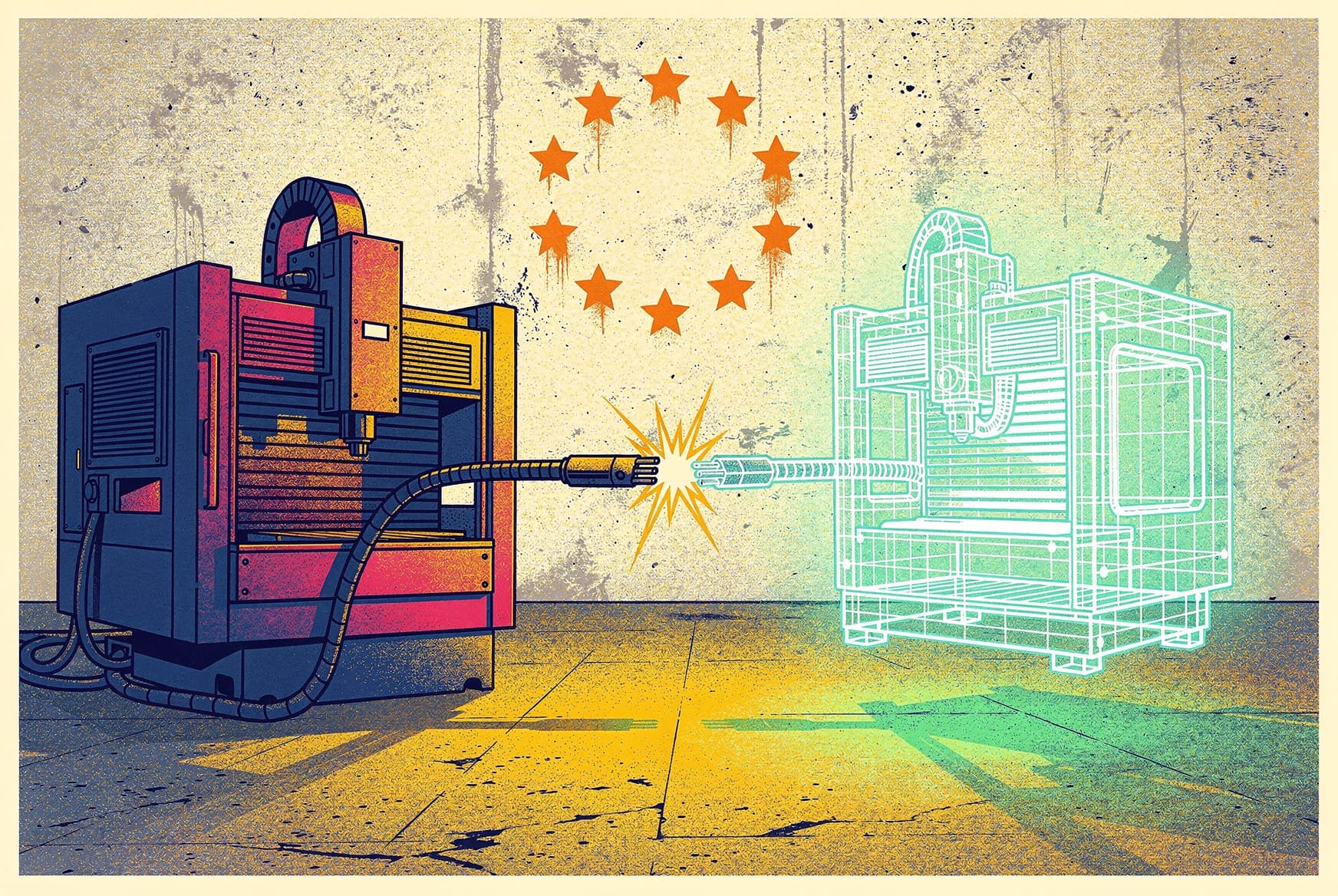
Portugal has a credible, sectorally uneven digital-twin (DT) ecosystem anchored by one globally relevant Tier-1 vendor (Critical Manufacturing, Porto, an ASMPT subsidiary that ships MES-integrated DT capability to semiconductor and electronics fabs worldwide), one engineering-led integrator (CEiiA, Matosinhos) operating production twins for vehicles, satellites and city mobility, and a strong applied-research backbone in INESC TEC (Porto) and LARSyS / IST (Lisbon).
Outside this core, most deployments are still descriptive or predictive twins — not yet prescriptive or autonomous in the sense required by agentic AI — and very few are explicitly architected for the new EU Data Act (Regulation (EU) 2023/2854), which became applicable on 12 September 2025. Readiness for integration with Gemini, Claude, GPT and MCP-style agentic tooling is medium in industrial manufacturing (Critical Manufacturing has shipped natural-language MES Copilots), medium in mobility / aerospace (CEiiA's SPIRIT platform), emerging in smart cities (Lisbon's PGIL and the LDT4SSC consortium), and low in energy, water, ports, healthcare and construction, where most "twins" are still 3D-BIM models, SCADA dashboards or simulation studies rather than bidirectional, API-exposed semantic twins.
The country has ample funding (PRR mobilising agendas, Portugal 2030, Horizon Europe, Digital Europe LDT calls), credible talent (INESC TEC, INL Braga, INESC-ID, IT, Fraunhofer Portugal AICOS), but a clear gap in semantic interoperability layers (Asset Administration Shell, NGSI-LD, IDS / Gaia-X connectors) and in any explicitly "Data-Act-compliant" twin architecture.
1 · The Article 2 / Data Act regulatory backbone
What the regulation actually says about digital twins
It is important to be precise: Regulation (EU) 2023/2854 (the Data Act) does not contain a free-standing legal definition of "digital twin" in Article 2. The verifiable text of Article 2 (Definitions) instead establishes the building blocks that twins inherit:
- Art. 2(1) 'data' — "any digital representation of acts, facts or information…"
- Art. 2(5) 'connected product' — an item that obtains, generates or collects data concerning its use or environment and that is able to communicate it (the regulation's de facto IoT scope).
- Art. 2(6) 'related service' — a digital service whose absence would prevent the connected product from performing its functions.
- Art. 2(12)–(14) defines user, data holder, data recipient.
- Art. 2(15) 'product data' and Art. 2(16) 'related service data'.
- Art. 2(31) 'virtual assistants'.
- Art. 2(39) 'smart contract' — "a computer program used for the automated execution of an agreement…"
- Art. 2(40) 'interoperability' — the ability of two or more data spaces, networks, systems, connected products, applications or components to exchange and use data.
The closest approximation of the DT phrasing — "a digital representation of an intended or actual real-world object, system, process or service" — is industry / standards-body language (Gartner, ISO 30173, ISO 23247, the Building Digital Twin Association, FIWARE position papers), not a verbatim Data Act provision. This distinction matters for legal-compliance work: under the Data Act, a digital twin is regulated indirectly through the data it ingests from connected products and related services, not as a regulated artefact in itself.
Provisions that bind digital-twin operators in Portugal
When a Portuguese DT ingests data from a connected product (a tyre, vehicle, turbine, water meter, MES-tracked machine, drone), the operator inherits the following obligations:
- Art. 3 — design connected products and related services so users can access by default the data they generate.
- Art. 4–5 — rights of users to access, use and share with third parties the data generated by their connected products, including any digital representation of that data fed by it.
- Chapter III (Art. 8–12) — obligations on data holders to make data available under FRAND (fair, reasonable, non-discriminatory, transparent) terms; prohibits unfair contractual clauses (Art. 13).
- Chapter V (Art. 14–22) — public-sector access in cases of exceptional need, directly relevant for smart-city / port / utility twins.
- Chapter VI (Art. 23–31) — switching between data-processing services (cloud lock-in rules), with egress charges to be prohibited from 12 January 2027.
- Chapter VIII (Art. 33–36) — essential interoperability requirements for participants in data spaces (machine-readable dataset descriptions, common vocabularies, technical access means, smart-contract interoperability).
Interaction with adjacent EU laws
A Portuguese DT operator must reconcile the Data Act with GDPR (Reg. 2016/679) where personal data flows through the twin; Data Governance Act (Reg. 2022/868) for data-intermediation roles; AI Act (Reg. 2024/1689) where the twin embeds high-risk AI systems (e.g. a hospital twin or a critical-infrastructure agentic controller); NIS2 Directive (2022/2555) for essential / important entities (energy, water, transport, health, manufacturing); Cyber Resilience Act (Reg. 2024/2847) for the security of the connected products feeding the twin; and the Interoperable Europe Act for public-sector twins. Recent academic work (MDPI, Electronics 2025, "Digital Twins Under EU Law: A Unified Compliance Framework") proposes a Unified Digital Twin Compliance Framework (UDTCF) that consolidates these six regimes — there is no Portuguese national equivalent yet.
European Commission digital-twin programmes touching Portugal
- Local Digital Twins Toolbox (Digital Europe Programme, 2023–2025) and LDT for Smart and Sustainable Communities (LDT4SSC) — Lisbon, Porto, Aveiro, Guimarães, Famalicão, Cascais, Braga have appeared in pilot lists through Ubiwhere's CityCatalyst PRR consortium and through OASC.
- Destination Earth (DestinE) — Portugal is listed as a participating country, but as of May 2026 the page states implementation activities will be published "as soon as more information becomes available"; no production-grade Portuguese DestinE twin is currently advertised.
- Gaia-X — the Gaia-X Summit 2025 was hosted in Porto (20–21 November 2025) in partnership with Gaia-X Hub Portugal and Porto Digital, where the "Danube" Trust Framework 3.0 was released. The Portuguese national Gaia-X hub (Porto Digital, AICEP, INESC TEC and Capgemini Engineering Portugal among the participants) is the natural anchor for any Data-Act-compliant Portuguese DT data space.
- Common European Data Spaces — Portuguese participation appears in Manufacturing-X (PRODUTECH R3), Mobility (CEiiA), and the Smart Communities space (Lisbon, Porto, Cascais via LDT4SSC). No Portuguese entity is yet a flagship of the Health Data Space or the Energy Data Space.
2 · Tier-1 case studies — verifiable production twins
Critical Manufacturing (Porto / ASMPT) — the Portuguese DT champion
The Critical Manufacturing MES (cmNavigo) ships with an integrated digital-twin layer for manufacturing operations covering asset twins (equipment), process twins (production lines) and system twins (whole fab). Deployed in semiconductor, electronics, PCB, medical-device and industrial-equipment manufacturing globally; positioned as a Leader in Gartner's Magic Quadrant for MES.
The Connect IoT module supports SECS / GEM, OPC-UA / OPC-DA, MQTT, Bluetooth Low Energy, RS-232, TCP/IP sockets, IPC-CFX, Fuji Nexim, OIB, CSV / RAW files and SQL Server. The Twinzo partnership (announced 23 April 2025, showcased at the MESI Summit, Porto, 12–13 June 2025) added a real-time 3D digital-twin connector for desktop and mobile visualisation, OEE monitoring and role-based contextual views.
Critical Manufacturing has publicly shipped MES Copilots — an Analytics Copilot and an MES Copilot — that implement natural-language querying of MES data, instant chart / dashboard generation, contextual explanations and document search, using governed data and structured RAG. Co-published research with FLAIR (Hong Kong) and WZL RWTH Aachen describes an LLM + RAG copilot for manufacturing equipment selection validated in real ramp-up scenarios. This is, by some distance, the most advanced explicit LLM-on-twin work by a Portuguese-headquartered vendor.
CEiiA (Matosinhos) — vehicle, satellite and mobility twins via SPIRIT
CEiiA — Centro de Engenharia e Desenvolvimento — operates the proprietary SPIRIT digital platform exposing a real-time Digital Twin for connected vehicles and shared mobility. It powers (i) BEN (BE Neutral), the modular B2B micro electric vehicle (March 2026 MoU with Micro and AMFI to industrialise BEN in Turin); (ii) AYR, a blockchain-anchored CO₂-credit platform that won the Imprensa Nacional IN3+ Prize and the Bauhaus Europe Prize; (iii) the MobiCascais integrated mobility app; (iv) Matosinhos by AYR bike-sharing / parking; (v) the Toyota APM for the Paris 2024 Olympics; (vi) the MH-1 satellite (first end-to-end Portuguese satellite, launched on SpaceX Transporter 10 in 2024) and GARAI (Atlantic Constellation precursor, Iberian Space Partnership with SATLANTIS, OHB Sweden, GEOSAT).
AI is used for object / change detection (Embraer KC-390 industrialisation, Atlantic Constellation EO downstream services, PhiSat-2 ESA mission contribution). No publicly announced Gemini / Claude / GPT integration or MCP server for SPIRIT. CEiiA's CO₂ ledger and BEN's user-data flows (biometrics, location) place it squarely under GDPR + Data Act overlap; the AYR blockchain layer is an interesting test case for Art. 36 smart-contract requirements when applied to environmental claims. Maturity: production.
INESC TEC + Efacec + INEGI + MIT Portugal — Transformer 4.0
A national-first digital twin of a power transformer covering the entire lifecycle — preliminary design, manufacturing, operation, maintenance, end-of-life. Coordinated by INESC TEC's Centre for Enterprise Systems Engineering (CESE, António Lucas Soares) under the MIT Portugal Program. Stack: Knowledge-Based Engineering, ontology-driven information architectures, operational research, AI / ML, AAS-style asset modelling. Funded by COMPETE 2020 / MIT Portugal flagship, 2020–2023. AI / ML for predictive operations is integral; no LLM integration is announced. Maturity: late-pilot / first production, transferred to Efacec.
INESC TEC + PRODUTECH R3 — the PRR low-code industrial DT programme
Under the PRODUTECH R3 mobilising agenda (Recuperação-Resiliência-Reindustrialização, PRR), INESC TEC, INEGI, ZGDV, Adira, Sistrade, Introsys, NEAdvance, Kaizen Tech and ~108 Portuguese partners (led by COLEP Packaging) are delivering a low-code library of digital-twin building blocks for Portuguese industry. Solzaima (heating equipment, Águeda) was the first published demonstrator.
Other PRODUTECH R3 demonstrators with DT content: Simoldes Plásticos (automotive moulds, SAP 4.0), Vista Alegre Atlantis, Navigator Tissue / Pulp, OGMA aeronautics, CTT, Worten, Sonae Arauco. The agenda also includes a Digital4Circular programme (DT-based circularity) and Industry-UP (DT for industrial equipment lifecycle extension). Funded through NextGenerationEU / Mecanismo de Recuperação e Resiliência, component C05-i01.01. Maturity: pilot to early-production.
Bosch Ovar / Bosch Car Multimedia Braga — Sensitive Industry & Big Data plant twins
Bosch Ovar (~170 specialists) co-launched in 2020 the Sensitive Industry project (~€17M) with Universidade do Porto and INL Braga to deliver a digital twin of the production and logistics area based on cameras and sensor fusion. Bosch Car Multimedia (Braga) operates a Big Data Industry 4.0 architecture (peer-reviewed in International Journal of Information Management, 2017) that integrates production-line sensor data, controllers and MES into a centralised analytics layer.
Globally, Bosch ships Bosch IoT Things / Eclipse Ditto-based DT registry, the Eclipse Semantic Modeling Framework (ESMF) with the Semantic Aspect Meta Model (SAMM), and uses Asset Administration Shell — the most semantically mature vendor-supported DT stack in use in Portugal. Strategic Member of the Eclipse Foundation IDTA and works with COVESA on Vehicle Signal Specification — both directly relevant to Data Act Art. 33 interoperability. Maturity: production (Big Data architecture); Sensitive Industry in advanced pilot.
Volkswagen Autoeuropa (Palmela) — digital shop-floor twin via Mendix / Siemens low-code
A digital value-stream monitor (the plant calls it a "digital shop floor application") shows in real time the status of all machines and the entire process chain along T-Roc and (from 2027) ID.1 / ID.EVERY1 production. Co-developed with Mendix (a Siemens business). UNINOVA (NOVA Lisboa) published a peer-reviewed digital twin for intra-logistics process planning at Autoeuropa combining real data, prediction techniques and 3D simulation. Won the OEM-category Automotive Lean Production Award in 2023. Generative-AI integration is at corporate-VW level (the Volkswagen Group's "industrial cloud" with AWS), not yet a Palmela-specific publicly announced agentic deployment. Maturity: production.
Continental Mabor (Lousado) — tyre product DT
Continental's group-wide ContiConnect 2.0 gives every commercial tyre a digital twin record (article number, fitted vehicle / position, pressure, temperature, tread depth, mileage). Lousado is one of its highest-volume contributors. The Continental Solution Center in Portugal works on AI-enhanced final-finishing inspection. ContiConnect is an exemplar of Data Act Art. 3–4 product / related-service-data accessibility. Maturity: production at scale (global).
EPAL / Águas de Portugal — water-network hydraulic and energy twins
EPAL, serving roughly one-third of Portugal's population, is publicly developing hydraulic and energy digital twins combined with ML-based functional condition assessment, sensorisation and AI for non-revenue-water reduction (Nuno Medeiros, Head of Asset Management, 2025 interview in Smart Water Magazine). EPAL is a SWAN Forum member and a CleanEnergyMinisterial reference case for ISO 50001. Stack not publicly disclosed in detail. Maturity: programme-launch / early-pilot; EPAL openly states the integration of these technologies into organisational routines is "still evolving".
Port of Sines (APS) — Smart-Gate digital twin
The Port of Sines, integrated into the new APS (Administração dos Portos de Sines e do Algarve), runs a Smart Gate / pre-gate digital twin anchored in discrete-event simulation (AnyLogic 8.9.0) to forecast bottlenecks, lane allocation and processing times at the container terminal. Benchmarked in 2026 against seven major European port DT initiatives in CORDIS-funded projects. Maturity: pilot / specific-process production.
Port of Leixões / APDL — 4PORT product family
APDL has commercialised three operational DT-style products — 4Planning (port-traffic planning), 4Watch (operations control centre) and LiveMap (real-time maritime visualisation). In April 2026, APDL signed a 3-year cooperation with APRAM (Madeira ports) to deploy these products there. The 2nd-generation Janela Única Portuária (JUP II), now evolving into the Janela Única Logística (JUL) with APL, APDL, APS and the Tax Authority, is a national-scale data-sharing platform that will likely fall under Data Act Chapter V (public-sector access) and Chapter VIII interoperability. Maturity: production.
3 · Tier-2 — promising pilots, consortia and adjacent twins
- LARSyS / IST (LisbonU) — Urban DT for Lisbon and Braga: 3D city DT used for energy efficiency, mobility, perceived-security mapping (Lisbon's Polícia Municipal), waste management modelling. Co-developed with Thales Portugal, NOS, COMPTA. A LARSyS member is on the EC's "Carbon Neutral and Smart Cities" Mission Board.
- Lisbon City Council — PGIL: Operational platform integrating 60,000+ users, sensors, social data; uses FIWARE open-source building blocks (Context Broker, NGSI-LD). Coupled with LxDataLab (since October 2019). City data platform — the technical substrate on which a true urban DT can be built; not yet a closed-loop twin.
- Cascais — Deloitte Digital Command Center / CitySynergy: Cloud-based command centre with data-visualisation and analytics for mobility, parking, waste, civic protection and emergency management. Closer to city operations than to a fully-fledged DT but a stepping-stone.
- CityCatalyst (PRR Mobilising Agenda, led by Ubiwhere): Pilots in Porto, Aveiro, Guimarães, Famalicão, Cascais, focused on normalised city analytics (PPS3) and breaking sector silos via NGSI-LD-style data models — the most credible Portuguese vehicle for an EU-aligned local digital-twin federation.
- NOVA IMS / NexTCity: Pilot DT for Lisbon's Low Emission Zone (in partnership with Universidad Jaume I and KU Leuven), with capacity-building, summer schools and a Research Management Office at NOVA IMS.
- Tekever (Lisbon UAS unicorn): Not a twin operator per se but a high-readiness AI / data company (drone "Atlas" intelligence platform, Series A NATO Innovation Fund + Baillie Gifford, June 2024 funding). Generates data streams that twin platforms would consume; relevant for defence / maritime / border twins.
- OGMA (Alverca): Aeronautics MRO, on PRODUTECH R3 as a user; aerospace plant twin still indicative.
- EDP / EDP Renewables: No public, named, production digital twin product for wind / solar in Portugal as of mid-2026; renewables hybrid sites (Sabugal, Penela / Ansião) operated with conventional SCADA + AI / forecast tooling. EDP is investing in the Sines hydrogen hub and offshore floating wind (WindFloat Atlantic 25 MW), which are natural future twin candidates but not yet announced as such.
- REN (TSO): Classical EMS / SCADA on the high-voltage grid; no publicly announced grid-wide DT product; DT-style pilots through Inesc collaborations are reported in the academic literature.
- Galp (Sines refinery): Industrial-scale instrumented refinery; €430M EIB-financed biofuels / SAF unit and 100MW green-hydrogen electrolysis under construction. No public DT product is named.
- Healthcare (CUF / José de Mello Saúde, Luz Saúde): No publicly verifiable production hospital digital twin in Portugal as of mid-2026. Hospital da Luz operates a "centro clínico digital"; "patient digital twin" remains research-stage in Portugal (Champalimaud, IT, INESC-ID).
- Construction / BIM (Mota-Engil, Teixeira Duarte, Casais): Mota-Engil operates BIM at scale on infrastructure projects, but no public closed-loop DT integrating live IoT to a BIM model has been announced.
4 · Sector-by-sector readiness scorecard
Readiness for Gemini / Claude / GPT + agentic tooling, by sector:
| Sector | Best-in-class operators | Real-time data flow | Semantic / ontology layer | LLM-on-twin work | Readiness |
|---|---|---|---|---|---|
| Industrial / discrete mfg | Critical Mfg, Bosch, Continental, VW Autoeuropa | High (OPC-UA, MQTT, SECS / GEM) | Medium–High (Bosch AAS / ESMF; cmNavigo data model) | Yes — Critical Mfg MES & Analytics Copilots; LLM+RAG paper | Medium-High |
| Mobility & automotive | CEiiA (SPIRIT), VW Autoeuropa, Bosch Braga | High (telemetry) | Medium (custom) | Limited — AI for vision; no LLM-in-twin | Medium |
| Aerospace / space / defence | CEiiA / GEOSAT, Tekever, OGMA | High in flight ops; batch in EO | Low–Medium | AI for object / change detection (Atlas, PhiSat-2) | Medium |
| Smart cities / local DTs | PGIL, LARSyS, NOVA IMS NexTCity, Cascais, CityCatalyst | Mixed | Medium (FIWARE NGSI-LD where present) | Limited public LLM integration; LDT4SSC aims at AI decisions | Medium (emerging fast) |
| Energy & utilities | EDP, REN, Galp | High but siloed (SCADA) | Low (no public AAS / CIM product) | Not announced | Low–Medium |
| Water & environment | EPAL, Águas de Portugal | Medium | Low | EPAL: AI / ML stated, integration 'still evolving' | Low |
| Ports & logistics | APDL (4PORT), APS (Sines Smart-Gate), APL | Medium | Low–Medium | Not announced | Low–Medium |
| Healthcare | CUF, Luz Saúde, Champalimaud (research) | Mostly batch | Low | None publicly announced | Low |
| Construction & BIM | Mota-Engil, Teixeira Duarte, Casais | Low (mostly design-time BIM) | Low | None publicly announced | Low |
5 · Funding & policy landscape
PRR — the dominant 2022–2026 driver
- Component C05 — Capitalização e Inovação Empresarial (€930M envelope, of which €558M for Mobilising Agendas and €372M for Green Agendas; 64 of 144 applications selected). Twin-relevant agendas:
- PRODUTECH R3 — Reindustrialisation of Production Technologies (lead COLEP Packaging; 108–112 partners; INESC TEC, INEGI, IEP, ZGDV, Sistrade, Adira, Introsys) — explicit DT and low-code DT focus.
- New Space Portugal (lead GEOSAT; CEiiA, LusoSpace, IdD Portugal Defence, Edisoft, GMV, NOS, Thales, OHB, AAC Clyde, OpenCosmos) — Atlantic Constellation, Digital Planet platform.
- BE.NEUTRAL (CEiiA, Toyota Portugal) — sustainable mobility with explicit DT / SPIRIT integration.
- Sustainable Stone, Sustainable Plastics, BioShoes4All, INOV.AM (additive manufacturing), Descentralizar Portugal com Blockchain — adjacent but DT-relevant.
- PRR Component C16 — Empresas 4.0, channelled through IAPMEI, supports digital adoption by SMEs (vouchers, training, "Indústria 4.0 Skills").
Other Portuguese / EU instruments
- Portugal 2030 / COMPETE 2030 — successor framework with €23bn envelope; explicit digital and green priorities.
- ANI (Agência Nacional de Inovação) — co-promotion projects, Eureka, Eurostars; manages MIT Portugal, CMU Portugal, UT Austin Portugal.
- AICEP — investment promotion, FDI for plants like VW Autoeuropa, Bosch.
- Horizon Europe — INESC TEC / INESC-ID lead or participate in 50+ projects each.
- EU Chips Act / European Chips JU — INL Braga and Critical-Manufacturing-adjacent semiconductor work.
- ENISA & Centro Nacional de Cibersegurança (CNCS) — both relevant to NIS2 obligations on twin operators in essential sectors.
System integrator and partner ecosystem
- Accenture Portugal, Capgemini Engineering Portugal (Aveiro, Lisbon; Gaia-X Hub Portugal contributor), Deloitte Portugal (Cascais smart-city work, Lisbon DT publications), Glintt, Reditus, NOS Technology, Altice Labs, Ubiwhere.
- Hyperscalers: Microsoft (Azure region in Spain serves Portugal; Bosch twin-on-Azure template), AWS (Sines Start Campus data-centre megaproject), Google Cloud (Lisbon).
- Local DT / IoT vendors: Ubiwhere (Aveiro; FIWARE-NGSI-LD heritage), Altice Labs (DigitalRoom / IoT), GMV Portugal, Edisoft (defence / space), NEAdvance (machine vision), Sistrade (MES).
6 · Gap analysis — Portugal vs Germany / Netherlands / France
| Dimension | Portugal | Germany | Netherlands | France |
|---|---|---|---|---|
| Vendor depth | One global DT-MES leader (Critical Mfg) | Siemens Xcelerator, Bosch IoT Things, SAP, Software AG | Siemens NL ecosystem, Brainport | Dassault 3DEXPERIENCE, Schneider EcoStruxure |
| Semantic interoperability | Limited explicit AAS / NGSI-LD adoption | RAMI 4.0, AAS, IDTA, Catena-X | Active in IDS, MaaS, DPP | Active in Gaia-X, Catena-X |
| Reference data spaces | No flagship Portuguese-led space | Catena-X, Manufacturing-X | Mobility, Health | Aerospace (DECADE-X) |
| Production city DTs | PGIL platform; pilots only | Hamburg, Munich | Rotterdam, Amsterdam | Rennes, Angers |
| LLM-on-twin shipped | Critical Mfg Copilots | Siemens Industrial Copilot, Bosch ESMF | Multiple Brainport pilots | Dassault 3DEXPERIENCE GenAI |
| MCP-server availability | None publicly known | Emerging via Bosch / Siemens | Emerging | Emerging |
| Data Act alignment | Mostly aspirational | Industry-led Catena-X test cases | DPP & Mobility leadership | Aerospace and energy pilots |
Concrete Portuguese gaps: (i) no nationally branded manufacturing data space with Portuguese leadership; (ii) limited adoption of Asset Administration Shell outside Bosch's local sites; (iii) no public Gemini / Claude / GPT integration announced for any flagship Portuguese twin; (iv) no MCP server publicly advertised by Critical Manufacturing, CEiiA, INESC TEC or any Portuguese vendor; (v) hospital DTs and energy-system twins are notably underdeveloped; (vi) BIM-to-DT live-link in construction is essentially absent.
7 · Concrete opportunities at the DT × agentic-AI × Data-Act intersection
- Build an MCP server for Critical Manufacturing's MES Copilot — Critical Manufacturing already exposes a governed semantic catalogue and an LLM-RAG layer; wrapping it as a Model Context Protocol server would make it instantly addressable from Claude, Gemini and GPT-class agents — the lowest-effort, highest-impact action in the Portuguese ecosystem.
- Anchor a Portuguese Manufacturing-X node in Gaia-X Hub Portugal — leveraging Porto Digital's role as 2025 summit host and the Danube Trust Framework, with PRODUTECH R3 as the user base. Directly addresses Data Act Art. 33–36 obligations.
- Wrap CEiiA SPIRIT in a Data-Act-compliant API surface — as BEN scales B2B fleets across Portugal / Italy and Atlantic Constellation EO services scale, the user-data access (Art. 3–5) and FRAND B2B sharing (Art. 8–12) obligations become commercially material; an "agentic mobility-twin" interface is a credible product.
- Federate Lisboa PGIL, Cascais Digital Command Center, Porto Urban Platform and Águeda smart-city projects through the LDT4SSC / EU LDT Toolbox using NGSI-LD + FIWARE — creating Portugal's first true Local Digital Twin Federation and the natural pilot ground for Gemini- or Claude-grounded urban agents.
- Develop an EPAL hydraulic-twin LLM copilot under the Portugal Smart Cities / Smart Water umbrella, anchored on EPAL's own announced AI / ML programme; first credible Portuguese case for an "operations agent" on a Data-Act-regulated essential service (NIS2 + Data Act + AI Act overlap).
- Create an open Portuguese Asset Administration Shell library for Portuguese SMEs (PRODUTECH R3 next phase) — immediate semantic grounding for any LLM that needs to query manufacturing twins via knowledge graphs.
- Establish a national DT compliance assessment based on the MDPI 2025 UDTCF / DTCEM matrix, jointly run by CNCS, CNPD, ANACOM and the AI-Act competent authority once designated — Portugal would be the first member state to operationalise the framework.
- Healthcare twin sandbox at Hospital da Luz Lisboa or CUF, exploiting the "centro clínico digital" infrastructure; pair it with the AI Act's high-risk regime so the twin is built compliance-first.
- Integrate Tekever's Atlas intelligence platform with Atlantic Constellation EO downstream services as a maritime / border-surveillance agentic-twin product — there is already a credible technical pipeline; what is missing is an explicit "agent-on-twin" wrapper.
8 · Caveats and source-quality notes
- The framing of Article 2 as containing a verbatim definition of "digital twin" is not supported by the verifiable Data Act text; the closest provisions are the connected-product, related-service, interoperability and smart-contract definitions, plus the recitals on product / related-service data.
- Several Portuguese DT claims in corporate communications (BEN as "the first car with a CO₂-avoidance counter", Atlantic Constellation timelines) are forward-looking marketing language; this report retains them where they are consistent with named contracts (Satellogic $18M, GARAI launch Jan 2025, Micro / AMFI MoU March 2026) and flags them otherwise.
- Hospital, energy and water digital-twin claims in Portugal often refer to predictive analytics or 3D models rather than bidirectional, real-time twins; we have classified them conservatively.
- Where I could not verify a publicly announced LLM / agentic integration, I have written "no public statement" rather than asserting absence.
- For statutory text, cite the consolidated EUR-Lex version of Regulation (EU) 2023/2854, not the secondary trackers used here as efficient summaries.