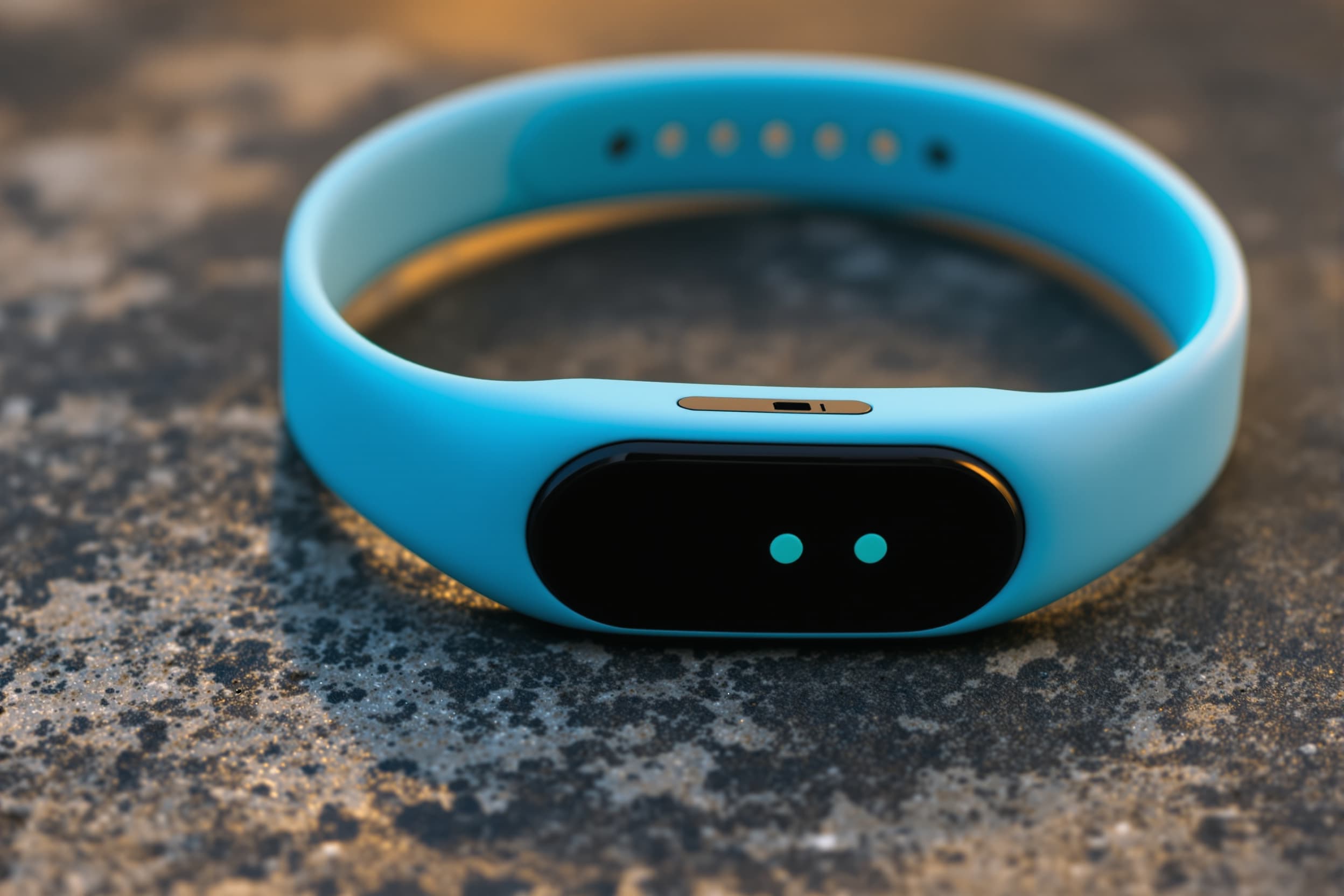
A continuous SpO2 and heart-rate monitor with dual-wavelength PPG (660 nm red and 940 nm IR) that streams raw 25 Hz waveforms over BLE and logs 24 hours on-device. Built on open firmware (ESP32-S3 or nRF52840) with exposed JTAG and a documented signal-processing chain, it targets biohackers, sleep-apnea self-trackers, and endurance athletes who want unfiltered physiological data.

Feasibility at a glance
PT localization
7/10
High
Most steps can be localised in Portugal.
Per unit
€80–150 per unit (early batch)
at 200-unit volume
Starter batch
200units
minimum viable run
To first batch
22weeks
8 phases, design to ship
Budget
€55,000–75,000 total project cost
all-in estimate
Bottom line
A clinical-grade pulse oximeter wristband with rigid-flex PCB, precision optics, and medical certification requirements is too complex for local Portuguese manufacturers in batch 200. White-label options do not exist for open-source, JTAG-exposed devices with custom rigid-flex designs. EU co-development with an experienced medical-electronics partner offers the best balance: access to rigid-flex PCB fabrication, medical-grade enclosure molding, optical assembly expertise, and CE class IIa pathway guidance, while keeping IP control, shorter lead times than China, and alignment with GDPR and MDR compliance. Partners like Philips Portugal or Siemens Healthineers Portugal can provide medical-device knowhow, while specialized EU contract manufacturers handle rigid-flex and optical integration.
5 capabilities
Continuously measures blood oxygen saturation (SpO2) and heart rate using red and infrared light shone through the skin.
Streams live, unfiltered waveform data at 25 Hz to a phone or computer over Bluetooth so users can see real-time physiology.
Logs a full day of readings on internal memory for offline analysis or troubleshooting.
Runs open-source firmware that anyone can inspect, modify, or extend for research or personal experiments.
Recharges via USB-C and lasts through multi-day use depending on logging frequency.
5 stations · build route
Fabricate the rigid-flex PCB
Layer polyimide flex sections with FR4 rigid islands, drill vias, plate copper, and apply solder mask.
Populate surface-mount components
Use pick-and-place and reflow ovens to solder the PPG front-end, MCU, flash, and passives onto the PCB.
Injection-mold the enclosure and cure the silicone strap
Mold medical-grade polycarbonate shells and overmold or cure silicone straps with optional adhesive backing.
Integrate battery, assemble optics, and secure sapphire window
Solder or connector-attach the LiPo cell, align the PPG sensor under the sapphire window, and seal the housing.
Flash firmware, calibrate SpO2, and perform functional testing
Program the MCU over JTAG, run optical calibration routines, verify BLE streaming, and log sample data.
Fabricate the rigid-flex PCB
Layer polyimide flex sections with FR4 rigid islands, drill vias, plate copper, and apply solder mask.
Populate surface-mount components
Use pick-and-place and reflow ovens to solder the PPG front-end, MCU, flash, and passives onto the PCB.
Injection-mold the enclosure and cure the silicone strap
Mold medical-grade polycarbonate shells and overmold or cure silicone straps with optional adhesive backing.
Integrate battery, assemble optics, and secure sapphire window
Solder or connector-attach the LiPo cell, align the PPG sensor under the sapphire window, and seal the housing.
6 identified · 4 blocking
Critical
CE MDR class IIa certification complexity
The EU Medical Device Regulation (MDR) 2017/745 classifies this pulse oximeter as class IIa, requiring a Notified Body review, clinical evaluation report, risk management file (ISO 14971), technical documentation, post-market surveillance plan, and a Quality Management System (ISO 13485). For a 200-unit pilot, the cost and timeline of full MDR compliance can exceed €50k and 6–9 months, dwarfing the unit economics. If the device launches without CE MDR marking, it cannot legally be sold or distributed in the EU for medical use, and the entire batch becomes unsellable.
Mitigation — Engage a medical-device regulatory consultant (e.g. TÜV SÜD, BSI Group, or a specialized MDR consultancy) at the design phase to scope the class IIa pathway and prepare the technical file in parallel with hardware development. Partner with an EU contract manufacturer that already holds ISO 13485 certification and has experience with Notified Body submissions, so they can share templates and audit documentation. Consider launching the first 200 units as a 'research-use-only' or 'wellness device' (non-MDR) to gather real-world data, then upgrade to MDR compliance for the second production run once clinical validation is complete.
High
Rigid-flex PCB supply bottleneck
Only a handful of EU manufacturers (AT&S in Austria, Schweizer Electronic in Germany, Aspocomp in Finland, and a few specialty houses in Switzerland) can fabricate medical-grade rigid-flex PCBs with polyimide flex sections, controlled impedance, and the tight tolerances required for flush PPG sensor contact. Lead times for prototype and low-volume runs (200 units) are 5–7 weeks, and any design re-spin adds another 5 weeks. A single supplier delay or capacity constraint can push the entire project timeline by 6–8 weeks.
Mitigation — Dual-source the rigid-flex PCB design by qualifying two EU fabricators (e.g. AT&S + Schweizer) during the prototype phase. Work with the EU co-development partner to pre-book PCB capacity with a 50% deposit before finalizing the design. Implement a 'design for manufacturability' review with the fab early in the CAD phase to minimize re-spins, and maintain a 2-week buffer in the timeline for PCB delivery.
High
Sapphire window and optical assembly delay
Sapphire optical windows must be laser-cut or CNC-machined to precise dimensions (±0.05 mm), then optically polished and bonded to the enclosure with UV-curable adhesive or epoxy to maintain light transmission >90% and prevent scratches. EU suppliers for small-batch sapphire windows (e.g. Rayner Portugal, specialty German optical houses, or Swiss precision manufacturers) often have 4–6 week lead times and minimum order quantities of 500–1,000 pieces. A single batch of 200 wristbands may not meet MOQs, forcing either over-ordering (increasing inventory cost) or acceptance of longer lead times.
Mitigation — Pre-order sapphire windows (500 units) during the PCB fabrication phase to absorb the 6-week lead time in parallel. Store surplus windows as safety stock for future batches or RMA repairs. Alternatively, design the enclosure to accept either sapphire or high-grade optical glass (Gorilla Glass, SCHOTT) as a Plan B, and qualify both materials during prototype testing. Work with the EU partner to negotiate a consignment stock agreement with the optical supplier, so they hold inventory and release it as needed.
High
PPG calibration and SpO2 accuracy validation
Achieving clinical-grade SpO2 accuracy (±2% per FDA/ISO 80601-2-61) requires per-device calibration of the PPG sensor against a reference pulse oximeter during manufacturing. Variations in LED emission wavelength, photodetector sensitivity, skin contact pressure, and ambient light rejection mean that a one-size-fits-all firmware calibration will fail on 10–20% of units. If the EU manufacturing partner lacks experience with PPG calibration rigs or does not have a reference oximeter setup (e.g. a Masimo Radical-7 or Nonin 3150), the first batch will ship with uncalibrated sensors, leading to field failures, returns, and regulatory scrutiny.
Mitigation — Specify in the contract that the EU partner must provide or subcontract a PPG calibration station with a certified reference pulse oximeter and a controlled test jig (finger or wrist phantom). Budget €8k–12k for the calibration rig NRE. Require the partner to run a 20-unit pilot with clinical validation (human subjects tested against a reference device) before committing to the full 200-unit batch. Implement an automated pass/fail test in firmware that flags units with SpO2 error >2% and quarantines them for rework or scrap.
Medium
IP and firmware leakage risk
Because the device is open-source with exposed JTAG and documented firmware, competitors or bad actors can trivially clone the hardware design, extract the signal-processing algorithms, and launch competing products. If the manufacturing partner or any subcontractor in the supply chain shares the Gerber files, BOM, or calibration routines without permission, the commercial advantage evaporates. This risk is amplified if any part of the supply chain touches China or low-IP-protection jurisdictions.
Mitigation — Formalize a strict NDA and IP assignment agreement with the EU co-development partner, explicitly covering all subcontractors (PCB fab, molding house, optical assembly). Watermark CAD files and Gerbers with unique identifiers to trace leaks. Keep the most sensitive firmware modules (PPG calibration coefficients, BLE pairing keys) in a separate private repository that is flashed only at final test under controlled conditions. Consider filing a defensive patent or design registration in the EU to establish prior art and enforce against clones.
Medium
LiPo battery transport and REACH compliance
The 80 mAh lithium polymer battery must comply with UN 38.3 transport testing (vibration, thermal, short-circuit, impact) for air and road shipment, and the battery chemistry must pass REACH substance restrictions (no restricted phthalates, heavy metals, or flame retardants). If the battery supplier does not provide UN 38.3 certification or REACH declaration, the finished wristbands cannot be legally shipped within the EU or exported. Additionally, if the battery is integrated into the device without a UL/IEC 62133 safety certification, insurers and retailers may refuse to handle the product.
Mitigation — Source the 80 mAh LiPo cell from a Tier 1 EU battery supplier (e.g. Varta Microbattery in Germany, or a qualified distributor of Samsung SDI / LG Chem cells) that provides UN 38.3, IEC 62133, and REACH documentation as standard. Require the EU manufacturing partner to include battery compliance documents in the technical file for MDR submission. Design the battery compartment with a fuse and thermal cutoff to meet IEC 60601-1 medical electrical safety, reducing the risk of field failures and liability claims.
22 weeks to first batch
Finalize CAD design, BOM, and rigid-flex PCB layout
wk 1–3Procure long-lead components and fabricate rigid-flex PCBs
wk 4–9SMT assembly and component population
wk 10–11Injection mold enclosures and cure silicone straps
wk 12–15Optical assembly: bond sapphire window and integrate PPG sensor
wk 16–17Firmware flashing and PPG calibration
wk 18–19Functional testing, QC, and MDR documentation
wk 20–21Final packaging, labeling, and shipment
wk 22wk 4–9 is the longest stretch — Procure long-lead components and fabricate rigid-flex PCBs takes 6 weeks of the 22 weeks on this build.
6 materials · 10 processes
Materials
Processes
599 Portuguese manufacturers matched
None cover the whole build — it splits across steps.
20 tasks · 22 weeks to first batch
Week 1
2 tasks
Select and contract EU co-development partner
Evaluate and negotiate NDA + statement of work with Philips Innovation Services (NL), Siemens Healthineers Engineering (DE), IMI Bulgaria, or Cicor Switzerland. Confirm their capability for rigid-flex PCB coordination, PPG optical assembly, and ISO 13485 QMS. Lock pricing, NRE breakdown, and 22-week delivery timeline.
Finalize rigid-flex PCB design and run DFM review
Complete the rigid-flex PCB layout (polyimide flex + FR4 rigid islands) with the EU partner's electrical engineers. Submit Gerbers to AT&S (Austria) or Schweizer (Germany) for a design-for-manufacturability check, focusing on bend radius, via placement, copper weight, and medical traceability requirements. Iterate once if needed.
Weeks 2–3
3 tasks
Order long-lead components (PPG AFE, MCU, flash, sapphire windows)
waits on Finalize rigid-flex PCB design and run DFM review
Purchase Maxim MAX30102 or TI AFE4960, ESP32-S3 or nRF52840 modules, 4 MB flash chips, and 80 mAh LiPo cells from authorized distributors (Mouser, Digi-Key). Pre-order 500 sapphire windows from German or Swiss optical supplier to meet MOQ and absorb 6-week lead time. Confirm UN 38.3 and REACH docs for battery.
Submit rigid-flex PCB order to AT&S or Schweizer
waits on Finalize rigid-flex PCB design and run DFM review
Send final Gerber files, stack-up specification, and assembly drawings to the rigid-flex PCB fabricator. Confirm 6-week lead time, pay 50% deposit to reserve capacity. Request daily status updates on lamination, drilling, plating, and electrical test milestones.
Design and order injection mold tooling for enclosure
Finalize CAD for polycarbonate/ABS enclosure (top and bottom shells) with sapphire window recess, USB-C port, and strap attachment points. Commission injection mold tooling from Portuguese or Polish molder. Include ISO 10993 biocompatibility material cert and laser-etch CE mark cavity.
Weeks 4–7
3 tasks
Design silicone strap mold and medical adhesive spec
Complete CAD for curved silicone wrist strap with optional medical-grade adhesive backing. Submit to silicone molder (Portugal or Poland) for compression mold tooling. Specify shore hardness, biocompatibility (ISO 10993), and hypoallergenic adhesive supplier. Order 250 straps (200 + 25% spare).
Engage MDR regulatory consultant for class IIa pathway scoping
Contract TÜV SÜD, BSI Group, or specialized MDR consultancy to scope the CE MDR class IIa requirements. Request technical file template, risk management file outline (ISO 14971), and clinical evaluation plan (ISO 80601-2-61 accuracy validation). Decide whether to launch as research-use-only or pursue full MDR in parallel.
Specify PPG calibration station and reference oximeter setup
waits on Select and contract EU co-development partner
Define the calibration jig requirements with the EU partner: certified reference pulse oximeter (Masimo Radical-7 or Nonin 3150), wrist phantom or human-subject protocol, automated pass/fail firmware test (±2% SpO2 error). Budget €10k for calibration rig NRE and confirm who owns/operates the equipment.
Weeks 8–16
9 tasks
Receive rigid-flex PCBs and perform incoming inspection
waits on Submit rigid-flex PCB order to AT&S or Schweizer
Accept delivery of 220 rigid-flex PCBs from AT&S or Schweizer (200 + 10% yield buffer). Inspect for delamination, via quality, solder mask registration, and electrical continuity using a flying-probe tester. Quarantine any boards with defects and request rework or credit from the fab.
SMT assembly: populate all surface-mount components
waits on Receive rigid-flex PCBs and perform incoming inspection, Order long-lead components (PPG AFE, MCU, flash, sapphire windows)
EU partner performs pick-and-place and reflow soldering of PPG AFE, MCU, flash, passives, and USB-C connector onto the rigid-flex PCBs. Run AOI and X-ray inspection for BGA joints. Hand-solder JTAG header and battery connector. Yield target: 95% first-pass.
Injection mold enclosure shells and inspect for tolerances
waits on Design and order injection mold tooling for enclosure
Molder produces first 220 polycarbonate/ABS enclosure sets (top + bottom). Measure sapphire window recess (±0.1 mm), USB-C port alignment, and strap attachment points with CMM or calipers. Check ISO 10993 material cert and laser-etched CE mark legibility. Request rework if >5% fail dimensional inspection.
Ongoing
3 tasks
Maintain IP protection and subcontractor NDA enforcement
Monitor compliance with NDA and IP assignment agreements across EU partner and all subcontractors (PCB fab, molders, optical assembly). Watermark CAD files and Gerbers with unique identifiers. Keep most sensitive firmware modules (PPG cal coefficients, BLE keys) in private repo, flashed only at final test. Review any requests for design files or BOM sharing.
Track rigid-flex PCB fab capacity and dual-source readiness
Monitor lead times and capacity constraints at AT&S and Schweizer. If primary fab signals delay, activate backup with second qualified rigid-flex vendor. Maintain 2-week buffer in project timeline for PCB delivery. Request weekly status updates during lamination and plating phases.
Prepare MDR technical file and clinical validation data in parallel
waits on Engage MDR regulatory consultant for class IIa pathway scoping
Work with MDR consultant to compile risk management file (ISO 14971), clinical evaluation report, technical documentation, and post-market surveillance plan. If pursuing full CE class IIa, coordinate 20-unit human-subject validation study (SpO2 accuracy vs. reference device) and submit to Notified Body. Track progress weekly to avoid blocking future sales.
5 roles to fill before month one
EU co-development partner lead
Senior medical-device project manager at Philips Innovation Services (NL) or Siemens Healthineers Engineering (DE)
This person owns end-to-end coordination of rigid-flex PCB fab (AT&S/Schweizer), SMT assembly, optical integration, PPG calibration station setup, and ISO 13485 QMS compliance. They have existing relationships with specialty rigid-flex fabs and optical suppliers, cutting 6–8 weeks off lead time and reducing re-spin risk. Essential for hitting the 22-week timeline and ensuring medical-grade traceability.
PCB fab technical contact
Rigid-flex PCB application engineer at AT&S (Austria) or Schweizer Electronic (Germany)
Provides design-for-manufacturability feedback on polyimide flex + FR4 rigid stack-up, via placement, bend radius, and copper weight before production. Helps avoid costly re-spins (5-week delay each) and ensures medical traceability (serial numbers, material certs). Critical bottleneck resource—only a handful of EU fabs can deliver 200-unit rigid-flex runs with required precision.
CE MDR class IIa pathway advisor
MDR regulatory consultant at TÜV SÜD, BSI Group, or specialized MedTech consultancy
Scopes the technical file, risk management file (ISO 14971), clinical evaluation, and Notified Body submission requirements for class IIa pulse oximeter. Provides templates and audit support to keep MDR compliance on track in parallel with hardware development. Without this expertise, the €40k–60k certification cost and 6–9 month timeline can balloon or block EU market entry entirely.
5 things to avoid in this plan
lead time
Rigid-flex PCB supply bottleneck: Only AT&S (Austria), Schweizer (Germany), and a few specialty EU fabs can deliver 200-unit medical-grade rigid-flex runs. A single design re-spin or capacity constraint adds 5–7 weeks. Mitigate by dual-sourcing (qualify two fabs) and pre-booking capacity with 50% deposit.
quality
PPG calibration and SpO2 accuracy validation: Achieving clinical-grade ±2% SpO2 accuracy requires per-device calibration against a reference oximeter and a controlled test jig. If the EU partner lacks PPG calibration experience or equipment, the first batch ships uncalibrated, leading to field failures and regulatory scrutiny. Budget €10k for calibration rig NRE and run a 20-unit human-subject pilot before full production.
lead time
Sapphire window lead time and MOQ mismatch: EU optical suppliers demand 500-unit MOQs and 6-week lead times for laser-cut, polished sapphire windows. A 200-unit batch leaves 300 surplus pieces or forces over-ordering cost. Mitigate by pre-ordering during PCB fab (parallel timeline) and storing surplus as safety stock for future batches or RMA repairs.
2 tasks in week 1
Select and contract EU co-development partner
Flash firmware, calibrate SpO2, and perform functional testing
Program the MCU over JTAG, run optical calibration routines, verify BLE streaming, and log sample data.
Finalize CAD design, BOM, and rigid-flex PCB layout
Procure long-lead components and fabricate rigid-flex PCBs
SMT assembly and component population
Injection mold enclosures and cure silicone straps
Optical assembly: bond sapphire window and integrate PPG sensor
Firmware flashing and PPG calibration
Functional testing, QC, and MDR documentation
Final packaging, labeling, and shipment
Cure silicone straps and apply medical adhesive backing
waits on Design silicone strap mold and medical adhesive spec
Silicone molder compression-cures 250 wrist straps, applies medical-grade adhesive backing (if specified), and inspects for air bubbles, tears, or contamination. Confirm shore hardness and biocompatibility cert (ISO 10993). Deliver straps to final assembly site.
Optical assembly: bond sapphire windows and integrate PPG sensors
waits on SMT assembly: populate all surface-mount components, Injection mold enclosure shells and inspect for tolerances, Cure silicone straps and apply medical adhesive backing
UV-cure or epoxy-bond sapphire windows into enclosure recesses, align PPG sensor LEDs/photodetector behind the window with optical coupling gel to eliminate air gaps. Attach silicone straps via screws or ultrasonic welding. Solder/connect 80 mAh LiPo batteries and secure in compartment. Inspect for light leakage and mechanical fit.
Flash open-source firmware via JTAG and perform per-unit PPG calibration
waits on Optical assembly: bond sapphire windows and integrate PPG sensors, Specify PPG calibration station and reference oximeter setup
Program ESP32-S3 or nRF52840 with open-source firmware using production JTAG jig. Run each unit on the PPG calibration station (reference oximeter + wrist phantom or human volunteer) and tune firmware calibration coefficients to ±2% SpO2 accuracy. Store per-device cal data in flash. 5-min burn-in test for BLE, charging, logging.
End-to-end functional testing and QC inspection
waits on Flash open-source firmware via JTAG and perform per-unit PPG calibration
Test each unit on multiple human subjects: measure SpO2 and HR, verify 24-hour data logging, confirm 25 Hz BLE streaming, check USB-C charging current and battery run-time, validate JTAG debug access. Inspect optical alignment, enclosure fit, strap security, cosmetics. Quarantine failures for rework/scrap. Generate serial numbers and traceability records.
Package units with USB-C cables, guides, and regulatory inserts
waits on End-to-end functional testing and QC inspection
Place each wristband in anti-static bag with USB-C cable, quick-start guide, and regulatory inserts (CE declaration placeholder, IFU, warranty card—full MDR docs if class IIa submission is complete). Print outer cartons with CE mark, UDI barcode (if applicable), batch number, manufacturing date. Palletize 200 units for shipment.
Arrange freight and deliver to Portuguese warehouse
waits on Package units with USB-C cables, guides, and regulatory inserts
Coordinate road freight from EU partner's facility (Netherlands, Germany, Bulgaria, or Switzerland) to customer warehouse in Portugal. Confirm delivery date, insurance, and customs paperwork (if crossing non-Schengen border). Retain 10 sample units and full documentation set for post-market surveillance and potential Notified Body audit.
PPG sensor alignment and SpO2 calibration specialist
Optical assembly and calibration engineer at EU partner or specialized subcontractor
Designs and operates the sapphire window bonding process, optical coupling (gel or adhesive to eliminate air gaps), and the PPG calibration station (reference oximeter + wrist phantom). Ensures each unit achieves ±2% SpO2 accuracy per ISO 80601-2-61. This is the second-hardest technical bottleneck after rigid-flex PCB; without proven optical expertise, 10–20% of units will fail field accuracy tests.
Long-lead component and sapphire window sourcing coordinator
Procurement lead at the EU co-development partner or independent supply-chain consultant
Manages orders for PPG AFE (Maxim/TI), MCU modules (ESP32-S3/nRF52840), 4 MB flash, 80 mAh LiPo cells, and 500 sapphire windows (MOQ). Negotiates consignment stock or pre-booking with optical suppliers to absorb 6-week lead times in parallel with PCB fab. Confirms UN 38.3, IEC 62133, and REACH compliance docs for battery to avoid shipment blocks.
certification
CE MDR class IIa certification cost and timeline explosion: Full Notified Body submission for class IIa can cost €40k–60k and take 6–9 months, dwarfing the 200-unit pilot economics. If the device launches without CE MDR marking, it cannot legally be sold in the EU for medical use. Consider launching first 200 units as 'research-use-only' to gather real-world data, then upgrade to MDR compliance for the second production run.
certification
LiPo battery transport compliance (UN 38.3, REACH, IEC 62133): If the 80 mAh battery supplier does not provide UN 38.3 transport testing, IEC 62133 safety cert, and REACH declaration, the finished wristbands cannot be legally shipped within the EU or exported, and insurers/retailers may refuse to handle the product. Source only from Tier 1 EU battery suppliers (Varta Microbattery, Samsung SDI, LG Chem distributors) with full compliance docs.
599 matched · 8 shown, ranked by coverage
Covers, left to right: PCB Fabrication · SMT Assembly · Injection Molding · Laser Cutting · Battery Pack Assembly · Cable Assembly · Soldering · Testing & Inspection · Final Assembly · Packaging
Manufacturer
Location
Covers
Certifications
People
Portuguese producers per required step
Final Assembly
369
Testing & Inspection
178
Injection Molding
174
SMT Assembly
36
Laser Cutting
13
Soldering
13
Cable Assembly
12
How many cover more than one step
The gap
A clinical-grade pulse oximeter wristband with rigid-flex PCB, precision optics, and medical certification requirements is too complex for local Portuguese manufacturers in batch 200. White-label options do not exist for open-source, JTAG-exposed devices with custom rigid-flex designs. EU co-development with an experienced medical-electronics partner offers the best balance: access to rigid-flex PCB fabrication, medical-grade enclosure molding, optical assembly expertise, and CE class IIa pathway guidance, while keeping IP control, shorter lead times than China, and alignment with GDPR and MDR compliance. Partners like Philips Portugal or Siemens Healthineers Portugal can provide medical-device knowhow, while specialized EU contract manufacturers handle rigid-flex and optical integration.
Send one RFQ to the top 4
Keenfinity EMS, Uartrónica, Proto-Electronics, Codica Cables — same package, one click.
PCB Fabrication
6
Battery Pack Assembly
3
Packaging
0