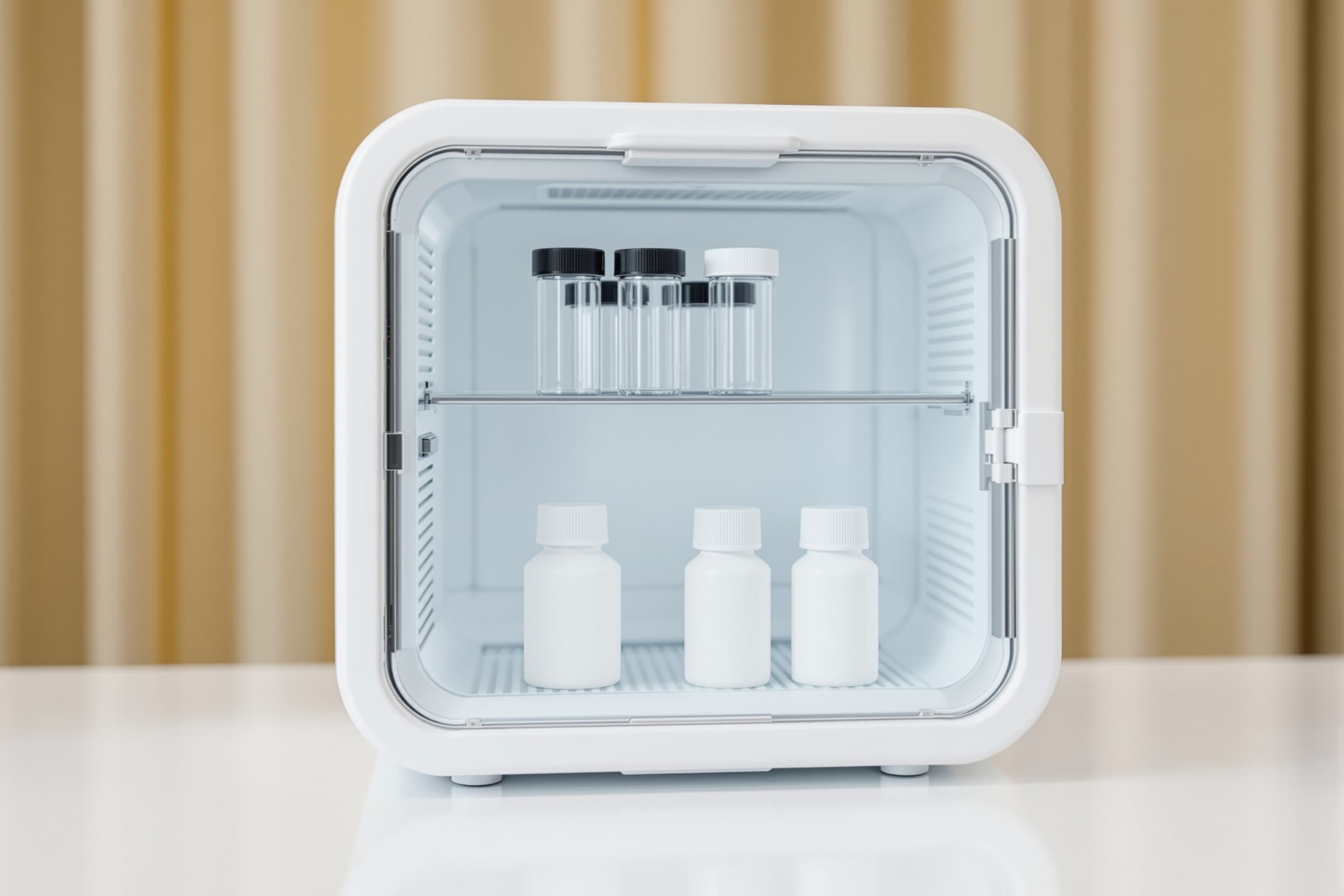
An 8-channel stepper-driven peristaltic pump designed for cell culture, organ-on-chip, and microfluidics applications. Each channel delivers pulse-free flow from 0.5 µL/min to 50 mL/min with ±2% dosing accuracy over 24 hours. Controlled via WiFi browser UI or REST API with auto-detection of tubing cassettes.

Feasibility at a glance
PT localization
6/10
Partial
Most steps can be localised in Portugal.
Per unit
€2,500–€4,500
at 60-unit volume
Starter batch
60units
minimum viable run
To first batch
24weeks
8 phases, design to ship
Budget
€65–95k
all-in estimate
Bottom line
For a high-precision, low-to-medium volume (60 units) medical-grade peristaltic pump array, co-development with an EU partner offers the best balance. Local Portuguese capability is insufficient for complex motor integration, PCB assembly, and firmware development at this difficulty level. White-label options do not exist for this highly specialized 8-channel system with barcode scanning and WiFi API. EU co-development provides access to precision CNC machining, motor sourcing, certified PCB assembly houses, and regulatory expertise (CE-MDR, EMC), while keeping IP protected, lead times manageable (20–24 weeks), and ensuring compliance with medical device directives. The unit economics (€2,200–€2,800) align with the target range and justify the engineering investment for a differentiated product.
4 capabilities
Delivers precise amounts of nutrient media or reagents to living cell cultures without contamination
Pumps fluids smoothly through delicate microfluidic chips without creating pressure spikes that damage channels
Allows researchers to program multi-step dosing schedules from a web browser on any device
Automatically recognizes which tubing size is installed so the correct flow calculations are used
5 stations · build route
CNC machine aluminium chassis
Mill the main enclosure and motor mounts from billet aluminium for rigidity and precision alignment.
Injection mould peristaltic cassettes
Produce PMMA cassette bodies and silicone tubing holders in volume using custom tooling.
Fabricate and populate motor driver PCBs
Order bare boards, apply solder paste, place components via pick-and-place, reflow, and inspect.
Assemble stepper motors and rollers
Mount each motor to the chassis, attach twin-roller mechanisms, and integrate cassette holders.
Final integration and calibration
Install touchscreen, WiFi module, barcode scanner, wire everything, flash firmware, and run flow calibration tests.
CNC machine aluminium chassis
Mill the main enclosure and motor mounts from billet aluminium for rigidity and precision alignment.
Injection mould peristaltic cassettes
Produce PMMA cassette bodies and silicone tubing holders in volume using custom tooling.
Fabricate and populate motor driver PCBs
Order bare boards, apply solder paste, place components via pick-and-place, reflow, and inspect.
Assemble stepper motors and rollers
Mount each motor to the chassis, attach twin-roller mechanisms, and integrate cassette holders.
Final integration and calibration
6 identified · 4 blocking
Critical
CE-MDR Medical Device Classification and Conformity
Peristaltic pumps for cell culture and organ-on-chip are likely Class IIa medical devices under EU MDR 2017/745, requiring a Technical File, risk management per ISO 14971, usability engineering per IEC 62366, and Notified Body review. If classification is underestimated or documentation incomplete, the product cannot be sold in the EU. WiFi connectivity adds Radio Equipment Directive (RED) requirements, and motor drivers must meet EMC and LVD. Missing any of these blocks market entry.
Mitigation — Engage a regulatory consultant (TÜV SÜD, BSI, or Dekra) during design phase to confirm classification and build the Technical File in parallel with development. Conduct EMC/RED pre-compliance testing at 80% design maturity to catch issues early. Budget €25k–€40k and 8–10 weeks for Notified Body review. Partner with a CM experienced in ISO 13485 and MDR to ensure traceability, DHR, and post-market surveillance foundations are in place.
High
Stepper Motor Lead Time and Allocation
Brushless stepper motors with the required torque, speed range (0.5 µL/min to 50 mL/min), and encoder feedback are specialized components. Lead times from Faulhaber, Maxon, or Nanotec can stretch to 12–16 weeks, especially for custom winding or gearbox configurations. For 60 units (480 motors), allocation may be constrained if larger OEM customers take priority. A stock-out or delay cascades directly into final assembly, pushing delivery by 8–12 weeks.
Mitigation — Place motor orders immediately after design freeze, even before chassis tooling begins. Negotiate a frame agreement with two motor suppliers (e.g., Faulhaber + Nanotec) to split risk. Request vendor-managed inventory (VMI) for 10% buffer stock. Design motor mount to accept two mechanically compatible motor families, enabling dual-sourcing without chassis redesign.
High
Firmware and Calibration Algorithm IP Leakage
The core value of this pump lies in dosing accuracy (±2%), auto-calibration via barcode, and REST API integration. If the contract manufacturer or subcontractor reverse-engineers the firmware or calibration lookup tables, a competing product can appear within 12 months, eroding differentiation. This risk is highest with Chinese suppliers but also present if EU partners subcontract software development to third parties without NDA coverage.
Mitigation — Retain all firmware source code, calibration algorithms, and barcode database in-house. Deliver only compiled binaries to the CM, using encrypted bootloader and code-signing. Segment the WiFi/API layer (developed in-house) from the motor control layer (co-developed with CM under strict NDA). Conduct final firmware flashing and calibration in Portugal or at a trusted EU facility under direct supervision.
High
Flow Calibration and Long-Term Accuracy Drift
Achieving ±2% dosing accuracy over 24 hours requires precise calibration of each motor's step-to-volume relationship, accounting for tubing elasticity, roller wear, and temperature. Without a robust calibration fixture and test protocol, units may pass initial QC but drift out of spec after 100 hours of operation, leading to customer returns, reputational damage, and costly field retrofits.
Mitigation — Develop an automated calibration station with gravimetric or flow-sensor verification for each of the 8 channels. Run 48-hour burn-in tests on 10% of production units (6 units) to characterize drift and validate calibration stability. Implement over-the-air (OTA) firmware updates so calibration coefficients can be refined post-deployment. Require the CM to maintain ISO 13485 and provide full calibration traceability (certificates, test data) with each batch.
Medium
Injection Mould Tooling Delays for Cassettes
Custom injection moulds for the 8 peristaltic cassettes (PMMA or polycarbonate, with precise tubing channels and barcode mounting) require 8–12 weeks for tooling and first-article validation. If the design changes after tool cut—e.g., tubing diameter tolerance or roller clearance adjustment—rework adds another 4–6 weeks and €8k–€15k in costs. Tooling delays block final assembly and calibration.
Mitigation — Freeze cassette CAD early (week 4) and validate with 3D-printed prototypes on real pump heads before committing to steel tooling. Use a rapid-tooling approach (aluminum or P20 steel) for the first 100 cassettes to enable faster iteration, then transition to hardened steel for production volumes. Order tooling from two EU mould shops (DE/PT) in parallel if budget allows, to de-risk single-vendor delays.
Medium
Component Obsolescence (Touchscreen, WiFi Module)
Capacitive touchscreens and WiFi modules (e.g., ESP32, Raspberry Pi Compute Module) have 2–4 year product lifecycles. If a key component goes end-of-life (EOL) mid-production or before the expected 3-year product lifespan, redesigning the PCB and recertifying under RED/EMC can cost €30k–€50k and delay production by 12+ weeks.
Mitigation — Select long-lifecycle industrial-grade components (e.g., industrial touchscreens from Winstar, WiFi modules from u-blox or Microchip). Design the PCB with modular connectors so the touchscreen and WiFi module can be swapped without board redesign. Purchase 1-year forward inventory (70 units' worth) of critical ICs and modules at production kickoff. Subscribe to component lifecycle monitoring services (SiliconExpert, Echelon) to receive 6-month EOL warnings.
24 weeks to first batch
Design Freeze and DFM Review
wk 1–3Tooling and Component Procurement
wk 4–13PCB Fabrication and SMT Assembly
wk 14–17CNC Machining and Cassette Moulding
wk 18–22Mechanical Subassembly (Motors and Rollers)
wk 23–25Final Integration and Firmware Flashing
wk 26–27Flow Calibration and Accuracy Validation
wk 28–30EMC/RED Testing, QC, and Packaging
wk 31–34Design Freeze and DFM Review
Tooling and Component Procurement
PCB Fabrication and SMT Assembly
wk 4–13 is the longest stretch — Tooling and Component Procurement takes 10 weeks of the 34 weeks on this build.
7 materials · 9 processes
Materials
Processes
683 Portuguese manufacturers matched
None cover the whole build — it splits across steps.
15 tasks · 12 weeks to first batch
Week 1
2 tasks
Finalize CAD for chassis, cassettes, and motor mounts
waits on Motor torque/speed specs must be confirmed before finalizing shaft coupling design
Complete 3D CAD models for CNC aluminium chassis, 8-channel motor mounting plate, peristaltic cassette geometry (tubing channels, barcode holder), and roller assemblies. Export STEP files and 2D drawings with GD&T for DFM review. Freeze mechanical BOM (motors, bearings, fasteners, tubing).
Shortlist and contact 3 EU contract manufacturers
Research and reach out to Benchmark Electronics (CZ), Rau (DE), and one PT-based precision assembly house. Request capability statements for CNC machining, PCBA, motor integration, and ISO 13485 compliance. Schedule intro calls to discuss 60-unit pilot, NRE estimates, and lead times.
Weeks 2–3
3 tasks
Conduct DFM review workshop with selected CM
waits on Requires T02 completion and CM selection
Share CAD, schematics, and BOM with chosen EU CM. Run 2-day remote or on-site DFM session covering: chassis tolerances, cassette draft angles, motor mount alignment, PCB stackup (4-layer vs 6-layer), cable routing, and test point access. Document design changes and update CAD by end of week 3.
Request quotes for stepper motors from Faulhaber and Maxon
waits on Motor specs must be locked from T01
Send RFQ to Faulhaber (DE) and Maxon (CH) for 480 brushless stepper motors (60 units × 8) with encoder feedback, specifying torque (≥20 mNm), speed range (10–3000 rpm), and shaft diameter. Request lead time, unit cost at 480 qty, and sample availability (8 units for prototyping). Negotiate frame agreement and VMI terms.
Engage regulatory consultant for CE-MDR classification
Hire TÜV SÜD, BSI, or Dekra to confirm Medical Device Regulation (MDR) classification (Class IIa expected) and scope the Technical File requirements: risk management (ISO 14971), usability (IEC 62366), clinical evaluation, and Notified Body pathway. Establish timeline and budget (€25k–€40k, 8–10 weeks for review).
Weeks 4–7
3 tasks
Order injection mould tooling for peristaltic cassettes
waits on T03 DFM must finalize cassette geometry
Award tooling contract to EU mould shop (DE or PT) for 8-cavity cassette mould (PMMA or PC, 480 parts). Provide final CAD with barcode mount, tubing compression surfaces, and draft analysis. Specify rapid-tooling approach (aluminum or P20 steel) for first 100 units to enable iteration. Confirm 8–10 week delivery and first-article inspection protocol.
Design and validate motor driver PCB schematic
waits on Motor pinout and current requirements from T04
Complete 4-layer PCB schematic for 8-channel stepper motor drivers (e.g., TMC2209 or DRV8825), power regulation (12V/24V), WiFi module interface (ESP32 or u-blox), touchscreen controller (SPI/I²C), and barcode scanner UART. Run SPICE simulations for motor current handling and EMC pre-compliance (filtering, grounding). Submit Gerbers and BOM to PCBA house for quote.
3D print cassette prototypes and test fit with motors
waits on T01 cassette CAD freeze
Print 8 cassette prototypes (SLA or MJF) using final CAD. Install sample silicone tubing (ID 1.6 mm, 3.2 mm) and test roller compression, tubing retention, and barcode label placement. Measure runout and alignment with motor shafts. Iterate design if clearance or clamping issues found. Validate before committing to steel tooling.
Weeks 8–16
6 tasks
Procure 8 sample motors and build breadboard test rig
waits on T04 motor procurement and T07 driver circuit validation
Purchase 8 sample motors (Faulhaber or Maxon) and assemble a breadboard test fixture with temporary motor mounts, roller shafts, and silicone tubing. Connect to evaluation motor driver boards and run flow tests at 5 speed settings (0.5, 5, 20, 40, 50 mL/min). Validate torque, noise, heating, and step accuracy. Record flow vs RPM data to inform calibration algorithm.
Draft risk management file (ISO 14971) and usability plan
waits on T05 regulatory consultant engagement
Create initial Risk Management File identifying hazards (over-dosing, motor overheating, WiFi security, EMC interference, tubing rupture). Assign severity/probability, define mitigations (software limits, thermal cutoff, encrypted API, CE testing). Draft usability engineering plan (IEC 62366) covering touchscreen UI, error messages, and user training. Submit to regulatory consultant for review.
Fabricate and test 3 motor driver PCB prototypes
waits on T07 PCB design completion
Ongoing
1 task
Weekly sync with EU CM and component suppliers
Hold 30-minute weekly call with CM, motor supplier, and tooling vendor to track: cassette mould progress, motor allocation and shipping, PCB fabrication status, chassis machining queue, and any design change requests. Escalate blockers immediately. Maintain shared tracker (Airtable, Notion, or Excel) with lead times, PO numbers, and delivery milestones.
4 roles to fill before month one
EU Contract Manufacturing Partner – DFM and Assembly Lead
Senior Mechatronics Engineer at Rau GmbH or Benchmark Electronics
You need a partner with ISO 13485 certification and proven experience integrating precision motors, CNC chassis, PCBAs, and calibration for medical devices. This contact will run the DFM review (T03), coordinate chassis machining and PCBA (T06, T11), manage final assembly (weeks 16–24), and ensure traceability for CE-MDR Technical File. They also provide access to Tier-1 motor and component suppliers across Germany and Czech Republic.
Stepper Motor Supplier – Technical Spec and Delivery Assurance
Application Engineer at Faulhaber or Maxon Motor
Your 8-channel design depends on 480 high-precision brushless stepper motors with tight torque, speed, and encoder specs. This contact will help finalize motor selection (T04), provide 8 samples for breadboard testing (T09), confirm lead times (12–16 weeks), and negotiate VMI or frame agreement (T12) to prevent allocation delays. They also advise on shaft coupling, thermal management, and EMC filtering for motor drivers.
CE-MDR and EMC/RED Compliance Advisor
Regulatory Affairs Consultant at TÜV SÜD, BSI, or Dekra
Achieving CE-MDR Class IIa certification and RED (WiFi) conformity is the critical path to market entry. This contact will confirm device classification (T05), guide the Technical File structure (ISO 14971 risk file, IEC 62366 usability, clinical evaluation), coordinate Notified Body review (8–10 weeks), and oversee EMC/RED testing (T13). Their expertise prevents costly redesigns or delayed launches due to missing compliance documentation.
5 things to avoid in this plan
lead time
Lock motor orders by week 4—Faulhaber/Maxon lead times are 12–16 weeks and allocation can slip if larger OEMs take priority; negotiate VMI and dual-source (Nanotec backup) to avoid 8–12 week cascade delays in final assembly.
cost
Freeze cassette CAD by week 3 before tooling commit—any post-tooling design change (tubing ID, roller clearance, barcode mount) adds 4–6 weeks and €8k–€15k rework; validate with 3D-printed prototypes (T08) under real motor compression before steel cut.
certification
Secure Notified Body slot early (week 6)—CE-MDR Class IIa review queues are 8–10 weeks; late engagement pushes market entry by 3+ months; run parallel Technical File prep (ISO 14971, IEC 62366) starting week 4 so submission is ready by week 10.
quality
Validate flow calibration on breadboard (T09) before PCB production commit—if motor torque, step resolution, or tubing compression is wrong, the ±2% accuracy spec fails and you face board redesign (12 weeks) or motor swap (16 weeks); test 8 channels at 5 flow rates before T11 PCB order.
2 tasks in week 1
Finalize CAD for chassis, cassettes, and motor mounts
Install touchscreen, WiFi module, barcode scanner, wire everything, flash firmware, and run flow calibration tests.
CNC Machining and Cassette Moulding
Mechanical Subassembly (Motors and Rollers)
Final Integration and Firmware Flashing
Flow Calibration and Accuracy Validation
EMC/RED Testing, QC, and Packaging
Order 3 prototype PCBs with SMT assembly from EU PCBA house (Würth Elektronik, NCAB, or CM partner). Populate with motor drivers, WiFi module, touchscreen controller, and power supplies. Flash test firmware and verify: all 8 motor channels drive correctly, WiFi connects and serves REST API, touchscreen responds to touch, barcode scanner reads sample codes. Debug and document any rework needed for production revision.
Place long-lead orders for production motors and components
waits on T09 motor validation and budget approval
Commit purchase orders for 480 motors (Faulhaber/Maxon), 60 touchscreens, 60 WiFi modules, 60 barcode scanners, and 60 power supplies based on breadboard validation. Confirm delivery by week 18–20 to align with PCB and chassis production. Negotiate payment terms (30% deposit, 70% on delivery) and request vendor-managed inventory (VMI) for 10% buffer.
Select EMC/RED test lab and book preliminary test slot
Identify accredited EU test lab (TÜV Rheinland, Dekra, SGS) for EMC (EN 61326-1), LVD (EN 61010-1), and RED (WiFi) pre-compliance testing. Reserve test slot in week 14–16 for 3 prototype units. Request test plan and cost estimate (€5k–€8k). Plan to conduct informal pre-scan at CM facility to catch major EMC issues before formal testing.
Develop calibration protocol and fixture design
waits on T09 flow data collection
Design automated calibration station: gravimetric scale (±0.01 g), reference tubing set, 8-channel parallel test fixture, data logging PC. Write calibration software to run each channel at 5 flow rates, measure dispensed volume, compute µL/step coefficients, and store in device EEPROM. Specify 24-hour accuracy test (±2% target). Prepare fixture BOM and build plan for week 10–12 assembly.
Cassette Tooling and First-Article Validation
Precision Injection Mould Toolmaker (Germany or Portugal)
The 8 peristaltic cassettes require tight tolerances for tubing compression, barcode holder fit, and roller clearance. This contact will manufacture the injection mould (T06), deliver first articles by week 10, and support design iteration if 3D-printed prototypes (T08) reveal fit or function issues. Rapid-tooling expertise (aluminum or P20 steel) enables fast iteration before committing to hardened production tooling for 500+ unit scale.
certification
Plan EMC pre-compliance sweep by week 10—motor drivers and WiFi are high EMC-risk; informal pre-scan at CM (€1k–€2k) catches grounding, filtering, or shielding issues before formal TÜV test (€5k–€8k); fixing post-certification adds 6–8 weeks and forces re-test.
683 matched · 8 shown, ranked by coverage
Covers, left to right: CNC Machining · Injection Molding · Motor Winding · SMT Assembly · PCB Fabrication · Cable Assembly · Final Assembly · Testing & Inspection · Packaging
Manufacturer
Location
Covers
Certifications
People
Portuguese producers per required step
Final Assembly
369
CNC Machining
212
Testing & Inspection
178
Injection Molding
174
SMT Assembly
36
Cable Assembly
12
PCB Fabrication
6
How many cover more than one step
The gap
For a high-precision, low-to-medium volume (60 units) medical-grade peristaltic pump array, co-development with an EU partner offers the best balance. Local Portuguese capability is insufficient for complex motor integration, PCB assembly, and firmware development at this difficulty level. White-label options do not exist for this highly specialized 8-channel system with barcode scanning and WiFi API. EU co-development provides access to precision CNC machining, motor sourcing, certified PCB assembly houses, and regulatory expertise (CE-MDR, EMC), while keeping IP protected, lead times manageable (20–24 weeks), and ensuring compliance with medical device directives. The unit economics (€2,200–€2,800) align with the target range and justify the engineering investment for a differentiated product.
Send one RFQ to the top 4
REROM, MOLDMAK, ITECMO, Quickmold — same package, one click.
Motor Winding
0
Packaging
0