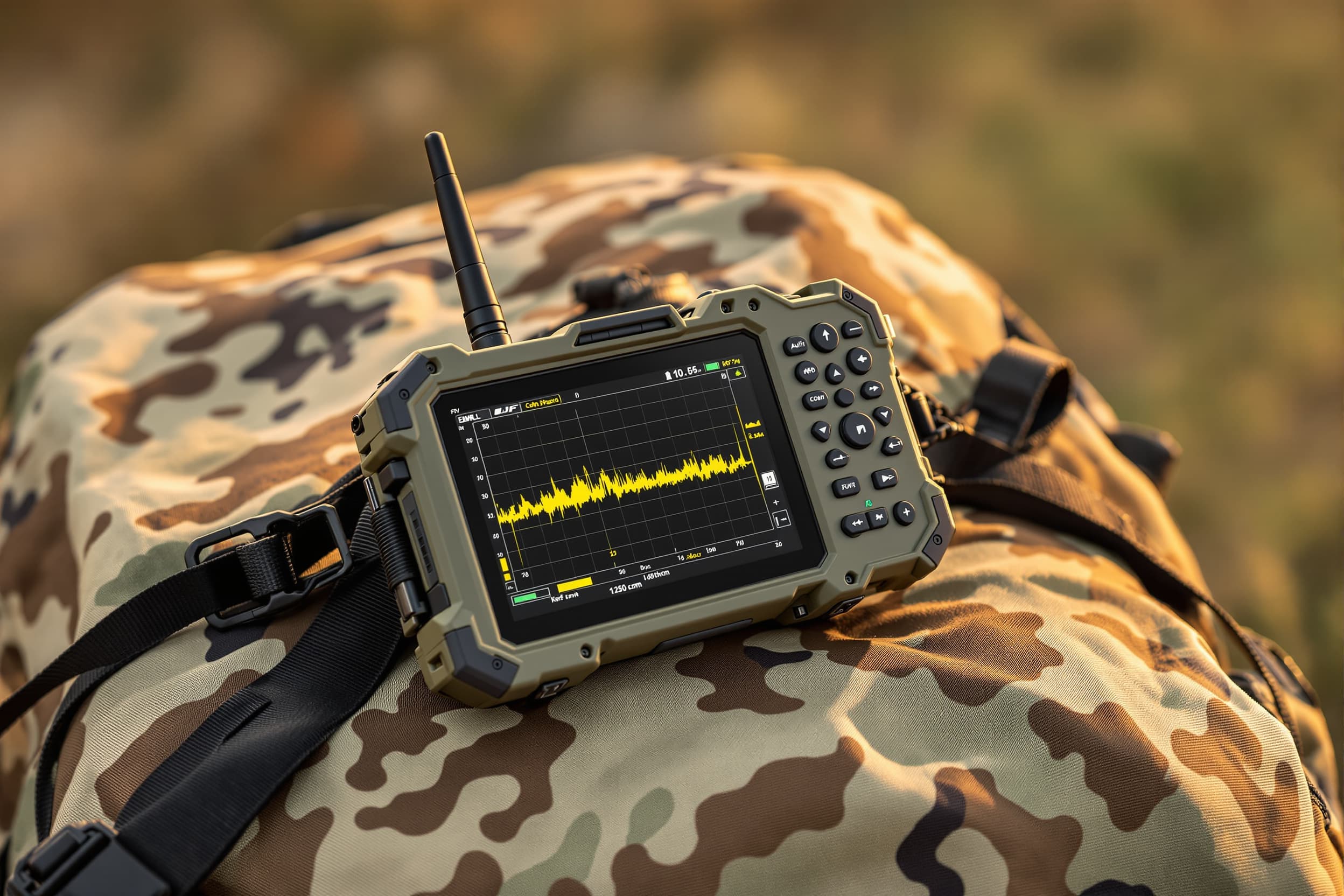
A rugged, handheld passive RF detector covering 100 MHz to 6 GHz, designed for field operators to identify and direction-find drone control signals, WiFi, GSM, and other emitters. Features auto-classification of DJI OcuSync, Autel, and FPV signals, live spectrogram display, and geo-tagged spectrum recording. Passive-only architecture designed for EU export compliance.

Feasibility at a glance
PT localization
5/10
Partial
Most steps can be localised in Portugal.
Per unit
€2,000–3,500
at 200-unit volume
Starter batch
200units
minimum viable run
To first batch
28weeks
8 phases, design to ship
Budget
€520–600k
all-in estimate
Bottom line
A handheld RF spectrum analyzer with drone-detection capability requires deep RF engineering, precision SDR integration, export-controlled signal processing, and IP54 ruggedization. No single Portuguese manufacturer has the full stack of capabilities for wideband SDR, signal classification firmware, and tactical-grade enclosures. Co-developing with an established EU defense electronics or RF instrumentation partner (e.g., Rohde & Schwarz, Thales, or a tier-2 EMS house experienced in RF) provides access to certified SDR modules, antenna design, and compliance expertise while keeping production inside the EU for export-control simplicity. This approach balances capability, time-to-market, and regulatory risk for a 200-unit pilot run targeting defense, security, and critical-infrastructure customers.
5 capabilities
Scans radio spectrum from 100 MHz to 6 GHz to detect and identify transmissions from drones, phones, and other wireless devices.
Automatically labels common drone control protocols like DJI OcuSync, Autel, and analog FPV so users know what type of aircraft is nearby.
Displays a live color waterfall chart that shows signal strength and frequency in real time, even in bright sunlight.
Combines GPS position and compass heading to estimate the direction of a transmitter after multiple readings.
Records every scan with time, location, and frequency data, then exports it as a map file that can be opened in Google Earth.
5 stations · build route
Machine and anodize aluminium chassis
CNC mill the main enclosure from billet, then anodize NATO-green and laser-etch markings.
Fabricate and populate main PCB
Order multilayer FR4 board, place RF components and processor via SMT, reflow, and inspect.
Injection-mold TPE overmold and polycarbonate window
Mold the rubber grip layer and hardened display cover; assemble gaskets into button cavities.
Integrate SDR, GPS, compass, and storage modules
Mount LimeSDR-class receiver, GPS/compass sensors, and SSD into chassis; connect via shielded flex cables.
Final assembly, firmware load, and IP54 test
Install display, battery, and antenna; flash signal-classification firmware; run dust/splash chamber test and RF calibration.
Machine and anodize aluminium chassis
CNC mill the main enclosure from billet, then anodize NATO-green and laser-etch markings.
Fabricate and populate main PCB
Order multilayer FR4 board, place RF components and processor via SMT, reflow, and inspect.
Injection-mold TPE overmold and polycarbonate window
Mold the rubber grip layer and hardened display cover; assemble gaskets into button cavities.
Integrate SDR, GPS, compass, and storage modules
Mount LimeSDR-class receiver, GPS/compass sensors, and SSD into chassis; connect via shielded flex cables.
6 identified · 4 blocking
Critical
Export Control and Dual-Use Licensing
This device is a passive RF surveillance system with auto-classification of drone protocols, direction-finding, and geo-tagged recording—capabilities that place it under EU Dual-Use Regulation (EU 2021/821) Category 3 (Electronics) and Category 5 (Telecommunications). Export outside the EU, especially to non-NATO countries, requires individual export licenses and end-user certificates. Failure to obtain licenses exposes GETMILK to criminal liability, asset seizure, and multi-year export bans. Even intra-EU transfer to certain end-users (e.g., private security firms, research institutes with non-EU funding) may trigger notification requirements. The passive-only architecture avoids Category 4 (Computers – Information Security) controls on active jamming, but you are still exporting a surveillance capability.
Mitigation — Engage a specialized EU export-control attorney during design phase to conduct commodity-classification analysis and prepare Technical Specifications for Dual-Use Items. Design the product with a hardware token or licensing server that restricts signal-classification features to pre-approved end-users; this creates an auditable access-control mechanism. Register with your national export-control authority (in Portugal, DGTF – Direção-Geral do Tesouro e Finanças) and apply for a global or group export license covering NATO and EU government customers. For non-EU sales, require certified end-user undertakings and verify against denied-parties lists. Document the passive-only nature (no jamming, no active RF emission) in all technical literature to distinguish from Category 11 (Electronic Warfare) systems.
High
SDR Module Supply Bottleneck
High-performance wideband SDR receivers (LimeSDR Mini 2.0, Ettus B200, HackRF One) are niche products with long lead times (12–20 weeks) and limited production capacity. Lime Microsystems (UK) and Ettus Research (US-owned but EU distribution) prioritize large defense contracts and academic orders. A 200-unit run sits in the awkward middle—too large to pull from distributor stock, too small to command priority production slots. Component shortages in RF front-end ICs (mixers, LNAs, ADCs) can push lead times to 6+ months. Without secured SDR module inventory, your entire production schedule collapses.
Mitigation — Parallel-path the SDR architecture: design the main processor board with modular SDR interfaces (USB 3.0, Ethernet, or PCIe Mini Card) so you can swap between LimeSDR, Ettus, or Analog Devices ADALM-Pluto without firmware rewrites. Place non-cancellable purchase orders for 250 SDR modules (25% buffer) at project kickoff, accepting 50% deposit to lock supplier capacity. Negotiate a frame agreement with a European distributor (e.g., Farnell, RS Components) for priority allocation. As a fallback, design a custom 2-chip SDR front-end using Analog Devices AD9361 or AD9363 RF transceiver and Xilinx Artix-7 FPGA—this adds 12 weeks NRE but eliminates dependence on third-party modules for future production runs.
High
RF Regulatory Certification Delays (CE/RED)
This device is a radio receiver covering 100 MHz to 6 GHz, which places it under the EU Radio Equipment Directive (RED 2014/53/EU) and requires CE marking with a notified-body assessment for EMC (EN 301 489), radio spectrum use (EN 300 328 for WiFi bands, EN 301 511 for cellular), and safety (EN 62368-1). Testing must prove it does not cause harmful interference and can tolerate interference from other devices. A wideband receiver presents unique challenges: you must demonstrate compliance across dozens of frequency bands, validate shielding effectiveness of the aluminium chassis, and prove the directional antenna does not pick up spurious emissions. Typical RED certification takes 8–12 weeks for a single-band device; your multi-band, ruggedized unit could stretch to 16–20 weeks if initial EMC tests fail and require PCB layout rework or additional shielding.
Mitigation — Engage an accredited EMC/RED test laboratory (e.g., SGS, TÜV Rheinland, Intertek) at the prototype stage for pre-compliance testing. Run informal radiated emissions and immunity sweeps in your own lab using a spectrum analyzer and signal generator to catch obvious issues before formal testing. Design the aluminium chassis with continuous EMI gaskets on all seams and star-grounding for the SDR module, GPS, and display. Use a Pi-filter on the battery input and ferrite beads on all I/O cables. Budget €25,000–35,000 for full RED certification and plan for two test iterations. If timeline is critical, parallelize mechanical and RF testing: send one prototype batch to the EMC lab while you iterate antenna tuning and firmware on a second batch.
High
Signal-Classification Algorithm IP Theft
Your competitive moat is the auto-classification engine that fingerprints DJI OcuSync, Autel, FPV, WiFi, GSM, and LoRa signals in real time. This involves proprietary DSP libraries, machine-learning models, and protocol decoders developed over months of field data collection. If you outsource firmware integration to a Chinese ODM or use an untrusted EU subcontractor, the algorithms can be copied, reverse-engineered, and deployed in competing products within 6–9 months. The counter-drone market is intensely competitive, and Chinese vendors (e.g., Shenzhen-based RF surveillance firms) have a track record of cloning Western signal-processing IP.
Mitigation — Architect the firmware with a two-tier design: a generic SDR interface layer (open-source or vendor-supplied) running on the device, and a cloud-connected or encrypted-USB signal-classification engine that runs proprietary algorithms in a secure enclave or external server. For the 200-unit pilot, consider a hybrid model where real-time basic detection runs on-device but advanced classification (DJI OcuSync PHY-layer fingerprinting, triangulation fusion) happens server-side via LTE or post-mission upload. This keeps your crown-jewel IP off the hardware entirely. For on-device deployment, compile algorithms into an encrypted binary blob with hardware key binding (using the GPS module's unique ID or a discrete crypto chip like ATECC608). Require all subcontractors to sign comprehensive NDAs with Portuguese-law jurisdiction and conduct code reviews to ensure no algorithm source code is transmitted outside your secure repository.
Medium
IP54 Ingress Protection Field Failures
You promise IP54 (dust and splash resistance) for outdoor operation in rain, dust storms, and maritime environments. Achieving this requires precise gasket design, sealed buttons, conformal coating on PCBs, and validated assembly procedures. Even minor gaps—undersized O-rings, misaligned TPE overmold, unsealed SMA antenna connector—cause catastrophic failures when moisture ingresses and shorts the SDR front-end or corrodes battery contacts. Field returns due to water damage are expensive (€800–1,200 per unit to diagnose, dry, and refurbish) and destroy customer confidence in a product marketed to defense and security users who operate in harsh conditions.
Mitigation — Design the chassis with captured gaskets (press-fit into machined grooves, not adhesive) and use redundant sealing: a primary silicone gasket at each seam plus a secondary hydrophobic membrane vent (e.g., Gore-Tex) to equalize pressure without admitting water. Conformal-coat all PCBs with Parylene C or acrylic spray to 50–75 µm thickness. Specify IP68-rated connectors for the SMA antenna (Amphenol or Radiall) and USB-C charging port. Conduct design-validation testing per IEC 60529: 10 minutes of dust exposure in a talcum-powder chamber, then 5 minutes of splashing water from all angles at 10 L/min. Test 20 units (10% of pilot batch) and perform electrical functional checks plus internal inspection for moisture ingress. If any unit fails, halt production, root-cause the leak path, and re-tool gaskets or seals before resuming.
Medium
Antenna Directional Gain and Drone Detection Range
The product's value proposition hinges on direction-finding and triangulation of drone control signals at operationally useful ranges (500–2,000 meters). This requires a directional patch antenna with at least 8–12 dBi gain and a narrow beamwidth (30–60°) across 400 MHz to 6 GHz. Designing a multi-band directional antenna is non-trivial: gain, beamwidth, and VSWR vary sharply across such a wide range, and physical size constraints (must fit on a handheld device) force compromises. An under-optimized antenna delivers poor signal-to-noise ratio, limiting detection range to 200–300 meters and making triangulation impossible. Customers expect to detect DJI Mavic 3 (OcuSync 3.0 at 5.8 GHz) at 1+ km; if you deliver 300 m, the product is non-competitive.
Mitigation — Partner with a specialized EU antenna design house (e.g., Taoglas in Ireland, Fractus Antennas in Spain, or HUBER+SUHNER in Switzerland) to co-develop a custom log-periodic or Vivaldi antenna optimized for 400 MHz to 6 GHz with >10 dBi gain across the band. Simulate performance in HFSS or CST Microwave Studio and fabricate five prototypes for field validation. Conduct live detection trials against known drone flights at an RF test range (coordinate with a drone service provider or military test facility). Measure detection range, bearing accuracy, and false-alarm rate for DJI OcuSync, Autel, and FPV signals. If the custom antenna misses performance targets, fall back to a dual-antenna design: a wideband log-periodic for 100–1,000 MHz and a high-gain patch for 2.4/5.8 GHz drone bands, with electronic or manual switching. Document achieved range in user manual to set realistic customer expectations.
28 weeks to first batch
Requirements Freeze & Export Control Classification
wk 1–2SDR Module & Component Procurement
wk 3–16Chassis Machining & Anodizing
wk 17–20PCB Fabrication & SMT Assembly
wk 21–25Injection Molding of TPE Overmold & Display Window
wk 26–31Antenna Design & RF Tuning
wk 32–36Final Assembly & IP54 Validation
wk 37–39CE/RED Certification & Production Release
wk 40–46Requirements Freeze & Export Control Classification
SDR Module & Component Procurement
wk 3–16 is the longest stretch — SDR Module & Component Procurement takes 14 weeks of the 46 weeks on this build.
5 materials · 8 processes
Materials
Processes
681 Portuguese manufacturers matched
None cover the whole build — it splits across steps.
16 tasks · 13 weeks to first batch
Week 1
2 tasks
Freeze product specification and dual-use classification
Finalize BOM, enclosure CAD, and electrical architecture. Engage EU export-control attorney to classify device under EU 2021/821 and draft Technical Specification for Dual-Use Items. Document passive-only architecture (no jamming) to avoid Category 11 EW controls. Output: locked specification + commodity classification memo.
Issue RFQ to three EU defense electronics partners
Send detailed RFQ with BOM, CAD files, and 200-unit volume target to Rohde & Schwarz, Hensoldt, and one tier-2 EMS house with RF experience. Request quotes for SDR integration, antenna co-design, chassis machining, and final assembly. Specify co-development IP split and RED certification support. Shortlist one partner by week 3.
Weeks 2–3
3 tasks
Secure SDR module allocation (250 units)
waits on Freeze product specification and dual-use classification
Place non-cancellable PO with Lime Microsystems (LimeSDR Mini 2.0) or Ettus Research for 250 SDR modules at 50% deposit. Negotiate 14-week delivery into partner's facility. Parallel-source Analog Devices ADALM-Pluto as fallback. Lock pricing and confirm export-control documentation for intra-EU transfer.
Select co-development partner and sign NDA + LOI
waits on Issue RFQ to three EU defense electronics partners
Negotiate co-development agreement covering IP ownership (GETMILK retains signal-classification algorithms, partner owns antenna/chassis design), cost split, and production rights. Execute mutual NDA with Portuguese-law jurisdiction. Sign Letter of Intent for 200-unit pilot + option for 500-unit production run. Budget 6 weeks for full contract.
Kick off custom antenna design with partner
waits on Select co-development partner and sign NDA + LOI
Partner's RF team designs directional patch or log-periodic antenna for 400 MHz–6 GHz with >10 dBi gain. GETMILK provides detection-range requirements (1 km for DJI OcuSync at 5.8 GHz). Simulate in HFSS and order five prototypes for field validation by week 6. Target SMA quick-release and <2:1 VSWR.
Weeks 4–7
4 tasks
Design main processor PCB and integrate SDR interface
waits on Select co-development partner and sign NDA + LOI
Partner's hardware team designs 6-layer PCB with ARM Cortex-A72 or equivalent, USB 3.0 for LimeSDR, GPS/compass I²C interfaces, 4" LCD MIPI-DSI, and 64 GB M.2 SSD. GETMILK provides firmware architecture and boot-loader requirements. Complete schematic review and release for PCB fab by week 5.
Order chassis machining and anodizing tooling
waits on Select co-development partner and sign NDA + LOI
Partner's mechanical team finalizes aluminium chassis CAD with EMI gasket grooves, battery pocket, and button wells. Place order with CNC job-shop for 250 chassis (5-axis machining from 6061-T6 billet) plus NATO-green anodizing and laser etching. Delivery week 8. Inspect first articles for gasket fit.
Order injection-molding tools for TPE overmold and display window
waits on Select co-development partner and sign NDA + LOI
Partner contracts mold-maker for two-shot TPE overmold tool (PC + TPE) and single-cavity polycarbonate window tool. Lead time 6 weeks for tool delivery + first shots. Order 300 gasket sets (buttons + seals) from silicone vendor. Budget €40k total tooling NRE.
Weeks 8–16
6 tasks
Fabricate and populate 20 pre-production PCBs
waits on Design main processor PCB and integrate SDR interface
Partner's EMS subcontractor fabricates 20 PCBs, places components via SMT, reflows, and applies Parylene-C coating. Hand-solder SMA and USB-C connectors. Conduct AOI and functional test (power-on, USB enumeration, GPS lock). Ship to GETMILK for firmware integration by week 9.
Integrate signal-classification firmware and validate on pre-prod units
waits on Fabricate and populate 20 pre-production PCBs
GETMILK flashes proprietary signal-classification engine (DJI OcuSync, Autel, FPV, WiFi, GSM, LoRa fingerprinting) onto 20 pre-production boards. Validate live spectrum waterfall, GPS tagging, compass fusion, and KML export. Debug any SDR driver issues or timing glitches. Lock firmware build by week 10.
Assemble 20 alpha units and conduct IP54 validation
waits on Order chassis machining and anodizing tooling, Order injection-molding tools for TPE overmold and display window, Integrate signal-classification firmware and validate on pre-prod units
Partner assembles 20 alpha units: chassis, PCB, SDR, battery, LCD, antenna, TPE shell, gaskets. Torque fasteners per spec. Flash firmware. Test power-on, RF sweep, GPS, compass. Run IP54 dust chamber + splash test (IEC 60529) on five units. Inspect for moisture ingress. If pass, release for RED certification.
Ongoing
1 task
Negotiate pilot customer contracts (defense/security)
waits on Assemble 20 alpha units and conduct IP54 validation
Identify 3–5 launch customers: Portuguese or EU defense ministries, border-security agencies, critical-infrastructure operators (airports, ports). Provide alpha units for field evaluation. Negotiate 20–50 unit pilot orders with end-user undertakings for export compliance. Close first paid order by week 10 to derisk production investment.
5 roles to fill before month one
Co-development partner lead – RF front-end and antenna design
Dr. Stefan Brunner, Rohde & Schwarz Custom Solutions
You need a tier-1 EU partner with proven SDR integration, directional antenna expertise, and existing RED certification templates to derisk the 200-unit pilot. R&S has counter-drone product lines and can absorb antenna NRE while giving you full firmware control.
Portuguese dual-use export licensing officer
Catarina Lopes, DGTF Export Control Division
This device is export-controlled under EU 2021/821. Catarina will walk you through commodity classification, group license applications for EU/NATO customers, and individual license procedures for non-EU sales. Early engagement prevents shipment delays and legal exposure.
Notified-body test engineer for CE/RED certification
Eng. Miguel Sousa, SGS Portugal EMC/RED Lab
SGS Portugal offers local EMC and RED testing with 8–10 week turnaround. Miguel will conduct pre-compliance consultations to catch shielding or filtering issues before formal testing, saving you €15k in re-test fees and 4 weeks of delay.
Antenna prototyping and RF test-range access
Joana Pereira, TecMinho (University of Minho technology transfer)
5 things to avoid in this plan
lead time
Watch for SDR module lead-time slippage—LimeSDR and Ettus have 12–20 week backlogs and prioritize defense contracts; lock your 250-unit allocation with 50% deposit in week 2 or your entire schedule collapses.
liability
Front-load export-control legal work—this is a dual-use surveillance device under EU 2021/821; register with DGTF and obtain commodity classification before first customer shipment to avoid asset seizure and criminal liability.
certification
Budget two EMC/RED test iterations—wideband receivers across 100 MHz–6 GHz often fail initial radiated-emissions or immunity tests; allocate €35k and 12 weeks for certification, and design in extra shielding and filtering from day one.
watch-out
Protect your signal-classification IP—architect firmware with encrypted binaries or server-side processing so your DJI/Autel fingerprinting algorithms never live in plaintext on partner-assembled hardware.
2 tasks in week 1
Freeze product specification and dual-use classification
Final assembly, firmware load, and IP54 test
Install display, battery, and antenna; flash signal-classification firmware; run dust/splash chamber test and RF calibration.
Chassis Machining & Anodizing
PCB Fabrication & SMT Assembly
Injection Molding of TPE Overmold & Display Window
Antenna Design & RF Tuning
Final Assembly & IP54 Validation
CE/RED Certification & Production Release
Conduct field trials of antenna prototypes with live drones
waits on Kick off custom antenna design with partner
Borrow or rent DJI Mavic 3, Autel EVO, and analog FPV drone. Fly at 500m, 1km, 1.5km while capturing signals with five antenna prototypes mounted on breadboard SDR rig. Measure SNR, bearing accuracy, and false-alarm rate. Select best-performing antenna design for production. Document results for RED testing.
Submit five units to EMC/RED test lab for certification
waits on Assemble 20 alpha units and conduct IP54 validation
Ship five alpha units to SGS or TÜV Rheinland for full RED compliance: EN 301 489 (EMC), EN 300 328 / EN 301 511 (radio), EN 62368-1 (safety). Lab conducts radiated emissions, immunity, and radio-performance sweeps. Expect one iteration for shielding or filtering fixes. Target Declaration of Conformity by week 12.
Finalize co-development contract and production order
waits on Select co-development partner and sign NDA + LOI
Legal finalizes co-development agreement with IP schedule, payment milestones, and liability caps. Founder signs contract and issues PO for 200 production units at negotiated price (€2,400–3,000/unit). Partner commits to 4-week production lead time post-RED certification. Confirm delivery into GETMILK warehouse by week 16.
Register with Portuguese export-control authority (DGTF)
waits on Freeze product specification and dual-use classification
Prepare Technical Specification for Dual-Use Items and end-user declaration templates. Submit registration to DGTF (Direção-Geral do Tesouro e Finanças) and apply for EU/NATO group export license. Provide product photos, block diagrams, and passive-only architecture documentation. Target approval by week 11 for first customer shipments.
TecMinho has an anechoic chamber and outdoor RF test range for antenna pattern measurement and live drone detection trials. Joana can arrange facility access and coordinate drone flights for validation testing at a fraction of commercial lab rates.
SDR module supplier and technical liaison
Hans Müller, Lime Microsystems EU Sales
Securing 250 LimeSDR Mini 2.0 modules on a 14-week lead time requires direct engagement with Lime's sales and allocation team. Hans provides firmware support, USB driver libraries, and early access to next-gen SDR modules for future product roadmap.
cost
Validate antenna performance with live drone flights by week 6—if your directional patch underperforms (e.g., only 300m range instead of 1 km), you have no product differentiation and must fall back to a dual-antenna design, adding 4 weeks and €15k.
681 matched · 8 shown, ranked by coverage
Covers, left to right: CNC Machining · Injection Molding · PCB Fabrication · SMT Assembly · Final Assembly · Testing & Inspection · Anodizing · Packaging
Manufacturer
Location
Covers
Certifications
People
Portuguese producers per required step
Final Assembly
369
CNC Machining
212
Testing & Inspection
178
Injection Molding
174
SMT Assembly
36
PCB Fabrication
6
Anodizing
3
How many cover more than one step
The gap
A handheld RF spectrum analyzer with drone-detection capability requires deep RF engineering, precision SDR integration, export-controlled signal processing, and IP54 ruggedization. No single Portuguese manufacturer has the full stack of capabilities for wideband SDR, signal classification firmware, and tactical-grade enclosures. Co-developing with an established EU defense electronics or RF instrumentation partner (e.g., Rohde & Schwarz, Thales, or a tier-2 EMS house experienced in RF) provides access to certified SDR modules, antenna design, and compliance expertise while keeping production inside the EU for export-control simplicity. This approach balances capability, time-to-market, and regulatory risk for a 200-unit pilot run targeting defense, security, and critical-infrastructure customers.
Send one RFQ to the top 4
REROM, MOLDMAK, ITECMO, Quickmold — same package, one click.
Packaging
0