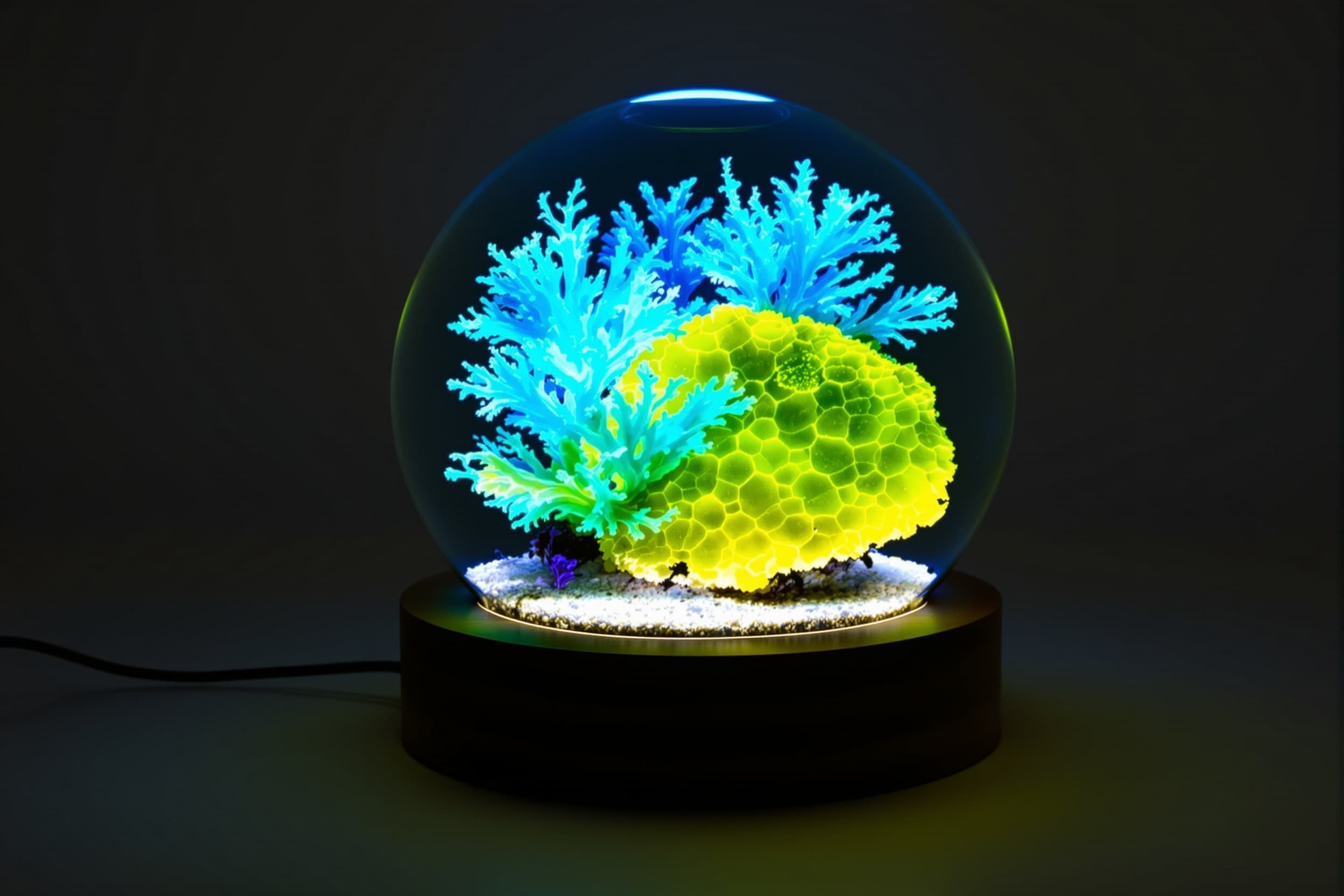
A 600 mL hand-blown borosilicate glass vessel housing a living Pyrocystis dinoflagellate culture that emits blue-green bioluminescence when mechanically agitated. Includes a built-in solar-cycle LED for photosynthesis support, a touch-activated quiet stir mechanism for evening glow effects, and requires nutrient media refills every three months.

Feasibility at a glance
PT localization
7/10
High
Most steps can be localised in Portugal.
Per unit
€120–180
at 1000-unit volume
Starter batch
1,000units
minimum viable run
To first batch
8 phases, design to ship
Budget
€85–120k
all-in estimate
Bottom line
Portugal has exceptional glass manufacturing heritage (Vidrala, Verallia), precision medical-device component suppliers (Turtle Silicone Valve Factory for food-grade silicone), and electronics assembly capabilities. The biocompatibility and sterile culture requirements align well with the medical-device cluster present in Portugal. Local assembly ensures tighter control over the delicate inoculation step, reduces lead times for iteration, and mitigates biosafety/customs risks associated with shipping live organisms internationally. The €120–180 price point supports local labor costs for artisan glasswork and final QC.
4 capabilities
Houses a living bioluminescent organism culture that glows blue-green when gently shaken or stirred
Automatically provides light for the organisms to photosynthesize during a 12-hour day cycle
Activates a quiet stirring motion when touched to create a wave effect and trigger glowing
Serves as an educational display piece showing real biology in action for students and science enthusiasts
5 stations · build route
Hand-blow borosilicate glass vessel
Artisan glassblowers shape the 600 mL culture chamber with precise wall thickness for optical clarity and thermal stability.
CNC-machine stainless steel base
Base housing is machined to fit electronics, motor mount, and vessel seat with IP44 sealing grooves.
Assemble PCB with LED controller and touch sensor
SMT assembly of microcontroller, timer ICs, and capacitive touch circuit; wire harness connects to motor and LED module.
Integrate magnetic stir motor and silicone bar
Motor is mounted in base; food-grade silicone stir bar is placed in vessel and magnetically coupled.
Seal, test, and inoculate with dinoflagellate culture
Electronics are sealed, lamp is functionally tested, then sterile culture medium with live organisms is added before final packaging.
Hand-blow borosilicate glass vessel
Artisan glassblowers shape the 600 mL culture chamber with precise wall thickness for optical clarity and thermal stability.
CNC-machine stainless steel base
Base housing is machined to fit electronics, motor mount, and vessel seat with IP44 sealing grooves.
Assemble PCB with LED controller and touch sensor
SMT assembly of microcontroller, timer ICs, and capacitive touch circuit; wire harness connects to motor and LED module.
Integrate magnetic stir motor and silicone bar
Motor is mounted in base; food-grade silicone stir bar is placed in vessel and magnetically coupled.
6 identified · 3 blocking
Critical
Living Organism Supply Chain Vulnerability
Dinoflagellate cultures are living organisms requiring strict temperature control (18–24°C), sterile handling, and stable nutrient media. Supply interruptions—whether from culture contamination, seasonal die-offs, or biosafety import restrictions—can halt production entirely. Unlike inert components, organisms cannot be warehoused long-term and require continuous culturing infrastructure. A single contamination event in the master culture can wipe out weeks of inventory.
Mitigation — Establish redundant culture facilities in two geographic locations (e.g., Porto and Lisbon). Maintain master seed cultures in cryopreservation as backup. Partner with a university marine biology lab (e.g., CIIMAR Porto) for emergency culture recovery. Implement daily culture health monitoring with automated alerts. Stock 6-week buffer of inoculated units in climate-controlled storage.
High
EU Biosafety and Phytosanitary Compliance
Shipping living organisms (even non-pathogenic dinoflagellates) within and across EU borders triggers biosafety regulations, phytosanitary certificates, and potentially CITES-like oversight depending on species origin. Import from non-EU countries (e.g., China) requires extensive documentation, quarantine, and risk of customs rejection. Mislabeling or lack of proper certifications can result in product seizure, fines, or brand damage.
Mitigation — Work with EU regulatory consultants to classify the organism under EFSA guidelines and obtain necessary biosafety certifications upfront. Source cultures from EU-certified marine biotech suppliers with existing permits. Label products clearly as 'non-GMO, non-pathogenic ornamental organism' and include MSDS-style safety data sheets. Maintain chain-of-custody documentation for all culture transfers. Avoid cross-border culture shipments where possible by producing locally.
High
Sterile Inoculation and Contamination Control
Final assembly requires inoculating sterile culture medium with live organisms in a cleanroom environment. Any contamination (bacteria, fungi, competing algae) will rapidly outcompete the dinoflagellates, turning the lamp into a murky, non-functional product within days. Poor sealing or non-biocompatible materials can leach toxins that kill the culture. Quality failures manifest post-sale, leading to high return rates and reputation damage.
Mitigation — Implement ISO Class 7 cleanroom protocols for final inoculation step. Pre-sterilize all glass vessels and silicone components via autoclave. Use only certified food-grade or USP-grade materials in contact with culture. Conduct 7-day accelerated life testing on 100% of batches before shipping. Train assembly staff in aseptic technique and conduct monthly sterility audits. Offer proactive 3-month culture replacement kits to manage customer expectations.
Medium
Hand-Blown Glass Lead Time Variability
Artisan glassblowing for borosilicate vessels introduces schedule variability due to kiln scheduling, artisan availability, and reject rates (typically 10–15% for complex shapes). A single batch delay cascades through the assembly line, as electronics and cultures cannot be stockpiled indefinitely. Seasonal demand spikes (holidays, Kickstarter campaigns) can overwhelm small glass studios.
Mitigation — Pre-order glass vessels with 8-week lead time buffers. Dual-source from both Vidrala and Verallia to balance capacity. Negotiate priority slots with glass suppliers for rush orders. Maintain 4-week safety stock of finished glass vessels. Explore semi-automated glass forming (pressing + hand-finishing) to reduce artisan bottlenecks while preserving aesthetic quality.
Medium
Thermal Management and Culture Viability in Transport
Dinoflagellates are temperature-sensitive; exposure above 26°C or below 15°C for more than 12 hours can kill the culture. Standard parcel shipping (especially in summer or unheated winter trucks) can exceed safe ranges. Customer complaints about 'dead lamp on arrival' spike seasonally, harming Net Promoter Score and increasing support costs.
Mitigation — Design passive thermal packaging (phase-change gel packs, insulated shippers) rated for 72-hour transit across EU temperature extremes. Pause shipments during extreme weather (>35°C heatwaves). Offer customers a 'revival kit' with emergency nutrient boost and instructions. Include temperature data loggers in shipments to diagnose failure modes. Partner with logistics providers offering climate-controlled last-mile delivery in southern EU markets.
Low
Proprietary Culture Formulation IP Theft
The nutrient medium formulation and culture protocol represent key IP. If disclosed to contract manufacturers (especially outside EU), competitors could reverse-engineer the product or a supplier could become a competitor. However, dinoflagellate culture is relatively well-documented in academic literature, limiting the defensibility of this IP.
Mitigation — File trade-secret protections for any proprietary nutrient blend or culture longevity enhancements. Use strong NDAs with all manufacturing partners. Separate culture formulation (in-house or university partner) from final assembly (contract manufacturer). Avoid disclosing full formulation to any single partner. Patent any novel thermal-management or sterile sealing innovations around the culture chamber.
22 weeks to first batch
Design Freeze and Tooling Preparation
wk 1–4Component Fabrication and PCB Assembly
wk 5–10Electronics and Motor Integration
wk 11–13Cleanroom Inoculation and Culture Seeding
wk 14–15Functional Testing and Quality Assurance
wk 16–17Packaging, User Guides, and Nutrient Kits
wk 18Pilot Batch Production and Process Validation
wk 19–21Full-Scale Production and Logistics Setup
wk 22wk 5–10 is the longest stretch — Component Fabrication and PCB Assembly takes 6 weeks of the 22 weeks on this build.
6 materials · 9 processes
Materials
Processes
896 Portuguese manufacturers matched
None cover the whole build — it splits across steps.
16 tasks · 22 weeks to first batch
Week 1
2 tasks
Finalize CAD for glass vessel and base sealing interfaces
waits on Need thermal vent sizing validation for LED heat dissipation
Lock down borosilicate glass vessel geometry (600 mL, wall thickness, seal lip specs), stainless steel base with motor mount and gasket grooves, and walnut trim mounting. Send approved models to Vidrala/Verallia for glassblowing mandrel prep and CNC shop for base toolpaths.
Source and order long-lead electronics components
Procure microcontroller ICs, LED grow light modules (specific photosynthesis spectrum), capacitive touch sensors, and magnetic stir motors from EU suppliers (Würth, Siemens, or Italian motor vendors). Confirm biocompatibility certs for PCB conformal coating.
Weeks 2–3
3 tasks
Secure cleanroom partner for sterile inoculation
Identify and contract ISO Class 7 cleanroom facility in Porto or Lisbon (medical-device or biotech park) for final culture inoculation step. Negotiate hourly access, autoclave use, and aseptic workspace for pilot and production runs.
Partner with marine biology lab for master culture supply
Establish agreement with CIIMAR Porto or similar university lab to supply healthy Pyrocystis dinoflagellate master cultures and provide emergency culture recovery. Set up cryopreservation backup protocol.
Design and order PCB prototypes with SMT assembly
waits on T2 – component lead times
Finalize PCB layout for microcontroller, 12-hour timer, LED driver, and capacitive touch circuit. Send to local Portuguese or EU electronics assembler for fab and SMT population. Order 150 boards for pilot.
Weeks 4–7
3 tasks
Produce first glass vessel samples and inspect
waits on T1 – CAD finalization
Vidrala or Verallia hand-blows 20 borosilicate vessels. Inspect for optical clarity, wall uniformity, seal surface flatness, and thermal shock resistance. Approve or iterate on mandrel geometry.
CNC-machine stainless steel base housings and walnut trim
waits on T1 – CAD finalization
Machine 150 stainless bases with motor mounts, gasket grooves, and electronics bays. Cut and finish FSC walnut trim pieces with food-safe oil. Validate fit with glass vessel samples.
Integrate electronics and motor into base assemblies
waits on T5 – PCB delivery, T7 – base machining
Mount PCBs, LED modules, and magnetic stir motors into machined bases. Route wiring with IP44 connectors, apply conformal coating, and install silicone gasket seals (from Turtle Silicone Valve Factory). Test each for LED timer, touch sensor, and motor function.
Weeks 8–16
7 tasks
Pilot inoculation run (100 units) in cleanroom
waits on T3 – cleanroom access, T4 – culture supply, T8 – electronics assemblies
Autoclave glass and silicone parts. Prepare sterile culture medium, inoculate with dinoflagellates, fill vessels to 600 mL, and seal to bases. Place in climate-controlled holding (20°C, 12h light) for 7-day viability observation.
Conduct accelerated QA and culture viability testing
waits on T9 – pilot inoculation
Test 100% of pilot units for LED accuracy, touch-stir activation, bioluminescence intensity, leak-free operation, and safe temps. Run 7-day accelerated aging under temp cycling. Document reject rate and failure modes.
Finalize CE/RoHS compliance documentation
waits on T8 – electronics integration
Compile EMC, LVD, and RoHS test reports for PCB and LED module. Obtain material declarations for REACH compliance (silicone, adhesives). Prepare technical file and affix CE marking. Engage external test lab if needed for EN 62368-1 safety testing.
Ongoing
1 task
Launch full-scale production and monitor field performance
waits on T15 – material delivery
Ramp to 1,000-unit assembly across multiple stations. Stagger fulfillment to gather early customer feedback on culture viability, glow intensity, and support questions. Set up nutrient refill subscription infrastructure and customer care protocols.
5 roles to fill before month one
Master culture supplier and biosafety advisor
Dr. Helena Cardoso – Marine Biologist, CIIMAR Porto
Provides healthy Pyrocystis dinoflagellate seed cultures, cryopreservation backup, and emergency culture recovery protocols. Critical for ensuring organism viability and navigating EU biosafety compliance for living products.
Borosilicate glass vessel fabrication lead
João Ferreira – Vidrala Account Manager
Coordinates hand-blown glass production, mandrel tooling, quality inspection, and delivery cadence. Vidrala's heritage in precision glasswork ensures optical clarity and thermal stability needed for culture chamber.
Sterile inoculation facility partner
Ana Silva – Cleanroom Operations Manager, Porto Biotech Park
Grants access to ISO Class 7 cleanroom, autoclave, and aseptic workstations for final culture seeding. Local proximity in Porto reduces logistics risk and enables tight control over contamination-critical assembly step.
PCB fabrication and SMT assembly contractor
Miguel Torres – Electronics Assembly, Philips Portugal or local CM
Delivers PCBs with microcontroller, LED driver, and capacitive touch circuits. Medical-device experience ensures conformal coating and IP44 moisture protection standards. Local partner enables rapid iteration on electronics.
5 things to avoid in this plan
supply
Watch for culture contamination in master stock or during inoculation—establish redundant culture facilities and daily health monitoring to prevent production halts.
lead time
Lock in cleanroom access slots early; medical-device demand can crowd out pilot runs, delaying inoculation and cascading the entire timeline.
lead time
Secure glass vessel delivery cadence with 4-week safety stock; artisan glassblowing has 10–15% reject rates and kiln scheduling variability that can bottleneck assembly.
watch-out
Validate thermal packaging with real EU shipping trials (summer heat, winter cold) before full launch—dead-on-arrival cultures will spike returns and damage brand trust.
watch-out
Confirm EU biosafety classification for Pyrocystis with EFSA or national authority upfront to avoid surprise import/export restrictions when scaling or partnering across borders.
2 tasks in week 1
Finalize CAD for glass vessel and base sealing interfaces
Seal, test, and inoculate with dinoflagellate culture
Electronics are sealed, lamp is functionally tested, then sterile culture medium with live organisms is added before final packaging.
Design Freeze and Tooling Preparation
Component Fabrication and PCB Assembly
Electronics and Motor Integration
Cleanroom Inoculation and Culture Seeding
Functional Testing and Quality Assurance
Packaging, User Guides, and Nutrient Kits
Pilot Batch Production and Process Validation
Full-Scale Production and Logistics Setup
Design thermal packaging and user care guides
Develop insulated shipping box with phase-change gel packs rated for 72h EU transit. Print user guides covering LED cycle, touch operation, nutrient refresh, and troubleshooting. Bundle starter nutrient refill kits.
Secure climate-controlled logistics partner
Contract with EU fulfillment provider offering temp-controlled last-mile delivery, especially for southern routes in summer. Negotiate rates for 1,000-unit rollout and set up tracking/monitoring.
Refine production SOP from pilot learnings
waits on T10 – pilot QA results
Document sterile inoculation workflow, sealing process, QC checkpoints, and reject handling. Train full assembly team on aseptic technique. Adjust nutrient concentration or seal torque specs based on pilot failure data.
Order materials for 1,000-unit production run
waits on T14 – SOP finalized
Place POs with Vidrala/Verallia for 1,100 glass vessels (10% buffer), Turtle Silicone for gaskets and stir bars, electronics assembler for PCBs, and motor supplier. Coordinate delivery cadence to match cleanroom inoculation throughput.
CE/RoHS/REACH compliance and biosafety advisor
Luís Ribeiro – Regulatory Consultant, EU Compliance Services
Navigates complex intersection of consumer electronics (LVD, EMC), chemical safety (REACH for culture additives), and biosafety (EFSA organism classification). Prevents costly customs rejections or product recalls due to missing certifications.
896 matched · 8 shown, ranked by coverage
Covers, left to right: CNC Machining · Injection Molding · PCB Fabrication · SMT Assembly · Wire Harness · Final Assembly · Testing & Inspection · Packaging · Other
Portuguese producers per required step
Final Assembly
369
Other
229
CNC Machining
212
Testing & Inspection
178
Injection Molding
174
SMT Assembly
36
PCB Fabrication
6
How many cover more than one step
The gap
Portugal has exceptional glass manufacturing heritage (Vidrala, Verallia), precision medical-device component suppliers (Turtle Silicone Valve Factory for food-grade silicone), and electronics assembly capabilities. The biocompatibility and sterile culture requirements align well with the medical-device cluster present in Portugal. Local assembly ensures tighter control over the delicate inoculation step, reduces lead times for iteration, and mitigates biosafety/customs risks associated with shipping live organisms internationally. The €120–180 price point supports local labor costs for artisan glasswork and final QC.
Send one RFQ to the top 4
Exatronic, REROM, MOLDMAK, ITECMO — same package, one click.
Wire Harness
5
Packaging
0