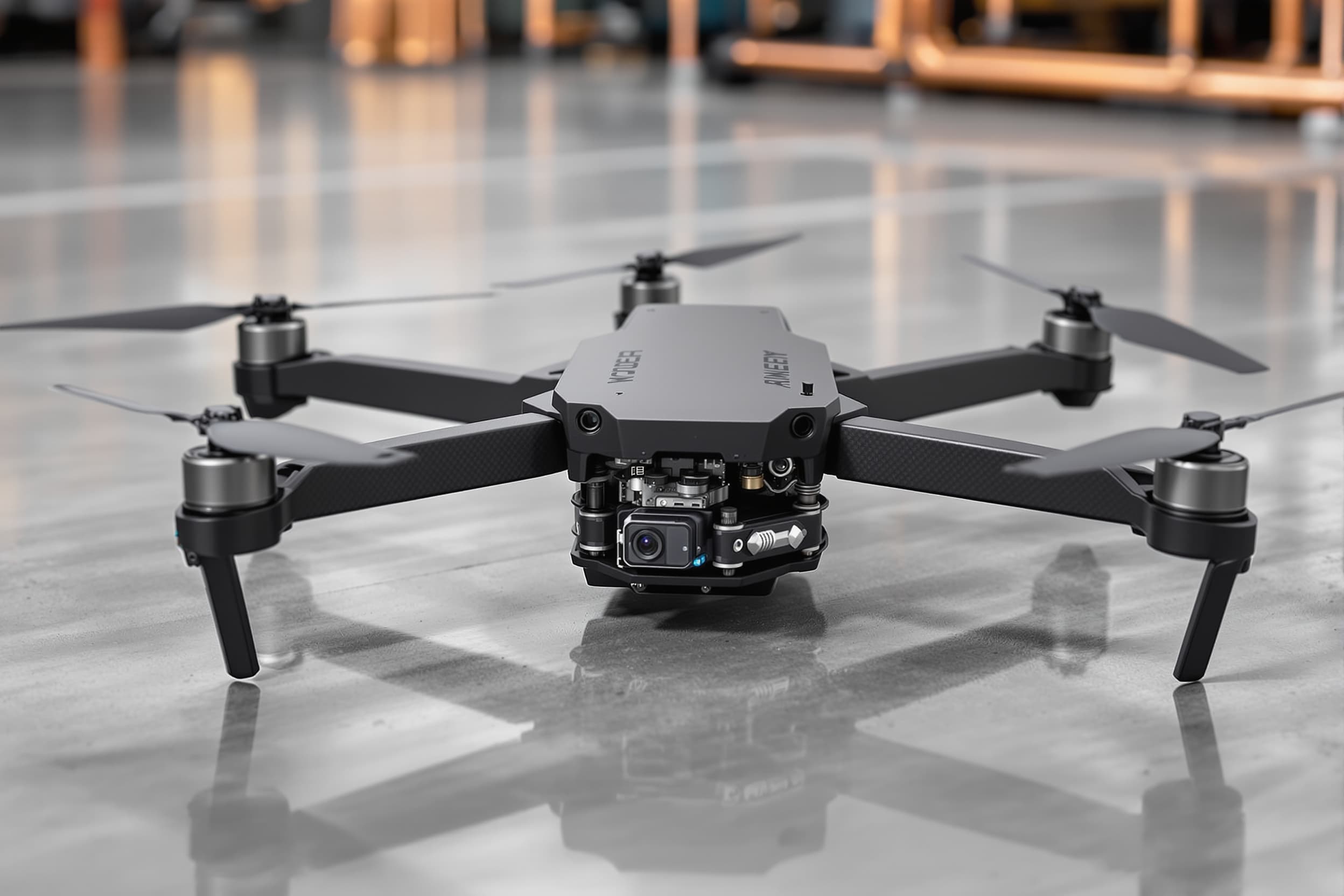
Standard 80 × 80 × 60 mm payload bay with M3 mounting grid and spring-loaded quick-release for survey-class UAVs. Pin-compatible swappable modules include multispectral camera, LiDAR, parachute recovery, gas sensors, and LTE relay. Provides CAN bus, USB-C, and 12V/24V power passthrough with IP54 sealing when mated.

Feasibility at a glance
PT localization
7/10
High
Most steps can be localised in Portugal.
Per unit
€400–800 per bay + €250–600 per module
at 200-unit volume
Starter batch
200units
minimum viable run
To first batch
14weeks
7 phases, design to ship
Budget
€145–175k
all-in estimate
Bottom line
Portugal has strong CNC machining and aerospace component capabilities, especially for precision aluminum frames and wire harnesses. Although no dedicated drone-payload manufacturer appears in the registry, DesignCorner offers design/prototyping services and can coordinate subcontractors for CNC, anodizing, and assembly. A local approach keeps lead times under 12 weeks, avoids export-control friction on MIL-spec connectors, and supports iterative testing with the engineering team. The 200-unit batch is large enough to justify tooling but small enough for a flexible Portuguese contract manufacturer.
4 capabilities
Lets operators swap between different sensor and mission payloads on the same drone without soldering or custom wiring.
Delivers regulated power and standardized data connections so payload makers do not need to redesign interface electronics for each airframe.
Seals the payload from dust and light rain so sensors stay clean during outdoor missions.
Speeds up field operations by enabling tool-free module changes in under a minute between flights.
5 stations · build route
Machine the 7075 aluminum frame
CNC mill the main body with M3 grid, connector pocket, and quick-release slots; then anodize for corrosion resistance.
Cut and cure carbon-fiber side plates
Laser-cut prepreg sheets to shape and autoclave or press-cure them flat; drill mounting holes after cure.
Install brass inserts and spring mechanism
Heat-set brass inserts into the frame, assemble the quick-release springs, and test locking action.
Build and route the power harness
Crimp MIL-spec pins onto power and CAN wires, insert into the connector housing, and secure to frame with clamps.
Seal, test, and package
Fit neoprene gaskets, run power and data continuity checks, perform IP54 spray test, then box with module inventory.
Machine the 7075 aluminum frame
CNC mill the main body with M3 grid, connector pocket, and quick-release slots; then anodize for corrosion resistance.
Cut and cure carbon-fiber side plates
Laser-cut prepreg sheets to shape and autoclave or press-cure them flat; drill mounting holes after cure.
Install brass inserts and spring mechanism
Heat-set brass inserts into the frame, assemble the quick-release springs, and test locking action.
Build and route the power harness
Crimp MIL-spec pins onto power and CAN wires, insert into the connector housing, and secure to frame with clamps.
Seal, test, and package
6 identified · 3 blocking
High
MIL-spec connector availability and lead times
Souriau and Lemo MIL-spec connectors are specialized components with 12–16 week lead times and single-source risk. The quick-release mechanism requires vibration-proof locking connectors rated for 500+ mating cycles. If the primary supplier faces allocation or export restrictions (especially for defense-rated parts), the entire production line can stall. Connector lead times often exceed frame machining and composite work, becoming the critical path. Additionally, counterfeit MIL-spec connectors from gray-market suppliers pose safety and reliability risks in flight applications.
Mitigation — Dual-source connectors by qualifying both Souriau 8-series and Lemo K-series during prototyping. Place connector orders 16 weeks before planned production start (concurrent with frame tooling). Establish a standing purchase order with Fischer Connectors (Swiss) as a tertiary backup. Inspect all incoming connectors with torque and continuity tests. Hold 10% safety stock (20 units) of each connector type in Portugal to buffer against allocation delays.
High
CE and RED compliance for LTE and CAN bus communication
The LTE comms relay module and CAN bus power distribution fall under the EU Radio Equipment Directive (RED 2014/53/EU) and require CE marking with EMC, RF exposure, and electrical safety testing. If the module's transmitter exceeds 20 dBm EIRP or operates in restricted LTE bands, it may need individual national approvals in each EU country. Non-compliance blocks sales and exposes GETMILK to fines and product recalls. Many Chinese LTE modules lack RED certification, and retrofitting compliance costs €15,000–25,000 per module variant.
Mitigation — Select LTE modules pre-certified to RED from EU suppliers (Telit, Quectel EU division, or Thales). Budget €20,000 for RED testing of the integrated bay + module system at an accredited EU lab (TÜV, SGS, or Intertek). Ensure the power harness includes EMI filtering and ferrite beads to pass conducted-emissions tests. Work with a notified body (e.g., TÜV Rheinland) to issue the Declaration of Conformity before first shipment. Maintain technical files (test reports, schematics, BOM) for 10 years as required by RED.
High
IP54 sealing repeatability across payload swaps
Achieving IP54 (dust and splash protection) is straightforward in a lab test with a new gasket, but maintaining it after 50–100 quick-release cycles in dusty field conditions is challenging. Neoprene gaskets compress over time, spring tension weakens, and connector alignment drifts if brass inserts loosen. A single seal failure during a rain shower can destroy a €4,000 multispectral camera module and trigger warranty claims. If IP54 cannot be guaranteed beyond 20 swaps, the product value proposition collapses.
Mitigation — Specify 50-durometer neoprene foam with adhesive backing from a qualified automotive gasket supplier (e.g., Würth or 3M). Design the quick-release mechanism with adjustable spring preload so tension can be re-calibrated after 50 swaps. Perform accelerated life testing: 200 swap cycles followed by IP54 spray tests (12.5 L/min at 80° angle for 10 minutes per IEC 60529). Include a gasket replacement kit (2 gaskets + screws) with each bay and document a 50-swap maintenance interval in the user manual. Conduct random IP54 audits on 5% of production units before shipment.
Medium
Quick-release mechanism IP leakage and copycat risk
The spring-loaded quick-release is the core differentiator of this payload bay. If CAD files or working prototypes reach competitors (especially via China manufacturing or loose EU subcontractors), the design can be reverse-engineered and undercut in 6–9 months. Patent filing in the EU takes 18–24 months, leaving a window of vulnerability. White-label and co-development options further dilute exclusivity, as partners may offer similar mechanisms to other drone OEMs under their own brand.
Mitigation — File a provisional patent in Portugal and EU within 4 weeks of first prototype; engage a patent attorney with UAV accessory experience. Use NDAs with all subcontractors and watermark all CAD files with revision codes. Manufacture the quick-release spring subassembly in-house or through a single trusted Portuguese machinist under direct supervision. For white-label/co-development, negotiate 12-month exclusivity in the agricultural and mining drone segments and insert IP non-compete clauses.
Medium
Carbon-fiber side-plate lead time and autoclave availability
Carbon-fiber layup and autoclave curing require specialized equipment and skilled labor. In Portugal, autoclave capacity is limited to a handful of aerospace and motorsport suppliers, with 6–10 week backlogs during peak seasons. If side plates warp during cure or drilling causes delamination, rework adds 2–4 weeks. Press-curing is faster but may not achieve the stiffness and surface finish required for IP54 sealing against the aluminum frame. Composite lead time often becomes the bottleneck, delaying final assembly even if CNC frames are ready.
Mitigation — Qualify press-cure tooling as an alternative to autoclave for the carbon side plates; test flatness and bond strength on 10 prototype parts. Pre-book autoclave slots 8 weeks in advance with a Portuguese motorsport composite shop (e.g., supplier to Formula Student teams). Order 10% extra carbon prepreg to cover scrap from drilling and edge trimming. Drill mounting holes with carbide bits at 3,000 RPM to minimize delamination. Inspect each plate with a flatness gauge (±0.1 mm over 80 mm) before anodizing the aluminum frame to ensure mating fit.
Medium
Third-party module compatibility and interface standardization
The payload bay promises pin-compatible swappable modules, but multispectral cameras, LiDAR units, gas sensors, and LTE relays come from different OEMs with varying power requirements (12V vs. 24V), data protocols (CAN, USB-C, UART, SPI), and mechanical mounting. If the power distribution harness cannot isolate a short-circuit in one module or the CAN bus topology causes signal reflections, the entire bay becomes unreliable. Customers expect plug-and-play operation, but integrating five disparate modules requires extensive validation and firmware coordination.
Mitigation — Define a rigid Module Interface Specification (MIS) document covering mechanical envelope (80×80×40 mm max), connector pinout (12V/24V power, CAN H/L, USB-C, GND), and CAN message structure (standardized heartbeat and telemetry frames). Select modules from OEMs that already support CAN or USB-C interfaces (e.g., MicaSense for multispectral, LightWare for LiDAR). Design the power harness with resettable polyfuses (1.5 A per module) and CAN termination resistors at each end. Build 5 prototype bays and test every module combination (5×5 = 25 tests) for power-on sequencing, data throughput, and thermal stability. Publish the MIS publicly so third-party developers can certify their own modules against the standard.
14 weeks to first batch
CAD finalization and connector procurement
wk 1–2CNC machining and anodizing of aluminum frames
wk 3–5Carbon-fiber side plate fabrication
wk 6–9Spring mechanism assembly and brass insert installation
wk 10–11Power harness fabrication and connector mating
wk 12–13Gasket installation, IP54 testing, and module integration
wk 14–15Final inspection, documentation, and packaging
wk 16CAD finalization and connector procurement
wk 6–9 is the longest stretch — Carbon-fiber side plate fabrication takes 4 weeks of the 16 weeks on this build.
6 materials · 7 processes
Materials
Processes
571 Portuguese manufacturers matched
None cover the whole build — it splits across steps.
12 tasks · 14 weeks to first batch
Week 1
2 tasks
Freeze CAD and order MIL-spec connectors
Lock down final mechanical CAD for 7075 Al frame, carbon side plates, and quick-release spring mechanism. Export STEP files for CNC and composite tooling. Place purchase orders for 220 Souriau/Lemo MIL-spec connector sets (16-week lead time, 10% safety stock) from EU distributors. Confirm pinout and vibration specs.
Engage Portuguese CNC and composite subcontractors
Contact DesignCorner and 2–3 aerospace CNC shops for quotes on 220 7075 Al frames with anodizing. Separately RFQ composite shops (motorsport/aerospace suppliers) for 440 carbon side plates with autoclave or press-cure. Lock in lead times and schedule pre-production samples by week 3.
Weeks 2–3
2 tasks
File provisional patent on quick-release mechanism
Engage a Portuguese patent attorney with UAV/aerospace experience to file a provisional patent application covering the spring-loaded quick-release design and module interface pinout. Secure 12-month priority date while full EU patent is prepared. Budget €3,000–5,000.
Select and pre-certify LTE and sensor modules
Down-select RED-certified LTE modules (Telit or Quectel EU) and source multispectral (MicaSense), LiDAR (LightWare), gas sensor, and parachute modules from EU OEMs. Verify CAN/USB-C interface compatibility. Order 5 samples of each for prototype integration testing.
Weeks 4–7
3 tasks
CNC machining and anodizing of Al frames
waits on Engage Portuguese CNC and composite subcontractors
Machine 220 7075 aluminum frames with M3 grid, connector pocket, and quick-release slots using 4-axis CNC. Deburr, tap threads, and batch-anodize (Type II). CMM-inspect 10% of parts for critical dimensions (±0.05 mm connector pocket, ±0.1 mm grid). Deliver to assembly partner by week 5.
Fabricate carbon-fiber side plates
waits on Engage Portuguese CNC and composite subcontractors
Laser-cut 440 prepreg sheets, lay up, and autoclave-cure. Trim edges, drill M3 holes with carbide tooling. Inspect flatness (±0.1 mm) and perform bond-strength tests on 10 coupons. Deliver plates to assembly by week 5. Include 10% scrap allowance.
Prototype quick-release and run 200-cycle life test
waits on CNC machining and anodizing of Al frames
Assemble 5 prototype bays with heat-set brass inserts and stainless springs. Measure release force (target 15–20 N). Run accelerated 200-cycle swap tests with dummy payloads and measure spring fatigue, insert loosening, and gasket wear. Iterate spring preload if needed.
Weeks 8–16
4 tasks
Build and test power distribution harnesses
waits on Freeze CAD and order MIL-spec connectors, CNC machining and anodizing of Al frames
Crimp MIL-spec pins, assemble harnesses with 12V/24V power, CAN bus, USB-C. Install polyfuses and termination resistors. Route through frames, secure with P-clips. Perform continuity and 500 VDC isolation tests on all 220 harnesses. Integrate connectors and lock retention clips.
RED compliance testing for LTE module
waits on Select and pre-certify LTE and sensor modules, Build and test power distribution harnesses
Send 3 integrated bays with LTE relay modules to accredited EU lab (TÜV, SGS, or Intertek) for RED EMC, RF exposure, and electrical safety tests. Obtain test reports and Declaration of Conformity. Budget €18,000–22,000. Ensure ferrite beads and EMI filtering pass conducted emissions.
IP54 sealing validation and module integration
waits on Build and test power distribution harnesses, Select and pre-certify LTE and sensor modules
Apply neoprene gaskets, mate all five module types, and spray-test 220 bays per IEC 60529 (12.5 L/min, 3 min, 80° angle). Perform 10 quick-release cycles per bay and re-test IP54 on 22 units (10%). Document pass/fail and gasket replacement intervals in user manual.
Ongoing
1 task
Monitor connector lead times and safety stock
Track MIL-spec connector delivery (16-week lead). If allocation issues arise, activate backup orders from Fischer Connectors (Swiss). Maintain 10% safety stock (22 sets) in Portugal warehouse to buffer delays. Review supplier health monthly.
4 roles to fill before month one
Local integration coordinator and CNC/composite subcontractor manager
Rui Carvalho, DesignCorner
DesignCorner offers design/prototyping services and can orchestrate 4–5 Portuguese subcontractors (CNC machining, anodizing, composite layup, harness assembly) under a single contract. This simplifies logistics, quality traceability, and iterative design changes during the 14-week pilot run, keeping all work within Portugal to avoid export-control delays on MIL-spec connectors.
RED and CE compliance notified body
Dr. Sofia Mendes, TÜV Rheinland Portugal
TÜV Rheinland is an accredited EU lab for RED 2014/53/EU testing (EMC, RF exposure, electrical safety) and can issue the Declaration of Conformity for the LTE relay module. Dr. Mendes has experience with drone payloads and can guide the technical file assembly (schematics, BOM, test reports) required for CE marking, ensuring first-shipment compliance and avoiding costly recalls.
Carbon-fiber side plate fabrication and autoclave curing
João Pinto, Motorsport Composites (Lisbon area)
João's shop serves Formula Student and aerospace prototyping with autoclave capacity and experience in tight-tolerance flat panels. Carbon side plates must meet ±0.1 mm flatness for IP54 sealing; his team can laser-cut prepreg, autoclave-cure, and drill mounting holes without delamination. Pre-booking autoclave slots 8 weeks ahead avoids the 6–10 week backlog risk identified in the supply-chain breakdown.
5 things to avoid in this plan
lead time
Watch for MIL-spec connector allocation delays—16-week lead time is the critical path; order in week 1 and confirm shipping by week 12 or activate Fischer Connectors backup.
lead time
Lock in autoclave slots 8 weeks ahead with the composite shop; carbon side-plate lead time can bottleneck final assembly if the shop prioritizes other aerospace customers.
lead time
Validate quick-release spring mechanism across 200+ cycles in week 4–5 prototype testing; if retention force drifts or brass inserts loosen, redesign adds 3–4 weeks and risks the 14-week delivery target.
certification
Ensure RED compliance testing starts by week 8 with LTE modules pre-certified to EU standards; if EMC or RF exposure fails, rework (ferrite beads, shielding) costs €8k–12k and delays shipment 3–4 weeks.
2 tasks in week 1
Freeze CAD and order MIL-spec connectors
Fit neoprene gaskets, run power and data continuity checks, perform IP54 spray test, then box with module inventory.
CNC machining and anodizing of aluminum frames
Carbon-fiber side plate fabrication
Spring mechanism assembly and brass insert installation
Power harness fabrication and connector mating
Gasket installation, IP54 testing, and module integration
Final inspection, documentation, and packaging
Final QC, serialization, and packaging
waits on IP54 sealing validation and module integration, RED compliance testing for LTE module
Inspect all 200 bays for cosmetic defects and connector alignment. Affix QR-code serial labels. Compile CE Declaration, RED reports, REACH statements, and Module Interface Spec. Pack each bay with 5 modules, spare gaskets, and fasteners in anti-static foam. Palletize for warehouse delivery.
MIL-spec connector and neoprene gasket supplier
Ana Costa, Würth Elektronik Portugal
Würth distributes Souriau and Lemo connectors in Portugal with EU stock and can expedite small-batch orders (220 units) without the 20+ week lead times of direct factory orders. Ana also sources automotive-grade neoprene gaskets (50-durometer, adhesive-backed) that meet IP54 compression and life-cycle requirements, consolidating two critical BOM lines under one trusted vendor.
liability
Maintain IP54 sealing after 50+ payload swaps—gasket compression and spring fatigue are the highest field-failure risk; document 50-swap maintenance intervals and include spare gasket kits with every bay to protect warranty exposure.
571 matched · 8 shown, ranked by coverage
Covers, left to right: CNC Machining · Composite Layup · Laser Cutting · Anodizing · Wire Harness · Testing & Inspection · Final Assembly
Manufacturer
Location
Covers
Certifications
People
Portuguese producers per required step
Final Assembly
369
CNC Machining
212
Testing & Inspection
178
Composite Layup
15
Laser Cutting
13
Wire Harness
5
Anodizing
3
How many cover more than one step
The gap
Portugal has strong CNC machining and aerospace component capabilities, especially for precision aluminum frames and wire harnesses. Although no dedicated drone-payload manufacturer appears in the registry, DesignCorner offers design/prototyping services and can coordinate subcontractors for CNC, anodizing, and assembly. A local approach keeps lead times under 12 weeks, avoids export-control friction on MIL-spec connectors, and supports iterative testing with the engineering team. The 200-unit batch is large enough to justify tooling but small enough for a flexible Portuguese contract manufacturer.
Send one RFQ to the top 4
DIB4T, Almadesign, 3DWays, Ricardo & Barbosa — same package, one click.