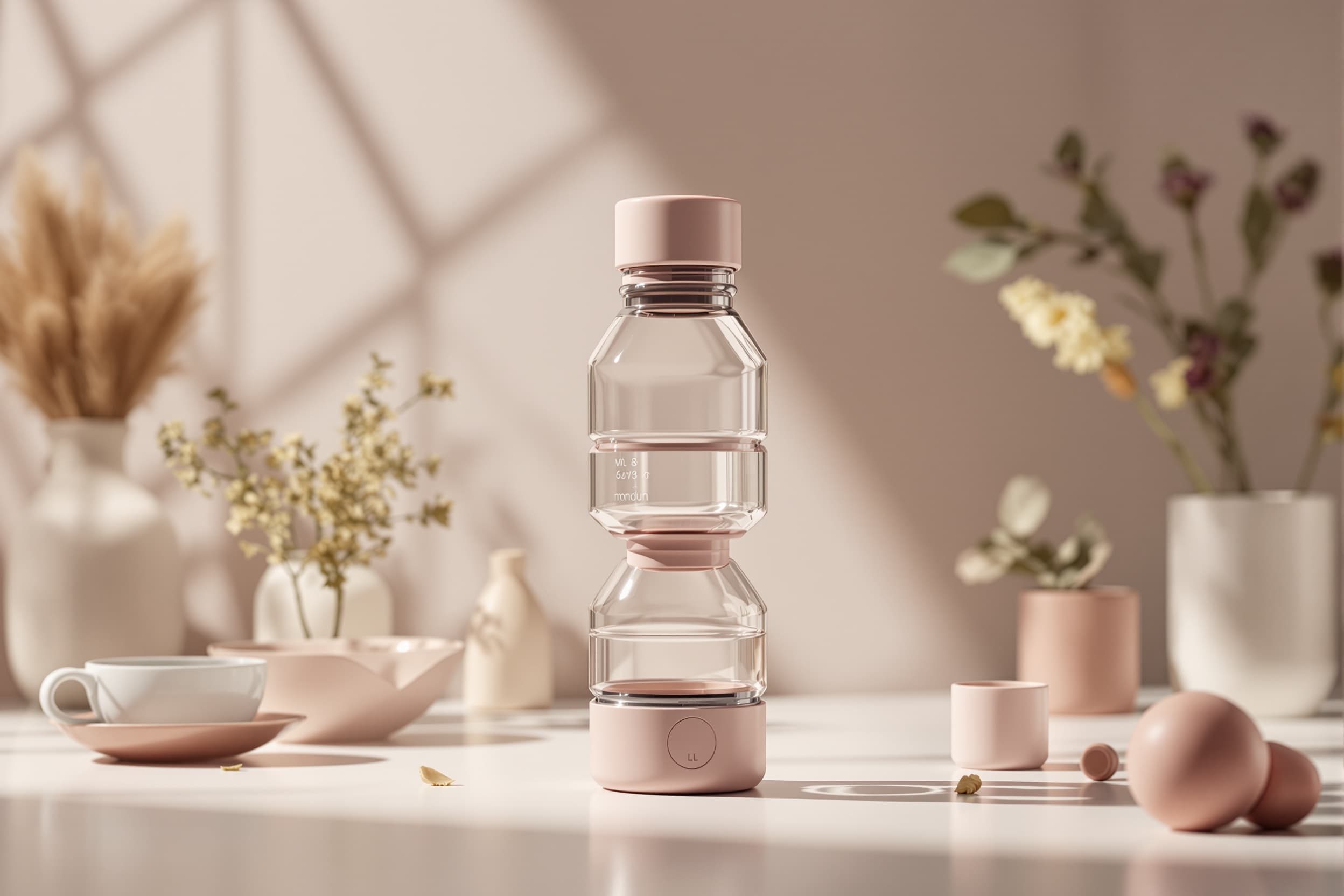
A reusable bottle system designed with a modular architecture that allows the user to swap different body sections while retaining the cap and base. This prototype targets sustainability and customization, enabling users to replace damaged or worn sections without discarding the entire product.

Feasibility at a glance
PT localization
9/10
Full
The whole build can be sourced in Portugal.
Per unit
€5–€15 per unit
at 50-unit volume
Starter batch
50units
minimum viable run
To first batch
8 phases, design to ship
Budget
€18–28k
all-in estimate
Bottom line
Portugal has strong injection-molding and final-assembly capabilities through Salvador Caetano, Mold-Tech Portugal, Microplásticos, TMG Automotive, and Copo Textil. For a low-complexity consumer product (50-unit pilot, localizationScore 9), local production minimizes lead time, enables rapid iteration on the modular interface design, ensures food-contact compliance oversight, and supports the sustainability narrative central to the product's value proposition. The cost premium over China is justified by faster time-to-market and alignment with EU regulatory standards.
2 capabilities
Stores and dispenses beverages or liquids safely
Allows the user to swap the body section for customization or replacement without buying a new bottle
5 stations · build route
Mold the plastic parts
Injection mold the cap, body sections, and base from food-safe polymers.
3D-print prototypes
Use FDM printing to rapidly iterate body and interface designs during development.
Trim and finish surfaces
Remove flash and smooth mating surfaces to ensure leak-proof fit.
Assemble gaskets and threads
Insert silicone gaskets into grooves and verify thread engagement.
Test for leaks
Fill assembled prototypes with water and check all joints under pressure.
Mold the plastic parts
Injection mold the cap, body sections, and base from food-safe polymers.
3D-print prototypes
Use FDM printing to rapidly iterate body and interface designs during development.
Trim and finish surfaces
Remove flash and smooth mating surfaces to ensure leak-proof fit.
Assemble gaskets and threads
Insert silicone gaskets into grooves and verify thread engagement.
Test for leaks
Fill assembled prototypes with water and check all joints under pressure.
5 identified · 2 blocking
High
Food-contact material compliance failure
EU Regulation 10/2011 and national implementations (e.g., BfR in Germany, DGCCRF in France) mandate migration testing for plastics in contact with food. If the chosen PP or PE grade has not been pre-certified, or if colorants/additives leach above limits, the entire batch is unsaleable in the EU. Testing (EN 1186, EN 13130) takes 4–6 weeks and costs €2,000–€5,000 per material/color combination. Silicone gaskets must also meet FDA 21 CFR 177.2600 or equivalent. Failure discovered post-production means scrapping inventory and re-tooling with certified resin.
Mitigation — Specify pre-certified food-contact grades (e.g., Borealis BH345MO for PP, Sabic HDPE FB3003 for PE) in the mold quote. Request supplier Declaration of Compliance (DoC) and third-party migration test reports before production. Budget €5,000 for independent lab verification (SGS, Eurofins) of first-batch samples. Include material traceability (lot numbers) in assembly BOM.
High
Leak-test escapes in assembly
A 50-unit pilot has no margin for quality escapes. If even 5% of bottles leak (cap-body joint, body-base joint, or gasket slip), customer confidence collapses and the sustainability value proposition is undermined. Manual assembly introduces variability: gaskets can twist, threads can cross-thread, and visual inspection misses micro-cracks. Without a formal leak-test protocol (pressure decay, submersion test), defects ship to customers, generating returns and negative reviews.
Mitigation — Implement 100% pressure-decay testing at final assembly: fill bottle to 90% capacity, seal, pressurize to 0.5 bar for 60 seconds, and monitor pressure drop (<5% acceptable). Use water submersion (5-minute soak, check for bubbles) as secondary verification. Train assembly technicians on gasket orientation and thread engagement (torque: hand-tight + 1/4 turn). Photograph each assembled unit with serial number for traceability. Budget 15 minutes per unit for assembly + test in pilot phase.
Medium
Silicone gasket supply-chain bottleneck
Portugal has limited domestic silicone-compounding capacity for food-grade gaskets. Lead times from German or Italian suppliers (Freudenberg, Trelleborg, Eriks) can stretch 6–8 weeks, and MOQs (500–1,000 pcs per SKU) may force over-ordering for a 50-unit pilot. If gasket dimensions require iteration after leak testing, re-ordering delays the entire production schedule by 4–6 weeks. Silicone shore-hardness and compression-set specifications are critical for repeated disassembly cycles; off-spec material risks leaks and customer returns.
Mitigation — Pre-qualify two silicone suppliers (one PT/ES, one DE/IT) and order gaskets in parallel with mold build. Negotiate sample batches (50–100 pcs) at premium pricing to de-risk fit testing. Design gasket grooves with ±0.2 mm tolerance to accommodate minor supplier variation. Maintain buffer stock (200 pcs) for pilot phase.
Medium
Mold design IP leakage
The modular interface—thread pitch, snap-fit geometry, and gasket-seat details—constitutes the core IP. If tooling is built by a mold shop that also serves competitors (e.g., other drinkware brands), the design may be reverse-engineered or reused. Portuguese moldmakers are generally trustworthy, but smaller shops may lack formal IP-protection protocols. A leaked design could appear in white-label catalogs within 6–9 months, eroding first-mover advantage.
Mitigation — Require NDA with penalty clause (€50,000+) before releasing CAD files. Split tooling across two vendors (cap + base at Shop A, body at Shop B) so no single supplier holds complete interface geometry. Laser-etch serial numbers into mold cavities for traceability. File for EU design registration (€350, 3-week turnaround) before first production run.
Medium
Thread-fit iteration extends lead time
Modular bottles are notorious for tolerance stack-up: if the cap threads are too tight, users struggle to open; too loose, and leaks occur. A first-shot mold may require 1–2 steel-safe corrections (adding material to the cavity), each taking 2–3 weeks and costing €1,500–€3,000. If the mold needs welding or insert replacement (e.g., to tighten thread pitch), lead time and cost double. For a 50-unit pilot, this iteration eats into the 14-week schedule and delays customer validation.
Mitigation — Run mold-flow simulation (Moldex3D, Autodesk Moldflow) during CAD phase to predict shrinkage and warp. Print SLA prototypes of threads at 1:1 scale and hand-test engagement with real silicone gaskets. Specify 'steel-safe' mold design (allowing material addition but not removal) and budget +3 weeks float time. Plan first-shot samples (T0) at week 8, correction at week 10, T1 validation at week 12.
14 weeks to first batch
CAD finalization and mold-flow simulation
wk 1–2Tooling design and mold fabrication
wk 3–7First-shot sampling and mold correction (T0 → T1)
wk 8–10Silicone gasket procurement and qualification
wk 11–14Production injection molding (50-unit batch)
wk 15Final assembly and leak testing
wk 16–17Food-contact compliance testing and documentation
wk 18–22Packaging, logistics, and handover
wk 23wk 3–7 is the longest stretch — Tooling design and mold fabrication takes 5 weeks of the 23 weeks on this build.
4 materials · 4 processes
Materials
Processes
566 Portuguese manufacturers matched
Only three cover the whole build — the rest split across steps.
10 tasks · 14 weeks to first batch
Week 1
2 tasks
Freeze CAD and run mold-flow simulation
Finalize 3D models for cap, body, base, and gasket grooves. Run Moldex3D or Autodesk Moldflow to predict shrinkage and gate placement. Generate 2D drawings with GD&T for thread pitch and gasket seats. Export STEP files for mold quotes.
Request quotes from 3 Portuguese mold shops
Send STEP files and production-intent resin specs (food-grade PP/PE) to Salvador Caetano, Mold-Tech Portugal, and Microplásticos. Request 3-cavity mold quotes, T0 sampling timeline, and steel-safe correction policy. Target award by end of week.
Weeks 2–3
2 tasks
Award mold contract and kick off tooling
waits on Request quotes from 3 Portuguese mold shops
Select mold shop based on lead time, food-packaging experience, and NDA willingness. Sign contract with 50% deposit. Provide certified resin grade (Borealis BH345MO or Sabic FB3003) and request lot traceability. Confirm T0 sampling at week 8.
Source silicone gaskets from EU supplier
Contact Freudenberg, Trelleborg, or Eriks for food-grade silicone gaskets (shore A 50–60, platinum-cure). Order 100-pc sample batch with Declaration of Compliance for EU 10/2011 and FDA 21 CFR 177.2600. Negotiate 200-pc production order with 4-week lead time.
Weeks 4–7
2 tasks
Validate T0 mold samples and identify corrections
waits on Award mold contract and kick off tooling
Receive first-shot injection-molded parts (cap, body, base) from mold shop. Measure thread pitch, gasket-groove depth, and wall thickness. Hand-assemble with sample gaskets and perform water-fill torque test. Document required corrections (e.g., tighten thread by 0.1 mm) and return to shop for steel-safe adjustments.
Approve T1 mold samples and lock design
waits on Validate T0 mold samples and identify corrections
Inspect corrected T1 samples. Assemble 5 prototype bottles with production gaskets and run pressure-decay leak test (0.5 bar, 60 sec). Confirm <5% pressure drop and no visible leaks in submersion test. Sign off on mold for production run.
Weeks 8–16
4 tasks
Run 50-unit injection-molding batch
waits on Approve T1 mold samples and lock design
Execute production run: 55 caps, 55 body sections, 55 base rings (10% spares). Monitor cycle time, inspect first/last articles, and check for flash or defects. De-gate and tumble-finish parts. Confirm lot numbers for resin traceability and pack by SKU.
Assemble and leak-test all 50 bottles
waits on Run 50-unit injection-molding batch, Source silicone gaskets from EU supplier
At assembly partner (INL, RTE, or Vortex), train technicians on gasket insertion and thread engagement. Perform 100% pressure-decay and water-submersion testing. Apply serial-number labels and photograph each unit. Pack in retail-ready boxes with instruction cards.
Submit samples for EU food-contact compliance testing
waits on Assemble and leak-test all 50 bottles
Send 3 randomly selected finished bottles to SGS Portugal or Eurofins for migration testing per EU 10/2011 (water, 3% acetic acid, 10% ethanol simulants). Request certificate of compliance and detailed test report. Budget 4–5 weeks turnaround.
3 roles to fill before month one
Tooling engineer
Mold-shop technical lead (Salvador Caetano, Mold-Tech, or Microplásticos)
Own the mold design, T0/T1 sampling, and steel-safe corrections. Critical for hitting thread tolerances and leak-proof interface on first iteration.
Lab account manager
Food-contact compliance specialist (SGS Portugal or Eurofins)
Guide migration testing protocol, interpret EU 10/2011 results, and issue certificate of compliance required for legal sale of food-contact bottles in EU.
Contract manufacturing lead
Assembly partner project manager (INL, RTE, or Vortex)
Coordinate final assembly, train technicians on gasket installation and leak testing, and manage logistics for 50-unit handover with serial-number traceability.
5 things to avoid in this plan
lead time
Gasket lead time stretches to 6–8 weeks if Portuguese suppliers lack capacity; pre-order 100-pc sample batch in week 2 to de-risk fit testing.
quality
Thread-fit iteration requires mold correction, adding 2–3 weeks; run mold-flow simulation and SLA prototype tests before steel cut to minimize rework.
certification
Food-contact compliance testing fails if resin or colorant not pre-certified; specify Borealis BH345MO (PP) or Sabic FB3003 (PE) with supplier DoC upfront.
quality
Leak-test escapes in manual assembly damage pilot reputation; implement 100% pressure-decay testing and photograph each unit for traceability.
liability
Mold shop IP leakage risks design replication; require NDA with €50k penalty clause and consider filing EU design registration (€350, 3 weeks) before T0 sampling.
2 tasks in week 1
Freeze CAD and run mold-flow simulation
CAD finalization and mold-flow simulation
Tooling design and mold fabrication
First-shot sampling and mold correction (T0 → T1)
Silicone gasket procurement and qualification
Production injection molding (50-unit batch)
Final assembly and leak testing
Food-contact compliance testing and documentation
Packaging, logistics, and handover
Compile technical file and traceability records
waits on Submit samples for EU food-contact compliance testing
Gather material Declarations of Compliance, mold drawings, injection logs, leak-test data, and compliance certificates into a regulatory technical file. Archive serial-number photos and assembly SOPs for future audits or customer inquiries.
566 matched · 8 shown, ranked by coverage
Covers, left to right: Injection Molding · FDM 3D Printing · Final Assembly · Testing & Inspection
Manufacturer
Location
Covers
Certifications
People
Portuguese producers per required step
Final Assembly
369
Testing & Inspection
178
Injection Molding
174
FDM 3D Printing
33
How many cover more than one step
The gap
Portugal has strong injection-molding and final-assembly capabilities through Salvador Caetano, Mold-Tech Portugal, Microplásticos, TMG Automotive, and Copo Textil. For a low-complexity consumer product (50-unit pilot, localizationScore 9), local production minimizes lead time, enables rapid iteration on the modular interface design, ensures food-contact compliance oversight, and supports the sustainability narrative central to the product's value proposition. The cost premium over China is justified by faster time-to-market and alignment with EU regulatory standards.
Send one RFQ to the top 4
IMOPLASTIC, Quickmold, CEFAMOL, Codica Cables — same package, one click.