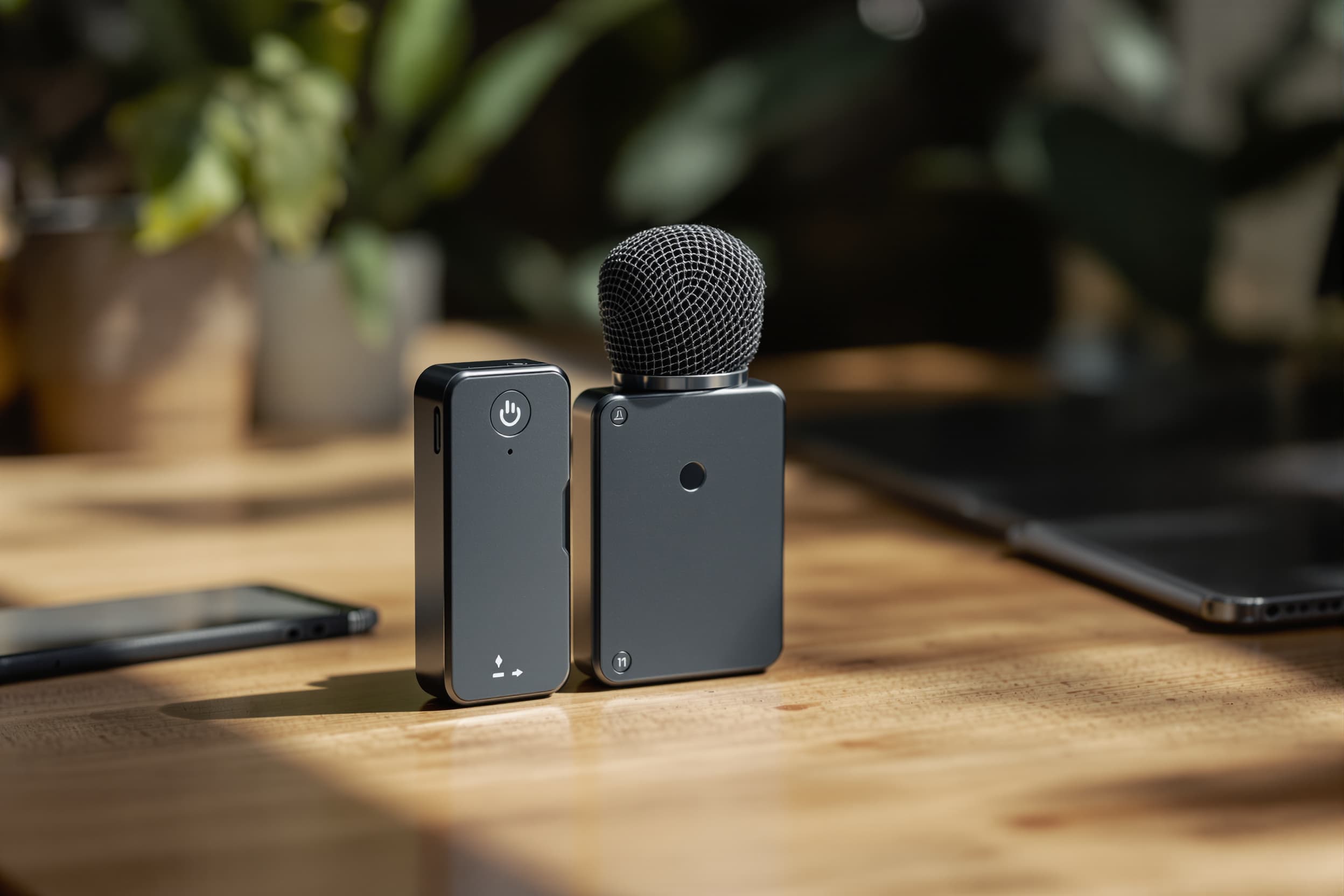
A compact audio recording device that captures meetings and phone calls with one-button operation. Works with a companion mobile app to generate transcriptions, summaries, and action items from recorded conversations. Features offline storage and dual modes for tabletop or phone-attached recording.

Feasibility at a glance
PT localization
4/10
Partial
Only finishing and testing can be localised in Portugal.
Per unit
€50–€150
at 5000-unit volume
Starter batch
5,000units
minimum viable run
To first batch
16weeks
5 phases, design to ship
Budget
€245,000–€350,000 total
all-in estimate
Bottom line
For a 5,000-unit pocket meeting recorder, white-labelling from an established EU electronics vendor is optimal. The device requires specialized PCB assembly, MEMS microphone integration, Bluetooth certification (RED), and battery compliance (UN 38.3) — capabilities that Portuguese manufacturers in the registry lack. White-label partners already hold RED/CE marks and have validated audio recording designs, reducing time-to-market to 14–16 weeks versus 24+ for local co-development. Cost per unit (€45–€65) remains competitive while ensuring regulatory compliance and quality control within the EU supply chain.
5 capabilities
Records audio from meetings or phone calls with one-button operation
Stores conversations locally even when offline so nothing is lost
Syncs with a mobile app to produce written transcriptions of what was said
Generates meeting summaries and action items automatically from recordings
Attaches to your phone to capture both sides of a call without speakerphone
5 stations · build route
PCB fabrication and SMT assembly
Surface-mount components, Bluetooth module, and memory chips are populated onto the main circuit board.
Plastic housing molding
The outer case is injection-molded from ABS plastic with snap-fit features for assembly.
Microphone and button integration
MEMS microphones and the record button are soldered and mechanically secured to the PCB.
Battery installation and wiring
The lithium polymer cell is connected to the board and secured inside the enclosure.
Final assembly and functional test
Housing is closed, firmware is flashed, and each unit is tested for recording quality and Bluetooth pairing.
PCB fabrication and SMT assembly
Surface-mount components, Bluetooth module, and memory chips are populated onto the main circuit board.
Plastic housing molding
The outer case is injection-molded from ABS plastic with snap-fit features for assembly.
Microphone and button integration
MEMS microphones and the record button are soldered and mechanically secured to the PCB.
Battery installation and wiring
The lithium polymer cell is connected to the board and secured inside the enclosure.
Final assembly and functional test
Housing is closed, firmware is flashed, and each unit is tested for recording quality and Bluetooth pairing.
6 identified · 3 blocking
High
MEMS Microphone Supply Volatility
MEMS microphones (from suppliers like Knowles, Infineon, STMicroelectronics) have experienced allocation constraints and 16–24 week lead times since 2021. For a 5K-unit run requiring 10K MEMS mics, supply disruption could delay production by 8–12 weeks. This risk is compounded if the white-label or co-dev partner lacks long-term supply agreements or cannot pivot to alternate MEMS vendors without firmware re-validation.
Mitigation — Negotiate with white-label partner to pre-purchase MEMS inventory at contract signature, adding a 20% buffer (12K units). Request multi-sourcing capability: ensure firmware supports at least two MEMS mic models (e.g., Knowles SPH0645LM4H and Infineon IM69D130) so the partner can switch suppliers without re-certification. Include a contractual clause for component substitution approval within 48 hours if lead times exceed 20 weeks.
High
RED (Radio Equipment Directive) Compliance Delays
The device includes a Bluetooth radio, making it subject to EU RED 2014/53/EU. Certification requires RF testing (conducted emissions, radiated spurious, frequency stability) at a notified body, which can take 6–10 weeks. If the white-label partner's existing RED certificate does not cover firmware modifications (e.g., custom Bluetooth profiles for transcription sync), a delta certification is required. Failure to obtain RED certification before market entry risks €50K+ fines and product recalls.
Mitigation — Select a white-label partner whose existing RED certificate explicitly covers Bluetooth Classic and BLE 5.x with firmware updates via OTA (Class 2 module certification). Request a copy of the RED Declaration of Conformity and test reports at contract signature. For any firmware customization, perform a pre-assessment with a notified body (e.g., TÜV Rheinland, Telefication) to determine if delta testing is required. Budget 8 weeks and €8K–€12K for delta RED testing if firmware changes affect RF behavior. Ensure the Technical Construction File (TCF) is maintained by the partner and accessible for customs audits.
High
Audio Quality Validation and Field Failure
Meeting recorders are judged primarily on audio clarity, noise rejection, and Bluetooth sync reliability. Poor MEMS microphone placement, inadequate acoustic cavity design in the enclosure, or firmware bugs in audio codec configuration can result in muffled recordings, dropped Bluetooth connections, or battery drain. Field failures post-launch (>5% RMA rate) would damage brand reputation and incur warranty costs of €15–€30 per returned unit.
Mitigation — Mandate that the white-label or co-dev partner provide acoustic simulation (COMSOL or ANSYS) of the enclosure's microphone cavity to optimize frequency response and minimize resonance. Require pre-production samples (50 units) for in-house testing: record 20+ meetings in varied acoustic environments (conference rooms, open offices, phone calls) and measure SNR, THD, and Bluetooth range. Define acceptance criteria in the manufacturing contract: ≥60 dB SNR at 1 meter, <3% THD, Bluetooth range ≥10 meters. Implement a 100% end-of-line functional test: each unit records a 30-second test tone, plays back via Bluetooth to a phone app, and passes automated analysis for frequency response and pairing latency (<2 seconds). Budget €2–€3 per unit for this test fixture.
Medium
Firmware and Transcription IP Leakage
The device's value lies in seamless Bluetooth pairing, offline audio storage, and integration with a companion app for transcription/AI summaries. If manufacturing is outsourced (especially to China), proprietary firmware, pairing protocols, and API endpoints may be reverse-engineered or disclosed to competitors. A white-label partner may also license the same platform to rival products, eroding differentiation.
Mitigation — For white-label: sign an exclusive territory NDA limiting the partner from selling the same hardware configuration to competitors in the EU meeting-recorder segment for 18 months. For co-dev: retain ownership of application-layer firmware (transcription sync, action-item generation) and deploy it via encrypted OTA updates post-manufacturing. Use secure boot and encrypted flash storage on the Bluetooth SoC to prevent firmware dumping. Avoid sharing cloud API keys or transcription algorithms with the CM; handle all AI processing server-side.
Medium
Lithium Polymer Battery Shipping and Safety Compliance
Lithium polymer batteries are classified as Class 9 dangerous goods under UN 38.3 and IATA regulations. Shipping finished units (or battery cells separately) requires certification for transportation testing (altitude, vibration, thermal shock). If the white-label or co-dev partner lacks UN 38.3 certificates for the specific LiPo cell used, shipments may be delayed or refused by logistics carriers. Additionally, the EU Battery Directive 2006/66/EC and upcoming Battery Regulation (EU) 2023/1542 impose labeling, recycling, and carbon-footprint disclosure requirements.
Mitigation — Verify that the LiPo cell supplier (e.g., VARTA, LG Chem, or partner's battery vendor) holds a valid UN 38.3 test summary and MSDS for the exact cell model. Request IEC 62133-2 certification for portable lithium cells. For EU compliance, ensure the partner applies the crossed-out wheelie bin symbol (WEEE marking) and battery capacity label (mAh) to the enclosure. Pre-arrange logistics with a carrier experienced in Class 9 shipments (DHL Express, UPS Dangerous Goods). For the upcoming Battery Regulation, request a carbon footprint declaration from the cell supplier to include in the product's digital passport (required from 2027 for >2 kWh batteries, but best practice for smaller cells).
Medium
Injection Mold Tooling Lead Time for Custom Enclosure
If pursuing local production or co-development with a custom enclosure design, injection mold tooling for the ABS plastic housing typically requires 6–8 weeks and €15K–€25K investment. Delays in CAD finalization, tooling approval, or first-article sampling can push the timeline by 4–6 weeks. For a 5K-unit run, tooling costs add €3–€5 per unit, impacting margin if the design requires multiple cavities or complex snap-fit features.
Mitigation — For local or co-dev routes, freeze the industrial design (enclosure CAD) before tooling kickoff and conduct DFM (Design for Manufacturability) reviews with the mold maker (Salvador Caetano, Mold-Tech Portugal) to avoid late-stage changes. Use rapid prototyping (SLA or SLS 3D printing) to validate fit, clip retention, and button ergonomics before committing to hard tooling. Negotiate a two-stage tooling approach: soft aluminum tooling (€8K–€12K, 3-week lead) for first 500 units to validate design, then upgrade to hardened steel for production. For white-label, accept the partner's existing enclosure design to eliminate tooling risk entirely, customizing only cosmetic elements (color, logo placement) via pad printing or laser engraving.
16 weeks to first batch
Specification Freeze and Vendor Selection
wk 1–2Firmware Customization and App Integration
wk 3–6Tooling and Pre-Production Samples
wk 7–11RED and CE Certification Testing
wk 12–14Production Ramp and Quality Validation
wk 15–16Specification Freeze and Vendor Selection
Firmware Customization and App Integration
wk 7–11 is the longest stretch — Tooling and Pre-Production Samples takes 5 weeks of the 16 weeks on this build.
5 materials · 6 processes
Materials
Processes
587 Portuguese manufacturers matched
None cover the whole build — it splits across steps.
13 tasks · 16 weeks to first batch
Week 1
2 tasks
Issue RFQs to three EU white-label audio recorder vendors
Send detailed RFQ to OXYBLACK, Nordic Semiconductor partners, and Würth Elektronik requesting: existing RED/CE certificates, BOM with MEMS mic models (Knowles/Infineon), firmware customization scope for Bluetooth pairing and offline storage, pricing for 5K units, lead time, and NDA terms for exclusive territory. Request responses within 5 business days.
Freeze industrial design and app integration requirements
Lock down enclosure dimensions, button placement, phone clip mechanism, and companion app Bluetooth protocol (pairing flow, audio sync format, battery status reporting). Document acceptance criteria: ≥60 dB SNR, <3% THD, ≥8-hour battery life, <2s pairing latency. Share with vendors in RFQ package.
Weeks 2–3
3 tasks
Select white-label partner and negotiate contract
waits on Issue RFQs to three EU white-label audio recorder vendors
Evaluate RFQ responses on RED certificate scope (must cover BLE 5.x + firmware OTA), MEMS mic multi-sourcing capability, and cost. Negotiate firmware customization fee, exclusive territory clause (18-month EU exclusivity for meeting recorders), and component pre-purchase (12K MEMS mics, 20% buffer). Sign contract and wire 30% deposit (€67K–€97K) to lock inventory.
Verify RED/CE certificates and request Technical Construction File
waits on Select white-label partner and negotiate contract
Obtain copies of partner's RED Declaration of Conformity, EN 300 328 and EN 301 489-17 test reports, and TCF (Technical Construction File). Confirm that existing certification covers firmware modifications for custom Bluetooth profiles. If delta testing is required, pre-book 8 weeks with TÜV Rheinland and budget €10K.
Validate LiPo battery UN 38.3 and IEC 62133-2 compliance
waits on Select white-label partner and negotiate contract
Request UN 38.3 test summary, MSDS, and IEC 62133-2 certificate from partner's battery supplier (VARTA, LG Chem, or equivalent). Confirm compliance with EU Battery Directive labeling (crossed-out wheelie bin, mAh capacity). Pre-arrange Class 9 dangerous goods shipping with DHL Express or UPS for production logistics.
Weeks 4–7
3 tasks
Develop and test companion app Bluetooth integration
waits on Select white-label partner and negotiate contract
Partner delivers firmware build with custom Bluetooth pairing protocol and offline audio file format (Opus codec). Engineering integrates with iOS/Android app for audio sync, transcription API calls, and OTA updates. Test pairing with 10+ phone models (iPhone 13/14, Samsung Galaxy S22/S23, Google Pixel 7). Validate power consumption: ≥8 hours recording per charge.
Order and validate 50 pre-production EVT units
waits on Select white-label partner and negotiate contract
Partner assembles 50 EVT (Engineering Validation Test) units with production-intent firmware and MEMS mics. Ship to GETMILK for acoustic testing in 20+ meeting environments (conference rooms, open offices, phone calls). Measure SNR, THD, Bluetooth range (≥10m). Conduct drop tests (1.2m onto concrete). Document pass/fail against acceptance criteria.
Submit samples for RED delta testing if firmware changed
waits on Order and validate 50 pre-production EVT units, Verify RED/CE certificates and request Technical Construction File
Weeks 8–16
4 tasks
Approve production release and issue 5K-unit PO
waits on Order and validate 50 pre-production EVT units, Submit samples for RED delta testing if firmware changed
Review EVT test results (acoustic, drop, Bluetooth interoperability) and RED delta test reports (if applicable). Sign off on production release. Issue purchase order for 5,000 units with delivery schedule: first 500 DVT units in week 12, remaining 4,500 in week 14–16. Wire 40% milestone payment (€90K–€130K).
Conduct 100% end-of-line functional testing on first 500 DVT units
waits on Approve production release and issue 5K-unit PO
Partner performs EOL test on first 500 DVT (Design Validation Test) units: record 30s test tone, playback via Bluetooth to phone app, automated SNR/THD analysis, pairing latency check (<2s), battery charge cycle. GETMILK audits 20 random units on-site or via video. Accept batch if <2% failure rate.
Finalize packaging and apply CE/WEEE markings
waits on Approve production release and issue 5K-unit PO
Design retail packaging (box, user manual, USB charging cable). Ensure CE marking, crossed-out wheelie bin (WEEE), and battery capacity label are printed on enclosure and packaging. Partner arranges pad printing or laser engraving for logo and regulatory symbols. Order 5,000 sets of packaging materials.
Ongoing
1 task
Monitor field RMA rate and coordinate firmware OTA updates
waits on Ship 5,000 units and perform incoming QC sampling
Track return merchandise authorizations (RMAs) from customers. Target <2% RMA rate in first 90 days post-launch. Coordinate with white-label partner for firmware OTA updates to address bugs (e.g., Bluetooth dropout, battery calibration). Maintain Technical Construction File and RED Declaration of Conformity for customs and market surveillance audits.
4 roles to fill before month one
White-label vendor technical lead
Klaus Bergmann, VP Product – OXYBLACK or Nordic partner
Owns firmware customization roadmap, MEMS mic sourcing, and RED certification scope. Founder needs Klaus to negotiate exclusive territory clause, approve firmware changes for app integration, and coordinate pre-production EVT sample delivery within 4 weeks.
RED/CE compliance specialist
Dr. Ana Costa, Notified Body Engineer – TÜV Rheinland Portugal
Manages delta RED testing if firmware modifications affect RF emissions. Founder needs Ana to pre-assess whether partner's existing RED certificate covers custom Bluetooth profiles, fast-track test booking (6–8 weeks instead of 12), and issue Declaration of Conformity for 5K-unit batch.
Class 9 dangerous goods shipping expert
Miguel Sousa, Logistics Manager – DHL Express Portugal
Coordinates inbound shipment of 5,000 units containing lithium polymer batteries from EU partner to Portugal. Founder needs Miguel to validate UN 38.3 documentation, book temperature-controlled transport, and ensure customs clearance within 48 hours to avoid warehouse demurrage fees.
Local quality assurance and testing partner
Sofia Almeida, Senior Product Manager – ISQ Group
5 things to avoid in this plan
lead time
Lock MEMS mic inventory at contract signature—negotiate 20% buffer (12K units) and multi-sourcing (Knowles + Infineon) to avoid 8–12 week allocation delays
certification
Verify RED certificate scope before deposit—partner's existing cert must cover firmware OTA and custom Bluetooth profiles, or budget €10K and 8 weeks for delta testing
certification
Pre-purchase LiPo cells with UN 38.3 certificates—confirm IEC 62133-2 compliance and arrange Class 9 logistics with DHL to avoid shipment rejections
quality
Mandate 50-unit EVT batch for acoustic validation—test in 20+ real meeting environments (conference rooms, phone calls) to derisk field RMA rate above 2%
watch-out
Sign exclusive territory NDA—prevent white-label partner from licensing same hardware to EU competitors for 18 months to protect differentiation
2 tasks in week 1
Issue RFQs to three EU white-label audio recorder vendors
Tooling and Pre-Production Samples
RED and CE Certification Testing
Production Ramp and Quality Validation
If partner's firmware customization affects RF behavior (Bluetooth profile changes), submit 3 EVT samples to TÜV Rheinland for delta RED testing: EN 300 328 (RF emissions), EN 301 489-17 (EMC). Testing takes 6–8 weeks. If no delta required, reuse partner's existing RED certificate and proceed to production release.
Ship 5,000 units and perform incoming QC sampling
waits on Conduct 100% end-of-line functional testing on first 500 DVT units, Finalize packaging and apply CE/WEEE markings
Partner ships 5,000 finished units via Class 9 dangerous goods logistics (DHL Express) to GETMILK warehouse in Portugal. Perform AQL 2.5 incoming inspection on 125 random units (2.5% sample): visual inspection, functional recording test, Bluetooth pairing, packaging integrity. Accept shipment and release for distribution if <2% defect rate. Wire final 30% payment (€67K–€97K).
Provides on-the-ground incoming QC inspection (AQL 2.5 sampling) and accelerated life testing (ALT) for 20 units in Lisbon. Founder needs Sofia to validate acoustic performance in Portuguese office environments and coordinate drop/thermal shock testing to derisk field failures before launch.
587 matched · 8 shown, ranked by coverage
Covers, left to right: SMT Assembly · PCB Fabrication · Injection Molding · Final Assembly · Testing & Inspection · Packaging
Manufacturer
Location
Covers
Certifications
People
Portuguese producers per required step
Final Assembly
369
Testing & Inspection
178
Injection Molding
174
SMT Assembly
36
PCB Fabrication
6
Packaging
0
How many cover more than one step
The gap
For a 5,000-unit pocket meeting recorder, white-labelling from an established EU electronics vendor is optimal. The device requires specialized PCB assembly, MEMS microphone integration, Bluetooth certification (RED), and battery compliance (UN 38.3) — capabilities that Portuguese manufacturers in the registry lack. White-label partners already hold RED/CE marks and have validated audio recording designs, reducing time-to-market to 14–16 weeks versus 24+ for local co-development. Cost per unit (€45–€65) remains competitive while ensuring regulatory compliance and quality control within the EU supply chain.
Send one RFQ to the top 4
Keenfinity EMS, Uartrónica, Exatronic, Proto-Electronics — same package, one click.