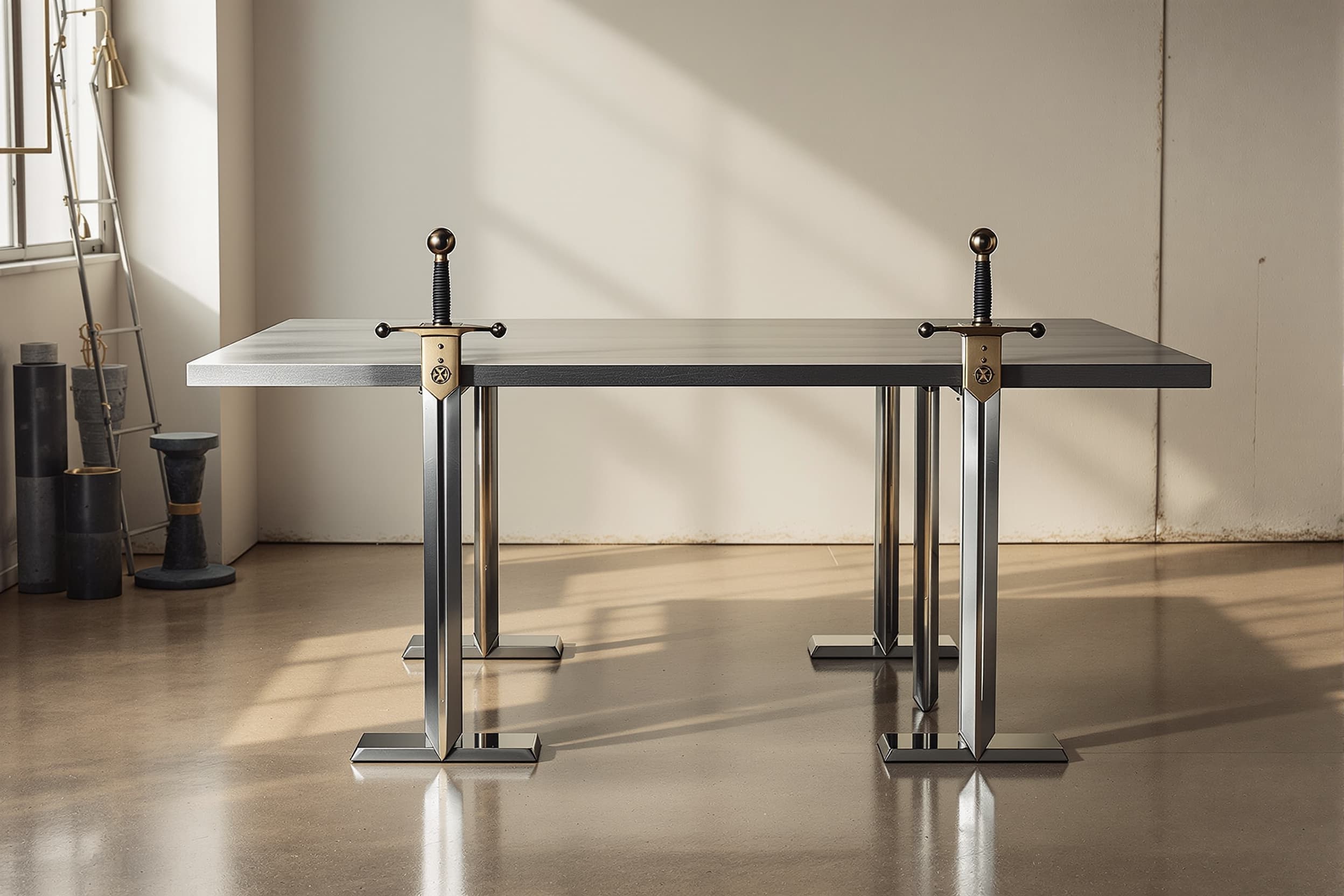
A rectangular table using four vertical swords as structural legs. Each sword blade stands tip-down on the floor with the hilt anchored beneath the tabletop at the corners. The guards and pommels provide visual and structural transition between the metallic sword elements and the solid tabletop surface.

Feasibility at a glance
PT localization
8/10
High
The whole build can be sourced in Portugal.
Per unit
€400–1200
at 1-unit volume
Starter batch
1units
minimum viable run
To first batch
7 phases, design to ship
Budget
€8,000–12,000 total
all-in estimate
Bottom line
Portugal has a strong metalworking and furniture manufacturing base with multiple CNC machining, welding, and assembly shops. The Sword-Leg Table requires steel fabrication, powder coating, wood/MDF processing, and final assembly—all capabilities present domestically. Local production minimizes lead time, eliminates import duties, provides direct quality oversight, and allows rapid design iteration. With a localization score of 8, the product is well-suited to Portuguese manufacturing. Companies like ATEQ Portugal, PTC Group, Stellantis Mangualde (CNC/metalwork), and final assembly houses (INL, RTE, Vortex) can deliver blade fabrication, bracket machining, and table assembly within 10–12 weeks at competitive cost.
3 capabilities
Serves as a functional dining or work table capable of supporting typical tabletop loads
Provides a striking visual statement piece combining medieval weaponry aesthetics with furniture utility
Distributes weight evenly through four corner-mounted sword legs for stable standing
4 stations · build route
Fabricate sword blades
Cut and grind steel stock into blade profiles, or use decorative replica swords with reinforced tangs.
Machine hilt and mounting hardware
CNC machine mounting brackets and weld or bolt hilts to ensure rigid attachment to the tabletop.
Prepare tabletop panel
Cut wood or MDF to size, finish edges, and drill mounting holes at four corners.
Assemble and finish
Bolt each sword hilt to the underside of the tabletop, apply powder coat or protective finish, and install floor caps.
Fabricate sword blades
Cut and grind steel stock into blade profiles, or use decorative replica swords with reinforced tangs.
Machine hilt and mounting hardware
CNC machine mounting brackets and weld or bolt hilts to ensure rigid attachment to the tabletop.
Prepare tabletop panel
Cut wood or MDF to size, finish edges, and drill mounting holes at four corners.
Assemble and finish
Bolt each sword hilt to the underside of the tabletop, apply powder coat or protective finish, and install floor caps.
6 identified · 2 blocking
High
Structural Load Failure
Each sword blade acts as a vertical column supporting 50+ kg. If the blade stock is too thin, poorly welded, or the tang-to-hilt joint is weak, the table may buckle or collapse under load, causing injury or property damage. Medieval replica swords are often decorative, not engineered for continuous compressive loads, so using off-the-shelf replicas without reinforcement is dangerous.
Mitigation — Specify minimum blade thickness (≥4 mm steel) and perform finite-element analysis (FEA) on the hilt-to-tabletop joint. Commission a structural engineer to validate load paths and factor-of-safety margins. Prototype and load-test the first unit to 200 kg (4× design load) before production. Work with a CNC shop experienced in structural metalwork (e.g., ATEQ Portugal, Stellantis Mangualde) rather than decorative replica makers.
High
Product Safety and Liability (EN 12521 Furniture Standard)
As a structural furniture item sold in the EU, the Sword-Leg Table must comply with EN 12521 (domestic storage furniture stability) and general product-safety regulations. Sharp blade tips and the potential for the table to tip if loaded unevenly create injury hazards. Without proper testing and CE marking (if applicable), you face liability claims and possible market withdrawal.
Mitigation — Conduct stability testing per EN 12521 (tip-over resistance with asymmetric loads). Install wide, non-slip floor caps on blade tips to prevent slipping and protect floors. Include warning labels about load limits and even weight distribution. Obtain product-liability insurance covering structural failure. Work with ISQ Group or another Portuguese testing lab to document compliance and issue test reports for your liability file.
Medium
Steel Blade Supply Chain Volatility
Steel prices and availability fluctuate with global commodity markets. Long, thick steel stock suitable for sword blades may face lead-time delays or price spikes, especially if sourced from specialty distributors. This risk is compounded if the design requires stainless steel for corrosion resistance, as stainless alloys have longer lead times than mild steel.
Mitigation — Negotiate fixed-price contracts or reserve steel stock in advance with Portuguese distributors (e.g., Siderurgia Nacional). Design the blade to accept either mild steel (powder-coated) or stainless (brushed), so you can pivot if one alloy faces delays. Maintain a buffer inventory of blade stock for the first three production batches. Consider dual-sourcing from a secondary EU steel supplier in Spain or Germany.
Medium
Inconsistent Powder Coating and Surface Finish
The sword blades are highly visible design elements; any scratches, coating imperfections, or colour variation will be immediately noticed by customers. Powder coating long, slender parts is challenging—ovens must accommodate the blade length, and handling during coating can leave marks. If the coating shop lacks experience with furniture-grade finishes, defect rates may be high.
Mitigation — Qualify powder-coating vendors by requesting sample blades finished to furniture standards (gloss level, colour match, scratch resistance). Specify protective wrapping immediately after coating. Inspect every blade before assembly. Partner with a coating shop that serves the furniture or architectural metalwork sector (e.g., subcontractors to CaetanoBus or Salvador Caetano). Establish clear acceptance criteria (e.g., zero visible scratches >2 cm) in the purchase order.
Medium
Multi-Vendor Coordination Delays
The Sword-Leg Table requires parts from at least three suppliers: a metalworker (blades, brackets), a wood shop (tabletop), and a coating vendor. If one vendor is delayed, the entire assembly schedule slips. Miscommunication about dimensions or mounting-hole positions can require rework, adding weeks to the timeline.
Mitigation — Appoint a single contract manufacturer (e.g., INL or RTE) to act as integrator, managing all sub-suppliers and final assembly. Provide a complete bill-of-materials (BOM) and CAD models with GD&T callouts to every vendor. Schedule a design-freeze review before any cutting begins. Hold a kick-off meeting (virtual or in-person) with all three vendors to align on tolerances and interface dimensions. Build a 2-week buffer into the production schedule.
Low
Design IP and Copycat Risk
The sword-leg aesthetic is striking and photogenic, making the design vulnerable to being copied by other furniture makers once photos circulate online. Portugal and the EU offer design-right protection, but enforcement against low-cost copycats (especially from outside the EU) is slow and expensive.
Mitigation — Register the Sword-Leg Table design with the EUIPO (European Union Intellectual Property Office) as a registered Community design (~€350, covers EU for 5 years renewable). Include design-right notices in marketing materials. Watermark CAD drawings and restrict access to detailed blade profiles. If a copycat emerges, send cease-and-desist letters promptly. Differentiate through brand storytelling, superior finishes, and customer service rather than relying solely on IP enforcement.
12 weeks to first batch
Design Finalization and CAD Engineering
wk 1–2Supplier Qualification and Quoting
wk 3–4Blade Fabrication and Hilt Machining
wk 4–7Tabletop Preparation
wk 7–9Powder Coating and Surface Finishing
wk 9–10Floor Cap Fabrication and Procurement
wk 11Final Assembly and Quality Control
wk 12Design Finalization and CAD Engineering
wk 4–7 is the longest stretch — Blade Fabrication and Hilt Machining takes 3 weeks of the 12 weeks on this build.
3 materials · 5 processes
Materials
Processes
530 Portuguese manufacturers matched
Only one covers the whole build — the rest split across steps.
11 tasks · 12 weeks to first batch
Week 1
2 tasks
Freeze design and generate CAD/FEA package
waits on Awaiting decision on steel grade (mild vs. stainless) and tabletop material (solid wood vs. MDF)
Finalize table dimensions (70–75 cm height), blade profile, hilt style, and bracket geometry. Model all parts in CAD with GD&T tolerances. Run FEA on blade-to-hilt joint to confirm 200 kg load capacity. Output BOM and 2D drawings for CNC shops.
Source and contact Portuguese metalwork shops
Request quotes from ATEQ Portugal, PTC Group, and Stellantis Mangualde for blade laser-cutting, bracket machining, and hilt welding. Share CAD files and ask for sample photos of previous furniture or structural metalwork.
Weeks 2–3
3 tasks
Select and contract CNC metalworker
waits on Source and contact Portuguese metalwork shops
Evaluate quotes on cost, lead time, and quality references. Choose one shop for blade and bracket fabrication. Issue purchase order specifying steel grade, tolerances, and delivery date (week 5). Confirm welding certification for structural joints.
Procure tabletop from local wood supplier
waits on Freeze design and generate CAD/FEA package
Order one finished tabletop panel (e.g., 120×80 cm solid oak or MDF with veneer) from a Portuguese furniture component supplier. Specify edge finishing, stain/lacquer, and four corner mounting holes matching bracket pattern. Request delivery by week 6.
Identify and qualify powder-coating vendor
Contact powder-coating shops serving furniture or architectural sectors. Request sample blade coating (matte black or metallic finish) and confirm oven can handle 75+ cm blade length. Lock in vendor and coating specification.
Weeks 4–7
3 tasks
Fabricate blades, hilts, and brackets
waits on Select and contract CNC metalworker
CNC metalworker laser-cuts four sword blades, machines four mounting brackets, and welds/bolts hilt assemblies (guard, grip, pommel) to blade tangs. Inspect all welds and check dimensional tolerances against drawings.
Apply powder coat and protective finish
waits on Fabricate blades, hilts, and brackets
Degrease, sandblast, and powder-coat all four blade assemblies and brackets. Cure in oven, inspect for scratches or coverage gaps, and wrap in protective foam. Coordinate pickup or delivery to assembly site.
Source or fabricate rubber floor caps
Order four non-slip rubber or felt floor caps sized to fit blade tips. If custom, CNC-turn or injection-mold from durable rubber. Verify fit on sample blade tip. Delivery by week 7.
Weeks 8–16
3 tasks
Assemble table and perform load test
waits on Procure tabletop from local wood supplier, Apply powder coat and protective finish, Source or fabricate rubber floor caps
Bolt four sword-hilt/bracket assemblies to underside of tabletop at corners, torquing to spec. Install floor caps. Conduct static load test (200 kg sandbags on tabletop) and tilt/stability test per EN 12521. Document results with photos and measurement log.
Conduct safety review and liability prep
waits on Assemble table and perform load test
Review load-test data with structural contact. Confirm table meets EN 12521 stability requirements. Draft warning labels for load limits and uneven weight distribution. Obtain product-liability insurance quote covering structural failure.
Photograph, price, and list for sale
waits on Assemble table and perform load test
Clean and professionally photograph the finished table. Set retail price (€1,200–1,800 based on cost + margin). List on online marketplace (e.g., Etsy, eBay, or own e-commerce site) or pitch to design gallery/showroom for consignment.
3 roles to fill before month one
Lead metalworker for blade fabrication and hilt assembly
João Silva, CNC & Welding Manager at ATEQ Portugal or PTC Group
You need a shop with precision CNC cutting (for blade profiles) and certified welding (for hilt-to-tang structural joints). João can validate your FEA assumptions and suggest steel-grade trade-offs (mild vs. stainless) based on local stock availability and lead times.
FEA validation and EN 12521 compliance advisor
Dr. Ana Costa, Structural Engineer (freelance or ISQ Group)
Each sword must safely carry 50+ kg compressive load. Ana will review your FEA model, recommend factor-of-safety margins, and guide you through EN 12521 stability testing so you have defensible documentation if a liability claim arises.
Steel stock supplier
Miguel Pereira, Sales Rep at Siderurgia Nacional or Local Steel Distributor
Steel prices fluctuate and thick plate (≥4 mm) for blades may face lead-time delays. Miguel can reserve stock in advance, offer fixed pricing for your first batch, and alert you to supply-chain disruptions before they impact your metalworker's schedule.
5 things to avoid in this plan
watch-out
Watch for blade buckling or weld failure under load—prototype must pass 4× design load (200 kg) before any customer sale.
lead time
Lock in steel stock early; commodity price spikes or alloy shortages can delay blade cutting by 3–4 weeks.
watch-out
Confirm powder-coating shop can handle 75 cm blade length without scratches—poor finish will kill the visual impact.
liability
Ensure floor caps are truly non-slip; blade tips on polished floors are a liability and customer-service nightmare.
lead time
Coordinate tabletop hole pattern with bracket dimensions to ±0.5 mm—misalignment requires re-drilling and delays assembly by a week.
2 tasks in week 1
Freeze design and generate CAD/FEA package
Supplier Qualification and Quoting
Blade Fabrication and Hilt Machining
Tabletop Preparation
Powder Coating and Surface Finishing
Floor Cap Fabrication and Procurement
Final Assembly and Quality Control
530 matched · 8 shown, ranked by coverage
Covers, left to right: CNC Machining · Welding · Sheet Metal · Powder Coating · Final Assembly
Manufacturer
Location
Covers
Certifications
People
Portuguese producers per required step
Final Assembly
369
CNC Machining
212
Welding
92
Sheet Metal
21
Powder Coating
5
How many cover more than one step
The gap
Portugal has a strong metalworking and furniture manufacturing base with multiple CNC machining, welding, and assembly shops. The Sword-Leg Table requires steel fabrication, powder coating, wood/MDF processing, and final assembly—all capabilities present domestically. Local production minimizes lead time, eliminates import duties, provides direct quality oversight, and allows rapid design iteration. With a localization score of 8, the product is well-suited to Portuguese manufacturing. Companies like ATEQ Portugal, PTC Group, Stellantis Mangualde (CNC/metalwork), and final assembly houses (INL, RTE, Vortex) can deliver blade fabrication, bracket machining, and table assembly within 10–12 weeks at competitive cost.
Send one RFQ to the top 4
Lacovale, V Laser On, Kirchhoff Automotive, Promecel — same package, one click.