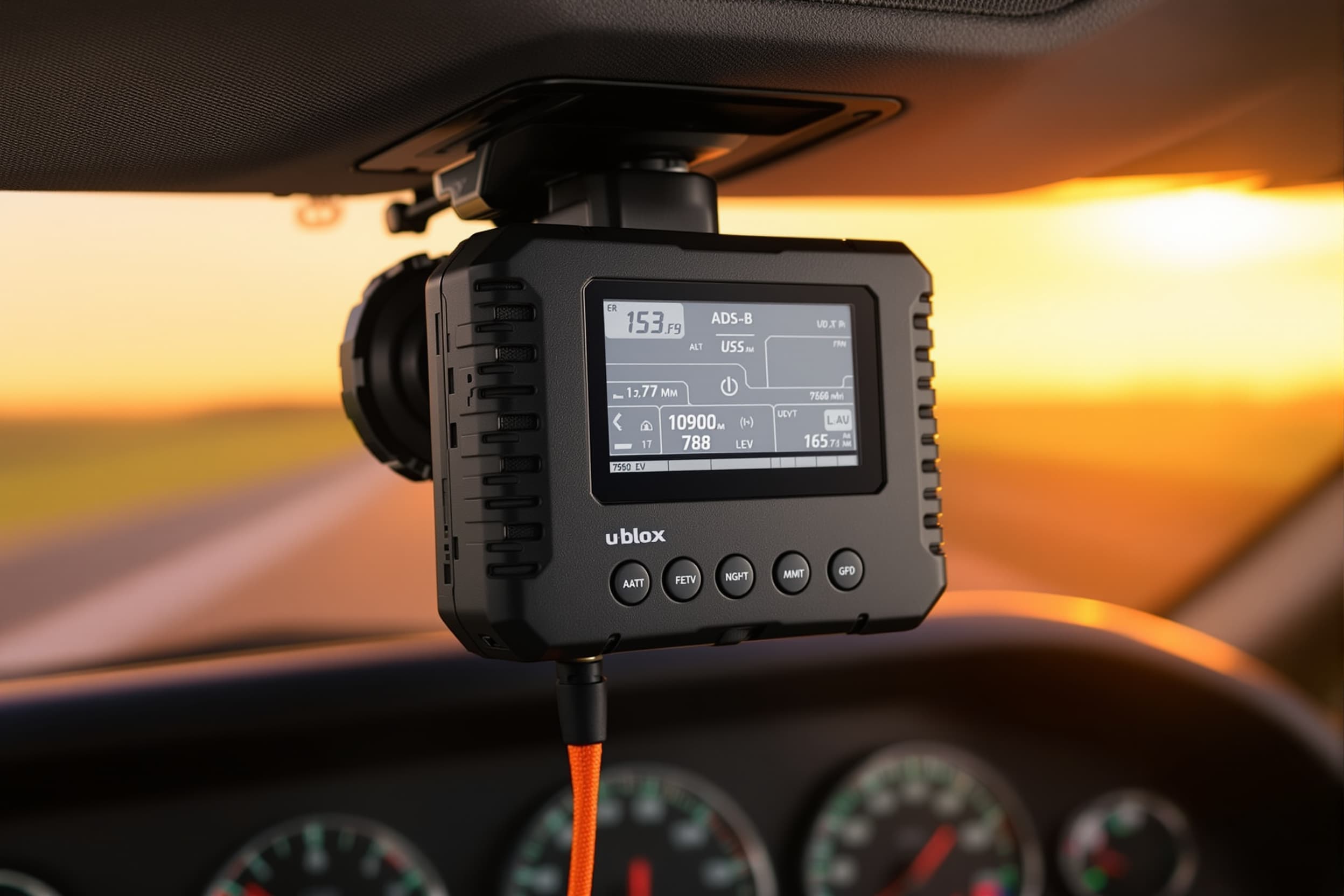
Portable ADS-B transceiver for ultralight and light-sport aircraft, combining 1090 MHz Extended Squitter receive with UAT 978 MHz transmit (US) or 1090 MHz Mode S transponder output (EU). Integrates u-blox NEO-M9N GPS and Bluetooth output to consumer flight apps. Carbon-fiber-reinforced ABS housing with sunlight-readable OLED, 6-hour LiPo battery, and yoke or glareshield mounting.

Feasibility at a glance
PT localization
5/10
Partial
Most steps can be localised in Portugal.
Per unit
€800–1200
at 100-unit volume
Starter batch
100units
minimum viable run
To first batch
38weeks
8 phases, design to ship
Budget
€95–135k
all-in estimate
Bottom line
The complexity of RF design at 1090/978 MHz, combined with strict aviation certification requirements (EASA Part 21, DO-160), makes co-development with an established EU aerospace electronics partner the most pragmatic path. Portugal lacks indigenous aviation RF/transceiver expertise, but partnering with a proven EU firm (e.g. Rohde & Schwarz, Thales Avionics, or Cobham) ensures access to certified design libraries, test facilities, and regulatory pathways. This option balances time-to-certification, IP control, and cost better than trying to build from scratch locally or relying on uncertified Chinese modules for a safety-critical aviation product.
5 capabilities
Receives ADS-B traffic on 1090 MHz so the pilot can see nearby aircraft on a map
Transmits the aircraft's own position via ADS-B Out so other pilots and air traffic control can see you
Shows real-time GPS position and nearby traffic on a built-in screen without needing a tablet
Sends traffic and weather data over Bluetooth to popular flight planning apps on a phone or tablet
Runs for six hours on battery so you don't need aircraft power for short flights
5 stations · build route
Fabricate multi-layer RF PCB with controlled impedance
Use 4-layer FR-4 with precise trace widths for 1090 MHz and 978 MHz signals.
Place and reflow SMT components including transceiver ICs and GPS module
Automated pick-and-place followed by controlled-profile reflow oven to avoid tombstoning on RF components.
CNC-machine aluminum RF shield and sheet-metal antenna ground plane
Mill the shield from 6061-T6 aluminum; fold and fixture the ground plane for consistent RF performance.
Injection-mold carbon-fiber ABS housing and assemble gasket seal
Use 10–15% short carbon fiber filler for rigidity; press silicone gasket into lid groove.
Final assembly, RF calibration, and environmental testing
Integrate battery, mount boards, calibrate transmit power and receiver sensitivity, then test to DO-160 vibration and temperature profiles.
Fabricate multi-layer RF PCB with controlled impedance
Use 4-layer FR-4 with precise trace widths for 1090 MHz and 978 MHz signals.
Place and reflow SMT components including transceiver ICs and GPS module
Automated pick-and-place followed by controlled-profile reflow oven to avoid tombstoning on RF components.
CNC-machine aluminum RF shield and sheet-metal antenna ground plane
Mill the shield from 6061-T6 aluminum; fold and fixture the ground plane for consistent RF performance.
Injection-mold carbon-fiber ABS housing and assemble gasket seal
Use 10–15% short carbon fiber filler for rigidity; press silicone gasket into lid groove.
5 identified · 3 blocking
Critical
EASA Part 21 and DO-160 certification timeline
ADS-B Out transceivers must meet DO-260B (ADS-B message format and performance) and DO-160 (environmental qualification—vibration, temperature, EMI/EMC, altitude) before they can be legally installed in EU-registered aircraft. Achieving these certifications typically requires 6–9 months of test campaigns at accredited labs (e.g. DEKRA in Germany, LNE in France) plus document review by an EASA Design Organisation Approval (DOA) holder. If your RF design fails a DO-160 EMI test or your Mode S transponder output is out of spec, you face expensive board respins and re-test cycles. A single failure can push your market entry by a full year.
Mitigation — Engage an EASA DOA consultancy (e.g. APAVE, TÜV Rheinland Aviation, or your co-development partner's internal DOA) during the design phase to perform pre-compliance EMI scans and protocol validation in-house before submitting to the formal test lab. Budget €80,000–120,000 and 9 months for certification. Plan the test campaign in parallel with pilot production so you can address findings quickly. If targeting the US market as well, pursue FAA TSO-C154c in tandem to avoid duplicating test costs.
High
RF component supply and allocation
The ADS-B transceiver depends on specialized RF components—power amplifiers for 1090 MHz transmit, low-noise amplifiers (LNAs) for receive, and Mode S-capable transceiver ICs—that are manufactured by a handful of suppliers (Analog Devices, Qorvo, NXP). These parts often have 16–26 week lead times and are subject to allocation during aerospace demand spikes (e.g. post-pandemic fleet modernization). A shortage or allocation cut from your distributor can delay the entire production batch by months, since there are no pin-compatible drop-in replacements for certified avionics designs.
Mitigation — Secure a multi-quarter supply agreement with an authorized aerospace distributor (e.g. Avnet Abacus, Mouser Aerospace division, or Arrow) at the design freeze stage. Order long-lead RF ICs and power amplifiers for at least 200 units upfront (covering the pilot batch plus buffer stock). If co-developing with an EU partner, ensure their existing supplier contracts cover your volume and that components are reserved in their ERP system before you commit to production dates.
High
RF calibration and production yield variability
Each ADS-B transceiver must be individually calibrated after assembly: transmit power tuned to ±1 dB, receiver sensitivity verified to –87 dBm or better, and antenna VSWR measured across 1090 and 978 MHz bands. This requires a production test fixture with a spectrum analyzer, signal generator, and RF attenuators—capital equipment costing €50,000–80,000. If your EMS partner lacks this fixture or trained RF technicians, you'll see high scrap rates (10–15%) from units that fail power or sensitivity specs, driving up your effective per-unit cost and delaying shipments while rework is performed.
Mitigation — During EMS partner selection, verify they have in-house RF test capabilities and experience calibrating transceivers or similar products (e.g. LoRa gateways, cellular base stations, marine VHF radios). If not, co-invest in a shared test fixture or require them to subcontract calibration to a specialist lab. Implement statistical process control (SPC) on the SMT reflow profile and antenna mounting torque to reduce process variation. Plan for a 5–8% yield loss in the first production batch and build that into your unit cost model.
Medium
Intellectual property and firmware source-code ownership
If you co-develop with a tier-1 EU partner, the Mode S protocol stack, ADS-B message encoding, and RF calibration firmware are likely to remain the partner's IP, licensed to you under restrictive terms (e.g. no derivatives, no resale of boards to third parties, royalty per unit). This limits your ability to pivot to a different manufacturing partner, offer OEM variants, or sell the design if you exit the business. Conversely, if you hire a contract design house and they retain the RF schematics, you may be locked into their production line for future orders.
Mitigation — Negotiate explicit IP ownership or perpetual license terms in the co-development MOU. Aim to own the mechanical design, enclosure tooling, display firmware, and Bluetooth app integration outright, while accepting a paid license for the core RF protocol stack. Require the partner to escrow all design files (Altium/Eagle projects, Gerbers, BOM, firmware source) with a neutral third party so you can recover them if the partnership dissolves. Budget an extra 5–8% per-unit royalty if the partner retains core IP.
Medium
Lithium polymer battery transport and UN 38.3 compliance
Shipping finished units with installed LiPo batteries triggers UN 3481 (lithium batteries packed with equipment) dangerous-goods regulations, requiring UN 38.3 testing (vibration, thermal cycling, short-circuit, impact) and special labeling/packaging. Most air-freight carriers limit or refuse LiPo shipments, forcing you onto slower sea or truck routes. If your battery supplier's UN 38.3 certificate expires or is found non-compliant, customs can seize your entire shipment. This risk is amplified if you source cells from China and integrate them in Portugal, since you become the 'manufacturer' responsible for testing.
Mitigation — Source LiPo battery packs pre-certified to UN 38.3 from a reputable EU supplier (e.g. VARTA, Saft, or BMZ Group in Germany) who will provide test reports and retain liability. Design the enclosure so the battery is field-removable, allowing you to ship units and batteries separately (reducing freight costs and avoiding some dangerous-goods restrictions). Work with a freight forwarder experienced in IATA DGR (e.g. DHL Aviation, Kuehne+Nagel Dangerous Goods division) and budget €8–15 extra per unit for compliant packaging and documentation.
38 weeks to first batch
Design freeze and component sourcing (RF transceiver, GPS, Bluetooth)
wk 1–6PCB fabrication and SMT assembly of RF boards
wk 7–16CNC machining of aluminum RF shield and sheet-metal forming
wk 17–20Injection molding of carbon-fiber ABS housing and gasket assembly
wk 21–25RF calibration and receiver sensitivity testing
wk 26–28Final assembly: integrate battery, display, and mechanical parts
wk 29–32DO-160 environmental testing and EASA certification submission
wk 33–41Packaging, labeling, and shipment of first production batch
wk 42–43Design freeze and component sourcing (RF transceiver, GPS, Bluetooth)
PCB fabrication and SMT assembly of RF boards
wk 7–16 is the longest stretch — PCB fabrication and SMT assembly of RF boards takes 10 weeks of the 43 weeks on this build.
6 materials · 8 processes
Materials
Processes
686 Portuguese manufacturers matched
None cover the whole build — it splits across steps.
12 tasks · 12 weeks to first batch
Week 1
2 tasks
Sign NDA and term sheet with EU avionics RF partner
Finalize non-disclosure and letter of intent with Rohde & Schwarz, Thales, or Cobham covering IP ownership (you own mechanical/UI, license RF protocol stack), revenue split, and 100-unit pilot commitment. Confirm partner has DO-260B-compliant Mode S library and can deliver calibrated RF boards in 24 weeks.
Lock BOM and place POs for long-lead RF components
waits on Sign NDA and term sheet with EU avionics RF partner
Freeze the bill of materials with partner: transceiver IC, PA, LNA, u-blox NEO-M9N GPS, Bluetooth 5.0 module. Place purchase orders through Avnet Abacus or Arrow for 200 units' worth of long-lead parts (16–20 week delivery). Secure written allocation confirmation.
Weeks 2–3
2 tasks
Finalize mechanical CAD for housing, RF shield, and antenna ground plane
Complete SolidWorks models for carbon-fiber ABS top/bottom shells, aluminum RF shield (6061-T6), and folded sheet-metal ground plane. Design gasket groove for IP54 seal. Export STEP files and 2D drawings with GD&T for RFQs to injection molder and CNC shop.
Issue RFQs for injection-molding tool and CNC machining
waits on Finalize mechanical CAD for housing, RF shield, and antenna ground plane
Send RFQ packages to 3 EU injection molders (Portugal, Spain, Germany) for carbon-fiber ABS housing tool (2-cavity, €18–25k NRE) and to 2 CNC shops for aluminum shield and sheet-metal ground plane prototypes (10 units each). Request quotes by week 3.
Weeks 4–7
3 tasks
Select and contract injection molder and CNC supplier
waits on Issue RFQs for injection-molding tool and CNC machining
Evaluate RFQ responses on lead time, NRE cost, and aviation-grade quality systems (AS9100 preferred). Award contracts for housing tooling and shield/ground-plane production. Transfer CAD files and initiate mold design review (DFM). Target first housing samples by week 9.
Engage EASA DOA consultant for pre-compliance roadmap
waits on Sign NDA and term sheet with EU avionics RF partner
Hire APAVE, TÜV Rheinland, or partner's internal DOA to draft certification plan: DO-160G test schedule, DO-260B compliance checklist, and RED 2014/53/EU radio module declaration. Identify accredited labs (DEKRA, LNE) and book tentative test slots for week 20–28.
Source UN 38.3-certified LiPo battery pack from EU supplier
Select VARTA, Saft, or BMZ Group for 6-hour LiPo pack with USB-C charging controller. Verify UN 38.3 test report and MSDS. Order 120 packs (100 + spares) with 10-week lead time. Confirm field-removable design to simplify freight.
Weeks 8–16
4 tasks
Receive and validate first mechanical prototypes (housing, shield)
waits on Select and contract injection molder and CNC supplier
Inspect injection-molded housing samples and CNC-machined RF shield/ground plane for dimensional tolerance (±0.2 mm), gasket fit, and EMI shielding continuity. Perform test assembly with dummy RF board to verify mounting holes and cable routing. Iterate if needed.
Coordinate RF board SMT assembly and calibration with partner
waits on Lock BOM and place POs for long-lead RF components
Monitor partner's PCB fab and SMT schedule. Confirm they will perform per-unit RF calibration (transmit power ±1 dB, RX sensitivity ≤ –87 dBm, VSWR < 2:1). Request weekly status updates and photos of first article. Plan for 10 calibrated boards delivered to Portugal by week 10 for integration testing.
Develop and test display firmware and Bluetooth app integration
Write firmware for sunlight-readable OLED to show GPS position, nearby traffic, and system status. Implement Bluetooth 5.0 profile to stream ADS-B data to ForeFlight and SkyDemon. Test pairing and data throughput on iOS/Android tablets. Validate 6-hour battery life in lab.
Ongoing
1 task
Prepare certification test plan and ship units to DO-160 lab
waits on Assemble and functionally test 5 alpha prototypes, Engage EASA DOA consultant for pre-compliance roadmap
Finalize DO-160G test matrix with DOA consultant: vibration, temp, humidity, altitude, EMI/EMC. Box 3 alpha units with test fixtures and ship to DEKRA or LNE by week 12. Await test results (9-week campaign starts outside this 90-day window). Budget €80k for full certification.
4 roles to fill before month one
EU RF co-development partner lead
Dr. Stefan Müller, Avionics Module Sales – Rohde & Schwarz
Brings certified Mode S / ADS-B protocol IP, DO-260B compliance expertise, and access to aerospace-grade RF component supply chains. Critical for reducing certification risk and meeting the 38-week timeline to first batch.
Freight forwarder for LiPo battery transport
Ana Costa, Dangerous Goods Manager – DHL Aviation Portugal
Ensures UN 38.3 compliant packaging, labeling, and IATA DGR documentation for lithium battery shipments, avoiding customs seizures and enabling timely delivery to customers and test labs.
EASA DOA consultant for DO-160 and Part 21 pathway
Jean-Luc Arnaud, Principal Certification Engineer – APAVE Certification
Guides pre-compliance testing, drafts Technical Standard Order application, and liaises with accredited labs (DEKRA, LNE) to navigate EASA Part 21 requirements and avoid costly test failures.
Authorized distributor for long-lead RF components
Paulo Ribeiro, Account Manager – Avnet Abacus (Portugal)
Secures allocation and delivers transceiver ICs, power amplifiers, and LNAs from Analog Devices/Qorvo/NXP on time. Provides supply-chain visibility and buffers you from component shortages that could delay the pilot batch.
5 things to avoid in this plan
lead time
Lock RF component allocation early – transceiver ICs and PAs have 16–20 week lead times and are subject to aerospace demand spikes; a supplier cut can delay production by 6 months
certification
Budget €80–120k and 9 months for DO-160/DO-260B certification – a single EMI or protocol failure triggers expensive board respins and re-test, pushing market entry by a year
watch-out
Negotiate IP ownership upfront – ensure you own mechanical design and can escrow RF schematics; restrictive license terms from the co-dev partner will lock you into their production line
certification
Verify UN 38.3 LiPo certification from day one – expired or non-compliant battery test reports will cause customs seizures and halt shipments; source only from EU suppliers with current certificates
quality
2 tasks in week 1
Sign NDA and term sheet with EU avionics RF partner
Final assembly, RF calibration, and environmental testing
Integrate battery, mount boards, calibrate transmit power and receiver sensitivity, then test to DO-160 vibration and temperature profiles.
CNC machining of aluminum RF shield and sheet-metal forming
Injection molding of carbon-fiber ABS housing and gasket assembly
RF calibration and receiver sensitivity testing
Final assembly: integrate battery, display, and mechanical parts
DO-160 environmental testing and EASA certification submission
Packaging, labeling, and shipment of first production batch
Assemble and functionally test 5 alpha prototypes
waits on Receive and validate first mechanical prototypes (housing, shield), Coordinate RF board SMT assembly and calibration with partner, Develop and test display firmware and Bluetooth app integration
Integrate calibrated RF boards, battery, display, and mechanical parts into 5 complete alpha units. Verify GPS lock, ADS-B In/Out, Bluetooth pairing, and runtime. Conduct informal EMI scan and temperature cycling (–20°C to +55°C) in-house to identify issues before formal DO-160 testing.
Invest in RF calibration fixture or partner capability – without in-house test gear (spectrum analyzer, signal generator), you'll see 10–15% scrap rates and long rework cycles that blow your unit economics
686 matched · 8 shown, ranked by coverage
Covers, left to right: PCB Fabrication · SMT Assembly · CNC Machining · Sheet Metal · Injection Molding · Final Assembly · Testing & Inspection · Packaging
Manufacturer
Location
Covers
Certifications
People
Portuguese producers per required step
Final Assembly
369
CNC Machining
212
Testing & Inspection
178
Injection Molding
174
SMT Assembly
36
Sheet Metal
21
PCB Fabrication
6
How many cover more than one step
The gap
The complexity of RF design at 1090/978 MHz, combined with strict aviation certification requirements (EASA Part 21, DO-160), makes co-development with an established EU aerospace electronics partner the most pragmatic path. Portugal lacks indigenous aviation RF/transceiver expertise, but partnering with a proven EU firm (e.g. Rohde & Schwarz, Thales Avionics, or Cobham) ensures access to certified design libraries, test facilities, and regulatory pathways. This option balances time-to-certification, IP control, and cost better than trying to build from scratch locally or relying on uncertified Chinese modules for a safety-critical aviation product.
Send one RFQ to the top 4
Keenfinity EMS, Uartrónica, REROM, MOLDMAK — same package, one click.
Packaging
0