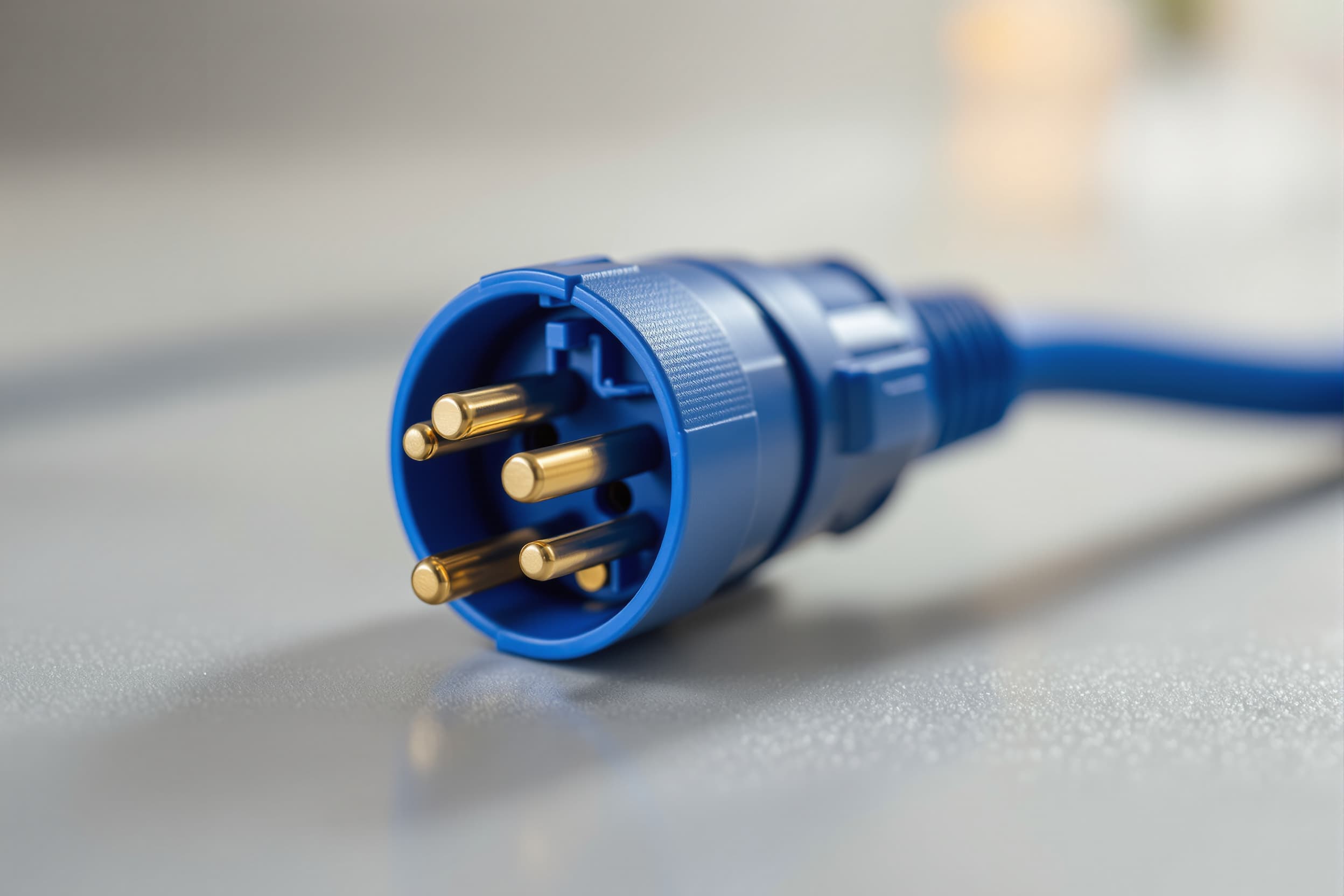
A short adapter cable that converts a 3-pin industrial CEE (IEC 60309) blue plug to a weatherproof Schuko socket with protective cap. This connector is used in temporary power installations, outdoor events, and industrial equipment to bridge between different power standards.

Feasibility at a glance
PT localization
9/10
Full
The whole build can be sourced in Portugal.
Per unit
€5–€15
at 50-unit volume
Starter batch
50units
minimum viable run
To first batch
7 phases, design to ship
Budget
€8–12k
all-in estimate
Bottom line
Portugal has strong capabilities in injection molding and cable assembly, with manufacturers like Salvador Caetano, Mold-Tech Portugal, and Microplásticos capable of producing thermoplastic connector housings. The product is straightforward with well-established processes, and local production offers superior quality control for electrical safety compliance, faster iteration on IP-rating testing, and eliminates import lead times. Given the localizationScore of 9 and the availability of local final assembly partners (INL, RTE, Vortex, ISQ Group), a Portuguese supply chain is both feasible and cost-competitive for batches of 50+ units.
2 capabilities
Converts industrial CEE power plugs to household Schuko sockets for equipment compatibility.
Protects the socket from weather and contamination when not plugged in.
5 stations · build route
Mold connector housings
Injection mold the CEE plug body, Schuko socket housing, and protective cap from thermoplastic.
Strip and crimp wires
Cut multi-core cable to length, strip insulation, and crimp or solder contacts to each end.
Assemble connectors
Insert crimped contacts into connector housings and secure with screws or snap-fit retention.
Attach protective cap
Fit the rubber cap onto the Schuko socket with a tether or hinge so it stays attached.
Test and package
Verify continuity, insulation resistance, and IP rating, then label and box the finished cable.
Mold connector housings
Injection mold the CEE plug body, Schuko socket housing, and protective cap from thermoplastic.
Strip and crimp wires
Cut multi-core cable to length, strip insulation, and crimp or solder contacts to each end.
Assemble connectors
Insert crimped contacts into connector housings and secure with screws or snap-fit retention.
Attach protective cap
Fit the rubber cap onto the Schuko socket with a tether or hinge so it stays attached.
Test and package
Verify continuity, insulation resistance, and IP rating, then label and box the finished cable.
5 identified · 2 blocking
High
Electrical Safety and CE Compliance Gaps
Adapter cables carrying 16 A at 250 V AC are subject to the EU Low Voltage Directive (LVD 2014/35/EU), and must bear CE marking with a Declaration of Conformity. Non-compliance—such as undersized conductors, inadequate insulation resistance, or missing IP-rating validation—can result in product recalls, liability for electrical fires or shock injuries, and fines up to €100,000. If you source from a white-label supplier or Chinese OEM, you inherit responsibility for verifying their test reports and ensuring traceability of materials (RoHS, REACH SVHC compliance).
Mitigation — Engage an accredited Notified Body (e.g., TÜV Rheinland, Dekra, or ISQ in Portugal) to witness first-article inspection and validate insulation resistance, continuity, and IP44 ingress-protection tests. Require suppliers to provide material declarations (RoHS/REACH) and maintain a Technical Construction File per LVD. For white-label sourcing, request copies of the supplier's CE certificates and cross-check against the EU NANDO database. Conduct annual batch audits and retain samples for 10 years.
High
Inconsistent IP Rating and Contact Retention
The protective rubber cap and Schuko socket sealing must reliably achieve IP44 (protection against splashing water and solid objects >1 mm). Poor cap fit, worn O-rings, or improper assembly can degrade the IP rating over time, leading to corrosion, arcing, and electrical failure. Similarly, if brass contacts are not properly crimped or retained in the housing, they can loosen under vibration or thermal cycling, causing intermittent connections or overheating. These failure modes are safety-critical and can result in fires or electric shock.
Mitigation — Implement 100% go/no-go testing of contact retention force (minimum 50 N pull-out force per IEC 60309) and IP44 water-spray testing on a statistical sample (AQL 1.5, Level II per ISO 2859). Use automated crimp-force monitoring during cable assembly and reject any crimp below spec. Specify UV-resistant thermoplastic elastomer (TPE) for the rubber cap to prevent brittleness. Conduct accelerated life testing (500 plug/unplug cycles, thermal cycling -25°C to +70°C) on first articles and annually on production batches.
Medium
Raw Material Supply Chain Disruption
The adapter cable depends on specialized components—IEC 60309 CEE plugs, Schuko sockets, and multi-core H05VV-F or H07RN-F cable—that are manufactured by a concentrated set of European suppliers (Lapp, Helukabel, Weidmüller). A shortage of brass contacts, thermoplastic resin (PC/ABS), or copper wire due to energy prices, strikes, or raw-material inflation could delay production by 4–8 weeks. Portugal does not produce raw cable or contact pins domestically, so all input materials are pan-European or imported.
Mitigation — Dual-source critical components: pre-qualify both Lapp Kabel and Helukabel for cable supply, and maintain 4–6 weeks of safety stock for brass contacts and thermoplastic pellets. Establish framework agreements with ISQ Group or RTE to hold buffer inventory of molded housings. Monitor commodity copper and resin prices quarterly and lock in pricing for 6-month horizons during stable periods.
Medium
Injection-Mold Tooling Delays
If you choose local production, the CEE plug and Schuko socket housings require dedicated injection molds. Tooling lead time in Portugal is typically 6–8 weeks, but can stretch to 12 weeks if the mold shop is backlogged or if design changes require rework. A delay in tooling pushes back first-article samples and production ramp, risking missed delivery commitments or event deadlines (e.g., summer festival season for temporary power).
Mitigation — Front-load tooling by ordering molds as soon as design is frozen, even before finalizing assembly partners. Use rapid-prototyping (3D-printed housings) for fit-check and early testing while hard tooling is in progress. Split tooling across two suppliers (Salvador Caetano for CEE plug, Mold-Tech for Schuko socket) to parallelize and reduce single-point failure risk. Include penalty clauses in mold contracts for delays beyond 8 weeks.
Low
Intellectual Property and Design Copying
CEE-to-Schuko adapter cables are standardized commodity products with no patentable novelty. Connector geometries are defined by IEC 60309 and CEE 7/3 standards, and any supplier can replicate the design. While this limits IP risk, it also means competitors (or your own suppliers) can easily produce identical cables. The primary differentiator is branding, quality of weatherproofing, and reliability—none of which are legally protectable beyond trademark.
Mitigation — Focus on brand differentiation through superior IP-rating validation (test to IP54 instead of IP44), custom packaging, and warranty support. Trademark the GETMILK logo and ensure it is molded or laser-etched on both plug and socket housings. Use NDAs with local assemblers to prevent them from white-labeling your exact configuration to competitors. Build reputation through certified test reports published on your website.
10 weeks to first batch
Design Freeze and Tooling Kickoff
wk 1–2Injection-Mold Tooling Fabrication
wk 2–8Component Sourcing and Pre-Assembly
wk 9Crimping and Contact Assembly
wk 10Final Assembly and Cap Attachment
wk 10Electrical and IP-Rating Testing
wk 10Packaging and Quality Documentation
wk 11Design Freeze and Tooling Kickoff
wk 2–8 is the longest stretch — Injection-Mold Tooling Fabrication takes 6.5 weeks of the 10.5 weeks on this build.
5 materials · 4 processes
Materials
Processes
563 Portuguese manufacturers matched
Only one covers the whole build — the rest split across steps.
8 tasks · 10 weeks to first batch
Week 1
2 tasks
Finalize adapter cable spec and sourcing decision
Lock cable length (1.5 m or 3 m), confirm IP44 minimum rating, 16 A / 250 V AC, and branding placement (laser-mark or silk-screen GETMILK logo on housings). Decide between white-label EU supplier (Mennekes, PCE, Scame) for speed vs. local PT tooling for customization. For 50 units, white-label is fastest and lowest risk.
Request quotes and samples from EU white-label suppliers
Contact Mennekes, PCE Instruments, and Scame for 50-unit quotes, lead times, and sample units. Request copies of CE Declaration of Conformity, IEC 60309 and CEE 7/3 test reports, RoHS/REACH material declarations, and IP-rating certificates. Verify supplier credentials against EU NANDO database.
Weeks 2–3
2 tasks
Evaluate samples for IP rating and contact retention
waits on Request quotes and samples from EU white-label suppliers
Receive 2–3 sample adapter cables from shortlisted suppliers. Perform hands-on inspection: test rubber cap seal, measure contact retention force (target ≥50 N pull), check cable jacket quality (H05VV-F or H07RN-F), and verify markings (CE, rated current/voltage, supplier ID). Send one sample to ISQ Group for independent IP44 water-spray test.
Select supplier and place 50-unit purchase order
waits on Evaluate samples for IP rating and contact retention
Choose supplier based on sample quality, cost (€10–€14/unit), lead time (target 3–4 weeks), and completeness of compliance documentation. Issue PO specifying: quantity 50, custom labeling (GETMILK logo laser-etched on plug and socket), packaging (poly bags + instruction sheet), and delivery Incoterms (DDP to Portugal). Request batch test report and serial numbering.
Weeks 4–7
3 tasks
Arrange compliance validation with ISQ Group
waits on Select supplier and place 50-unit purchase order
Engage ISQ (or TÜV, Dekra) to witness first-article inspection when batch arrives. Scope: continuity testing (all 50 units), insulation resistance (500 V DC, ≥5 MΩ), IP44 ingress-protection test (statistical sample, AQL 1.5), and contact retention force check. ISQ will issue test report for Technical Construction File.
Prepare Technical Construction File and Declaration of Conformity
waits on Arrange compliance validation with ISQ Group
Compile LVD-required documentation: product drawings (from supplier), BOM, material certificates (RoHS/REACH from supplier), ISQ test report, risk assessment (electrical shock, fire, IP-rating failure scenarios), and user instructions. Draft Declaration of Conformity per LVD 2014/35/EU and affix CE marking. Retain file for 10 years.
Design packaging and user instructions
Create printed instruction sheet: safe usage (do not exceed 16 A, outdoor use only with cap closed, disconnect before cleaning), IP44 rating limits (splash-proof, not submersible), and warranty info. Design carton labels with CE mark, rated specs, and GETMILK branding. Order poly bags, foam inserts, and cartons for 50 units from local packaging supplier.
Weeks 8–16
1 task
Receive, inspect, and repackage 50-unit batch
waits on Prepare Technical Construction File and Declaration of Conformity, Design packaging and user instructions
Accept delivery from EU supplier. Visual QC all units: check for shipping damage, verify laser-etched GETMILK logo, confirm rubber cap attachment and seal. Repackage each cable in poly bag with instruction sheet, box in cartons of 10. Apply CE conformity labels and serial-number stickers. Store in climate-controlled warehouse (avoid UV exposure on rubber caps).
3 roles to fill before month one
White-label supplier and compliance partner
Technical Sales Engineer at Mennekes or PCE Instruments
Provides pre-certified CEE-to-Schuko adapter cables with IEC 60309 and CEE 7/3 compliance, CE Declaration of Conformity, and RoHS/REACH material declarations. Fastest path to 50 units with proven IP44 designs and European liability coverage.
Independent electrical safety and IP-rating validator
Test Engineer at ISQ Group (Instituto de Soldadura e Qualidade)
Accredited Notified Body in Portugal for LVD compliance. Performs first-article inspection (continuity, insulation resistance, IP44 water-spray, contact retention) and issues test reports required for Technical Construction File and CE marking.
Legal advisor for CE marking and Declaration of Conformity
Compliance Consultant specializing in Low Voltage Directive
Ensures Technical Construction File meets LVD 2014/35/EU requirements, reviews risk assessment for electrical shock/fire hazards, and audits supplier certificates (RoHS/REACH). Critical for defending CE mark if inspected by market surveillance authorities.
5 things to avoid in this plan
certification
Supplier CE certificates may be incomplete or invalid—cross-check against EU NANDO database and require ISQ independent testing before accepting batch.
quality
IP44 rating can degrade if rubber cap material is not UV-resistant TPE—specify material in PO and conduct accelerated weathering test on samples.
quality
Contact retention failures under vibration or thermal cycling—ISQ must verify ≥50 N pull-out force per IEC 60309 on statistical sample (AQL 1.5).
lead time
Lead time risk if EU supplier is backlogged—place PO early (week 2–3) and request firm delivery date with penalty clause for delays beyond 4 weeks.
liability
Liability exposure if adapter causes electrical fire or shock—maintain Technical Construction File for 10 years, purchase product liability insurance (€1M+ coverage), and include warranty terms limiting misuse.
2 tasks in week 1
Finalize adapter cable spec and sourcing decision
Injection-Mold Tooling Fabrication
Component Sourcing and Pre-Assembly
Crimping and Contact Assembly
Final Assembly and Cap Attachment
Electrical and IP-Rating Testing
Packaging and Quality Documentation
563 matched · 8 shown, ranked by coverage
Covers, left to right: Cable Assembly · Injection Molding · Testing & Inspection · Final Assembly
Manufacturer
Location
Covers
Certifications
People
Portuguese producers per required step
Final Assembly
369
Testing & Inspection
178
Injection Molding
174
Cable Assembly
12
How many cover more than one step
The gap
Portugal has strong capabilities in injection molding and cable assembly, with manufacturers like Salvador Caetano, Mold-Tech Portugal, and Microplásticos capable of producing thermoplastic connector housings. The product is straightforward with well-established processes, and local production offers superior quality control for electrical safety compliance, faster iteration on IP-rating testing, and eliminates import lead times. Given the localizationScore of 9 and the availability of local final assembly partners (INL, RTE, Vortex, ISQ Group), a Portuguese supply chain is both feasible and cost-competitive for batches of 50+ units.
Send one RFQ to the top 4
Codica Cables, EMKA Electronique, REROM, Porcher Industries — same package, one click.