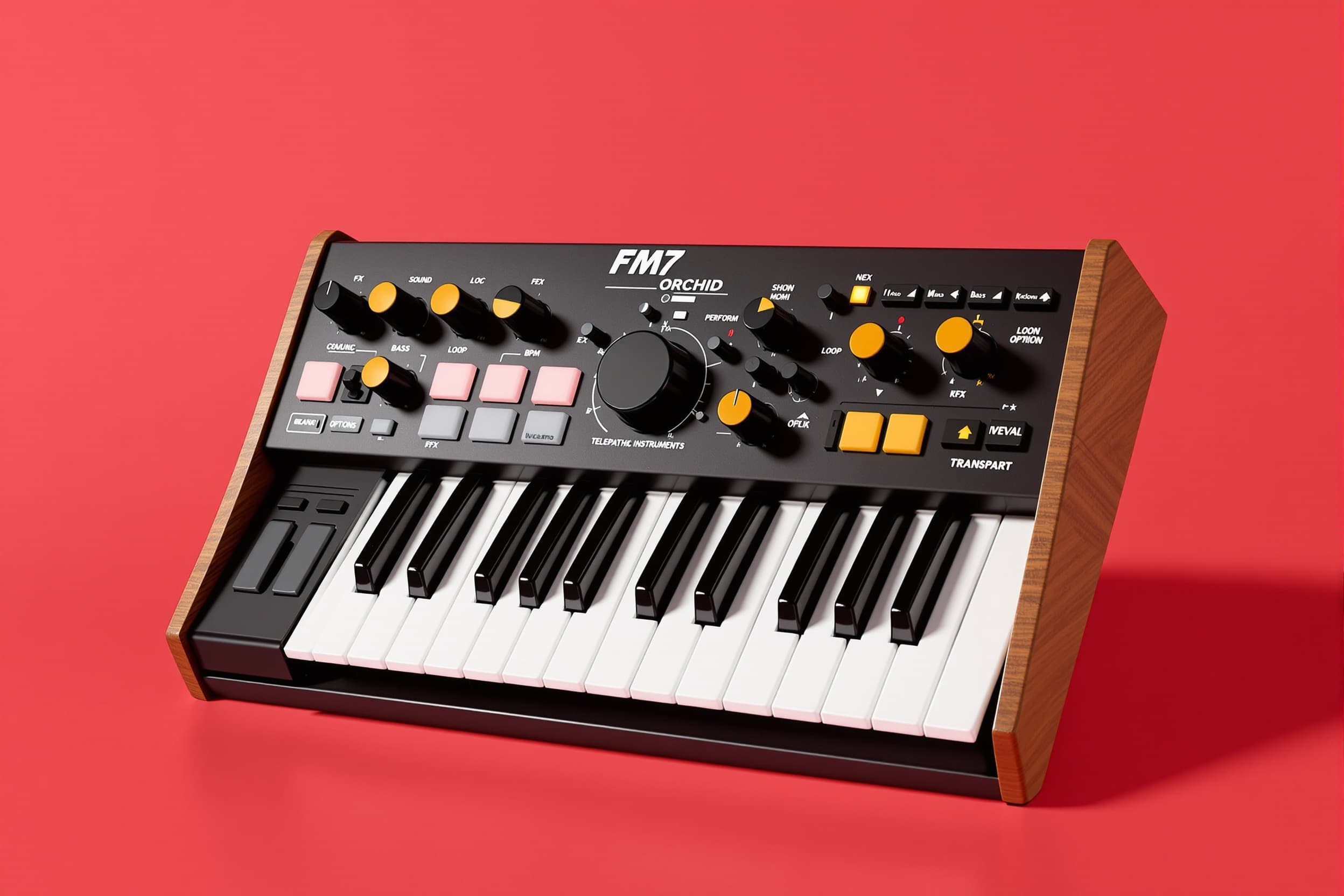
The Orchid is a chord-based MIDI controller and synthesizer by Telepathic Instruments. It features a compact keyboard layout with integrated sequencer pads, rotary encoders for sound shaping, and control buttons for performance parameters like tempo, loop, and volume. Designed for music creators who want chord-focused workflow with built-in sound generation and MIDI connectivity.

Feasibility at a glance
PT localization
4/10
Partial
Only finishing and testing can be localised in Portugal.
Per unit
€300–€600
at 500-unit volume
Starter batch
500units
minimum viable run
To first batch
18weeks
8 phases, design to ship
Budget
€160–210k
all-in estimate
Bottom line
For a specialized MIDI controller with integrated synthesis, white-label sourcing from an established EU electronic musical instrument manufacturer offers the fastest path to market with proven technology. The Orchid requires sophisticated firmware (low-latency MIDI, audio codec drivers, sequencer logic) that would take 6–9 months to develop in-house. European white-label partners already have certified audio/MIDI platforms, allowing you to focus on branding, UX customization, and go-to-market. This approach minimizes technical risk for a 500-unit pilot run while maintaining EU quality and compliance standards. Local Portuguese assembly would require building expertise in musical electronics from scratch—viable only at much higher volumes.
4 capabilities
Lets you play chords by pressing a single key, making it easier to compose music without traditional piano technique.
Generates its own sounds using a built-in synthesizer, so you can make music without connecting to a computer.
Sends MIDI messages to control other instruments or music software.
Records and loops short musical patterns so you can layer ideas in real time.
5 stations · build route
Fabricate and populate the main PCB
Use automated pick-and-place to mount microcontroller, audio codec, and passive components, then reflow-solder.
Mold the plastic enclosure halves
Injection-mold the top and bottom shells in ABS or polycarbonate with integrated mounting posts.
Machine or mold the keyboard bed
Either CNC-mill a metal keyboard chassis or mold plastic keys with conductive pads for capacitive sensing.
Assemble controls and display into top shell
Insert rotary encoders, buttons, and the OLED or LCD display, securing with clips or screws.
Final assembly and testing
Mount the PCB, connect ribbon cables, snap or screw the enclosure halves together, then flash firmware and test MIDI and audio output.
Fabricate and populate the main PCB
Use automated pick-and-place to mount microcontroller, audio codec, and passive components, then reflow-solder.
Mold the plastic enclosure halves
Injection-mold the top and bottom shells in ABS or polycarbonate with integrated mounting posts.
Machine or mold the keyboard bed
Either CNC-mill a metal keyboard chassis or mold plastic keys with conductive pads for capacitive sensing.
Assemble controls and display into top shell
Insert rotary encoders, buttons, and the OLED or LCD display, securing with clips or screws.
Final assembly and testing
5 identified · 3 blocking
High
Component Supply Chain Constraints
The Orchid relies on specialized components—microcontrollers (e.g. STM32H7 or ARM Cortex-M7), audio codecs (Cirrus Logic, ADI), rotary encoders (Bourns, Alps Alpine), and small OLED/LCD displays—that face 12–20 week lead times in the current market. A single out-of-stock part can delay the entire production run. Musical instrument electronics also require tight tolerance passives (1% resistors, low-ESR capacitors) for clean audio, which are harder to substitute than general-purpose components. At 500 units you lack the volume to secure priority allocation from distributors.
Mitigation — Negotiate a Bill of Materials (BOM) lock with your chosen partner (white-label or co-dev) at contract signature, requiring them to pre-purchase long-lead components within 2 weeks of PO. Use franchised distributors (Mouser, Digi-Key, Avnet) rather than brokers to ensure authenticity. Design in secondary sources for critical ICs (e.g. specify pin-compatible audio codecs from both ADI and TI). Hold a 10% component buffer stock in EU (e.g. at a bonded warehouse) to cover rework or late changes.
High
Intellectual Property and Firmware Leakage
The core value of the Orchid lies in its chord-mapping algorithm, sequencer logic, and user interface firmware. If you work with a white-label partner who retains firmware ownership, you lose the ability to iterate the product independently or pivot to a new manufacturer. Worse, a less scrupulous partner could white-label a near-identical product to a competitor. Even co-development contracts can be murky around derivative works and know-how. In China, IP enforcement is weak and circuit board clones can appear within months of launch.
Mitigation — Insist on full source code escrow and IP assignment clauses in any white-label or co-dev agreement, verified by legal counsel experienced in EU electronics contracts. For white-label, negotiate an exclusive SKU or chord algorithm that the partner will not sell to others. For co-dev, structure milestones so that you receive design files and firmware repositories at each gate. Use hardware security (encrypted boot, locked debug ports) to make firmware extraction difficult. If going to China, never share synthesis or chord-mapping source code—provide only compiled binaries and require signed NDAs with liquidated damages.
High
Keybed and Encoder Durability / Feel
The user experience of a MIDI controller hinges on the tactile feel and reliability of the keybed and rotary encoders. Capacitive keybeds require precise spacing, ground plane design, and firmware debouncing to avoid ghost notes or missed triggers. Mechanical keys need consistent actuation force (±10 gN tolerance) and at least 10 million cycles. Low-quality encoders exhibit cogging, missed detents, or electrical noise that corrupts MIDI CC messages. A single batch of out-of-spec encoders can destroy the product's reputation, as musicians are highly sensitive to 'mushy' or inconsistent controls.
Mitigation — Specify tier-1 encoder suppliers (Bourns, Alps Alpine, TT Electronics) in the BOM and require incoming inspection with a sample torque test (e.g. 10 units per lot). For the keybed, build a mechanical test jig that cycles keys 50k times under accelerated conditions and measures actuation force drift. Conduct a blind user test with 5–10 musicians during the pre-production phase to catch UX issues (key spacing, encoder resistance) before tooling lock. Include a 1-year warranty and allocate 2% of COGS to a repair/replacement reserve. If using capacitive sensing, validate the firmware debounce algorithm with a high-speed oscilloscope to ensure <5ms response and no false triggers under EMI stress (e.g. nearby phone, USB hub).
Medium
CE Marking, RED, and RoHS Compliance Gaps
The Orchid is an electronic device with USB connectivity and audio output, so it must meet the EU Radio Equipment Directive (RED) for conducted/radiated emissions, the Low Voltage Directive (LVD) for safety, and RoHS/REACH for material restrictions. Many white-label partners and ODMs provide 'CE certificates' that are self-declarations without independent test lab validation, leaving you liable if a market surveillance authority challenges the marking. USB audio devices can fail EMC tests due to ground loops or poor PCB layout, requiring costly board re-spins.
Mitigation — Require that your partner (or your own local assembly) conduct full RED and EMC testing at an accredited EU notified body (e.g. DEKRA, TÜV Rheinland, Applus+) before first shipment. Budget €8k–12k for EMC/LVD testing. Review the test plan to ensure it covers USB audio operation and MIDI data transmission under load. For RoHS, request material declarations and XRF test reports for all plastic and metal parts. Appoint an Authorized Representative in the EU (if your legal entity is outside EU) to hold technical documentation and handle compliance inquiries. Keep a compliance folder (test reports, DoC, risk assessments) for at least 10 years.
Medium
Lead Time Slippage and Batch Delay
Even with a white-label partner, an 18-week timeline is aggressive for a customized musical instrument. Delays can cascade from: encoder or display module shortages (adding 4–6 weeks), firmware bugs discovered during integration testing (2–4 weeks to patch and re-flash), injection mold validation cycles if you request cosmetic tweaks (2–3 weeks per iteration), and shipping/customs (1–2 weeks). Missing a product launch window or a key trade show (e.g. NAMM, Superbooth) can cost months of revenue and marketing momentum.
Mitigation — Build a 4-week buffer into all customer-facing ship dates. Structure the contract with weekly progress milestones and penalty clauses for delays beyond 2 weeks. Front-load risky tasks: freeze the industrial design and firmware feature set before starting tooling, run a pre-production batch of 10–20 units for beta testing, and conduct a design FMEA (Failure Mode and Effects Analysis) to catch integration issues early. Use air freight for the first 500 units to compress the shipping tail by 3–4 weeks, even though it raises logistics cost by €3–5 per unit. Maintain a shared project tracker (Jira, Asana) with your partner for real-time visibility.
18 weeks to first batch
Design Freeze and BOM Lock
wk 1–3Tooling and Component Procurement
wk 4–13PCB Fabrication and SMT Assembly
wk 14–16Enclosure Molding and Mechanical Fabrication
wk 17–20Firmware Development and Integration Testing
wk 21–26Pre-Production and Beta Testing
wk 27–29Full Production, Assembly, and Testing
wk 30–33Compliance Testing, Certification, and Shipment
wk 34–36Design Freeze and BOM Lock
Tooling and Component Procurement
wk 4–13 is the longest stretch — Tooling and Component Procurement takes 10 weeks of the 36 weeks on this build.
6 materials · 8 processes
Materials
Processes
683 Portuguese manufacturers matched
None cover the whole build — it splits across steps.
12 tasks · 18 weeks to first batch
Week 1
2 tasks
Freeze industrial design and firmware feature set
Lock enclosure CAD, button/encoder layout, labeling, and chord-mapping algorithm spec. Generate design-for-manufacturing (DFM) package with mechanical drawings, BOM, and firmware functional requirements. No further changes after sign-off to avoid tooling delays.
Issue RFQ to 3 EU white-label partners
Send detailed RFQ to Arturia (France), Studiologic (Italy), and Novation/Focusrite (UK) with design package, 500-unit volume, customization requirements (chord firmware, branding), and 18-week delivery target. Request BOM lock confirmation, lead-time guarantees, and IP/escrow terms.
Weeks 2–3
2 tasks
Select white-label partner and negotiate contract
waits on Issue RFQ to 3 EU white-label partners
Evaluate RFQ responses on cost, lead time, firmware customization depth, IP assignment, and references. Negotiate contract with penalty clauses for >2 week delays, source code escrow, and exclusive SKU terms. Engage legal counsel to review IP and liability clauses.
Lock BOM and pre-purchase long-lead components
waits on Select white-label partner and negotiate contract
Work with chosen partner to finalize part numbers for microcontroller (STM32H7 or equivalent), audio codec (ADI/Cirrus Logic), rotary encoders (Bourns/Alps Alpine), display module, and connectors. Partner places POs with franchised distributors (Mouser, Avnet) within 2 weeks of contract signature to secure allocation.
Weeks 4–7
3 tasks
Validate pre-production firmware build
waits on Lock BOM and pre-purchase long-lead components
Partner delivers pre-production firmware with chord-mapping, MIDI stack, and sequencer. Test on development board or first PCB samples for MIDI latency (<5ms), audio quality, encoder response, and button debouncing. Document bugs and request firmware iteration.
Conduct first-article inspection of enclosure and keybed
waits on Lock BOM and pre-purchase long-lead components
Partner ships first molded enclosure halves and keyboard bed samples. Inspect for fit, finish, mounting post alignment, and label quality. Test keybed actuation force (±10 gN tolerance) and encoder feel. Approve or request minor tweaks (max 1 iteration to stay on schedule).
Assemble and test 10 beta units
waits on Validate pre-production firmware build, Conduct first-article inspection of enclosure and keybed
Partner builds 10 beta units with pre-production firmware. Distribute to 5 musicians and internal QA for 2-week field test. Collect feedback on tactile feel, workflow, firmware bugs, and audio performance. Run 50k-cycle encoder test and drop test per IEC 60068.
Weeks 8–16
4 tasks
Finalize production firmware and flash 500 units
waits on Assemble and test 10 beta units
Incorporate beta feedback into final firmware release. Partner flashes production firmware onto all 500 PCBs, applies serial numbers/QR codes, and locks debug ports for security. Verify USB enumeration and basic I/O on every unit via automated test jig.
Complete RED/EMC/LVD testing at EU notified body
waits on Finalize production firmware and flash 500 units
Submit 3 production samples to DEKRA, TÜV Rheinland, or Applus+ for RED (conducted/radiated emissions, immunity), LVD (electrical safety), and RoHS XRF testing. Obtain test reports and draft EU Declaration of Conformity (DoC). Budget €8k–12k and 3 weeks for testing cycle.
Final assembly, QC, and packaging of 500 units
waits on Finalize production firmware and flash 500 units
Partner completes final assembly: PCB integration, encoder/button mounting, enclosure snap/screw, functional test (MIDI loopback, audio output, encoder sweep), cosmetic inspection. Pack with USB cable, quick-start guide, and protective foam. Prepare shipping manifest.
Ongoing
1 task
Monitor field performance and warranty claims
Track customer reports of encoder issues, firmware bugs, or keybed inconsistencies. Maintain 2% COGS reserve (€3k–4k) for warranty repairs. Share field data with partner for continuous improvement. Plan firmware OTA updates if USB bootloader supports it.
4 roles to fill before month one
White-label OEM partner lead
Jean-Marc Villiers, VP of Partnerships at Arturia (or equivalent at Studiologic/Novation)
Negotiates customization scope, BOM lock, IP escrow, and MOQ terms. Your primary point of contact for production milestones, component allocation, and schedule enforcement throughout the 18-week build.
Compliance testing and CE certification lead
Dr. Helena Costa, Senior Test Engineer at DEKRA Portugal (or TÜV Rheinland)
Conducts RED/EMC/LVD testing, interprets results, and advises on corrective actions if the Orchid fails any test. Essential for obtaining credible CE marking and avoiding market surveillance issues.
Component allocation and supply chain advisor
Miguel Andrade, Electronics Sourcing Specialist at Avnet Silica Portugal
Secures long-lead audio ICs (ADI, Cirrus Logic), encoders (Bourns, Alps Alpine), and displays if your white-label partner lacks direct allocation. Provides lead-time visibility and suggests pin-compatible alternates during shortages.
Legal counsel for white-label contract review
Sofia Mendes, IP and Electronics Contracts Lawyer at Cuatrecasas (Lisbon)
5 things to avoid in this plan
lead time
Lock BOM and pre-purchase long-lead components (microcontroller, audio codec, encoders) within 2 weeks of contract signature—single out-of-stock part can delay the entire 500-unit run by 12+ weeks.
supply
Insist on full firmware source code escrow and exclusive SKU terms in the white-label contract to prevent IP leakage and competitor clones; verify with legal counsel experienced in EU electronics agreements.
lead time
Budget 4-week schedule buffer and conduct 10-unit beta test with real musicians before full production—tactile feel (encoder cogging, keybed actuation force) is make-or-break for a MIDI controller's reputation.
certification
Require RED/EMC/LVD testing at accredited EU notified body (DEKRA, TÜV) before first shipment—self-declared CE marking leaves you liable if market surveillance challenges compliance.
2 tasks in week 1
Freeze industrial design and firmware feature set
Mount the PCB, connect ribbon cables, snap or screw the enclosure halves together, then flash firmware and test MIDI and audio output.
PCB Fabrication and SMT Assembly
Enclosure Molding and Mechanical Fabrication
Firmware Development and Integration Testing
Pre-Production and Beta Testing
Full Production, Assembly, and Testing
Compliance Testing, Certification, and Shipment
Affix CE marking and ship to warehouse
waits on Complete RED/EMC/LVD testing at EU notified body, Final assembly, QC, and packaging of 500 units
Apply CE marking to product labels and packaging. Prepare Technical Documentation File (TDF) with schematics, BOM, test reports, risk assessments, and user manual. Ship 500 units via road freight to your EU warehouse or fulfillment center (1–2 weeks). Notify sales channels.
Reviews IP assignment, source code escrow, and liability clauses in the white-label agreement. Ensures you can pivot to a new manufacturer if the partnership fails and that firmware ownership is clear.
quality
Front-load firmware validation (MIDI latency, audio quality, chord-mapping) in weeks 4–6; late-discovered bugs can cascade into 2–4 week re-flash and re-test cycles that blow the 18-week timeline.
683 matched · 8 shown, ranked by coverage
Covers, left to right: PCB Fabrication · SMT Assembly · Through-Hole Assembly · Injection Molding · CNC Machining · Final Assembly · Testing & Inspection · Packaging
Manufacturer
Location
Covers
Certifications
People
Portuguese producers per required step
Final Assembly
369
CNC Machining
212
Testing & Inspection
178
Injection Molding
174
SMT Assembly
36
Through-Hole Assembly
7
PCB Fabrication
6
How many cover more than one step
The gap
For a specialized MIDI controller with integrated synthesis, white-label sourcing from an established EU electronic musical instrument manufacturer offers the fastest path to market with proven technology. The Orchid requires sophisticated firmware (low-latency MIDI, audio codec drivers, sequencer logic) that would take 6–9 months to develop in-house. European white-label partners already have certified audio/MIDI platforms, allowing you to focus on branding, UX customization, and go-to-market. This approach minimizes technical risk for a 500-unit pilot run while maintaining EU quality and compliance standards. Local Portuguese assembly would require building expertise in musical electronics from scratch—viable only at much higher volumes.
Send one RFQ to the top 4
Keenfinity EMS, Uartrónica, Proto-Electronics, REROM — same package, one click.
Packaging
0