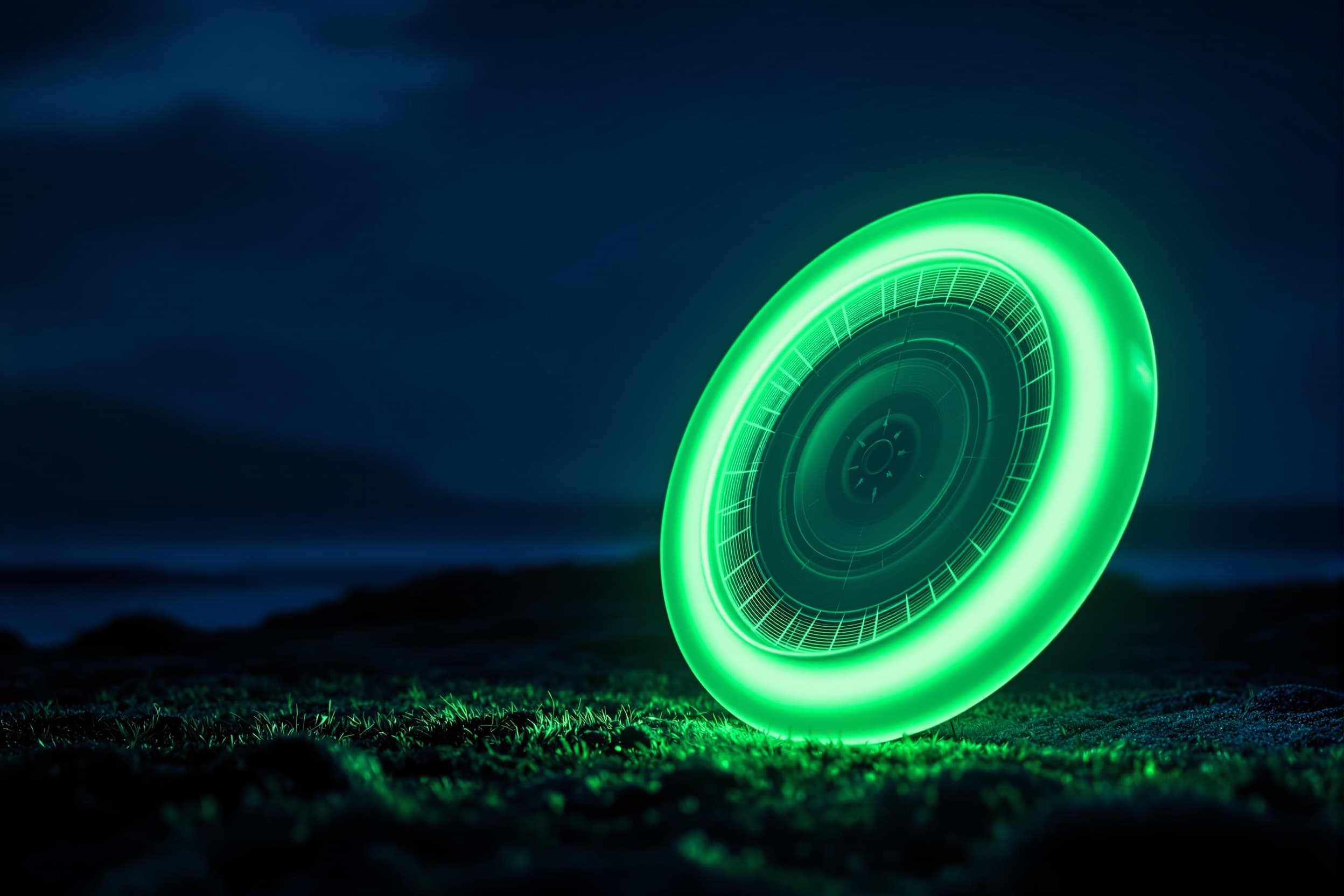
A 27 cm diameter, 175 g injection-molded flying disc for outdoor sports and night recreation. The polyethylene body features a translucent ring with photoluminescent material (strontium aluminate) that glows green for 4–8 hours after charging from sunlight or UV light. An optional premium variant includes an integrated LED ring with rechargeable battery and USB-C charging.

Feasibility at a glance
PT localization
8/10
High
The whole build can be sourced in Portugal.
Per unit
€3–8 per unit (basic); €12–18 per unit (LED variant)
at 10000-unit volume
Starter batch
10,000units
minimum viable run
To first batch
10weeks
7 phases, design to ship
Budget
€65,000–85,000 total: €55k–65k product cost
all-in estimate
Bottom line
For a 10,000-unit run of glow-in-the-dark flying discs, white-labeling from an established EU sporting goods or promotional products manufacturer offers the fastest time-to-market with proven quality. Portugal lacks specialized injection molding capacity for high-performance sports plastics and photoluminescent compounding at this scale. The white-label route leverages existing tooling, certifications (EN 71, RoHS, REACH), and established supply chains for photoluminescent masterbatch and LED electronics. EU partners can deliver tested, compliant products in 8–10 weeks vs. 14–18 weeks for local tooling development. The LED variant requires SMT and battery integration expertise that Portuguese manufacturers in the registry do not possess.
4 capabilities
Provides a regulation-weight flying disc for outdoor throwing sports and recreational games
Glows in the dark after charging from sunlight or UV light, enabling nighttime visibility and play
Optional LED variant actively illuminates the disc for enhanced brightness and extended play sessions
Rechargeable via USB-C for convenient and sustainable power in the LED variant
5 stations · build route
Injection mold the disc body
Melt polyethylene blend and inject into a two-part mold to form the aerodynamic disc shape with integrated ring channel.
Compound and mold photoluminescent insert
Mix strontium aluminate photoluminescent masterbatch with translucent polymer and mold as a separate ring that fits into the disc body.
Assemble LED ring electronics (premium variant)
Solder LEDs onto flexible PCB strip, connect to battery and USB-C charging module, and seal in water-resistant housing.
Final assembly and sealing
Insert photoluminescent ring and optional LED assembly into disc body, apply seals or adhesive, and verify fit and function.
Quality testing and packaging
Test glow duration, LED brightness, charging function, and IP65 rating; pack in retail-ready recycled cardboard boxes.
Injection mold the disc body
Melt polyethylene blend and inject into a two-part mold to form the aerodynamic disc shape with integrated ring channel.
Compound and mold photoluminescent insert
Mix strontium aluminate photoluminescent masterbatch with translucent polymer and mold as a separate ring that fits into the disc body.
Assemble LED ring electronics (premium variant)
Solder LEDs onto flexible PCB strip, connect to battery and USB-C charging module, and seal in water-resistant housing.
Final assembly and sealing
Insert photoluminescent ring and optional LED assembly into disc body, apply seals or adhesive, and verify fit and function.
5 identified · 2 blocking
Critical
Battery compliance and safety (LED variant)
Lithium polymer batteries are subject to strict UN 38.3 transport testing, EU Battery Directive 2006/66/EC (being replaced by Battery Regulation 2023/1542), and product-specific safety requirements. Non-compliant batteries risk shipment rejection, customs seizure, or—worst case—thermal runaway incidents leading to product recalls and liability. Chinese battery cells often lack proper documentation, and counterfeit safety certifications are common. The USB-C charging circuit must also prevent overcharge, over-discharge, and short-circuit conditions per IEC 62368-1.
Mitigation — Specify battery cells from Tier 1 manufacturers (Samsung SDI, LG Chem, Panasonic) with full UN 38.3, IEC 62133, and UL certifications. Require battery management system (BMS) with overcharge/over-discharge/short-circuit protection. Conduct third-party testing (e.g., TÜV Rheinland, Intertek) for IEC 62368-1 and EN 62368-1 compliance before mass production. For white-label or EU partners, verify existing certifications and request test reports. Include battery disposal information and recycling symbols per Battery Regulation Article 13. Implement drop-test protocol to verify housing integrity and prevent cell puncture.
High
Photoluminescent material supply and quality variance
Strontium aluminate photoluminescent compounds are specialty materials with only a handful of EU suppliers (e.g., Lumilum AG, Glow Inc). Quality variance directly impacts glow duration and brightness—critical product differentiation. Supply disruptions or inconsistent masterbatch formulation could result in products that fail to meet the 4–8 hour glow specification, leading to customer dissatisfaction and returns. Lead times for specialty masterbatch can extend 6–8 weeks, and minimum order quantities may exceed project needs, tying up working capital.
Mitigation — Specify strontium aluminate grade (e.g., D50 15–25 µm particle size) and glow performance metrics (ISO 17398 or DIN 67510) in supplier contracts. Require certificate of analysis with each batch. Establish dual-source strategy by qualifying a second masterbatch supplier during pilot production. Conduct incoming QC using calibrated luminance meter to verify glow intensity at 10 min and 60 min post-charge. Maintain 4-week safety stock of masterbatch once supply chain is qualified.
Medium
EN 71 toy safety certification timeline and cost
If the product is marketed for children under 14 or sold in toy retail channels, it requires EN 71 toy safety certification covering mechanical/physical properties (Part 1), flammability (Part 2), and migration of certain elements (Part 3). Photoluminescent materials containing strontium aluminate must demonstrate compliance with migration limits for barium and other elements. Testing and certification typically require 4–6 weeks and €2,000–4,000 per product variant, delaying launch and increasing unit economics. Failure to certify before market entry exposes GETMILK to regulatory enforcement and product withdrawal.
Mitigation — Clarify target market positioning early: if marketed as 'sports equipment for ages 14+' rather than a toy, EN 71 may not apply (but general product safety directive still does). If toy classification is required, budget €3,500 for EN 71 Part 1–3 testing through accredited EU lab (e.g., TÜV SÜD, SGS, Eurofins). For white-label option, verify supplier's existing EN 71 certificates and confirm they cover the specific photoluminescent compound being used. For local or co-development, factor testing into project timeline (week 8–12) and pre-qualify materials with supplier test data before committing to full production molds.
Medium
IP65 water resistance validation and field failures
Achieving and maintaining IP65 rating (dust-tight, protected against water jets) for the LED variant requires precise housing design, gasket material selection, and consistent assembly process control. Field failures due to moisture ingress—especially after repeated impacts during play—can lead to LED malfunction, battery corrosion, and safety hazards. IP testing per IEC 60529 is time-consuming (2–3 weeks) and may reveal design flaws late in development, forcing expensive mold modifications or housing redesigns.
Mitigation — Specify IP65 testing per IEC 60529 as a hard gate before pilot production sign-off. Design housing with silicone gasket compression seal and ultrasonic welding or adhesive bonding for USB-C port cover. Use salt-spray resistant coatings on PCB and conformal coating on solder joints. Conduct mechanical shock testing (drop from 1.5 m onto concrete, 10 cycles) followed by immediate IP65 re-test to simulate field abuse. For white-label suppliers, request test reports and conduct independent verification testing on 10-unit sample before placing full order. Include IP65 rating and 'not for submersion' warnings in user documentation.
Medium
Tooling lead time and sampling iteration delays
Injection molds for a 27 cm flying disc with integrated ring channel and precise aerodynamic profile are non-trivial—requiring two-cavity tooling, potentially with slides or lifters for undercuts. European mold shops (especially in Portugal) have lead times of 8–12 weeks, and first-shot samples often reveal issues with flash, sink marks, or dimensional accuracy requiring mold adjustments (adding 2–4 weeks per iteration). Delays cascade into missed launch windows and increased carrying costs. Chinese tooling is faster (6–8 weeks) but adds communication overhead and shipping time.
Mitigation — For local or co-development options, front-load mold design with DFM (design for manufacturing) review by toolmaker before steel cutting. Use mold-flow simulation software (Moldflow, Moldex3D) to predict and resolve fill, warp, and cooling issues before fabrication. Build in 2-week contingency buffer for one round of mold adjustments. Specify T1 sample delivery in contract with acceptance criteria (dimensional tolerances, surface finish, part weight). For white-label option, eliminate this risk entirely by leveraging supplier's existing tooling. If speed is critical and volume justifies, consider aluminum prototype molds (3–4 week lead time, good for 5,000–10,000 shots) for market validation before committing to production steel.
10 weeks to first batch
Design finalization and supplier selection
wk 1–2Tooling fabrication OR white-label sampling
wk 3–4First article sampling and testing
wk 5–7Compliance certification and mold refinement
wk 8–9Pilot production run and validation
wk 10–11Full-scale production and final QC
wk 11–13Packaging and fulfillment preparation
wk 13Design finalization and supplier selection
wk 5–7 is the longest stretch — First article sampling and testing takes 3 weeks of the 13 weeks on this build.
6 materials · 6 processes
Materials
Processes
588 Portuguese manufacturers matched
None cover the whole build — it splits across steps.
12 tasks · 12 weeks to first batch
Week 1
2 tasks
Issue RFQs to 4 EU white-label suppliers
Send detailed RFQ to Eurodisc GmbH (DE), Innova Disc Golf (NL), Gewo Sport (DE), and Discmania (FI) specifying 10k mixed volume (70% basic photoluminescent, 30% LED variant), strontium aluminate glow specs (4–8 hr post-charge), 175g weight, IP65 for LED, delivery to Portugal. Request samples, lead time, MOQ, compliance docs (RoHS, REACH, EN 71), and unit pricing.
Define compliance strategy and testing lab
Determine market positioning (toy vs. sports equipment 14+) to clarify EN 71 requirement. Contact TÜV SÜD, SGS Portugal, or Eurofins for quote on EN 71 Parts 1–3, RoHS/REACH screening, IEC 60529 (IP65), and battery tests (UN 38.3, IEC 62133) for LED variant. Budget €3,500, timeline 4 weeks. Decide if white-label certs are sufficient or independent verification needed.
Weeks 2–3
2 tasks
Evaluate supplier samples and select partner
waits on Issue RFQs to 4 EU white-label suppliers
Receive physical samples from shortlisted suppliers (3–5 day expedited shipping). Test glow duration with UV charge + luminance meter at 10 min and 60 min. Verify LED runtime (target 6 hrs), USB-C charging, weight (175g ±5g), flight characteristics. Review compliance documentation (CoA for materials, existing EN 71/RoHS certs). Score on quality, cost, lead time, cert transferability. Select supplier and negotiate contract terms.
Finalize branding and packaging artwork
Design GETMILK logo placement on disc (pad printing or hot stamp), create retail packaging with CE marking, safety warnings (battery disposal, age guidance), recycling symbols per Packaging Directive, QR code for registration. Prepare print-ready files for supplier. Include Portuguese/English instructions for LED charging and care. Coordinate with supplier's graphics team on print feasibility.
Weeks 4–7
3 tasks
Submit samples for EN 71 and battery certification
waits on Evaluate supplier samples and select partner
Send 10 units (5 basic, 5 LED) from selected supplier to accredited EU test lab for EN 71 Parts 1–3 (mechanical, flammability, migration), RoHS/REACH, IEC 60529 (IP65 for LED), UN 38.3, IEC 62133. Provide supplier's material declarations to expedite. Track testing progress weekly. Timeline: 4 weeks. Address any non-conformances immediately via supplier material substitution.
Negotiate PO terms and place pilot order
waits on Evaluate supplier samples and select partner
Draft purchase agreement with selected supplier: 1,000-unit pilot (700 basic, 300 LED) as first batch, delivery week 6–7. Lock pricing, payment terms (30% deposit, 70% on delivery), quality acceptance criteria (AQL 2.5, glow duration spec, LED runtime), packaging specs, Incoterms (DDP to Portugal preferred). Confirm compliance doc delivery (DoC, test reports, material certs). Issue PO and deposit payment.
Set up 3PL and fulfillment workflow
Contract Portuguese 3PL or configure in-house warehouse for receiving 10k units (approx. 40 pallets). Define receiving QC protocol: visual inspection, random glow test, LED function check on 2% sample. Set up inventory system (SKUs for basic vs. LED), order processing for e-commerce, and returns handling. Prepare for week 10 bulk delivery.
Weeks 8–16
4 tasks
Receive and validate pilot batch
waits on Negotiate PO terms and place pilot order
Accept 1,000-unit pilot delivery (week 6–7). Conduct incoming QC: measure weight (175g ±5g) on 20-unit sample, charge and time glow duration (target 4–8 hrs), test LED runtime and USB-C charging on 10 LED units, inspect packaging quality and branding accuracy. Perform field testing (flight stability, durability after drops). Approve for full production or flag defects for supplier correction before scaling.
Finalize compliance documentation package
waits on Submit samples for EN 71 and battery certification
Receive all test reports from lab (EN 71, RoHS, REACH, IP65, battery certs). Draft Declaration of Conformity (DoC) naming GETMILK as importer/brand owner, listing applied directives (GPSR, RoHS, REACH, Battery Reg), referencing test reports. Compile technical file: product description, CAD, material specs, test reports, risk assessment, user instructions. Store for 10 years per EU market surveillance requirements. Prepare summaries for customs and retail partners.
Place full production order (9,000 units)
waits on Receive and validate pilot batch
Ongoing
1 task
Monitor field performance and supplier relationship
Track customer feedback on glow duration, LED reliability, and any quality issues (moisture ingress, charging failures). Log defects and calculate return rate. Hold monthly supplier reviews to address quality trends, plan reorders, discuss product improvements (new colors, features). Maintain compliance doc updates if materials or suppliers change. Plan 6-month inventory refresh and negotiate volume pricing for next order.
4 roles to fill before month one
Eurodisc GmbH (Germany) – white-label sporting goods supplier
Jürgen Wald, Sales Director
Primary contact for RFQ, samples, and pricing negotiation. Eurodisc has 20+ years in promotional discs and existing photoluminescent product line with EN 71 certs. Jürgen can expedite sampling, clarify compliance doc transferability, and negotiate favorable terms for 10k mixed order. Critical for supplier selection by week 2.
SGS Portugal – testing and certification lab
Ana Sousa, Compliance Engineer
Manages EN 71, RoHS/REACH, and IEC testing for consumer products. Ana will quote testing package (€3.5k, 4 weeks), advise on toy vs. sports classification, coordinate sample logistics, and expedite results if timeline pressures arise. Essential for compliance gate (week 4–8) and DoC preparation.
Innova Disc Golf (Netherlands) – alternative white-label source
Pieter van Dijk, Product Manager
Backup supplier if Eurodisc pricing or lead time is unfavorable. Innova specializes in disc golf equipment with premium plastics and glow materials. Pieter can provide technical specs on strontium aluminate loading, LED integration options, and access to their Asian battery supply chain. Maintains competitive tension in negotiation and fallback if primary supplier stumbles.
Portuguese 3PL/fulfillment partner (e.g., Rangel Logistics, Luís Simões)
5 things to avoid in this plan
supply
Lock photoluminescent spec (strontium aluminate grade, 4–8 hr glow) in supplier contract with batch CoA requirement—quality variance will kill differentiation and drive returns
certification
Verify EN 71 and battery certs (UN 38.3, IEC 62133) are current and transferable to GETMILK branding; non-compliance discovered post-production forces costly rework or disposal
quality
Scrutinize LED variant IP65 claims with independent test—field moisture failures create safety liability and tank premium SKU reputation
lead time
Build 2-week schedule buffer into pilot delivery (week 6–7 target); supplier production delays cascade into missed summer launch window and lost seasonal revenue
lead time
Negotiate clear AQL 2.5 acceptance criteria and defect remediation terms upfront—discovering 10%+ defect rate at bulk delivery (week 10) with no recourse leaves founder stuck with unsellable inventory
2 tasks in week 1
Issue RFQs to 4 EU white-label suppliers
Quality testing and packaging
Test glow duration, LED brightness, charging function, and IP65 rating; pack in retail-ready recycled cardboard boxes.
Tooling fabrication OR white-label sampling
First article sampling and testing
Compliance certification and mold refinement
Pilot production run and validation
Full-scale production and final QC
Packaging and fulfillment preparation
Issue PO for remaining 9,000 units (6,300 basic, 2,700 LED) based on pilot validation and initial sales feedback. Confirm delivery week 10, stagger shipments if warehouse capacity limited. Lock same quality specs, update packaging if any pilot learnings (e.g., instruction clarity). Arrange final payment schedule and freight forwarding to Portugal. Supplier production time: 2 weeks.
Conduct final QC and stock fulfillment center
waits on Place full production order (9,000 units)
Receive 9,000-unit bulk shipment week 10. Perform AQL 2.5 sampling inspection (315-unit sample size for lot): check glow intensity with luminance meter, LED function, packaging integrity, branding accuracy. Quarantine any defective units. Stock fulfillment center with approved inventory, update system with final quantities by SKU. Activate e-commerce listings and B2B sales channels. Release pilot units for marketing/PR seeding.
Ricardo Mendes, Operations Manager
Handles inbound receiving of 10k units (40 pallets), warehouse storage, QC sampling, inventory management, and order fulfillment. Ricardo sets up SKU system, trains staff on LED product handling (battery safety), coordinates returns, and scales capacity for future reorders. Critical for week 7 pilot and week 10 bulk deliveries.
588 matched · 8 shown, ranked by coverage
Covers, left to right: Injection Molding · SMT Assembly · Battery Pack Assembly · Final Assembly · Testing & Inspection · Packaging
Manufacturer
Location
Covers
Certifications
People
Portuguese producers per required step
Final Assembly
369
Testing & Inspection
178
Injection Molding
174
SMT Assembly
36
Battery Pack Assembly
3
Packaging
0
How many cover more than one step
The gap
For a 10,000-unit run of glow-in-the-dark flying discs, white-labeling from an established EU sporting goods or promotional products manufacturer offers the fastest time-to-market with proven quality. Portugal lacks specialized injection molding capacity for high-performance sports plastics and photoluminescent compounding at this scale. The white-label route leverages existing tooling, certifications (EN 71, RoHS, REACH), and established supply chains for photoluminescent masterbatch and LED electronics. EU partners can deliver tested, compliant products in 8–10 weeks vs. 14–18 weeks for local tooling development. The LED variant requires SMT and battery integration expertise that Portuguese manufacturers in the registry do not possess.
Send one RFQ to the top 4
Codica Cables, REROM, Porcher Industries, MOLDMAK — same package, one click.