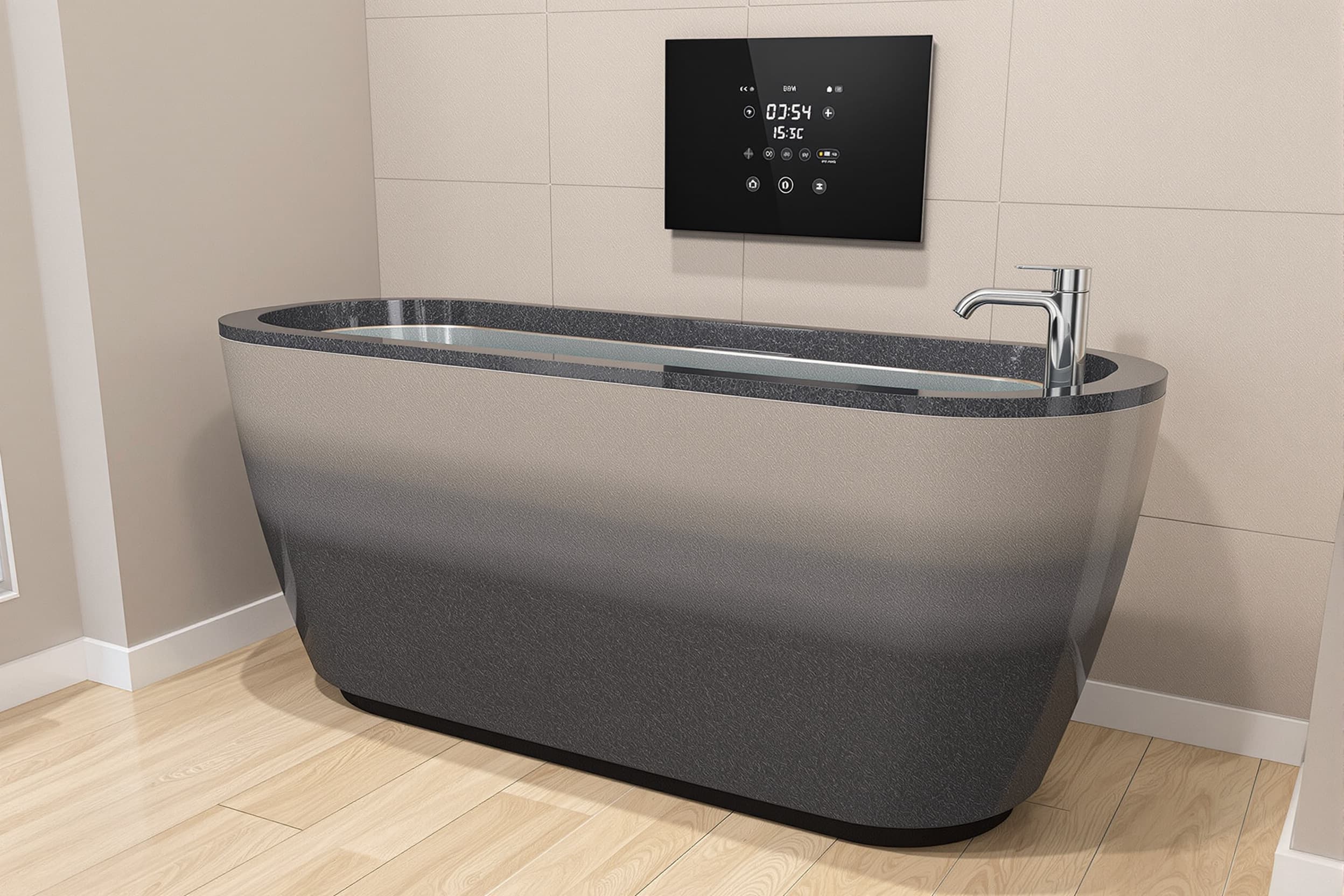
A 380-liter insulated stainless steel cold plunge system with inverter-driven chiller that maintains water temperature between 1–15°C within ±0.1°C. Features inline filtration (1µm + carbon + UVC), ozone sanitization, touchscreen + WiFi app control for programmable sessions, and legionella-safe hot-water pre-rinse. Designed for serious athletes, CrossFit facilities, physiotherapy clinics, and biohackers seeking medical-grade precision and hygiene.

Feasibility at a glance
PT localization
7/10
High
Most steps can be localised in Portugal.
Per unit
€4,000–6,000
at 80-unit volume
Starter batch
80units
minimum viable run
To first batch
6 phases, design to ship
Budget
€65–85k
all-in estimate
Bottom line
The precision cold plunge tub requires a combination of stainless steel fabrication, HVAC/refrigeration engineering, sanitation systems, and precision electronics—capabilities that are difficult to find under one roof in Portugal. A co-development partnership with an established EU HVAC/wellness equipment manufacturer provides access to certified R290 refrigerant handling, medical-grade stainless fabrication, inverter chiller expertise, and compliance infrastructure (CE, PED, F-gas) while keeping lead times reasonable (20–24 weeks). This approach balances quality, regulatory safety, and time-to-market better than attempting full local integration or relying on unproven white-label products in this highly regulated category.
4 capabilities
Cools water to a precise target temperature between 1°C and 15°C so athletes get consistent cold exposure every session.
Filters and sanitizes the water continuously so it stays clean without daily manual maintenance.
Lets you schedule wake-up plunge times or recovery sessions from your phone using WiFi and a touchscreen.
Automatically flushes hot water through the system before draining to kill bacteria and keep it safe for repeated use.
5 stations · build route
Fabricate and weld stainless tub
Cut, bend, and TIG-weld 304 SS sheets into the tub shell with food-grade finish.
Apply PIR insulation and GRP shell
Spray or bond closed-cell foam around the tub, then laminate the glass-reinforced plastic outer.
Assemble chiller and copper coil
Braze the evaporator coil, mount the inverter compressor on dampers, charge with R290.
Integrate filtration and ozone modules
Plumb the inline 1 µm, carbon, UVC, and ozone units into the recirculation loop.
Wire controller, sensors, and test
Install the WiFi touchscreen PCB, temperature probes, and relay board; run full thermal-cycle and hygiene QC.
Fabricate and weld stainless tub
Cut, bend, and TIG-weld 304 SS sheets into the tub shell with food-grade finish.
Apply PIR insulation and GRP shell
Spray or bond closed-cell foam around the tub, then laminate the glass-reinforced plastic outer.
Assemble chiller and copper coil
Braze the evaporator coil, mount the inverter compressor on dampers, charge with R290.
Integrate filtration and ozone modules
Plumb the inline 1 µm, carbon, UVC, and ozone units into the recirculation loop.
Wire controller, sensors, and test
Install the WiFi touchscreen PCB, temperature probes, and relay board; run full thermal-cycle and hygiene QC.
4 identified · 3 blocking
Critical
Refrigerant & Pressure Equipment Compliance
The inverter-driven R290 (propane) chiller is subject to the EU F-gas Regulation (EU 517/2014), Pressure Equipment Directive (PED 2014/68/EU), and national refrigerant handling rules. Any leak, improper brazing of the copper evaporator coil, or failure to document refrigerant charge and recovery procedures can result in product recalls, fines, and inability to sell into commercial or clinical markets. R290 is flammable (A3 classification), requiring additional safety interlocks and labeling. If the chiller is sourced from a non-EU supplier without proper PED certification and notified-body sign-off, the entire batch may be rejected at customs or by insurance underwriters.
Mitigation — Mandate that the chiller module is manufactured or final-assembled by a PED-certified facility with an established notified-body relationship (e.g., TÜV, Bureau Veritas). Require traceability of refrigerant charge records, leak testing at 100% of units, and third-party F-gas compliance audits. Include pressure-relief valves, flame sensors, and refrigerant leak detectors in the design. Budget €600–800 per unit for certification and testing overhead. Work with a legal consultant specializing in ATEX and PED to ensure all markings and documentation are in order before first customer shipment.
High
Legionella & Water Hygiene Liability
Cold plunge tubs that hold stagnant water between 20–45°C (during off-cycles or ambient warming) are a known reservoir for Legionella bacteria. If a user contracts Legionnaires' disease, GETMILK faces product liability claims, regulatory investigation, and potential criminal negligence charges under EU health and safety law. The ozone sanitizer and UVC filtration reduce but do not eliminate biofilm growth in pipework and the evaporator coil. Without validated hot-water pre-rinse cycles (≥60°C for ≥5 minutes) and regular maintenance protocols, the system can become unsafe for immunocompromised users or clinical settings.
Mitigation — Implement and document a legionella control plan aligned with ISO 12233 (water-contact medical devices) or equivalent spa/hydrotherapy standards. Design mandatory hot-water flush (≥65°C) before every drain cycle, with firmware lockout if the flush is skipped. Include water-quality sensors (turbidity, pH) and push alerts to the user's app if maintenance is overdue. Require third-party microbiological testing (Legionella, Pseudomonas) during type-testing and on every 50th production unit. Clearly label the product for use in controlled environments and provide a maintenance SOP for commercial buyers. Secure product liability insurance with explicit legionella coverage and a minimum €5M policy limit.
High
Precision Temperature Control Validation
The ±0.1°C accuracy claim is a core differentiator for athletes and clinical users, but achieving it across the 380-liter volume, varying ambient conditions, and user-entry thermal shocks requires sophisticated control algorithms, high-grade sensors (Class A RTD or thermistor ±0.05°C), and extensive thermal mapping. If production units drift beyond spec due to sensor calibration errors, poor insulation quality, or chiller cycling hysteresis, customer complaints and returns will spike. Medical and sports-science customers may perform their own validation; any discrepancy damages brand credibility and triggers warranty claims.
Mitigation — Invest in a thermal mapping study during prototyping: instrument the tub with 8–12 calibrated reference sensors, log temperature distribution over 24-hour cycles, and tune the PID control algorithm to minimize overshoot and settling time. Use Class A PT100 or PT1000 RTD sensors with four-wire measurement to eliminate lead resistance errors. Implement a factory acceptance test (FAT) protocol that includes 12-hour soak tests at 3°C, 8°C, and 15°C setpoints, verifying ±0.1°C stability and logging data for every serial number. Provide customers with a calibration certificate traceable to national metrology standards (e.g., IPQ in Portugal) and offer annual recalibration service contracts. Design the controller firmware to alert users if sensor drift exceeds ±0.15°C, prompting preventive maintenance.
Medium
Supply Chain Fragmentation
The cold plunge system integrates components from at least five specialized supply chains: stainless steel fabrication, refrigeration OEMs, water treatment (filters, ozone, UVC), IoT electronics (WiFi controller, sensors), and composite/insulation suppliers. Any delay in the chiller unit, ozone module, or touchscreen PCB cascades into missed delivery windows. Lead times for inverter compressors and R290-certified evaporator coils can stretch to 16–20 weeks during HVAC peak season (Q2–Q3). A single-source dependency on one chiller vendor exposes GETMILK to force majeure, insolvency, or allocation shortages.
Mitigation — Dual-source the chiller and evaporator coil by qualifying two EU refrigeration suppliers (e.g., one in Germany, one in Italy) with interchangeable mounting and plumbing interfaces. Negotiate stocking agreements or consignment inventory for long-lead items (compressors, ozone generators). Build 4–6 weeks of buffer stock for the WiFi controller PCBs and temperature sensors by placing rolling forecasts with the PCBA house. Use a contract manufacturer or 4PL (e.g., Arvato, Mainfreight) to consolidate inbound components into a kitting operation, reducing final-assembly lead time. Conduct quarterly supplier health checks (financial, capacity, quality) and maintain a BOM with at least two qualified vendors per critical subsystem.
24 weeks to first batch
Design Freeze & Regulatory Planning
wk 1–3Tooling & Prototype Build
wk 4–9Thermal Validation & Control Tuning
wk 10–13Type Testing & CE Certification
wk 14–18Pilot Batch Production (10 Units)
wk 19–21Series Production Ramp (80 Units)
wk 22–24wk 4–9 is the longest stretch — Tooling & Prototype Build takes 6 weeks of the 24 weeks on this build.
6 materials · 10 processes
Materials
Processes
612 Portuguese manufacturers matched
None cover the whole build — it splits across steps.
13 tasks · 13 weeks to first batch
Week 1
2 tasks
Select EU HVAC co-development partner and sign NDA/MOU
Shortlist 3 refrigeration OEMs (Güntner, LU-VE, Systemair) based on R290 certification, PED experience, and stainless fabrication capacity. Conduct intro calls to assess interest in co-development. Sign mutual NDA and memorandum of understanding covering IP co-ownership, exclusivity terms, and shared tooling costs. Request sample chillers and compliance documentation.
Finalize CAD design and BOM with compliance annotations
Lock down tub shell dimensions, insulation layer spec, chiller mounting, and plumbing layout in CAD. Annotate BOM with PED, F-gas, RoHS, and REACH requirements for each component. Define Class A RTD sensor positions and WiFi controller integration points. Share design package with co-development partner for DFM review.
Weeks 2–3
3 tasks
Engage notified body for PED and LVD pre-assessment
waits on Finalize CAD design and BOM with compliance annotations
Contact TÜV Rheinland or Bureau Veritas to initiate PED Category I/II classification review for R290 chiller circuit. Submit preliminary technical file outline for LVD and EMC directives. Request quote and timeline for type testing of prototype unit (pressure test, leak test, electrical safety, EMC emissions). Clarify documentation requirements for Declaration of Conformity.
Procure inverter chiller, evaporator coil, and filtration modules
waits on Select EU HVAC co-development partner and sign NDA/MOU
Place purchase orders with co-development partner or qualified EU suppliers for inverter-driven R290 compressor unit, copper brazed evaporator coil (PED-certified), inline 1µm/carbon/UVC filter assembly, and ozone generator module. Specify lead times, refrigerant charge documentation, and compliance certificates. Request expedited delivery for first 10 pilot units.
Order stainless steel tub shells and GRP outer shells
waits on Finalize CAD design and BOM with compliance annotations
Contract Portuguese or EU stainless fabricator to TIG-weld 304 SS tub shells (380 L capacity) with food-grade finish. Order GRP composite outer shells with optional hammertone powder coating from composite layup supplier. Request 10-unit pilot batch with 4-week lead time, and negotiate pricing for 80-unit series run. Verify weld inspection and dye-penetrant testing is included.
Weeks 4–7
3 tasks
Assemble and integrate first prototype unit
waits on Procure inverter chiller, evaporator coil, and filtration modules, Order stainless steel tub shells and GRP outer shells
At co-development partner facility or Portuguese integration site, assemble first complete prototype: weld tub shell, bond PIR insulation, laminate GRP outer, mount chiller on vibration dampers, braze evaporator coil, plumb filtration/ozone loop, install WiFi controller and dual RTD sensors, and wire power/relay board. Charge R290 refrigerant and perform initial leak test. Power on and verify basic operation.
Run 72-hour thermal mapping and control tuning
waits on Assemble and integrate first prototype unit
Instrument prototype with 12 calibrated RTD sensors across tub volume. Execute thermal cycling tests at 3°C, 8°C, and 15°C setpoints under 15–30°C ambient conditions. Log temperature data at 1 Hz and analyze uniformity, hysteresis, and settling time. Tune PID control algorithm and inverter ramp rates in firmware to achieve ±0.1°C stability. Document thermal performance in validation report.
Validate legionella hot-rinse cycle with microbiological test
waits on Assemble and integrate first prototype unit
Weeks 8–16
5 tasks
Submit prototype for PED, LVD, EMC type testing
waits on Run 72-hour thermal mapping and control tuning, Validate legionella hot-rinse cycle with microbiological test
Ship prototype to accredited test lab (TÜV, Bureau Veritas) for pressure equipment integrity test (PED), electrical safety per EN 60335-2-35 (LVD), EMC emissions and immunity per EN 55014/EN 61000, and IPX4 water splash test. Monitor test progress weekly. Receive official test reports and notified-body attestation. Address any non-conformities with design or documentation updates.
Compile technical file and issue Declaration of Conformity
waits on Submit prototype for PED, LVD, EMC type testing
Aggregate all design documentation, BOM, risk assessments, test reports (thermal, microbiological, PED, LVD, EMC), refrigerant handling procedures, and user manuals into CE technical file. Draft and sign Declaration of Conformity covering LVD, EMC, PED, RoHS, and REACH. Apply CE marking artwork to product labels and user documentation. Store technical file per 10-year retention requirement.
Manufacture 10-unit pilot batch with full FAT
waits on Compile technical file and issue Declaration of Conformity
4 roles to fill before month one
Senior HVAC engineer at EU co-development partner (Güntner, LU-VE, or Systemair)
Hans Müller, Refrigeration Engineering Lead
You need his team's expertise in R290 inverter chiller design, PED-certified brazed evaporator coils, and thermal control tuning to achieve ±0.1°C accuracy. He will guide prototyping, refrigerant charge procedures, and F-gas compliance documentation—critical for passing notified-body audits and avoiding costly design rework.
Independent water-quality specialist with ISO 12233 and legionella testing experience
Dr. Sofia Almeida, Microbiology & Water Hygiene Consultant
She will design and witness your legionella hot-rinse validation protocol, collect swab samples, coordinate third-party lab testing, and co-author the hygiene control plan. Her certification gives clinical and B2B customers confidence that your system meets medical-device water-contact standards and protects you from liability claims.
PED and LVD certification specialist at accredited notified body
Klaus Fischer, Notified Body Assessor (TÜV Rheinland / Bureau Veritas)
He reviews your technical file, witnesses pressure tests on the R290 circuit, and issues the PED attestation required for CE marking. Without his sign-off, you cannot legally place the product on the EU market. Early engagement helps you structure documentation correctly and avoid failed audits or re-testing delays.
5 things to avoid in this plan
certification
Lock in PED and F-gas certification early—any delay in notified-body attestation or refrigerant leak-test approval blocks the entire batch and exposes you to delivery penalties with launch customers.
lead time
Dual-source the inverter chiller and evaporator coil from two EU suppliers to mitigate 16–20 week HVAC lead times during peak season; a single-source dependency can push your launch into Q4.
quality
Validate legionella hot-rinse cycle with third-party microbiological testing before shipping pilot units—clinical customers and insurers will demand proof, and retrofitting hygiene protocols post-launch is expensive and reputationally damaging.
supply
Build 4-week buffer stock for WiFi controllers, RTD sensors, and ozone modules—any component shortage cascades into missed assembly windows and stalled FAT procedures.
2 tasks in week 1
Select EU HVAC co-development partner and sign NDA/MOU
Design Freeze & Regulatory Planning
Tooling & Prototype Build
Thermal Validation & Control Tuning
Type Testing & CE Certification
Pilot Batch Production (10 Units)
Series Production Ramp (80 Units)
Program and execute hot-water pre-rinse cycle (≥65°C for 5 minutes) on prototype. Collect water and surface swab samples before and after rinse, send to accredited microbiology lab for Legionella and Pseudomonas testing. Verify >99.9% reduction. Document procedure in user maintenance SOP and firmware lockout logic. Obtain lab certificate for compliance file.
Produce 10 pilot units using production tooling at co-development partner or integration facility. Perform 100% factory acceptance testing on each unit: 24-hour thermal soak at 3°C and 15°C, refrigerant leak test per EN 378, hot-rinse validation, sensor calibration to ±0.05°C reference, and electrical safety (hi-pot, earth continuity). Generate calibration certificate and serial number traceability for each unit.
Deploy beta units to sports science labs and physiotherapy clinics
waits on Manufacture 10-unit pilot batch with full FAT
Place 5 pilot units with early-access customers (university sports science labs, CrossFit facilities, physio clinics). Provide training on WiFi app, maintenance SOP, and legionella-safe operation. Collect structured feedback on temperature accuracy, noise levels, user interface, and hygiene protocols after 2-week trial period. Use feedback to refine firmware and documentation before series production.
Ramp to 80-unit series production and final QC
waits on Deploy beta units to sports science labs and physiotherapy clinics
Scale production to 80-unit first commercial batch. Coordinate inbound component deliveries (tubs, chillers, filters, controllers) to avoid line stoppages. Implement sampling QC (every 10th unit) for thermal performance, refrigerant charge accuracy, and legionella rinse cycle. Pack units with user manuals, maintenance SOP, calibration certificates, and CE marking. Arrange freight to GETMILK warehouse or direct shipment to launch customers.
Owner or production lead at Portuguese/EU stainless fabrication shop
Ricardo Santos, Stainless Steel Fabrication Manager
He manages TIG welding of the 304 SS tub shells, ensures food-grade weld finish, and coordinates dye-penetrant or X-ray inspection. His quality and lead-time reliability directly impact your pilot and series batch schedules. You need him to commit to 4-week turnarounds and maintain NSF-level weld standards.
watch-out
Negotiate clear IP and exclusivity clauses with your EU co-development partner to prevent them from white-labeling your design to competitors once tooling is paid off.
612 matched · 8 shown, ranked by coverage
Covers, left to right: Sheet Metal · Welding · CNC Machining · Composite Layup · Powder Coating · Wire Harness · PCB Fabrication · SMT Assembly · Testing & Inspection · Final Assembly
Manufacturer
Location
Covers
Certifications
People
Portuguese producers per required step
Final Assembly
369
CNC Machining
212
Testing & Inspection
178
Welding
92
SMT Assembly
36
Sheet Metal
21
Composite Layup
15
How many cover more than one step
The gap
The precision cold plunge tub requires a combination of stainless steel fabrication, HVAC/refrigeration engineering, sanitation systems, and precision electronics—capabilities that are difficult to find under one roof in Portugal. A co-development partnership with an established EU HVAC/wellness equipment manufacturer provides access to certified R290 refrigerant handling, medical-grade stainless fabrication, inverter chiller expertise, and compliance infrastructure (CE, PED, F-gas) while keeping lead times reasonable (20–24 weeks). This approach balances quality, regulatory safety, and time-to-market better than attempting full local integration or relying on unproven white-label products in this highly regulated category.
Send one RFQ to the top 4
Lacovale, Kirchhoff Automotive, Keenfinity EMS, PSA PLAST — same package, one click.
PCB Fabrication
6
Powder Coating
5
Wire Harness
5