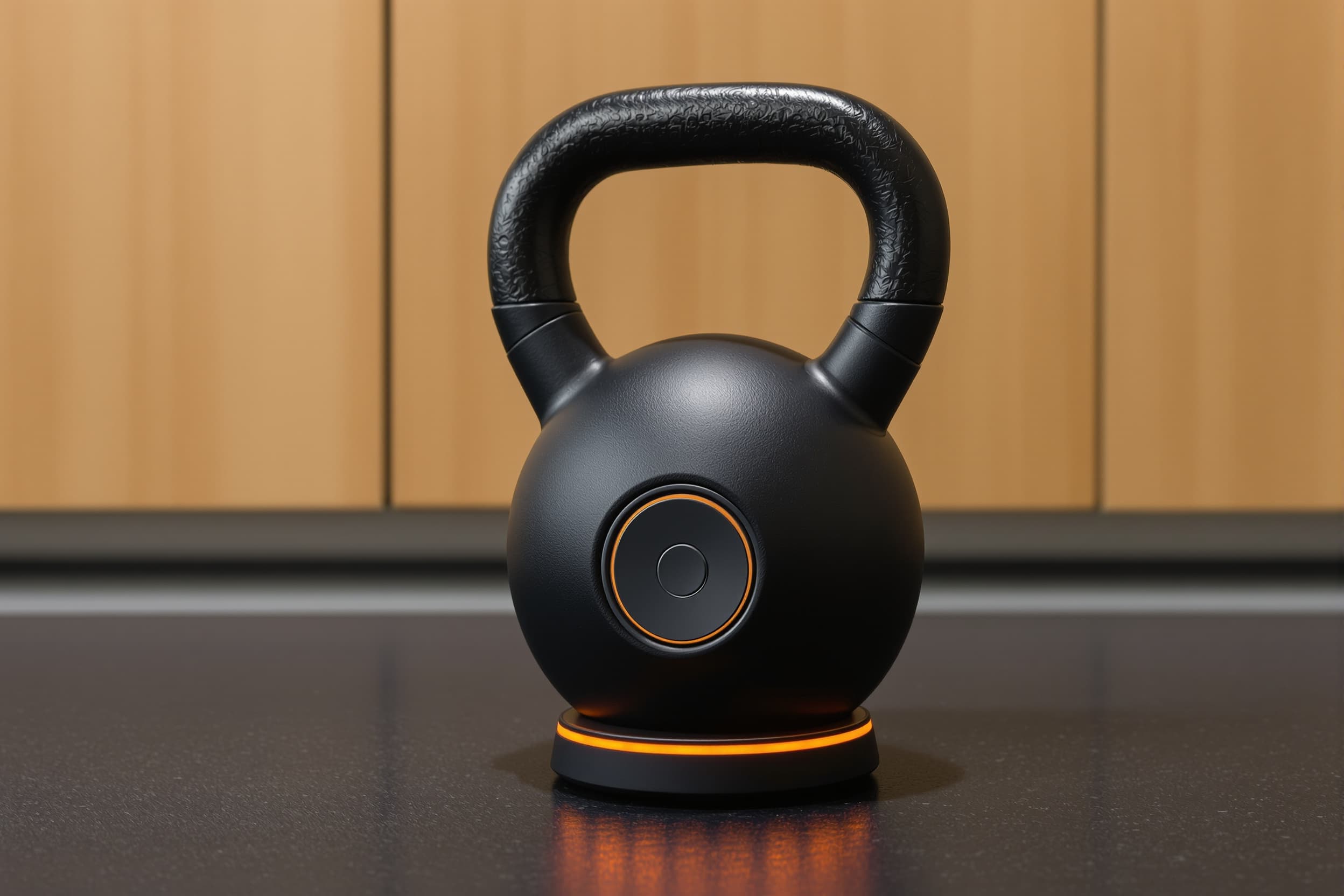
A ruggedized cast-iron kettlebell (16–32 kg) with embedded inertial measurement unit, magnetometer, and capacitive grip sensors that track swing path, tempo, asymmetry, and grip transitions. Wirelessly charges via inductive cradle and streams rep-by-rep movement-quality metrics over BLE. Designed for CrossFit, functional-fitness training, and physiotherapy applications where repeated drops and impacts are routine.

Feasibility at a glance
PT localization
6/10
Partial
Most steps can be localised in Portugal.
Per unit
€120–180
at 500-unit volume
Starter batch
500units
minimum viable run
To first batch
18weeks
8 phases, design to ship
Budget
€95,000–135,000 including €40k NRE
all-in estimate
Bottom line
A smart kettlebell demands three specialized capabilities—cast-iron foundry work, IP67-rated electronics integration, and shock-hardened sensor assembly—that no single Portuguese manufacturer in the registry possesses. Co-developing with an EU partner combines Portugal's machining and metal-finishing expertise with a northern European IoT integrator's experience in ruggedized sports electronics, enabling IP67 sealing, drop-testing, and BLE certification while keeping lead times under 18 weeks and meeting CE/RED/RoHS requirements within the EU regulatory framework.
4 capabilities
Tracks the swing path, tempo, and symmetry of each rep using sensors inside the handle
Detects whether you are gripping with one hand or two and notices when you shift your grip mid-lift
Wirelessly charges on a cradle so sweat and moisture never damage charging ports
Sends live feedback to your phone showing movement quality, fatigue trends, and video overlays
5 stations · build route
Gravity-cast the iron body
Pour molten cast iron into a sand or permanent mold to form the traditional kettlebell shape and weight.
Machine the electronics cavity and handle bore
CNC-mill or turn precise pockets and threads in the body for the stainless insert and handle attachment.
Assemble and pot the sensor PCB
Solder the IMU, grip sensors, BLE module, and Qi coil onto the board, then encapsulate in epoxy inside the stainless cavity.
Chrome-plate the handle and vinyl-dip the body
Electroplate the steel handle for corrosion resistance, then dip the cast body in vinyl plastisol and cure.
Final assembly, sealing, and drop testing
Press-fit or thread the electronics insert into the body, seal to IP67, then drop-test and verify BLE pairing and charging.
Gravity-cast the iron body
Pour molten cast iron into a sand or permanent mold to form the traditional kettlebell shape and weight.
Machine the electronics cavity and handle bore
CNC-mill or turn precise pockets and threads in the body for the stainless insert and handle attachment.
Assemble and pot the sensor PCB
Solder the IMU, grip sensors, BLE module, and Qi coil onto the board, then encapsulate in epoxy inside the stainless cavity.
Chrome-plate the handle and vinyl-dip the body
Electroplate the steel handle for corrosion resistance, then dip the cast body in vinyl plastisol and cure.
Final assembly, sealing, and drop testing
5 identified · 3 blocking
Critical
Shock and drop-test failures due to PCB or potting defects
A kettlebell designed for CrossFit and functional training will be dropped from 1–2 meters onto rubber mats dozens of times per week. If the IMU mounting, solder joints, or epoxy potting cannot absorb repeated 50–100 g shocks, the sensor will drift, the BLE connection will drop, or the battery will crack. Field failures trigger warranty returns, negative reviews, and potential liability if a cracked battery vents or leaks. Even a 2% field-failure rate at 500 units means 10 returns and a damaged brand reputation.
Mitigation — Specify MIL-STD-810G Method 516 shock testing (or equivalent EN 60068-2-27) with a minimum of 50 drops from 2 meters onto a hard rubber surface. Require the electronics integrator to use automotive-grade IMUs (e.g., Bosch BMA456 with 16 g shock rating) and conformal-coat the PCB before potting. Perform destructive testing on 5 units from each production batch, disassembling after 100 drops to inspect solder joints and potting adhesion. Implement a 2-year warranty and track return rates; if >1%, initiate a root-cause analysis and potting-process audit.
High
Cast-iron foundry capacity and lead-time volatility
European foundries serving automotive and industrial markets often allocate capacity 6–9 months ahead, and smaller fitness orders (500 units) may be deprioritized during high-demand cycles. Sand-mold or permanent-mold tooling for a kettlebell shape requires 4–6 weeks of setup, and any quality issue (porosity, dimensional variance) can delay the entire batch by 3–4 weeks. If the foundry is in Poland or Spain, logistics delays or strikes can further extend lead times.
Mitigation — Pre-book foundry capacity with a signed frame agreement covering 2–3 production runs (1,500–2,000 units over 12 months). Require the foundry to produce and inspect 10 qualification castings before committing to the full batch. Maintain a safety stock of 100 cast bodies after the first run to buffer against future foundry delays. Qualify a backup foundry in a different EU country (e.g., Italy or Germany) with a secondary tooling set.
High
CE and RED compliance for ruggedized BLE sports device
The kettlebell must meet CE marking requirements across the Low Voltage Directive (LVD), Electromagnetic Compatibility (EMC) Directive, and the Radio Equipment Directive (RED) for the BLE module. Additionally, the Qi wireless charging coil introduces inductive EMI that can interfere with the IMU magnetometer, and the epoxy potting must not degrade under repeated shock (affecting the EN 60950 or EN 62368 safety tests). Testing at a notified body (TÜV, Intertek) costs €8k–15k and takes 6–8 weeks; any failure triggers a redesign loop.
Mitigation — Select a pre-certified BLE module (e.g., Nordic nRF52840 with FCC/CE modular approval) to simplify RED compliance. Conduct pre-compliance EMC and drop-testing at an independent lab (e.g., Applus+ in Spain) before submitting to the notified body. Design the stainless-steel cavity as a partial Faraday shield to contain Qi coil emissions. Budget €20k and 8 weeks for certification in the project plan, and engage a regulatory consultant (e.g., CE-Check or Compliance & Risks) to review the technical file before submission.
Medium
Firmware and sensor-algorithm IP leakage
The core value of a smart kettlebell lies in the algorithms that interpret IMU data into swing tempo, asymmetry, and fatigue metrics. If the electronics integrator or any subcontractor gains access to the full firmware source code and calibration datasets, they can replicate the product or sell the algorithms to competitors. This risk is elevated when working with Chinese ODMs but also present with smaller EU EMS providers who may lack robust NDA enforcement or access controls.
Mitigation — Partition the firmware into a non-proprietary sensor-driver layer (delivered to the EMS for flashing) and a proprietary analytics layer that runs on the smartphone app or a secure cloud backend. Use encrypted BLE communication and authenticate the app before streaming calibrated sensor data. Sign a detailed IP assignment and NDA with the EMS, specifying that all calibration data, PCB layouts, and potting recipes remain your property. Conduct annual IP audits and restrict access to firmware source repositories to named individuals.
Medium
Integration and testing delays between foundry and electronics partners
When the cast body is produced in Spain and the electronics are assembled in Germany, the final integration—press-fitting the stainless insert, sealing to IP67, and running drop/pairing tests—must happen at one of the two sites or a third location. Any dimensional mismatch (e.g., the machined bore is 0.5 mm undersized) or sealing-gasket issue will halt production while parts are reworked or reshipped. This inter-plant coordination can add 2–4 weeks to the timeline and inflate logistics costs.
Mitigation — Define a clear integration plan with dimensional tolerances (±0.2 mm for the cavity bore) and a go/no-go gauge set shared between the foundry and EMS. Produce 10 pilot units using production tooling and ship cast bodies and electronics to a neutral assembly site (e.g., a contract manufacturer in Portugal or the Netherlands) for integration testing. Lock in the assembly process with a documented work instruction, torque specs, and IP67 test protocol (submersion in 1 m water for 30 min). Build a 2-week buffer into the project schedule for rework and retesting.
18 weeks to first batch
CAD finalization, mold design, and PCB layout
wk 1–4Mold fabrication, PCB fab, and component procurement
wk 5–9Pilot casting run, PCB assembly, and potting trials
wk 10–12Pilot integration, IP67 testing, and design validation
wk 13–14Tooling refinement, compliance testing, and charging cradle development
wk 15–20Production batch: casting, machining, plating, and vinyl dipping
wk 21–23Final assembly, sealing, drop-testing, and BLE pairing
wk 24–25Final inspection, packaging, and shipment to fulfillment center
wk 26wk 15–20 is the longest stretch — Tooling refinement, compliance testing, and charging cradle development takes 6 weeks of the 26 weeks on this build.
6 materials · 9 processes
Materials
Processes
637 Portuguese manufacturers matched
None cover the whole build — it splits across steps.
15 tasks · 18 weeks to first batch
Week 1
2 tasks
Finalize CAD models and issue RFQs to Spanish foundries and German EMS partners
Lock the kettlebell body geometry, electronics cavity dimensions, and handle interface. Generate manufacturing drawings with GD&T callouts for the cast body, stainless insert, and handle. Send RFQ packages to 3 Spanish/Polish foundries (Fundiciones de Precisión, ASGE) and 2 German electronics integrators (Würth Elektronik eiSos, ON Semi CZ). Request quotes for 500-unit pilot including mold NRE, per-unit cost, and lead time. Specify IP67, MIL-STD-810G drop requirements, and BLE module preferences (Nordic nRF52840).
Engage regulatory consultant for CE/RED roadmap and notified-body selection
Hire a European compliance consultant (e.g., CE-Check, Compliance & Risks) to draft a compliance roadmap covering LVD, EMC, RED, RoHS, and IP67 testing. Identify a notified body (TÜV Rheinland, Intertek) for RED module testing and obtain a quote and timeline (expect €10k–15k, 6–8 weeks). Confirm that the chosen BLE module (Nordic nRF52840) has modular CE/FCC approval to simplify RED filing.
Weeks 2–3
2 tasks
Select foundry and EMS partners, sign frame agreements, and release POs for tooling
waits on Finalize CAD models and issue RFQs to Spanish foundries and German EMS partners
Evaluate RFQ responses on cost, lead time, references, and willingness to produce 10 pilot castings before the full batch. Award contracts to one foundry (Spain preferred for proximity) and one EMS (Germany/Czech). Negotiate payment terms: 30% on tooling release, 40% on first-article approval, 30% on shipment. Issue purchase orders for sand-mold or permanent-mold tooling (€18k–25k), PCB layout and stencil fabrication (€6k), and injection mold for the charging cradle (€12k–15k).
Complete PCB schematic and layout, order long-lead components
waits on Select foundry and EMS partners, sign frame agreements, and release POs for tooling
Work with the EMS to finalize the PCB design: IMU (Bosch BMA456), magnetometer, capacitive-touch controller (e.g., Microchip CAP1208), BLE SoC (nRF52840), battery management IC, and Qi receiver coil. Run DFM review and generate Gerber files. Place orders for long-lead parts (IMU 4-week lead, BLE SoC 6-week lead, 18650 shock-rated Li-ion cells 4-week lead). Order 50 prototype PCBs from a European fab (2-week lead). Reserve stainless-steel bar stock for cavity inserts with the foundry's machining partner.
Weeks 4–7
3 tasks
Conduct joint design review with foundry and EMS on integration and sealing
waits on Select foundry and EMS partners, sign frame agreements, and release POs for tooling
Host a 2-day on-site or virtual design review with the foundry and EMS. Walk through the assembly sequence: casting → machining cavity bore → chrome-plating handle → vinyl dipping body → press-fitting electronics insert → installing handle → sealing with gasket. Define dimensional tolerances (±0.2 mm on cavity ID, ±0.5 mm on handle threads). Agree on IP67 test protocol (1 m submersion, 30 min) and drop-test procedure (50 drops from 2 m onto 10 mm rubber mat). Document the integration plan and assign a single point of contact at each supplier.
Produce and inspect 10 pilot castings, machine cavity bores, and validate dimensions
waits on Select foundry and EMS partners, sign frame agreements, and release POs for tooling
The foundry casts 10 kettlebell bodies using the new tooling. After cooling and shot-blasting, CNC-machine the electronics cavity bore and handle socket on the first 5 units. Measure critical dimensions with a CMM or calipers: cavity ID, depth, perpendicularity, handle-thread pitch. Ship 3 machined bodies to the EMS for fit-check with the stainless insert. If any dimensions are out of spec (>±0.3 mm), adjust the machining program or mold design. Approve the tooling once 3 consecutive parts pass inspection.
Weeks 8–16
7 tasks
Integrate 5 pilot kettlebells, seal to IP67, and run full drop and immersion tests
waits on Produce and inspect 10 pilot castings, machine cavity bores, and validate dimensions, Assemble and pot 10 pilot PCBs, conduct initial drop tests
Press-fit the potted electronics inserts into the machined pilot cast bodies. Install chrome-plated handles with thread-lock and torque to spec (e.g., 40 Nm). Apply vinyl dip coating to the body exterior (plastisol, cured at 200°C for 10 min). Install EPDM or silicone gaskets and seal the cavity. Test 3 units for IP67 (submersion), 2 units for 50-drop survivability. Collect IMU data during controlled swings on a test fixture. If any unit fails, perform root-cause analysis (gasket compression, potting voids, handle torque) and rework. Ship 2 passing units to the app team and 1 to the compliance consultant.
Design and prototype the Qi wireless charging cradle
waits on Assemble and pot 10 pilot PCBs, conduct initial drop tests
Design the cradle housing in CAD: a plastic base with alignment magnets, a Qi transmitter coil (5 W), and a USB-C power input. The EMS lays out the cradle PCB (Qi controller IC, coil driver, USB-C PD negotiation). Order injection-mold tooling for the plastic housing (€12k, 4-week lead). Assemble 10 prototype cradles using 3D-printed housings and hand-assembled PCBs. Test pairing with the pilot kettlebells: measure charging efficiency (target >70%), alignment tolerance (±5 mm), and thermal rise (<40°C after 2 hours). Finalize the design and release the injection mold for production.
Ongoing
1 task
Monitor field returns, collect user feedback, and plan cost-reduction roadmap
waits on Final QC, packaging, and shipment to EU fulfillment center
After the first 200 units ship to customers, track return rates, failure modes (BLE dropouts, battery issues, seal leaks, IMU drift), and user reviews. Set a target <1% return rate; if exceeded, initiate root-cause analysis with the EMS and foundry. Collect app-usage data (swing counts, charging frequency) to validate battery life and sensor calibration. Plan a cost-reduction initiative for the next 1,000-unit run: negotiate volume pricing on the BLE module and IMU, explore alternative potting compounds, and qualify a second foundry for supply-chain redundancy. Update the firmware to add new features (e.g., fatigue prediction, coaching cues).
5 roles to fill before month one
Foundry technical director
Miguel Soares, Fundiciones de Precisión (ES)
Owns the casting mold design, pilot-run quality, and machining of the electronics cavity. You need him to adjust tooling if dimensions drift, prioritize your 500-unit batch, and coordinate vinyl-dipping and plating subcontractors in Spain.
EMS project manager and ruggedized-electronics specialist
Dr. Klaus Weber, Würth Elektronik eiSos (DE)
Leads PCB layout, component sourcing (IMU, BLE SoC, Qi coil), epoxy potting, and drop-testing. His team has automotive-sensor experience; you depend on him for shock-rated assembly, IP67 validation, and firmware flashing at scale.
Compliance and certification consultant
Carla Mendes, CE-Check (PT/EU regulatory consultancy)
Guides you through CE, RED, RoHS, and WEEE requirements. She prepares the technical file, liaises with the notified body (TÜV), and ensures the Declaration of Conformity is legally sound—critical to avoid customs holds or market-surveillance audits.
Notified-body test engineer
Jana Novak, TÜV Rheinland Prague (CZ)
Conducts the EMC, RED, and IP67 tests that determine whether you can CE-mark and ship. She flags any non-conformances early (e.g., Qi coil EMI) so you can redesign before the full production run.
5 things to avoid in this plan
lead time
Watch for foundry capacity bottlenecks—pre-book 500-unit slots and qualify a backup Spanish or Italian foundry to avoid 6-week delays if your primary supplier prioritizes automotive orders.
watch-out
Lock down IP protection early: partition firmware into sensor drivers (shared with EMS) and proprietary analytics (cloud-side only), sign detailed NDAs, and restrict access to calibration data.
certification
Plan for certification failures—budget €20k and 8 weeks for CE/RED testing, conduct pre-compliance EMC sweeps at an independent lab (Applus+ Spain), and use a pre-certified BLE module to simplify RED.
quality
Validate shock and drop survivability ruthlessly—require MIL-STD-810G testing (50 drops from 2 m), use automotive-grade IMUs, conformal-coat PCBs, and destructively test 5 units per batch to catch potting defects before field failures destroy your brand.
2 tasks in week 1
Finalize CAD models and issue RFQs to Spanish foundries and German EMS partners
Press-fit or thread the electronics insert into the body, seal to IP67, then drop-test and verify BLE pairing and charging.
CAD finalization, mold design, and PCB layout
Mold fabrication, PCB fab, and component procurement
Pilot casting run, PCB assembly, and potting trials
Pilot integration, IP67 testing, and design validation
Tooling refinement, compliance testing, and charging cradle development
Production batch: casting, machining, plating, and vinyl dipping
Final assembly, sealing, drop-testing, and BLE pairing
Final inspection, packaging, and shipment to fulfillment center
Assemble and pot 10 pilot PCBs, conduct initial drop tests
waits on Complete PCB schematic and layout, order long-lead components
The EMS assembles 10 prototype PCBs: SMT reflow, hand-solder the Qi coil and battery leads, conformal-coat the board, and program the bootloader. Insert each PCB into a stainless-steel cavity, fill with two-part epoxy, and cure at 80°C for 4 hours. Once cured, test each assembly: power-on self-test, BLE pairing with a test phone, IMU data streaming, capacitive-touch response. Drop 3 potted assemblies (without the cast body) from 2 m onto a hard surface to verify PCB survival. Record any solder-joint cracks or IMU drift.
Submit pilot unit to notified body for CE, RED, and EMC testing
waits on Integrate 5 pilot kettlebells, seal to IP67, and run full drop and immersion tests
Ship one pilot kettlebell (with charging cradle) to the chosen notified body (TÜV Rheinland or Intertek). Submit the technical file: PCB schematics, BOM, risk assessment, EMC test plan, RED module approval certificate (nRF52840), user manual draft, and Declaration of Conformity template. The lab conducts LVD safety tests (insulation, touch current), EMC emission and immunity sweeps, RED spectrum analysis, and IP67 validation. Budget 6–8 weeks for testing; if any parameter fails, the lab issues a non-conformance report and you must redesign (e.g., add ferrite beads, adjust potting) and retest.
Refine tooling and launch 500-unit production casting run
waits on Integrate 5 pilot kettlebells, seal to IP67, and run full drop and immersion tests
Based on pilot results, make final adjustments to the casting mold (wall thickness, riser position) and machining program. The foundry launches the production run: cast, shot-blast, and machine 500 bodies over 3 weeks (shipping ~50 units/week to downstream partners). Conduct first-article inspection (FAI) on the first 10 production castings: measure dimensions, weigh (±2% of nominal), inspect for porosity or surface defects. Approve the batch and release payment milestone. Meanwhile, chrome-plate 500 handles and vinyl-dip 500 cast bodies in parallel streams.
Ramp PCB and cradle production to 500 units, conduct in-process QC
waits on Design and prototype the Qi wireless charging cradle, Refine tooling and launch 500-unit production casting run
The EMS scales PCB assembly to ~100 units/week for 5 weeks. Each PCB is reflowed, hand-soldered, conformal-coated, programmed, and potted into a stainless insert. Perform in-process QC: AOI after reflow, functional test after programming (BLE pairing, IMU self-test), visual inspection after potting (no voids or bubbles). Simultaneously, injection-mold 500 cradle housings and assemble cradle PCBs. Test 5% of potted inserts (25 units) with a drop rig to ensure consistent shock resistance. Quarantine any units that fail and conduct rework or scrap analysis.
Final assembly: integrate electronics, install handles, seal, and functional-test 500 units
waits on Refine tooling and launch 500-unit production casting run, Ramp PCB and cradle production to 500 units, conduct in-process QC
Consolidate vinyl-coated cast bodies, potted electronics inserts, chrome-plated handles, and gaskets at the foundry or a neutral contract-assembly site. Press-fit or thread each insert into a body, apply gasket, install handle, and torque. Flash production firmware (unique device ID, calibration constants) onto each unit. Conduct 100% functional testing: power-on, BLE MAC address logging, IMU streaming, grip-sensor response, charging initiation with cradle. Perform statistical drop-testing on 10 units (50 drops each). Record test results in a database and apply serial-number labels, CE marking, and QR codes.
Final QC, packaging, and shipment to EU fulfillment center
waits on Final assembly: integrate electronics, install handles, seal, and functional-test 500 units
Inspect all 500 units for cosmetic defects (plating scratches, vinyl bubbles, gasket misalignment), verify weight (±2%), and confirm firmware version. Pack each kettlebell with its charging cradle, USB-C cable (1 m, USB 2.0), quick-start guide (EN/DE/FR/ES/PT), and safety warnings into a retail box (corrugated, foam inserts). Palletize 20 units/pallet (total 25 pallets) and arrange freight to the fulfillment center in Portugal, Netherlands, or Germany. Generate the Declaration of Conformity and archive the technical file. Reserve 50 units as warranty buffer stock.
3PL warehouse and WEEE registration specialist
Rui Almeida, Portuguese fulfillment & logistics partner
Receives the 500-unit shipment, handles WEEE producer registration in Portugal, manages inventory, and coordinates direct-to-consumer or B2B shipments. He also advises on reverse logistics for warranty returns and battery take-back under the new Battery Regulation.
lead time
Manage two-site integration carefully—define tight dimensional tolerances (±0.2 mm on cavity bore), share go/no-go gauges between foundry and EMS, and build a 2-week rework buffer into the schedule for sealing or assembly mismatches.
637 matched · 8 shown, ranked by coverage
Covers, left to right: Die Casting · CNC Machining · Plating · SMT Assembly · Wire Harness · Soldering · Final Assembly · Testing & Inspection · Packaging
Manufacturer
Location
Covers
Certifications
People
Portuguese producers per required step
Final Assembly
369
CNC Machining
212
Testing & Inspection
178
Die Casting
96
SMT Assembly
36
Soldering
13
Plating
5
How many cover more than one step
The gap
A smart kettlebell demands three specialized capabilities—cast-iron foundry work, IP67-rated electronics integration, and shock-hardened sensor assembly—that no single Portuguese manufacturer in the registry possesses. Co-developing with an EU partner combines Portugal's machining and metal-finishing expertise with a northern European IoT integrator's experience in ruggedized sports electronics, enabling IP67 sealing, drop-testing, and BLE certification while keeping lead times under 18 weeks and meeting CE/RED/RoHS requirements within the EU regulatory framework.
Send one RFQ to the top 4
TDK Tronics, Promecel, CEFAMOL, Keenfinity EMS — same package, one click.
Wire Harness
5
Packaging
0