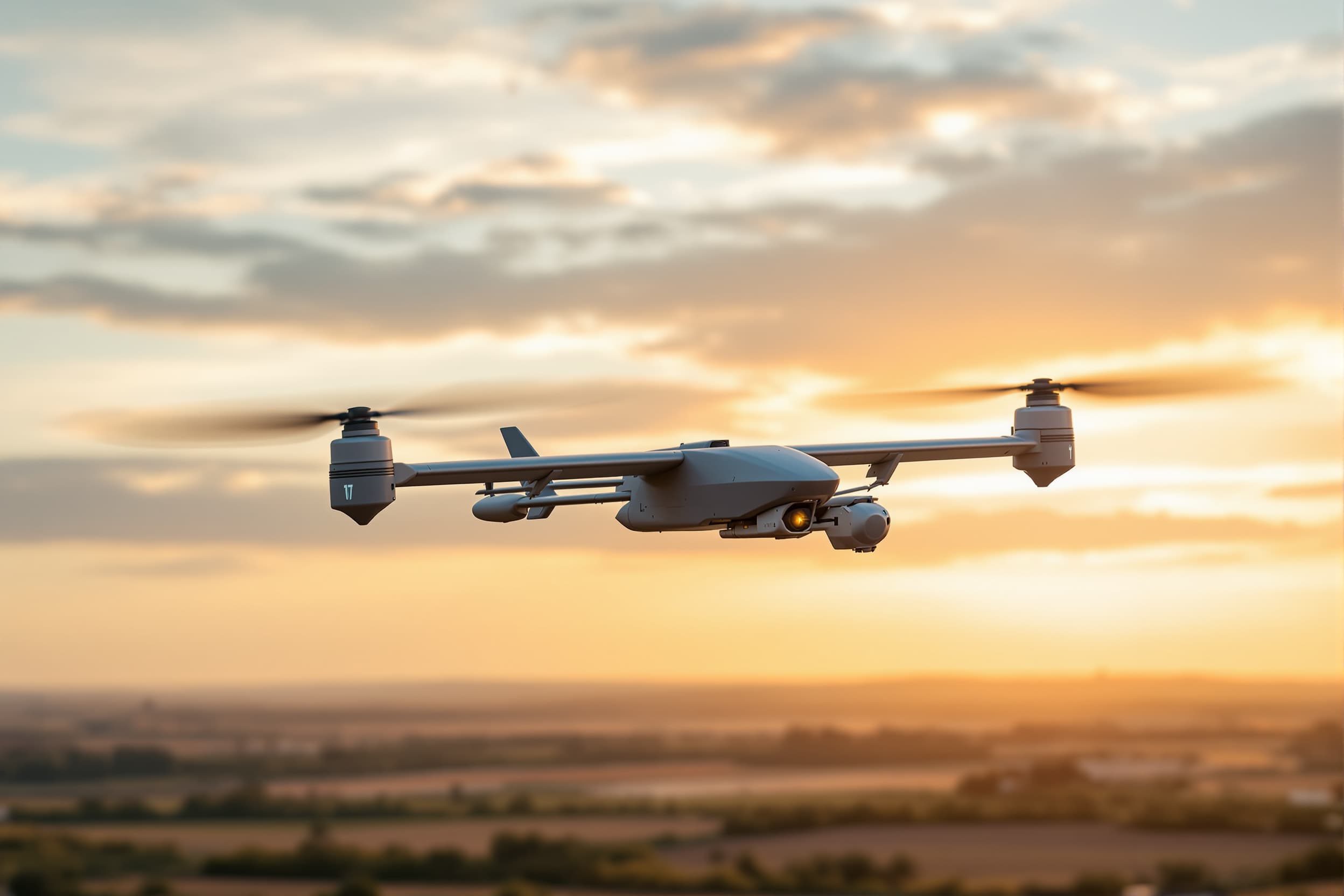
A vertical take-off and landing (VTOL) fixed-wing aircraft combining multirotor and fixed-wing flight capabilities. The airframe features a twin-boom pusher configuration with tilt-rotor nacelles on the wings for vertical lift and forward propulsion. Designed for long-endurance surveillance, mapping, and tactical reconnaissance missions.

Feasibility at a glance
PT localization
6/10
Partial
Most steps can be localised in Portugal.
Per unit
€15,000 - €45,000
at 5-unit volume
Starter batch
5units
minimum viable run
To first batch
44weeks
8 phases, design to ship
Budget
€85–120k
all-in estimate
Bottom line
A VTOL fixed-wing hybrid drone requires deep aerospace engineering expertise, precision composite fabrication, and flight-critical systems integration that are not readily available in Portugal's industrial base. Co-development with an established EU partner (Spain, France, Germany) offers access to certified aerospace composites suppliers, avionics integrators, and flight testing facilities while maintaining EU regulatory compliance. This route balances technical risk, lead time, and cost, avoiding the steep certification and IP risks of Chinese imports while being more realistic than attempting full local production without an aerospace manufacturing ecosystem in Portugal.
4 capabilities
Takes off and lands vertically like a multirotor without needing a runway
Transitions to fixed-wing flight for efficient long-range cruise
Carries camera or sensor payloads for surveillance and mapping
Operates autonomously using GPS waypoint navigation
5 stations · build route
Layup fuselage and wing molds
Carbon fiber sheets and foam cores are layered in molds, vacuum-bagged, and cured to form lightweight rigid structures.
CNC machine frame parts
Motor mounts, landing gear brackets, and servo trays are machined from aluminum for precision fit.
Assemble motor nacelles
Motors, tilt servos, and mounting hardware are integrated into the wing nacelle housings.
Wire and integrate avionics
Flight controller, ESCs, servos, and telemetry are connected with custom wire harnesses and secured inside the fuselage.
Final assembly and flight testing
Wings, booms, and tail are attached, control surfaces calibrated, and the aircraft flight-tested for stability and transition performance.
Layup fuselage and wing molds
Carbon fiber sheets and foam cores are layered in molds, vacuum-bagged, and cured to form lightweight rigid structures.
CNC machine frame parts
Motor mounts, landing gear brackets, and servo trays are machined from aluminum for precision fit.
Assemble motor nacelles
Motors, tilt servos, and mounting hardware are integrated into the wing nacelle housings.
Wire and integrate avionics
Flight controller, ESCs, servos, and telemetry are connected with custom wire harnesses and secured inside the fuselage.
Final assembly and flight testing
Wings, booms, and tail are attached, control surfaces calibrated, and the aircraft flight-tested for stability and transition performance.
5 identified · 3 blocking
Critical
Flight Control IP and Reverse Engineering
The transition control algorithms and tilt-rotor flight dynamics tuning represent the core competitive IP of a VTOL hybrid drone. If sourcing from China or using open-source flight controllers (ArduPilot, PX4), competitors can easily reverse-engineer flight parameters and replicate performance. Even with EU partners, poorly drafted co-development agreements may leave ownership of derivatives or improvements ambiguous. Loss of flight control IP would eliminate differentiation and allow competitors to undercut pricing within 6-12 months.
Mitigation — Use proprietary or white-labeled flight controller firmware with encrypted parameter storage and signed updates. Include explicit IP ownership clauses in all co-development contracts, specifying that GETMILK retains full rights to flight control tuning, transition logic, and airframe design. Require NDAs and non-compete clauses for all engineering partners. Consider firmware obfuscation and hardware-locked licensing for flight controllers to prevent cloning.
High
Composite Supply Chain Bottleneck
Aerospace-grade carbon fiber prepreg, foam cores, and epoxy resins are supplied by a small number of EU vendors (Hexcel, SGL Carbon, Gurit) with long lead times (12-16 weeks) and minimum order quantities. VTOL airframes require vacuum-bag autoclave curing, which is not widely available outside aerospace hubs. A disruption in composite supply or curing capacity could delay the entire production schedule by 2-4 months. Additionally, aerospace-grade composites require material traceability and batch certification, adding administrative overhead.
Mitigation — Establish dual-source agreements for prepreg materials (e.g., both Hexcel France and Cytec Belgium). Pre-qualify two composite fabricators (one in Spain, one in Germany) with autoclave capacity and AS9100 certification. Maintain a 4-week buffer stock of critical raw materials (prepreg, foam) in climate-controlled storage. Negotiate framework agreements with 60-day lead time commitments and penalty clauses for delays.
High
EASA Drone Regulation and Dual-Use Export Controls
EU Regulation 2019/945 and 2019/947 classify drones by mass, range, and operational risk. A VTOL drone with autonomous navigation and 40+ km range likely falls under 'open' or 'specific' category, requiring CE marking, geofencing, and remote ID compliance. If marketed for surveillance or tactical reconnaissance, it may trigger dual-use export controls (EU 428/2009) requiring export licenses for non-EU sales. EASA certification for beyond-visual-line-of-sight (BVLOS) operations adds 6-12 months and €50,000+ in compliance costs. Failure to comply risks fines, product recalls, and criminal liability.
Mitigation — Engage a specialized EU drone regulatory consultant early in design phase (e.g., DronePrep, JEDA). Design the flight controller with geofencing, remote ID (ASTM F3411 / ASD-STAN prEN 4709-002), and emergency return-to-home functions to meet open/specific category requirements. Obtain pre-assessment from national aviation authority (ANAC in Portugal) for operational category classification. For export sales, engage an export control attorney to determine if the platform falls under ML10 (military drones) or dual-use controls, and apply for any necessary licenses before customer demos.
Medium
Flight Testing and Certification Delays
VTOL drones require extensive flight testing to validate transition stability, motor tilt synchronization, and failsafe behavior. Weather delays, test site availability, and iterative tuning cycles can easily extend the flight test phase by 4-8 weeks beyond plan. If the design has center-of-gravity issues or control surface flutter, structural rework may require returning to composite fabrication, adding another 8-12 week cycle. Late-stage design changes also impact CE certification documentation, requiring resubmission of technical files.
Mitigation — Conduct extensive simulation and wind tunnel testing before first flight to validate CG range and stability margins. Use a modular battery and payload mounting system to allow rapid CG adjustment without structural changes. Schedule flight testing with a backup test site and reserve weather contingency windows (plan for 50% weather scrub rate in winter). Front-load avionics bench testing and hardware-in-the-loop (HITL) simulation to catch control issues before flight. Maintain parallel workstreams so that CE documentation and production tooling progress during flight test iterations.
Medium
Avionics Integration and EMI/RF Interference
VTOL drones pack high-current ESCs, GPS receivers, telemetry radios, and flight controllers in close proximity, creating risk of electromagnetic interference (EMI) that degrades GPS accuracy or causes control glitches. Poor wire harness routing or inadequate shielding can cause in-flight anomalies that are difficult to diagnose. Custom wire harnesses are prone to assembly errors (reversed connectors, pinch points, inadequate strain relief), which may only manifest after vibration testing or field deployment. A single avionics failure in flight can destroy the entire airframe and payload.
Mitigation — Use a professional avionics integrator with UAV experience (e.g., UAV Navigation, CubePilot) to design the wiring harness and conduct EMI testing per DO-160 guidelines. Specify shielded cables for all signal lines and use ferrite beads on power lines. Conduct pre-flight functional tests including GPS lock verification, telemetry range tests, and ESC calibration. Implement a 100% avionics bench test (power-on, sensor check, failsafe trigger) before final assembly. Use conformal coating on PCBs to protect against moisture and vibration.
44 weeks to first batch
Design Freeze and Supplier Qualification
wk 1–6Tooling and Mold Fabrication
wk 7–11Composite Layup and Curing
wk 12–15CNC Machining and Surface Treatment
wk 16–19Avionics Integration and Wire Harness Assembly
wk 20–24Mechanical Assembly and Structural Integration
wk 25–28Ground Testing and Pre-Flight Validation
wk 29–31Flight Testing, Tuning, and Certification
wk 32–44Design Freeze and Supplier Qualification
Tooling and Mold Fabrication
wk 32–44 is the longest stretch — Flight Testing, Tuning, and Certification takes 13 weeks of the 44 weeks on this build.
6 materials · 8 processes
Materials
Processes
589 Portuguese manufacturers matched
None cover the whole build — it splits across steps.
12 tasks · 12 weeks to first batch
Week 1
2 tasks
Select and contract EU co-development partner
waits on Partner availability, Contract negotiation timeline
Down-select from shortlist (Avy, Tekever, or Tier-1 integrator) based on VTOL experience, composite supply chain access, and IP ownership terms. Negotiate NDA, statement of work, and IP assignment clause. Confirm partner has AS9100-certified composite fabricator and flight test facilities.
Finalize airframe design and generate manufacturing package
waits on Design iteration cycles, CG simulation validation
Lock CAD models for fuselage, wings, booms, nacelles, and control surfaces. Export composite layup schedules, CNC toolpaths, and assembly drawings. Define critical tolerances for CG range, motor mount alignment, and control surface travel. Deliver full tech pack to partner.
Weeks 2–3
2 tasks
Procure avionics and propulsion components
waits on Component stock availability, Battery import compliance
Order flight controller (e.g., CubePilot Cube Orange+), ESCs (4×), GPS/telemetry module, tilt servos (3×), and brushless motors (4×) from EU distributors. Order battery packs meeting UN38.3 certification. Confirm lead times ≤3 weeks to avoid blocking integration phase.
Fabricate composite molds and first-article airframe parts
waits on Prepreg material lead time (12–16 weeks), Autoclave schedule conflicts
Partner fabricates layup molds for fuselage and wings using CNC tooling. Lay up and cure first fuselage shell, wing pair, and tail surfaces in autoclave. Conduct first-article inspection (visual, tap test, dimensional check). Iterate mold if voids or warping detected.
Weeks 4–7
3 tasks
CNC machine motor mounts, landing gear, and brackets
waits on CNC shop capacity, Anodizing vendor lead time
Machine aluminum motor mounts, tilt mechanism brackets, landing gear, and servo trays from 6061-T6 stock. Send for Type II anodizing. Conduct fit-check dry assembly of wing-nacelle joint and boom-fuselage interface to verify hole alignment before batch production.
Design and assemble custom wire harness
waits on Connector/cable sourcing, Harness jig fabrication
Design wire harness schematic with shielded cables for GPS/telemetry, power distribution, ESC-motor connections, and servo control lines. Crimp connectors, solder joints, apply heat-shrink and ferrite beads. Conduct bench continuity test and insulation resistance check.
Integrate avionics bay and conduct bench test
waits on Avionics component delays, Firmware compatibility issues
Install flight controller, ESCs, GPS, telemetry module into fuselage with vibration dampers. Route and secure wire harness. Power on, verify sensor outputs (IMU, GPS, mag), flash firmware, calibrate ESCs. Test failsafe and return-to-home logic on bench. Log all sensor data.
Weeks 8–16
4 tasks
Mechanical assembly of 5 airframes
waits on Composite part quality issues, Adhesive cure time
Bond wings to fuselage using aerospace epoxy and fasteners. Attach tail booms, stabilizers, motor nacelles, and landing gear. Install tilt servos and linkage. Verify control surface deflections and tilt range. Weigh and measure CG for each unit; adjust battery/payload mount if needed.
Conduct ground static and tilt mechanism tests
waits on Test facility access, Weather for outdoor RF test
Install battery, spin up motors on ground. Verify ESC sync, tilt servo response, and telemetry link at 500m range. Conduct static thrust test on load cell to validate motor output. Test vibration levels with datalogger. Check for EMI interference on GPS. Sign off pre-flight checklist.
Execute flight test campaign and tune transition logic
waits on Weather delays, Flight site permitting, Control stability issues requiring redesign
First hover test to validate VTOL stability. Progressive transition tests (partial/full tilt) to tune control gains. Full mission profile (takeoff, cruise, loiter, land) for all 5 units. Iterate PID tuning based on telemetry logs. Document flight test results and performance envelope.
Ongoing
1 task
Establish dual-source composite material agreements
waits on Supplier MOQ requirements, Storage facility setup
Negotiate framework agreements with two prepreg suppliers (e.g., Hexcel France, Cytec Belgium) for 60-day lead time commitments. Maintain 4-week buffer stock of critical carbon fiber and foam cores in climate-controlled storage. Set up material traceability system.
4 roles to fill before month one
VTOL systems integrator and composite fabrication manager
EU Co-Development Partner Lead Engineer
Owns the composite layup molds, autoclave curing schedule, CNC machining of metal parts, and has flight test infrastructure. Critical for timeline and quality control. Must have prior VTOL transition tuning experience and AS9100 supply chain.
CE marking and EASA compliance specialist
Drone Regulatory Consultant (EU)
Navigates EU Regulation 2019/945/947, RED compliance, Remote ID requirements, and dual-use export control classification. Prevents costly late-stage compliance failures and ensures technical file meets notified body standards.
Flight controller, ESC, GPS/telemetry provider
Avionics Supplier / Flight Controller Vendor
Supplies mission-critical electronics with known lead times and firmware support. Must provide hardware-in-the-loop (HITL) simulation tools for pre-flight tuning and offer rapid replacement if components fail during testing.
Carbon fiber prepreg and foam core supplier
Composite Materials Distributor
Long lead time (12–16 weeks) and material traceability requirements make this a schedule-critical path. Need dual-source agreements and buffer stock strategy to avoid composite supply bottlenecks that delay entire production.
5 things to avoid in this plan
lead time
Lock in composite material supply early—12–16 week prepreg lead times from Hexcel/Cytec can delay the entire build if not ordered by Week 2. Dual-source and maintain 4-week buffer stock.
watch-out
Protect flight control IP—ensure co-development contract explicitly assigns all transition algorithms, PID tuning, and airframe derivatives to GETMILK. Use encrypted firmware and hardware-locked licensing.
certification
Plan for flight test weather delays—assume 50% scrub rate in winter. Reserve backup test dates and parallel workstreams (CE documentation, production tooling) so delays don't cascade.
watch-out
Watch for CG balance issues—late-stage CG problems can force composite rework (8–12 week cycle). Front-load CAD simulation, use modular battery mounts, and conduct static balance checks before first flight.
2 tasks in week 1
Select and contract EU co-development partner
Composite Layup and Curing
CNC Machining and Surface Treatment
Avionics Integration and Wire Harness Assembly
Mechanical Assembly and Structural Integration
Ground Testing and Pre-Flight Validation
Flight Testing, Tuning, and Certification
Prepare CE technical file and regulatory documentation
waits on EMC test lab availability, Consultant review turnaround
Compile risk assessment per EU 2019/945, EMC test report (EN 301 489), radio compliance (EN 300 328), flight test summary, user manual, and declaration of conformity. Engage drone regulatory consultant (e.g., DronePrep) to review technical file. Prepare Remote ID compliance strategy.
watch-out
Clarify dual-use export controls—if marketing for surveillance/reconnaissance, engage export control attorney early to determine if EU 428/2009 or ML10 licensing applies before customer demos.
589 matched · 8 shown, ranked by coverage
Covers, left to right: Composite Layup · CNC Machining · Final Assembly · Motor Winding · SMT Assembly · Wire Harness · Testing & Inspection · Anodizing
Manufacturer
Location
Covers
Certifications
People
Portuguese producers per required step
Final Assembly
369
CNC Machining
212
Testing & Inspection
178
SMT Assembly
36
Composite Layup
15
Wire Harness
5
Anodizing
3
How many cover more than one step
The gap
A VTOL fixed-wing hybrid drone requires deep aerospace engineering expertise, precision composite fabrication, and flight-critical systems integration that are not readily available in Portugal's industrial base. Co-development with an established EU partner (Spain, France, Germany) offers access to certified aerospace composites suppliers, avionics integrators, and flight testing facilities while maintaining EU regulatory compliance. This route balances technical risk, lead time, and cost, avoiding the steep certification and IP risks of Chinese imports while being more realistic than attempting full local production without an aerospace manufacturing ecosystem in Portugal.
Send one RFQ to the top 4
Almadesign, REROM, MOLDMAK, DIB4T — same package, one click.
Motor Winding
0