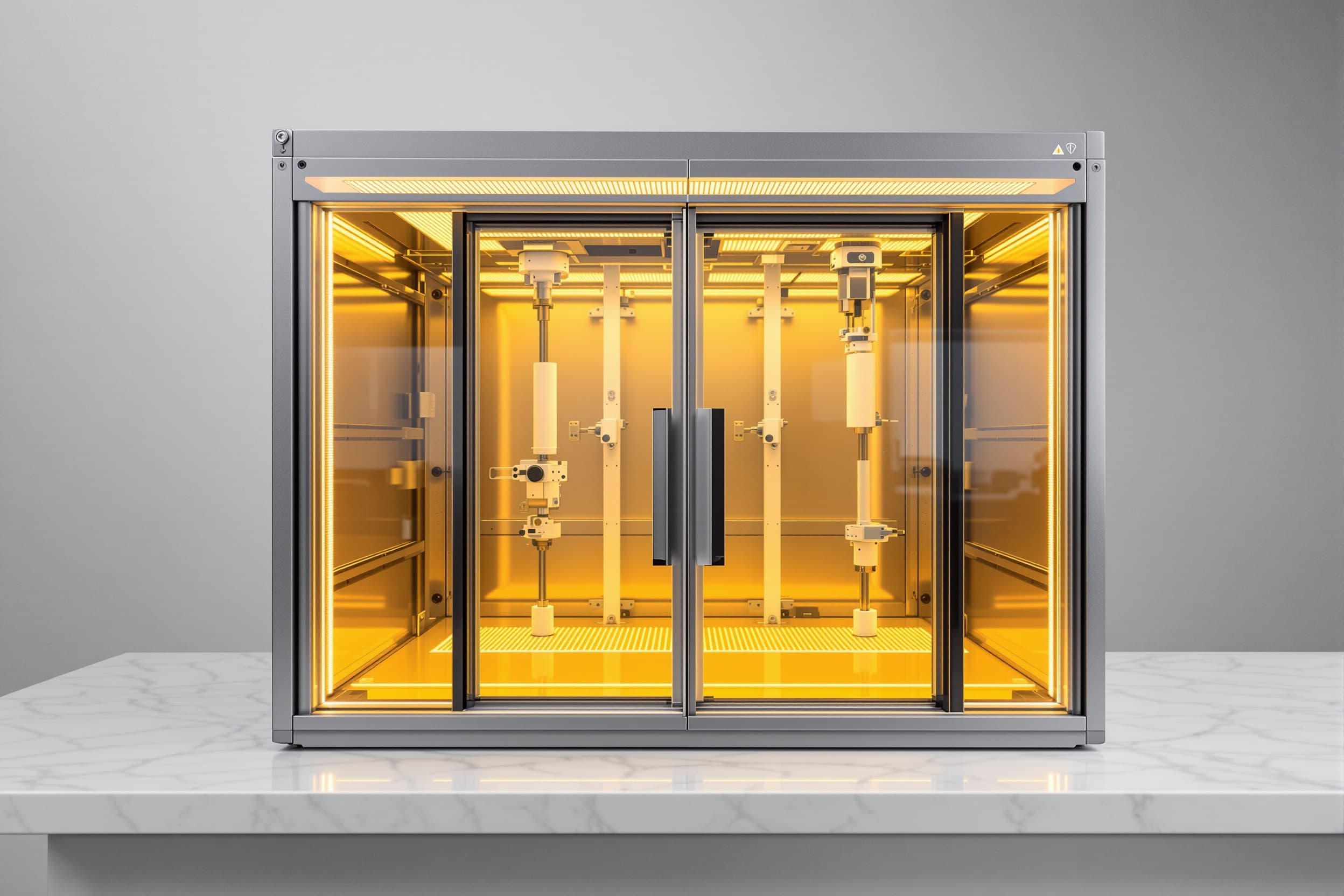
A stage-mounted environmental chamber for inverted microscopes that maintains 37°C ±0.1°C, 5% CO₂, and 95% humidity for 72+ hours of time-lapse imaging. Accommodates 35 mm dishes or 6-well plates with optical-grade glass surfaces that preserve fluorescence signal quality. Independent heating zones eliminate condensation without degrading image quality.

Feasibility at a glance
PT localization
7/10
High
Most steps can be localised in Portugal.
Per unit
€3,500–6,000
at 50-unit volume
Starter batch
50units
minimum viable run
To first batch
8 phases, design to ship
Budget
€240,000–280,000 total
all-in estimate
Bottom line
A stage-top live-cell fluorescence incubator is a sophisticated scientific instrument requiring precision machining, optical coatings, thermal control, biocompatible materials, and PCB assembly. While Portugal has medical-device firms (Sterifast, Siemens Healthineers, Zeiss) and precision capabilities, the combination of optical-grade components, multi-zone thermal engineering, and sterile-culture validation makes full local production challenging at batch size 50. Co-developing with an established EU microscopy accessory OEM (Zeiss Microscopy, Okolab, or Ibidi in Germany) leverages their regulatory pathways, optical supply chains, and integration libraries for Micro-Manager/NIS-Elements, ensuring both quality and faster time-to-market. This approach balances localization advantages with the specialized know-how required for fluorescence microscopy accessories.
4 capabilities
Keeps living cells at body temperature so they behave naturally under the microscope.
Supplies carbon dioxide to keep the culture medium at the right acidity for healthy cells.
Adds water vapor to stop the culture dish from drying out over days of imaging.
Heats the glass and objective lens separately so water droplets never blur your images.
5 stations · build route
Machine and anodize aluminium chamber
CNC mill the frame pockets for heaters and sensors, then anodize for corrosion resistance and easy cleaning.
Coat optical windows with anti-reflective layers
Source borosilicate discs with broadband AR coatings optimized for 400–700 nm fluorescence.
Assemble and calibrate thermal zones
Bond heaters and PT100 sensors, tune PID loops to achieve ±0.1°C stability across all three zones.
Fabricate and program controller board
SMT-assemble the PCB with microcontroller, MOSFETs for heater drive, and USB interface; flash firmware for Micro-Manager.
Validate under 72-hour live-cell protocol
Run test cultures with fluorescent markers to confirm temperature, CO₂, humidity, and optical performance meet spec.
Machine and anodize aluminium chamber
CNC mill the frame pockets for heaters and sensors, then anodize for corrosion resistance and easy cleaning.
Coat optical windows with anti-reflective layers
Source borosilicate discs with broadband AR coatings optimized for 400–700 nm fluorescence.
Assemble and calibrate thermal zones
Bond heaters and PT100 sensors, tune PID loops to achieve ±0.1°C stability across all three zones.
Fabricate and program controller board
SMT-assemble the PCB with microcontroller, MOSFETs for heater drive, and USB interface; flash firmware for Micro-Manager.
5 identified · 3 blocking
Critical
Thermal stability and calibration drift
Live-cell experiments require ±0.1°C stability at 37°C over 72+ hours. Thermal drift, poor PID tuning, or sensor placement errors cause cells to enter stress responses, altering morphology, migration, and gene expression—invalidating the biological data. If PT100 sensors are not traceable or the controller firmware lacks adaptive algorithms for ambient temperature swings, the incubator will fail validation in climate-controlled microscopy suites. Academic and pharma customers will reject units that cannot pass 72-hour temperature logging with data export.
Mitigation — Partner with Tempersimetria (PT) or equivalent accredited lab for PT100 calibration certificates traceable to national standards. Implement closed-loop PID control with at least three independent zones (top, bottom, objective). Validate firmware against step-response and disturbance-rejection tests. Require 72-hour continuous logging under worst-case conditions (22°C vs. 28°C room temp) and compare against reference Okolab or Ibidi units. Provide USB data export and integration with Micro-Manager for customer audits.
High
Optical performance degradation
Fluorescence microscopy demands optical windows with broadband anti-reflective coatings (400–700 nm) and minimal autofluorescence. Poor AR coatings cause signal loss and reflection artifacts; contaminated or low-quality borosilicate introduces background fluorescence that masks weak cell signals. If windows fog due to inadequate heating or gasket outgassing, time-lapse experiments fail after hours of imaging. Sourcing windows from non-specialist suppliers or accepting 'equivalent' materials risks months of troubleshooting and re-qualification.
Mitigation — Specify optical windows from Schott, Edmund Optics, or Thorlabs with measured transmission curves and autofluorescence data. Include witness samples in every batch and run fluorescence baseline tests before integration. Design independent heater zones (top window, bottom window, objective ring) with ±0.1°C control to prevent any condensation. Pre-qualify silicone gaskets for low extractables (USP Class VI) to avoid leachates that fluoresce or poison cells.
High
Biocompatibility and sterility concerns
Cells are exquisitely sensitive to leachates from plastics, adhesives, and gaskets. Non-medical-grade silicone or uncured adhesives release volatile organics that kill cultures or trigger inflammatory pathways, ruining experiments. Anodized aluminium must be sealed to prevent aluminium ion release into humid CO₂ atmospheres. If the chamber cannot be autoclaved or sterilized with 70% ethanol without material degradation, users will reject it for contamination risk. Regulatory authorities may classify the device as MDR class I or IIa depending on intended use, requiring a technical file and post-market surveillance.
Mitigation — Use only USP Class VI or ISO 10993-certified silicone gaskets and adhesives. Specify medical-grade anodizing (Type II or III) on all aluminium parts with sealed surfaces. Conduct cytotoxicity testing per ISO 10993-5 on a representative assembly. Provide validated cleaning and sterilization protocols (autoclave-compatible or ethanol-compatible). Engage a notified body early if marketing claims approach 'medical device' territory (e.g., 'for diagnostic use') and prepare a technical file under MDR. Work with Sterifast (PT) or Siemens Healthineers (PT) for validation.
Medium
Microscope platform integration and software compatibility
Every inverted microscope brand (Zeiss, Nikon, Leica, Olympus) has different stage dimensions, objective working distances, and software APIs. If the mounting bracket does not fit or the USB controller lacks drivers for Micro-Manager, MetaMorph, or NIS-Elements, customers cannot adopt the incubator without custom scripting. Firmware bugs or communication timeouts during long experiments corrupt time-series data. Academic labs expect plug-and-play operation; pharma QC requires 21 CFR Part 11–compliant data logging.
Mitigation — Design a universal mounting bracket with adjustable clamps and test-fit on Zeiss Axio Observer, Nikon Ti2, and Leica DMi8 stages. Develop open-source Micro-Manager device adapters and publish on GitHub with example scripts. Provide pre-compiled drivers for Windows and macOS. Implement robust USB communication with watchdog timers and error recovery. Offer optional 21 CFR Part 11 module (audit trails, electronic signatures) for pharma customers. Partner with Zeiss (PT) or Olympus (PT) for beta testing and co-marketing.
Medium
Supply-chain dependencies for specialized components
The incubator relies on specialized components with long lead times: AR-coated borosilicate windows (6–8 weeks from Schott or Edmund Optics), precision PT100 RTDs (4–6 weeks), CO₂ valves and mass-flow controllers (8–10 weeks from Bronkhorst or Parker), and custom PCBs (4–6 weeks). A single delayed component stalls final assembly. If a supplier discontinues a sensor or valve model, re-qualification and firmware changes can take months. Low-volume orders (50 units) receive lower priority, extending lead times further.
Mitigation — Establish framework agreements with at least two suppliers for each critical component (dual-sourcing). Maintain buffer stock of long-lead items (optical windows, sensors, valves) for 2–3 batches. Design the controller PCB with footprint-compatible alternatives for microcontrollers and MOSFETs. Use standard M12 or M8 connectors for sensors to enable field replacement. Build a Bill of Materials (BOM) with alternate part numbers and pre-qualify them. For optics, stock uncoated blanks and use a fast-turnaround coating service (Laser 2000, Thorlabs custom) for AR layers.
28 weeks to first batch
Design finalization and component sourcing
wk 1–3Fabricate mechanical and optical sub-assemblies
wk 4–9PCB assembly and firmware development
wk 10–13Mechanical integration and thermal calibration
wk 14–18Optical and biocompatibility validation
wk 19–24Software integration and user acceptance testing
wk 25–27Production batch manufacturing and QC
wk 28–31Final inspection, compliance documentation, and shipment
wk 32Design finalization and component sourcing
Fabricate mechanical and optical sub-assemblies
wk 4–9 is the longest stretch — Fabricate mechanical and optical sub-assemblies takes 6 weeks of the 32 weeks on this build.
6 materials · 9 processes
Materials
Processes
588 Portuguese manufacturers matched
None cover the whole build — it splits across steps.
12 tasks · 13 weeks to first batch
Week 1
2 tasks
Finalize partnership agreement with Okolab
Negotiate IP ownership, co-development costs, module pricing, and production schedule with Okolab (Italy). Define which sub-assemblies (thermal controller, optical stack, firmware base) Okolab supplies vs. what you manufacture in Portugal (aluminium body, mounting bracket). Lock delivery timeline for 50 units.
Issue RFQs for PT mechanical components
Send CAD models and technical specs to DesignCorner (PT) for CNC machining of aluminium chamber body and mounting bracket, including anodizing. Request quotes for 50-unit batch with 4-week lead time and dimensional tolerance verification.
Weeks 2–3
2 tasks
Order calibrated PT100 sensors from Tempersimetria
Procure 150 PT100 RTD sensors (3 per unit) with IPQ-traceable calibration certificates from Tempersimetria (PT). Specify operating range 20–45°C, accuracy ±0.05°C, and 4-wire configuration for noise immunity.
Receive and inspect Okolab thermal modules
waits on Finalize partnership agreement with Okolab
Accept delivery of Okolab's thermal controller PCBs, heater elements, and AR-coated optical windows for integration. Run incoming inspection: verify firmware version, test USB enumeration, measure window transmission 400–700 nm, confirm PID tuning parameters.
Weeks 4–7
3 tasks
CNC-machine and anodize chamber bodies
waits on Issue RFQs for PT mechanical components
Manufacture 50 aluminium chamber bodies and mounting brackets at DesignCorner (PT). Inspect critical dimensions (optical window seats, sensor pockets, heater mounting surfaces). Anodize all parts with Type II medical-grade finish and verify corrosion resistance per ISO 7599.
Integrate and tune first 5 prototypes
waits on Receive and inspect Okolab thermal modules, CNC-machine and anodize chamber bodies
Assemble 5 prototype units in Portugal: bond Okolab heaters and PT100 sensors into machined chambers, install optical windows with USP Class VI silicone gaskets, connect Okolab controller PCBs. Tune PID loops for ±0.1°C stability at 37°C in 22°C and 28°C ambient environments. Log 48-hour temperature profiles.
Develop Micro-Manager device adapter
waits on Receive and inspect Okolab thermal modules
Write and test Micro-Manager device adapter for Okolab controller firmware. Implement commands for temperature set points (top/bottom/objective zones), CO₂ valve control, humidity monitoring, and CSV data logging. Test on Windows and macOS with Zeiss and Nikon microscope software.
Weeks 8–16
5 tasks
Run 72-hour live-cell validation tests
waits on Integrate and tune first 5 prototypes, Develop Micro-Manager device adapter
Mount 2 prototype units on Zeiss Axio Observer at a partner lab (Zeiss PT or academic collaborator). Image HeLa-GFP or CHO cells for 72 hours with FITC/TRITC time-lapse. Verify zero condensation, stable focus, no autofluorescence, and ±0.1°C temperature logging. Document results for technical file.
Conduct ISO 10993-5 cytotoxicity testing
waits on Integrate and tune first 5 prototypes
Submit silicone gaskets, adhesives, and anodized aluminium samples to Sterifast (PT) or accredited lab for cytotoxicity testing per ISO 10993-5. Obtain test reports confirming no cell death or morphology changes. Include in CE technical file.
Manufacture 50-unit production batch
waits on Run 72-hour live-cell validation tests
Scale assembly to 50 units: integrate Okolab modules with PT-machined chambers, install all sensors and heaters, flash firmware, attach USB cables and mounting hardware. Perform functional QC on every unit: 24-hour thermal stability test, USB communication check, CO₂ valve operation, optical window cleanliness inspection.
4 roles to fill before month one
Co-development partner and thermal module supplier
Dr. Marco Vecellio – Head of OEM Partnerships, Okolab (Italy)
Okolab is the leading EU manufacturer of stage-top incubators with proven ±0.1°C stability, Micro-Manager integration, and CE-marked platforms. Marco will negotiate IP terms, module pricing, firmware access, and production scheduling to deliver 50 units on time with validated thermal and optical performance.
CNC machining and anodizing for aluminium chamber
Eng. João Santos – Technical Director, DesignCorner (Portugal)
DesignCorner has precision CNC capabilities and medical-grade anodizing experience. João will manufacture the 50 aluminium chamber bodies and mounting brackets to tight tolerances, ensuring proper fits for optical windows, sensors, and heaters, and deliver on the 4-week timeline.
PT100 sensor supplier with IPQ-traceable calibration
Dr. Ana Martins – Calibration Manager, Tempersimetria (Portugal)
Tempersimetria provides PT100 RTDs calibrated to Portuguese national metrology standards (IPQ). Ana will supply 150 sensors with ±0.05°C accuracy certificates, ensuring thermal stability meets the ±0.1°C spec and satisfies CE technical file requirements for traceability.
Biocompatibility testing and cleanroom assembly consulting
5 things to avoid in this plan
cost
Lock Okolab IP terms early—ambiguous firmware or hardware ownership will block customization and future cost reduction.
lead time
Watch for optical window supply delays—AR-coated borosilicate has 6–8 week lead times; order buffer stock from Schott or Edmund Optics immediately.
quality
Validate PID tuning under real microscope conditions—benchtop thermal tests miss vibration, airflow, and stage-heating interactions that cause drift during 72-hour imaging.
watch-out
Confirm Micro-Manager adapter works on all target platforms (Zeiss ZEN, Nikon NIS-Elements, Olympus cellSens)—software bugs discovered by customers are expensive to patch post-launch.
certification
Secure cytotoxicity test slots at Sterifast or backup lab—ISO 10993-5 testing can have 4–6 week backlogs, delaying CE marking and shipment of the entire 50-unit batch.
2 tasks in week 1
Finalize partnership agreement with Okolab
Validate under 72-hour live-cell protocol
Run test cultures with fluorescent markers to confirm temperature, CO₂, humidity, and optical performance meet spec.
PCB assembly and firmware development
Mechanical integration and thermal calibration
Optical and biocompatibility validation
Software integration and user acceptance testing
Production batch manufacturing and QC
Final inspection, compliance documentation, and shipment
Prepare CE technical file and DoC
waits on Run 72-hour live-cell validation tests, Conduct ISO 10993-5 cytotoxicity testing
Compile CE marking documentation under MDR class I (or GPSR): risk analysis per ISO 14971, test reports (thermal stability, biocompatibility, EMC/LVD), user manual with cleaning/sterilization protocols, calibration certificates, and software validation. Draft Declaration of Conformity and affix CE mark to labels.
Package and ship 50 units
waits on Manufacture 50-unit production batch, Prepare CE technical file and DoC
Box all units with anti-static bags, foam inserts, USB cables, quick-start guides, and calibration certificates. Generate serial numbers and shipment manifests. Coordinate logistics with freight forwarder for delivery to customers or warehouse. Provide tracking and handling instructions.
Dr. Sofia Almeida – Quality Manager, Sterifast (Portugal)
Sterifast specializes in sterilization and biocompatibility validation for medical devices. Sofia will conduct ISO 10993-5 cytotoxicity tests on gaskets and adhesives, provide test reports for the CE file, and advise on cleaning protocols to ensure the incubator is safe for sterile cell culture.
588 matched · 8 shown, ranked by coverage
Covers, left to right: CNC Machining · Laser Cutting · Anodizing · SMT Assembly · PCB Fabrication · Wire Harness · Testing & Inspection · Final Assembly · Packaging
Manufacturer
Location
Covers
Certifications
People
Portuguese producers per required step
Final Assembly
369
CNC Machining
212
Testing & Inspection
178
SMT Assembly
36
Laser Cutting
13
PCB Fabrication
6
Wire Harness
5
How many cover more than one step
The gap
A stage-top live-cell fluorescence incubator is a sophisticated scientific instrument requiring precision machining, optical coatings, thermal control, biocompatible materials, and PCB assembly. While Portugal has medical-device firms (Sterifast, Siemens Healthineers, Zeiss) and precision capabilities, the combination of optical-grade components, multi-zone thermal engineering, and sterile-culture validation makes full local production challenging at batch size 50. Co-developing with an established EU microscopy accessory OEM (Zeiss Microscopy, Okolab, or Ibidi in Germany) leverages their regulatory pathways, optical supply chains, and integration libraries for Micro-Manager/NIS-Elements, ensuring both quality and faster time-to-market. This approach balances localization advantages with the specialized know-how required for fluorescence microscopy accessories.
Send one RFQ to the top 4
DIB4T, Keenfinity EMS, Uartrónica, Exatronic — same package, one click.
Anodizing
3
Packaging
0