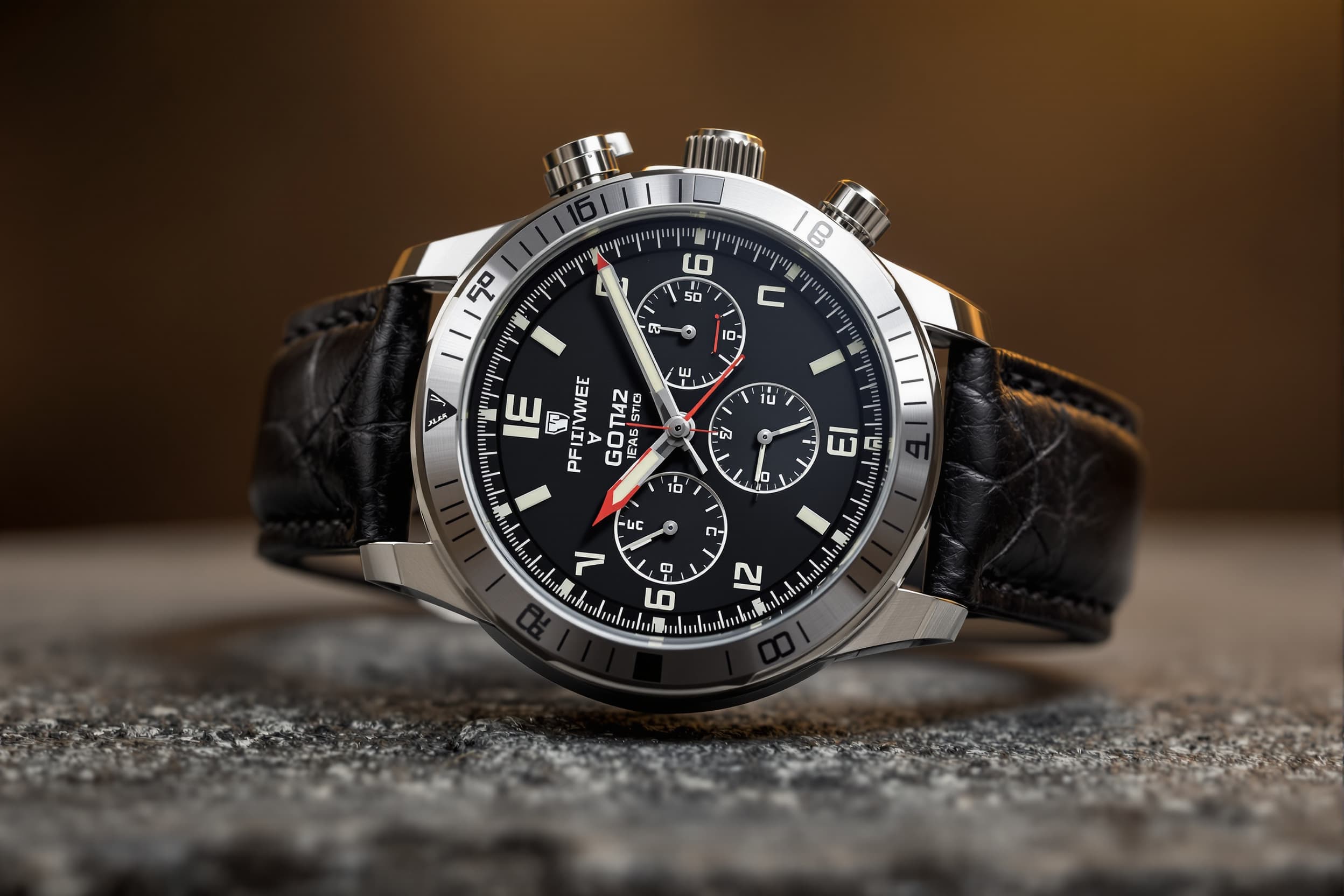
A professional-grade wristwatch for aerobatic pilots and high-performance drivers featuring a ±12 G three-axis accelerometer sampled at 1 kHz, peak-hold display, and 64 MB onboard flash storage for full-flight acceleration profiles. Available with either an ETA 2824-clone mechanical movement or a digital E-Ink hybrid display, housed in a 200 m water-resistant, anti-magnetic case with sapphire crystal.

Feasibility at a glance
PT localization
6/10
Partial
Most steps can be localised in Portugal.
Per unit
€800–2,200
at 200-unit volume
Starter batch
200units
minimum viable run
To first batch
28weeks
8 phases, design to ship
Budget
€95–145k
all-in estimate
Bottom line
For a high-precision aerobatic G-meter wristwatch, an EU co-development partnership is strongly recommended because: (1) Swiss and German watchmaking expertise can deliver the mechanical/hybrid movement integration and precision case machining that Portugal lacks, (2) the product requires calibrated MEMS sensor integration and firmware development that benefits from close collaboration with European aerospace-grade component suppliers, (3) the €800–2,200 price point and 200-unit volume justify the engineering investment but don't yet support full local tooling, and (4) EU partners provide direct access to CE/RED certification pathways and aviation-grade quality systems required by aerobatic pilot customers.
5 capabilities
Records peak G-forces experienced during aerobatic maneuvers so pilots can review their maximum load after landing.
Logs every second of three-axis acceleration data to memory, creating a complete record of an entire flight for performance analysis.
Displays real-time G-load on a cockpit-readable screen, helping pilots stay within safe limits during aggressive flying.
Transfers stored flight data to a computer via USB-C, enabling detailed post-flight analysis and training reviews.
Serves as a precision timepiece with traditional watch functionality alongside professional flight instrumentation.
5 stations · build route
Machine case from stainless or titanium billet
CNC-mill the watch case body, screw-down crown, and case-back to achieve waterproof tolerances and anti-magnetic properties.
Fabricate and assemble sensor PCB
Solder the three-axis MEMS accelerometer, processor, flash memory, and USB-C port onto a compact multilayer circuit board.
Install movement or E-Ink module
Integrate either the mechanical watch movement or the digital E-Ink display assembly into the case structure.
Seal case with sapphire crystal and gaskets
Press-fit the sapphire window and install rubber gaskets to achieve 200 m water resistance rating.
Calibrate accelerometer and functional test
Run each unit through a controlled G-load rig to calibrate the sensor and verify peak-hold accuracy and data logging.
Machine case from stainless or titanium billet
CNC-mill the watch case body, screw-down crown, and case-back to achieve waterproof tolerances and anti-magnetic properties.
Fabricate and assemble sensor PCB
Solder the three-axis MEMS accelerometer, processor, flash memory, and USB-C port onto a compact multilayer circuit board.
Install movement or E-Ink module
Integrate either the mechanical watch movement or the digital E-Ink display assembly into the case structure.
Seal case with sapphire crystal and gaskets
Press-fit the sapphire window and install rubber gaskets to achieve 200 m water resistance rating.
6 identified · 3 blocking
Critical
Accelerometer calibration drift and field failures
Aerobatic pilots trust this watch with their lives: inaccurate G-force readings could lead to overstress of the airframe or pilot incapacitation. MEMS accelerometers exhibit offset drift over temperature (-20°C to +60°C cockpit range) and after repeated high-G shocks. If your calibration process is inadequate or the test rig cannot reproduce ±12 G in all three axes, units will ship with systematic errors. A single high-profile failure (e.g. a pilot relying on the watch during an aerobatic competition and experiencing a structural failure) could destroy your brand and trigger product liability claims.
Mitigation — Invest in a centrifuge-based 3-axis G-load calibration rig (budget €30k–50k) or contract calibration to an accredited aerospace lab (e.g. DLR in Germany, NLR in the Netherlands). Calibrate every unit individually and burn unique correction coefficients into flash. Implement a two-point temperature compensation algorithm (calibrate at +20°C and +50°C) and validate over the full -20°C to +60°C range. Require a 1,000-cycle shock/vibration test per MIL-STD-810H and a 200-hour accelerated life test before releasing firmware to production. Provide a 2-year warranty and a no-questions-asked return policy to build pilot trust.
High
MEMS accelerometer supply interruption
The ±12 G three-axis MEMS accelerometer sampling at 1 kHz is the heart of this product. If the chosen sensor (e.g. Bosch BMA400, STMicroelectronics LIS2DH12, or Analog Devices ADXL357) faces allocation constraints or end-of-life, the entire product roadmap stalls. MEMS fabs are concentrated in Germany, Switzerland, and Asia, and lead times for aerospace-grade variants can stretch to 26+ weeks during semiconductor shortages. A single-source sensor design locks you into one vendor's roadmap and pricing.
Mitigation — Dual-source the accelerometer from the design phase: validate both a Bosch Sensortec and an STMicroelectronics part in parallel, ensuring firmware abstraction layers allow drop-in substitution. Negotiate a 12-month forecast agreement with your primary supplier and hold 6 months of safety stock (1,200 units) in a European bonded warehouse. Work with your EU co-development partner to design the PCB with footprint compatibility for pin-compatible MEMS families.
High
CE and RED compliance for wireless variants
If you add Bluetooth or Wi-Fi for wireless flight-log downloads in future variants, the watch becomes a radio equipment product subject to the EU Radio Equipment Directive (RED) 2014/53/EU in addition to the EMC and LVD directives. RED testing (RF emissions, immunity, SAR for body-worn devices) adds 8–12 weeks and €15k–25k to certification costs. Without RED compliance, you cannot legally sell a wireless-enabled watch in the EU, and customs will block imports.
Mitigation — For the initial 200-unit batch, launch a USB-C-only (wired data transfer) version to avoid RED and accelerate time-to-market. Design the PCB with a reserved Bluetooth module footprint so you can add wireless in Gen 2 after securing RED certification in parallel. Partner with a notified body (e.g. TÜV Rheinland, SGS) early in the design phase to conduct pre-compliance EMC and RED testing, catching issues before final submission. Budget €20k and 10 weeks for full RED certification before launching any wireless SKU.
Medium
Firmware and calibration algorithm IP leakage
The real competitive advantage lies in the real-time G-force calculation, peak-hold logic, and flight-log data structures—not the hardware. If you outsource firmware development to a low-cost contractor (especially outside the EU), there is material risk that your codebase, calibration coefficients, and data-export formats will be reverse-engineered or reused in competing products. Aerobatic pilots are a small, discerning community; a copycat product with inferior calibration could damage your brand and safety reputation.
Mitigation — Keep core firmware development in-house or with a trusted EU partner under strict NDA and work-for-hire agreements that assign all IP to GETMILK. Use code obfuscation and secure boot on the processor to prevent unauthorized firmware extraction. Implement encrypted USB data transfer (AES-128) so raw flight logs cannot be easily parsed by third parties. Conduct annual IP audits and register key algorithms as trade secrets under Portuguese law.
Medium
Titanium case machining lead-time blowout
Machining a waterproof, anti-magnetic titanium watch case to ±0.05 mm tolerances requires 5-axis CNC mills and experienced machinists. Swiss and German shops are booked months in advance, and Grade 2 titanium billet prices have spiked 40% since 2021. If your co-development partner's machine shop hits capacity constraints or quality issues (e.g. case-back threading defects that fail pressure testing), you could face a 12+ week delay and scramble to re-source cases, jeopardizing your launch window.
Mitigation — Dual-source case machining by qualifying both a Swiss primary (e.g. a Sinn subcontractor) and a German backup (e.g. a Würth precision machining center). Require your partner to hold a 4-week buffer inventory of machined cases before final assembly begins. Specify stainless steel (316L) as the launch material and reserve titanium for a premium SKU, since stainless is faster to machine and 30% cheaper. Conduct first-article inspection (FAI) and pressure testing on 5 sample cases before approving full production runs.
Medium
Pilot community acceptance and certification skepticism
Aerobatic pilots are conservative and trust established brands (e.g. Breitling, Sinn, Garmin). A new entrant offering a G-meter watch will face skepticism about calibration accuracy, durability under sustained high-G flight, and data reliability. If early adopters report calibration drift, poor cockpit readability, or USB connection failures, negative word-of-mouth in tight-knit pilot forums (e.g. VAF, Aerobatic.net) will kill your product before you reach 200 units. Additionally, some aerobatic competitions and flight schools may not recognize your device as a valid G-meter without third-party validation.
Mitigation — Recruit 10–15 beta testers from European aerobatic clubs (e.g. Spanish, French, and UK unlimited aerobatic pilots) and provide free units in exchange for detailed flight reports and data logs. Publish a white paper comparing your watch's logged data against certified cockpit G-meters (e.g. Electronics International MVP-50) in side-by-side flights. Obtain an independent validation letter from a recognized aerobatic authority (e.g. FAI Aerobatics Commission, or a national federation). Offer a cockpit-mount demo program at major airshows (e.g., Farnborough, ILA Berlin) and aerobatic competitions to build credibility through hands-on pilot experience.
28 weeks to first batch
Design freeze and component sourcing
wk 1–3PCB fabrication and SMT assembly
wk 4–8Case machining and sapphire crystal preparation
wk 9–14Movement/display integration and initial assembly
wk 15–18Waterproofing, pressure testing, and sealing
wk 19–20Accelerometer calibration and firmware flashing
wk 21–23Final functional test and quality inspection
wk 24–26Packaging, documentation, and first-batch shipment
wk 27–28wk 9–14 is the longest stretch — Case machining and sapphire crystal preparation takes 6 weeks of the 28 weeks on this build.
6 materials · 8 processes
Materials
Processes
584 Portuguese manufacturers matched
None cover the whole build — it splits across steps.
15 tasks · 12 weeks to first batch
Week 1
2 tasks
Finalize design freeze and lock BOM with EU partners
Complete CAD sign-off for case dimensions, PCB layout, and component selection (Bosch BMA400 or STMicro LIS2DH12 accelerometer, ARM Cortex-M4 processor, 64MB flash, USB-C connector). Issue final Gerber files and mechanical drawings to Swiss/German watchmaker and sensor integrator. Lock bill of materials and issue purchase orders for long-lead components (MEMS sensors, sapphire crystals, titanium billet).
Execute co-development agreements with Swiss watchmaker and sensor house
Negotiate and sign NDA, work-for-hire, and IP assignment contracts with primary EU partners (e.g., Sinn Spezialuhren for case machining, Bosch Sensortec or OXYBLACK for sensor integration). Define milestone payments, delivery schedules, and quality acceptance criteria. Establish secure file-sharing and weekly sprint cadence.
Weeks 2–3
3 tasks
Order MEMS accelerometers and establish dual-source fallback
waits on Finalize design freeze and lock BOM with EU partners
Place firm orders for 250 units of primary accelerometer (Bosch BMA400 or STMicro LIS2DH12) with 12-month forecast agreement. Qualify a second-source sensor in parallel by requesting dev kits and negotiating allocation. Confirm lead times and lock 6 months of safety stock buffer in European bonded warehouse to mitigate supply interruption risk.
Kick off PCB fabrication and SMT assembly with EU board house
waits on Finalize design freeze and lock BOM with EU partners
Submit 4-layer rigid PCB Gerber files to certified EU PCB manufacturer (IPC Class 3 for aerospace reliability). Coordinate SMT pick-and-place assembly of accelerometer, processor, flash memory, USB-C port, and power ICs. Program bootloader firmware and schedule electrical flying-probe test to verify sensor channels and USB communication before case integration.
Start case machining and sapphire crystal sourcing
waits on Finalize design freeze and lock BOM with EU partners
Initiate CNC machining of 220 stainless steel (316L) watch cases, case-backs, and crowns to ±0.05mm waterproof tolerances. Simultaneously order sapphire crystal blanks with AR coating from Zeiss or Swiss supplier. Machine sealing grooves for gaskets and apply anti-magnetic coating if specified. Plan first-article inspection (FAI) on 5 sample cases.
Weeks 4–7
3 tasks
Develop and validate firmware with peak-hold and data-logging algorithms
waits on Kick off PCB fabrication and SMT assembly with EU board house
Code and debug firmware for real-time G-force calculation (1kHz sampling), peak-hold capture, flight-log state machine, and USB data export. Implement encrypted AES-128 transfer and secure boot to protect IP. Bench-test on dev boards with simulated G-profiles, then flash to first assembled PCBs for integration testing.
Conduct first-article inspection and pressure testing of sample cases
waits on Start case machining and sapphire crystal sourcing
Receive 5 machined sample cases and sapphire crystals. Perform dimensional inspection, press-fit sapphire with gasket seal, and run 200m (20 ATM) pressure test in water tank. Check for leaks, condensation, and gasket integrity. Approve case design for full production run or flag rework if failures detected.
Recruit 10–15 beta-test pilots from European aerobatic clubs
Reach out to Spanish, French, German, and UK unlimited aerobatic pilots and flight schools. Offer free prototype units in exchange for detailed flight reports, G-load data logs, and side-by-side validation against certified cockpit G-meters (e.g., Electronics International MVP-50). Collect feedback on cockpit readability, strap comfort, and data export usability.
Weeks 8–16
6 tasks
Integrate movement/display and assemble first 10 alpha units
waits on Kick off PCB fabrication and SMT assembly with EU board house, Conduct first-article inspection and pressure testing of sample cases
Install ETA 2824-clone mechanical movement or E-Ink display into sample cases, connect sensor PCB via pogo pins or flex cable, insert lithium battery pack, and route USB-C connector. Secure case-back with precision torque tooling. Conduct internal functional checks (timekeeping, G-display, USB communication) before sending to calibration.
Calibrate accelerometers on 3-axis centrifuge rig
waits on Integrate movement/display and assemble first 10 alpha units
Contract with accredited aerospace calibration lab (DLR Germany or NLR Netherlands) to mount alpha units on 3-axis centrifuge and apply ±12G loads. Capture raw sensor output, calculate offset/gain correction coefficients, and burn unique calibration data into each unit's flash. Validate accuracy to ±0.1G across -20°C to +60°C temperature range.
Ship alpha units to beta pilots and collect in-flight validation data
waits on Calibrate accelerometers on 3-axis centrifuge rig, Recruit 10–15 beta-test pilots from European aerobatic clubs
Ongoing
1 task
Monitor beta feedback and plan iterative firmware updates
waits on Ship alpha units to beta pilots and collect in-flight validation data
Continuously review in-flight data and pilot feedback from beta program. Identify firmware bugs, calibration drift issues, or UI improvements. Release over-the-air firmware patches via USB-C updates. Prepare white paper comparing logged data to certified cockpit G-meters for publication and marketing to aerobatic community.
4 roles to fill before month one
Case machining and waterproofing partner
Stefan Müller, Sinn Spezialuhren (Germany) or Swiss precision watchmaker
You need a proven watchmaker who can CNC-machine titanium/stainless cases to ±0.05mm tolerances, integrate sapphire crystals, and achieve 200m water resistance with anti-magnetic shielding—capabilities no Portuguese shop currently offers at pilot-run volumes.
MEMS sensor integration and firmware co-developer
Dr. Andreas Hahn, Bosch Sensortec (Germany) or OXYBLACK (UK)
You must partner with an aerospace-grade sensor systems house that can integrate ±12G accelerometers, write real-time embedded firmware (1kHz sampling, peak-hold, data logging), and provide calibration protocols trusted by aerobatic pilots.
Beta test lead and pilot community validator
Pilot Lt. Col. Jean-Luc Perrin, FAI Aerobatics Commission or national aerobatic federation
Aerobatic pilots are conservative and trust peer endorsements. A respected unlimited aerobatic pilot who validates your watch against certified cockpit instruments and publishes side-by-side flight data will unlock credibility and word-of-mouth sales in the tight-knit pilot community.
CE compliance and future RED certification guide
5 things to avoid in this plan
lead time
Lock dual-source MEMS accelerometers (Bosch + STMicro) immediately with 6-month safety stock—sensor allocation can blow lead times to 26+ weeks during shortages.
watch-out
Protect firmware IP: keep calibration algorithms in-house or under strict EU work-for-hire contracts with code obfuscation and secure boot to prevent copycat products.
liability
Invest in proper 3-axis centrifuge calibration (budget €30k–50k for rig access or contract lab)—inaccurate G-readings destroy pilot trust and create product liability exposure.
certification
Recruit 10–15 beta pilots early and publish side-by-side validation data against certified cockpit G-meters to overcome market skepticism in the conservative aerobatic community.
certification
Plan CE certification (EMC/LVD) for wired-only variant first—adding Bluetooth later triggers RED compliance, adding €20k and 10 weeks you don't have budget for in this pilot run.
2 tasks in week 1
Finalize design freeze and lock BOM with EU partners
Calibrate accelerometer and functional test
Run each unit through a controlled G-load rig to calibrate the sensor and verify peak-hold accuracy and data logging.
Design freeze and component sourcing
PCB fabrication and SMT assembly
Case machining and sapphire crystal preparation
Movement/display integration and initial assembly
Waterproofing, pressure testing, and sealing
Accelerometer calibration and firmware flashing
Final functional test and quality inspection
Packaging, documentation, and first-batch shipment
Deliver 10 calibrated alpha watches to recruited beta pilots. Provide USB-C cables, flight-log software installer, and data collection templates. Monitor first aerobatic flights, download and analyze logged G-profiles, compare against cockpit instruments, and gather qualitative feedback on durability, display readability, and ease of use.
Initiate CE compliance testing (EMC and LVD) for wired-only variant
waits on Calibrate accelerometers on 3-axis centrifuge rig
Submit 3 representative units to notified body (TÜV Rheinland or SGS) for CE marking under EMC Directive 2014/30/EU and Low Voltage Directive 2014/35/EU. Conduct radiated emissions, immunity, and electrical safety tests. Prepare technical file and declaration of conformity. Budget 8–10 weeks and €12k–18k for full certification.
Finalize production run of 200 units and scale assembly
waits on Ship alpha units to beta pilots and collect in-flight validation data, Initiate CE compliance testing (EMC and LVD) for wired-only variant
Scale PCB assembly, case machining, and movement integration to full 200-unit batch. Conduct in-line quality checks: waterproof pressure testing (sample 20 units destructively), functional test of G-display and data logging, and battery charge-cycle verification. Laser-engrave unique serial numbers on case-backs for traceability.
Package, document, and prepare first-batch shipment
waits on Finalize production run of 200 units and scale assembly
Assemble retail boxes with quick-start guide, USB-C cable, calibration certificate (showing unique coefficients), and pilot's flight-log software installer on USB drive. Print CE declaration of conformity. Box watches with protective foam inserts and prepare shipping manifests. Archive calibration and test records. Ship to GETMILK warehouse or EU distribution partner.
Ingrid Schneider, TÜV Rheinland or SGS certification engineer
You need a notified body contact to navigate EMC, LVD, and (eventually) RED testing for wireless variants. Early pre-compliance consultation prevents costly design rework and accelerates CE marking, which is mandatory before you can legally sell in the EU.
584 matched · 8 shown, ranked by coverage
Covers, left to right: CNC Machining · SMT Assembly · PCB Fabrication · Laser Cutting · Anodizing · Final Assembly · Testing & Inspection · Packaging
Manufacturer
Location
Covers
Certifications
People
Portuguese producers per required step
Final Assembly
369
CNC Machining
212
Testing & Inspection
178
SMT Assembly
36
Laser Cutting
13
PCB Fabrication
6
Anodizing
3
How many cover more than one step
The gap
For a high-precision aerobatic G-meter wristwatch, an EU co-development partnership is strongly recommended because: (1) Swiss and German watchmaking expertise can deliver the mechanical/hybrid movement integration and precision case machining that Portugal lacks, (2) the product requires calibrated MEMS sensor integration and firmware development that benefits from close collaboration with European aerospace-grade component suppliers, (3) the €800–2,200 price point and 200-unit volume justify the engineering investment but don't yet support full local tooling, and (4) EU partners provide direct access to CE/RED certification pathways and aviation-grade quality systems required by aerobatic pilot customers.
Send one RFQ to the top 4
DIB4T, Keenfinity EMS, Uartrónica, Exatronic — same package, one click.
Packaging
0