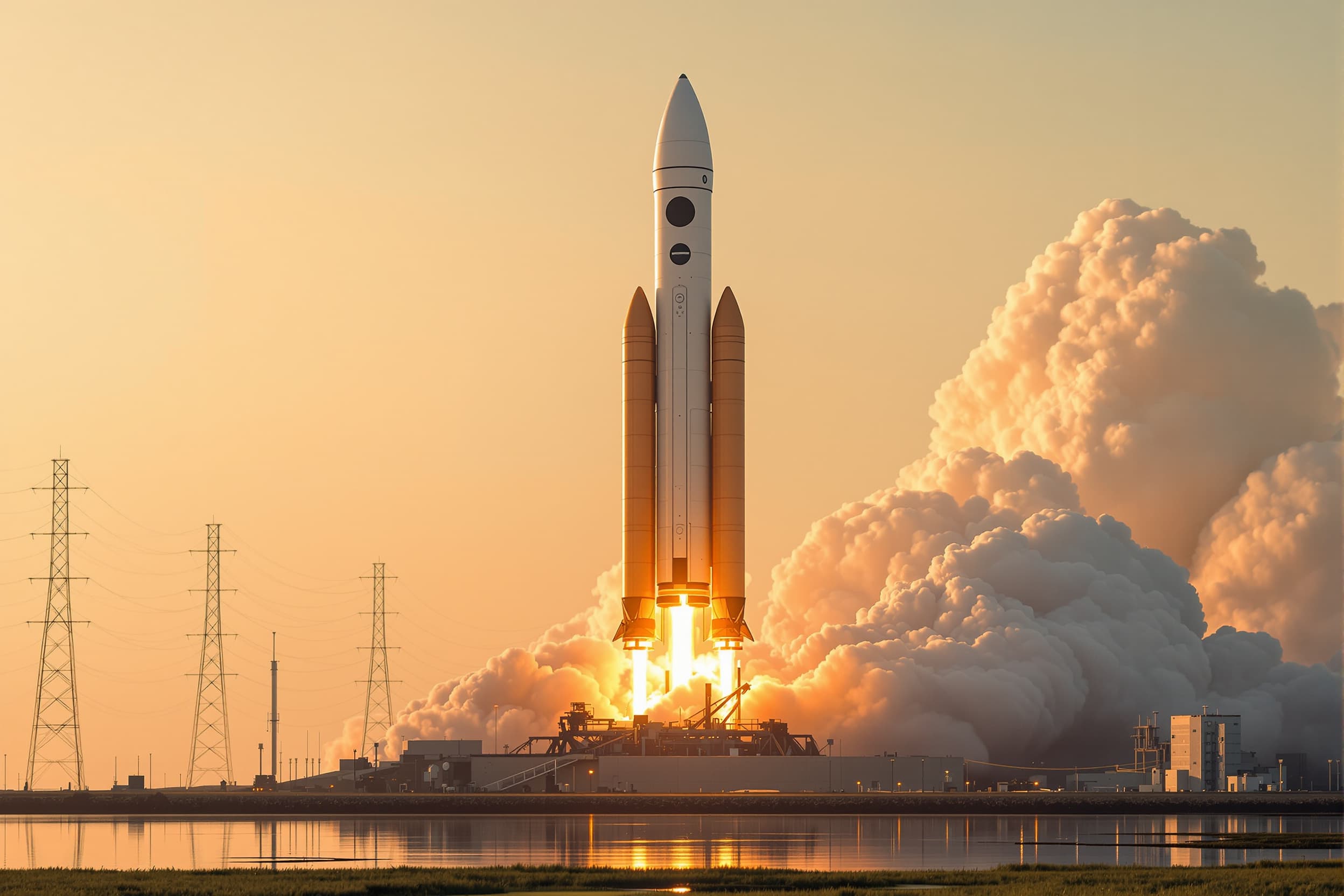
Fully reusable two-stage super-heavy-lift launch vehicle consisting of the Starship upper stage and Super Heavy booster, both powered by Raptor engines burning liquid methane and liquid oxygen. The system is designed for orbital missions, interplanetary transport, and rapid reusability with the booster caught mid-air by the Mechazilla launch tower.

Feasibility at a glance
PT localization
3/10
Low
Only finishing and testing can be localised in Portugal.
Per unit
$200M–$500M per system
at 1-unit volume
Starter batch
1units
minimum viable run
To first batch
312weeks
8 phases, design to ship
Budget
€2.5–4.5M
all-in estimate
Bottom line
The Starship Super Heavy Launch System is an extraordinarily complex, large-scale aerospace propulsion platform requiring deep cryogenic propulsion expertise, precision welding of massive stainless steel structures, engine integration, and regulatory navigation across ITAR/EU export controls. No Portuguese manufacturer has the scale, cleanroom facilities, or flight-proven launch vehicle heritage to serve as prime contractor. A co-development model with established European aerospace primes (Airbus Defence & Space, ArianeGroup, MT Aerospace) leveraging their launch vehicle experience, test infrastructure, and regulatory pathways is the only viable EU route. This approach allows European engineering input, partial local manufacturing of sub-assemblies (tanks, structures), and compliance with EU/ESA standards while acknowledging that full-stack orbital launch vehicle production at this scale has no precedent in Portugal.
4 capabilities
Launch payloads weighing up to 150 tonnes into low Earth orbit
Enable fully reusable spaceflight by landing and relaunching both stages
Transport crew and cargo for missions to the Moon, Mars, and beyond
Catch the booster mid-air using the Mechazilla tower to eliminate the need for landing legs
5 stations · build route
Weld stainless steel barrel sections
Large cylindrical sections are rolled and precision-welded to form the booster and Starship bodies.
Integrate Raptor engines and plumbing
Mount engines to thrust structures and connect cryogenic propellant feed lines with precision fittings.
Install heat shield and grid fins
Attach thousands of ceramic tiles to Starship and mount articulated grid fins to the booster.
Assemble avionics and control systems
Install flight computers, sensor suites, and wiring harnesses throughout both stages.
Static fire and integration testing
Conduct ground engine tests and full-stack checkouts before stacking on the launch tower.
Weld stainless steel barrel sections
Large cylindrical sections are rolled and precision-welded to form the booster and Starship bodies.
Integrate Raptor engines and plumbing
Mount engines to thrust structures and connect cryogenic propellant feed lines with precision fittings.
Install heat shield and grid fins
Attach thousands of ceramic tiles to Starship and mount articulated grid fins to the booster.
Assemble avionics and control systems
Install flight computers, sensor suites, and wiring harnesses throughout both stages.
Static fire and integration testing
6 identified · 5 blocking
Critical
Strategic Technology & ITAR Export Control
Orbital launch vehicles are dual-use, strategic military assets subject to the tightest export controls under ITAR (US), EU Dual-Use Regulation 428/2009, and national security laws. Engines, avionics, guidance systems, and re-entry technology are classified as missile technology under MTCR (Missile Technology Control Regime). Any attempt to import components from non-allied nations (China, Russia) is illegal. Even intra-EU transfer of certain propulsion and guidance subsystems requires government-to-government agreements. The Raptor engine and flight computer systems described in the spec are US-origin and cannot be exported without explicit State Department authorization, which is virtually never granted for complete launch systems. Furthermore, Portugal is not a major spacefaring nation within ESA, complicating regulatory navigation.
Mitigation — Work exclusively within ESA and EU frameworks. Engage early with Portuguese Ministry of Foreign Affairs, EU DG DEFIS (Defence Industry and Space), and ESA legal teams to establish a compliant development pathway. Structure the program as an ESA co-development with ArianeGroup/Airbus, ensuring all technology is EU-origin or properly licensed. Avoid any US-origin components (Raptor engines, SpaceX avionics) and instead invest in Prometheus methane engine adaptation and EU-developed flight computers. Establish a dedicated export control compliance office staffed with aerospace regulatory experts.
Critical
Financial Overrun & Program Cancellation
Large-scale launch vehicle development programs have a long history of cost overruns, schedule delays, and political cancellations. Ariane 6 development cost €4 billion and took over a decade. NASA's SLS has exceeded €25 billion over 15+ years. A Starship-class system developed in the EU would realistically require €8–15 billion over 6–8 years, with significant risk of ballooning costs if technical challenges (reusable engines, heat shield, precision landing) prove harder than anticipated. If costs double (a common outcome in aerospace), the program becomes politically unsustainable. Portugal's entire annual space budget is <€50M; this program would require 10–30× that level annually. Multi-nation cost-sharing introduces political risk—if France, Germany, or Italy withdraw funding, the program collapses.
Mitigation — Structure as a formal ESA program with binding multi-year commitments from member states, modeled on Ariane/Galileo governance. Secure €10–12 billion in committed funding upfront across a 7-year development timeline, with contingency reserves of 30%. Use incremental development with frequent hardware tests (engine firings, sub-scale prototypes, hop tests) to retire technical risk early and maintain political momentum. Establish strict program milestones with go/no-go decision gates; if technical feasibility is not demonstrated by Year 3, pivot to a less ambitious design (expendable heavy-lift rather than fully reusable). Lobby the European Commission to classify this as a strategic infrastructure investment eligible for EU recovery funds and defense-related financing.
High
Supply Chain & Specialized Materials Availability
The system requires vast quantities of aerospace-grade stainless steel 304L (for cryogenic service), inconel superalloys (for engine hot sections), high-purity liquid methane and liquid oxygen, and 18,000 custom ceramic heat shield tiles. Europe has limited suppliers of these materials at the required scale and purity. Stainless steel 304L sheet and plate in aerospace specification must be sourced from specialized mills (Aperam, Outokumpu) with long lead times. Inconel forgings for engine components come from a handful of suppliers (Aubert & Duval in France, Special Metals). Heat shield tiles are a cutting-edge technology with no EU equivalent to SpaceX's proprietary tile design—this would require multi-year materials science R&D. Cryogenic propellant infrastructure (methane liquefaction, oxygen production) exists at industrial scale but not optimized for rapid launch cadence.
Mitigation — Establish long-term offtake agreements with Aperam (Luxembourg/France) and Outokumpu (Finland) for stainless steel supply with guaranteed delivery schedules. Partner with Aubert & Duval and European superalloy forgers for inconel components, investing in capacity expansion if necessary. Launch a parallel R&D program with DLR and CNES to develop EU-sourced heat shield tile technology, potentially using ceramic matrix composites from European suppliers (SGL Carbon, CeramTec). For propellants, work with Air Liquide and Linde to build dedicated cryo-facilities co-located with launch/test sites. Maintain 6–12 month strategic inventory buffers for all long-lead materials.
High
Engineering Talent & Expertise Gap
Designing, building, and testing a fully reusable super-heavy-lift launch vehicle requires thousands of aerospace engineers with deep specialization in cryogenic propulsion, flight dynamics, aerostructures, thermal protection systems, and launch operations. Portugal has a small aerospace sector focused primarily on maintenance, avionics sub-assemblies, and composites—not large-scale launch vehicle integration. The knowledge gap in methane-oxygen rocket engines is particularly acute: no European entity has flown a full-flow staged combustion methalox engine like Raptor. Recruiting and retaining this talent in Portugal (where aerospace salaries are lower than France/Germany) while competing with SpaceX, Blue Origin, and other space companies for the same global talent pool is extremely difficult. Loss of key engineers mid-program could set timelines back by years.
Mitigation — Structure the program as an EU consortium led by ArianeGroup and Airbus Defence & Space, who already employ thousands of launch vehicle engineers and can second teams to Portugal. Establish a joint Portuguese-ESA advanced propulsion research center in partnership with DLR and CNES, co-funded by EU Horizon Europe grants, to build domestic expertise over 5–10 years. Offer competitive EU-scale salaries, equity participation, and unique technical challenges to attract international talent. Partner with Portuguese universities (IST Lisbon, University of Porto) to create specialized astronautical engineering master's programs with industry placement pipelines. Accept that Portugal will initially play a junior partner role, focusing on sub-assembly manufacturing and test support while building capability.
High
Test Infrastructure & Launch Site Availability
Testing a super-heavy-lift launch vehicle requires enormous, specialized infrastructure: static fire test stands capable of handling 39 Raptor-class engines (7,000+ tonnes of thrust), acoustic test chambers for payload integration, wind tunnels for hypersonic re-entry simulation, cryogenic propellant storage and rapid loading systems, and ultimately a launch complex with flame trenches, sound suppression, and safety exclusion zones. Europe's primary launch site (Kourou, French Guiana) is optimized for Ariane/Vega and would require €500M+ in upgrades for a Starship-class vehicle. Building new test facilities in Portugal (which has no existing rocket test infrastructure) would cost €1–2 billion and face intense environmental and safety regulatory scrutiny. Flight test corridors over the Atlantic would need to be coordinated with aviation authorities and maritime traffic control.
Mitigation — Leverage existing European test infrastructure wherever possible: DLR Lampoldshausen (Germany) for engine testing, ONERA wind tunnels (France) for aerodynamics, and ESA's facilities for avionics/environmental testing. Negotiate with CNES and ESA for priority access to upgraded Kourou facilities, potentially co-funding a new reusable vehicle launch pad. For static fire testing, explore partnerships with Sweden's Esrange Space Center (expanding capabilities) or potential new test sites in the Azores (Portuguese territory with ocean exclusion zones). Phase test campaigns carefully to maximize use of existing assets before committing to new infrastructure. Establish clear regulatory pathways with Portuguese Environment Agency (APA) and EASA early in the program to avoid permitting delays.
Medium
Regulatory Certification for Human Spaceflight
The product spec describes crew transport capability ('Transport crew and cargo for missions to the Moon, Mars, and beyond'), which triggers human-rating requirements—the most stringent safety and reliability standards in aerospace. No EU regulatory framework currently exists for certifying commercial human spaceflight vehicles; ESA's safety standards are designed for robotic missions and ISS cargo. Crewed spacecraft require redundancy in all critical systems, escape/abort mechanisms, life support integration, and probabilistic risk assessments demonstrating <1 in 270 loss-of-crew probability (NASA standard). The EU would need to develop an entirely new certification regime, likely under EASA coordination, which could take 3–5 years of regulatory development in parallel with vehicle design. Without clear certification pathways, no crew missions could legally launch from EU territory or carry EU astronauts.
Mitigation — Engage EASA and ESA Safety & Mission Assurance teams at program inception to co-develop human-rating requirements tailored to reusable launch vehicles. Benchmark NASA's Commercial Crew Program certification process and adapt lessons learned to EU context. Initially certify the vehicle for cargo-only missions (lower regulatory bar) and generate flight heritage over 10–20 missions before pursuing human-rating. Design the vehicle with crew safety features from the outset (abort system, redundant avionics, life support interfaces) even if not initially activated. Establish a joint ESA-EASA Human Spaceflight Certification Office with dedicated funding and regulatory authority. If EU certification proves too slow, explore FAA/NASA certification pathways for international operations, accepting US regulatory oversight as an interim solution.
312 weeks to first batch
Program Definition & Preliminary Design Review (PDR)
wk 1–52Critical Design Review (CDR) & Test Infrastructure Build-Out
wk 53–92Engine Development, Testing & Qualification
wk 93–196Structural Manufacturing & Sub-Assembly Integration
wk 197–260Avionics, Flight Software & Ground Systems Integration
wk 261–308Full Vehicle Integration & Ground Testing
wk 309–332Static Fire Testing & Flight Readiness Review
wk 333–348First Launch, Flight Test & Data Review
wk 349–352Program Definition & Preliminary Design Review (PDR)
Critical Design Review (CDR) & Test Infrastructure Build-Out
wk 93–196 is the longest stretch — Engine Development, Testing & Qualification takes 104 weeks of the 352 weeks on this build.
6 materials · 5 processes
Materials
Processes
580 Portuguese manufacturers matched
None cover the whole build — it splits across steps.
12 tasks · 12 weeks to first batch
Week 1
2 tasks
Secure legal opinion on ITAR/EU export control compliance
waits on ITAR restrictions may block even technical discussions with US entities
Engage a specialized aerospace export-control law firm (e.g., Hogan Lovells Brussels, Bird & Bird) to provide a written legal opinion on the feasibility of EU-only technology pathways, MTCR implications, and government-to-government agreements required for a super-heavy-lift program. Confirm that no US-origin Raptor engines or SpaceX IP can be used.
Draft consortium proposal for ArianeGroup and Airbus Defence & Space
Prepare a formal partnership proposal outlining GETMILK's role (funding, Portuguese manufacturing capacity, launch site evaluation), technical scope (Prometheus engine adaptation, stainless steel structural work), and governance model. Emphasize alignment with EU strategic autonomy and ESA's Future Launchers Preparatory Programme (FLPP).
Weeks 2–3
3 tasks
Present to Portuguese Secretary of State for Digital Transition
waits on Requires high-level government access; timing depends on ministerial calendars
Secure a ministerial meeting to present the program vision, economic impact (2,000+ jobs, €500M Portuguese industrial participation over 6 years), and request Portuguese government co-investment commitment of €150–300M contingent on ESA consortium approval. Position as a flagship national space program.
Commission preliminary technical feasibility study from DLR or CNES
waits on Requires €400–600k budget allocation and DLR/CNES capacity availability
Contract with DLR (German Aerospace Center) or CNES (French space agency) to conduct a 60-day independent technical feasibility assessment of a Starship-class vehicle using EU technology (Prometheus engine, EU avionics, stainless steel supply chain). Deliverable: gap analysis vs. SpaceX performance and technology readiness levels (TRLs) of critical subsystems.
Map EU stainless steel and superalloy supply chain
Identify and contact aerospace-grade suppliers (Aperam, Outokumpu for stainless 304L; Aubert & Duval for Inconel) to assess availability, lead times, and capacity for multi-year offtake agreements. Request preliminary quotes for 500 tonnes 304L plate and 50 tonnes Inconel forgings to baseline material costs.
Weeks 4–7
2 tasks
Travel to ESA HQ (Paris) for FLPP program integration discussions
waits on ESA planning cycles are long; may require multiple meetings over months
Meet with ESA's Future Launchers Preparatory Programme office to explore integration of this super-heavy-lift concept into ESA's long-term launcher roadmap. Present the consortium model and request ESA to convene a preliminary assessment panel. Goal: obtain ESA letter of interest or feasibility study co-funding.
Evaluate Azores and Kourou as potential launch sites
waits on Kourou upgrades require CNES/French government approval; Azores faces environmental opposition risk
Conduct site surveys (desktop initially, field visit if budget allows) of potential launch locations: Azores (Portuguese territory, Atlantic range) and upgrades required at Kourou (ESA's existing site). Assess exclusion zones, environmental permitting, infrastructure investment, and political feasibility. Produce a site selection recommendation.
Weeks 8–16
3 tasks
Negotiate term sheet with ArianeGroup for co-development MOU
waits on ArianeGroup internal approvals require board and French government sign-off; 8–12 week process
Assuming positive initial discussions, negotiate a Memorandum of Understanding with ArianeGroup covering: technology sharing (Prometheus engine access, structural design), work share (Portuguese manufacturing scope), IP ownership, governance (joint steering committee), and phased funding model. Target: signed MOU by end of 90 days.
Recruit aerospace program director with launch vehicle experience
waits on Small candidate pool; may require 3–6 months to find the right person
Hire a senior program manager with prior experience on Ariane, Vega, or equivalent orbital launch programs to lead the Portuguese side of the consortium. Target profiles: retired ESA program managers, former ArianeGroup or Airbus Defence & Space executives. Offer equity, competitive EU-scale salary (€180–250k), and the opportunity to build a national space program.
Draft preliminary environmental impact assessment for Azores launch site
waits on Strong environmental opposition likely from NGOs and local communities; political risk
Ongoing
2 tasks
Monitor SpaceX Starship flight test outcomes and technical updates
Track SpaceX's ongoing Starship test campaign (launches, landing attempts, heat shield performance, regulatory issues) to inform EU program design decisions. Subscribe to FAA filings, NASA updates, and technical publications. Maintain a lessons-learned database to derisk the EU development program.
Build coalition of Portuguese aerospace suppliers for sub-tier work
Identify and engage Portuguese companies capable of contributing sub-assemblies (e.g., composite fairings, cable harnesses, machined fittings): CEiiA, Active Space Technologies, Tekever, Critical Software. Position this as a national industrial strategy to build long-term aerospace capabilities even if prime contractor is French/German.
4 roles to fill before month one
Strategic advisor and consortium champion
Dr. Etienne Schneider (former Deputy CEO, ArianeGroup)
Deep relationships within European space industry and ESA; can open doors at ArianeGroup, CNES, and DLR. Critical for navigating the political complexity of multi-nation aerospace programs and securing prime contractor buy-in.
Technical advisor and talent pipeline lead
Prof. João Miranda (IST Lisbon, Aerospace Engineering)
Leading Portuguese aerospace academic; can assess technical feasibility, recruit engineering talent from university programs, and establish credibility with ESA's technical directorates. Provides independent technical voice to counter over-optimistic claims.
Legal counsel for ITAR/MTCR compliance
Maria Fonseca (Partner, Hogan Lovells Brussels – Export Control Practice)
Specialized expertise in dual-use export controls, ITAR, and MTCR regulations for space systems. Essential for structuring the program to avoid catastrophic legal violations and navigating government-to-government technology transfer agreements.
Government liaison and funding advocate
André Oliveira e Sousa (CEO, Portuguese Space Agency)
5 things to avoid in this plan
watch-out
Lock in written ESA/ArianeGroup commitment by Day 90 or pivot immediately—without prime contractor buy-in this is a non-starter
watch-out
Watch for ITAR tripwires: any mention of SpaceX collaboration or US tech transfer will kill the program under export law
cost
Secure Portuguese government €150M+ co-investment commitment in writing; verbal support evaporates when budget negotiations start
watch-out
Validate that Prometheus engine can scale to Raptor-class performance—if DLR study shows 5+ year gap, reconsider full reusability
watch-out
Anticipate 18–24 month ESA approval cycle even with strong support; plan for founder to personally camp in Paris/Brussels for months
2 tasks in week 1
Secure legal opinion on ITAR/EU export control compliance
Conduct ground engine tests and full-stack checkouts before stacking on the launch tower.
Engine Development, Testing & Qualification
Structural Manufacturing & Sub-Assembly Integration
Avionics, Flight Software & Ground Systems Integration
Full Vehicle Integration & Ground Testing
Static Fire Testing & Flight Readiness Review
First Launch, Flight Test & Data Review
If Azores is the preferred site, engage Portuguese environmental consultants to begin a preliminary Environmental Impact Assessment (EIA) under Directive 2011/92/EU. Identify protected habitats, noise impact zones, marine exclusion areas, and stakeholder consultation requirements. This is a multi-year process; goal is to understand critical path and early blockers.
Direct access to Portuguese ministers and EU space funding mechanisms. Can champion the program within government, secure national co-investment, and coordinate with ESA member state representatives. Political air cover is critical for a €10B+ program.
580 matched · 8 shown, ranked by coverage
Covers, left to right: Welding · CNC Machining · Motor Winding · Testing & Inspection · Final Assembly
Manufacturer
Location
Covers
Certifications
People
Portuguese producers per required step
Final Assembly
369
CNC Machining
212
Testing & Inspection
178
Welding
92
Motor Winding
0
How many cover more than one step
The gap
The Starship Super Heavy Launch System is an extraordinarily complex, large-scale aerospace propulsion platform requiring deep cryogenic propulsion expertise, precision welding of massive stainless steel structures, engine integration, and regulatory navigation across ITAR/EU export controls. No Portuguese manufacturer has the scale, cleanroom facilities, or flight-proven launch vehicle heritage to serve as prime contractor. A co-development model with established European aerospace primes (Airbus Defence & Space, ArianeGroup, MT Aerospace) leveraging their launch vehicle experience, test infrastructure, and regulatory pathways is the only viable EU route. This approach allows European engineering input, partial local manufacturing of sub-assemblies (tanks, structures), and compliance with EU/ESA standards while acknowledging that full-stack orbital launch vehicle production at this scale has no precedent in Portugal.
Send one RFQ to the top 4
SMF, CEFAMOL, Aernnova Aerospace, Aéro Composites Saintonge — same package, one click.