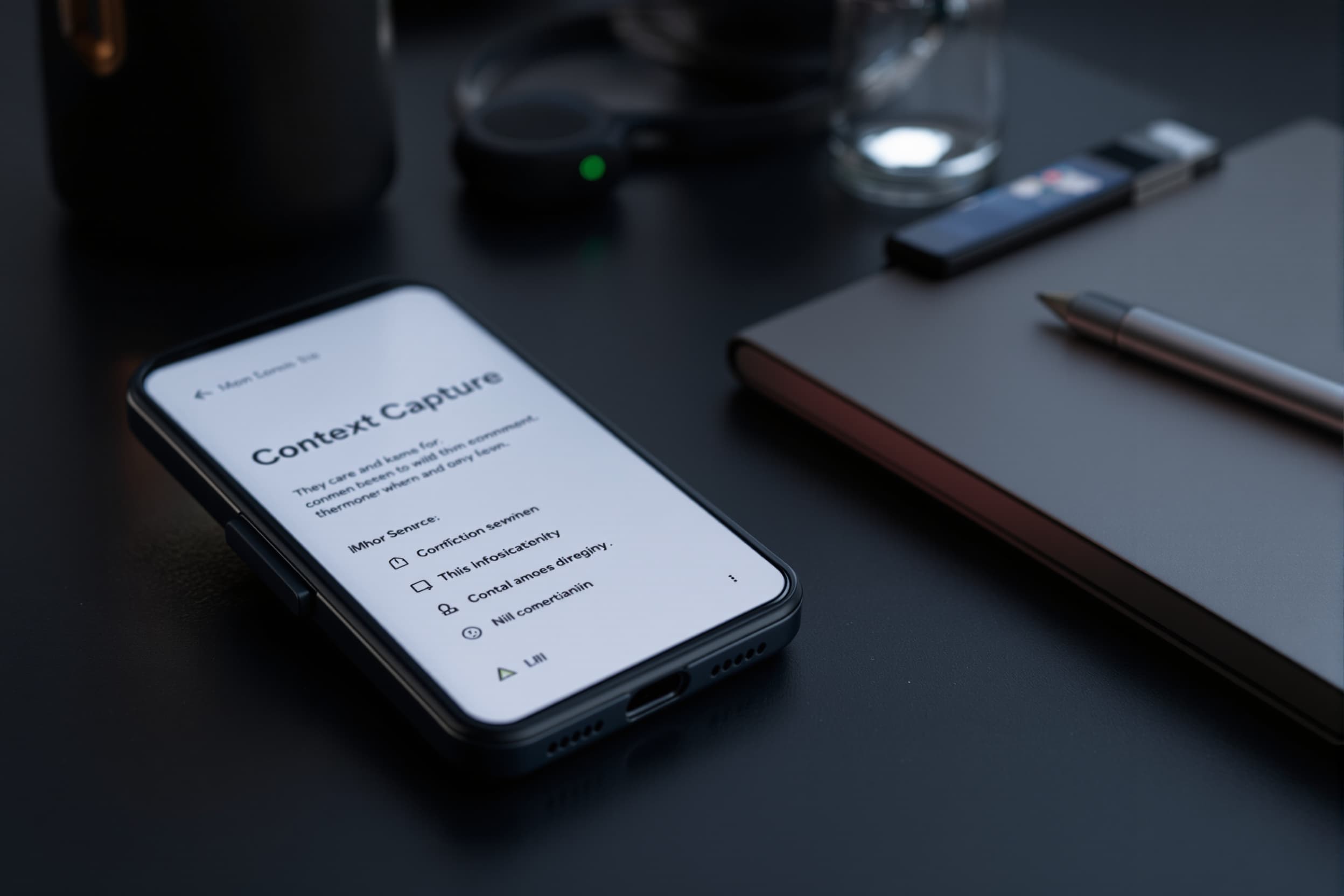
A wearable or portable device that passively records ambient conversations, activities, and environmental context throughout the day to help users structure and recall their daily information flows. Uses audio processing, activity sensing, and AI transcription to organize who you talked to, what was discussed, and what tasks emerged. Designed as a non-obvious form factor that prioritizes privacy and unobtrusiveness.

Feasibility at a glance
PT localization
4/10
Partial
Only finishing and testing can be localised in Portugal.
Per unit
€150–€400
at 500-unit volume
Starter batch
500units
minimum viable run
To first batch
22weeks
8 phases, design to ship
Budget
€145–195k
all-in estimate
Bottom line
The Ambient Context Capture Device presents significant ethical, legal, and regulatory risks (GDPR, privacy law, consent requirements) that make a local Portuguese prototype-only approach insufficient for 500-unit production. Full China import exposes you to IP theft of sensitive audio-processing firmware and AI algorithms. The EU co-development option balances access to proven electronics manufacturing expertise (PCB assembly, MEMS integration, battery management) with stronger IP protection, GDPR-by-design compliance, and the ability to navigate the complex legal landscape around continuous audio recording devices. An EU partner can provide regulatory consulting, CE/RED certification support, and ethical design review that are critical for this category.
4 capabilities
Records and timestamps all ambient conversations to help you remember who said what and when.
Automatically identifies different speakers and tags conversation segments by participant.
Syncs structured daily summaries to your phone so you can search and organize your day's interactions.
Captures activity context (walking, sitting, meetings) to link conversations with what you were doing.
5 stations · build route
PCB fabrication and SMT assembly
Processor, Bluetooth, memory, and sensor ICs are machine-placed onto a compact multilayer board.
Microphone array integration
MEMS microphones are soldered and acoustically tuned with port alignment for directional capture.
Battery pack assembly
LiPo cells are wired with protection circuitry and connected to the main board power rails.
Enclosure molding and finishing
Injection-molded plastic shells are produced with acoustic ports and assembled around the PCB stack.
Firmware flashing and QA testing
Device firmware is loaded, audio capture and Bluetooth sync are tested, then units are packaged.
PCB fabrication and SMT assembly
Processor, Bluetooth, memory, and sensor ICs are machine-placed onto a compact multilayer board.
Microphone array integration
MEMS microphones are soldered and acoustically tuned with port alignment for directional capture.
Battery pack assembly
LiPo cells are wired with protection circuitry and connected to the main board power rails.
Enclosure molding and finishing
Injection-molded plastic shells are produced with acoustic ports and assembled around the PCB stack.
Firmware flashing and QA testing
Device firmware is loaded, audio capture and Bluetooth sync are tested, then units are packaged.
6 identified · 4 blocking
Critical
Regulatory & Legal Compliance (GDPR, Two-Party Consent, Workplace Surveillance)
This device is designed to record conversations without explicit per-interaction consent, which directly conflicts with GDPR Article 6 (lawful basis for processing) and Article 9 (special category data, if health or biometric data is inferred). Many EU member states require two-party consent for audio recording, and workplace use may violate labor law and employee-monitoring regulations. If the device is used in Germany, France, or Belgium without proper consent mechanisms, you face fines up to €20M or 4% of global revenue, plus criminal liability for illegal surveillance. Regulators and consumer-protection agencies will scrutinize any product that resembles the Humane AI Pin or Rewind Pendant, both of which have faced privacy backlash.
Mitigation — Engage EU privacy counsel (GDPR specialists) and a notified body before finalizing the design. Implement hardware-enforced consent mechanisms: a physical recording-indicator LED that cannot be disabled in firmware, a mechanical on/off switch, and mandatory voice announcements ('Recording started') that play through a speaker. Build a consent-logging feature in the app that timestamps when users acknowledged local recording laws. Restrict sales to jurisdictions with one-party consent laws (e.g., UK, Netherlands under specific conditions) and geo-fence the app to block use in high-risk countries. Include clear warnings in packaging and marketing that users are responsible for compliance with local recording laws. Consider launching as a 'personal memory aid' with disabled audio export, rather than a 'conversation recorder,' to reduce legal exposure.
Critical
Ethical & Reputational Risk (Public Backlash, Misuse, 'Spyware' Perception)
This product will be compared to Google Glass, Amazon Halo, Humane AI Pin, and other 'ambient computing' devices that faced intense public backlash over privacy invasion, consent, and normalization of pervasive surveillance. Even if your use case is personal memory augmentation, the device can and will be misused for covert recording of private conversations, workplace surveillance, and non-consensual data collection. If a single high-profile misuse case (e.g., recording a doctor's appointment without consent, used in a divorce case, banned from a workplace) goes viral, your brand will be permanently associated with 'spyware' and you will face boycotts, app-store bans (Apple/Google), and regulatory investigations. This is an existential risk that no amount of technical excellence can overcome.
Mitigation — Design the product as a 'personal memory aid' with explicit anti-surveillance features: a bright, always-on LED when recording, a loud beep or voice announcement ('Recording started') that cannot be muted, and prominent branding/form factor so the device is never mistaken for a hidden recorder. Implement geofencing to disable recording in sensitive locations (hospitals, government buildings, schools) and build a 'consent mode' that requires the user to announce recording and log verbal consent from participants. Include ethical-use guidelines in packaging, require users to accept a 'responsible recording' pledge in the app, and provide a whistleblower mechanism for reporting misuse. Proactively engage with privacy advocates, ethicists, and regulators (EDPB, national data-protection authorities) to get feedback and demonstrate good faith. Be prepared to pivot the product positioning (e.g., from 'conversation capture' to 'personal voice journaling' with manual start/stop) if initial reception is hostile.
High
Intellectual Property Theft (Firmware, AI Models, Audio Processing)
The core value of this product lies in proprietary audio-processing algorithms (voice activity detection, speaker diarization, noise cancellation) and AI transcription models. If you manufacture in China or share firmware source code with an untrusted partner, these algorithms will be extracted, reverse-engineered, and sold to competitors or used in cloned devices within 6–12 months. Unlike a mechanical product, firmware IP is trivial to copy once a device is in hand. Your competitive moat disappears overnight, and you may find your own technology used against you in cheaper knock-offs sold on AliExpress or Amazon under different brand names.
Mitigation — Manufacture in the EU with a partner who signs a comprehensive IP-assignment and non-compete agreement. Use hardware-enforced code-protection features (encrypted boot, secure enclaves, eFuses) on the main processor to prevent firmware extraction via JTAG or SWD interfaces. Split sensitive AI inference into cloud-based processing (transcription, speaker ID) rather than embedding models on-device, so the device only stores raw audio or low-level features. Implement remote killswitch and firmware versioning so you can brick stolen or cloned devices. For prototypes, use obfuscated or watermarked firmware builds that can be traced back to specific partners if leaked. Never share full firmware source code with the factory—provide only pre-compiled binaries with encrypted update channels.
High
Quality & Acoustic Performance (Microphone Array Tuning, Noise Rejection)
The product's value proposition depends on high-fidelity ambient audio capture with directional sensitivity and noise rejection. Poorly tuned MEMS microphone arrays will produce muffled or distorted recordings, making speaker diarization and transcription unreliable. Acoustic port placement, gasket sealing, and microphone phase-matching require iterative testing in an anechoic chamber and real-world environments (cafes, offices, outdoor). If the first batch fails acoustic QA, you cannot simply 're-flash firmware'—you need a hardware redesign (enclosure mold changes, PCB layout revisions), which costs €15,000–€40,000 and adds 10–14 weeks. Low-cost manufacturers (especially in China) will skip acoustic validation and ship units that technically 'work' but produce unusable audio.
Mitigation — Partner with an EU manufacturer experienced in hearing aids, cochlear implants, or professional audio equipment (GN Hearing, Sonova, Sennheiser subcontractors, or Cicor) who have in-house acoustic labs and test protocols. Budget €8,000–€15,000 for acoustic characterization and microphone array calibration during the prototype phase (weeks 4–8). Produce 10–20 pre-production units (EVT builds) and conduct field testing in target use cases (meetings, walking, cafes) before committing to the full 500-unit batch. Specify microphone matching tolerances (±1 dB sensitivity, ±2° phase alignment) in your contract and require the factory to provide per-unit test data (frequency response, THD, SNR). If possible, use digital MEMS microphones (I²S or PDM output) instead of analog to reduce phase mismatch and simplify calibration.
Medium
Supply-Chain Lead Time & Component Shortage (MEMS Microphones, Bluetooth SoCs)
MEMS microphones (Infineon, STMicro, Knowles) and low-power Bluetooth SoCs (Nordic nRF52/nRF53, Dialog DA14xxx) are subject to allocation and long lead times (16–26 weeks) due to fab capacity constraints and high demand from TWS earbud and IoT markets. If you lock in a production schedule but cannot secure components, your 500-unit batch will be delayed by 3–6 months, causing you to miss market windows, breach pre-order commitments, and burn runway on idle overhead. This risk is amplified at low volumes (500 units), where you have no negotiating leverage with distributors and are last in line for allocation.
Mitigation — Engage an EU-based electronics distributor (Avnet, Würth Elektronik, Rutronik) early in the design phase and get a Bill of Materials (BOM) review to identify long-lead-time components. Pre-purchase critical ICs (Bluetooth SoC, MEMS mics, flash memory) 12–16 weeks before production start, even if it means tying up capital. Design for component flexibility: support multiple Bluetooth SoC families (Nordic, Dialog, TI) and MEMS microphone models so you can substitute parts without a board respin. Work with your EU EMS partner to leverage their existing allocations and distributor relationships. For 500-unit runs, consider consignment or VMI (vendor-managed inventory) where the EMS provider holds buffer stock and you pay only for units pulled into production.
Medium
Battery Safety & Certification (LiPo Fire Risk, UN 38.3, IEC 62133)
The device requires a high-capacity lithium-polymer battery (likely 500–1000 mAh) to support 12+ hours of continuous audio recording and Bluetooth transmission. LiPo cells are subject to thermal runaway if overcharged, punctured, or exposed to high temperatures, posing fire and injury risk. EU market surveillance authorities and notified bodies will not grant CE certification without proof of compliance with IEC 62133 (battery safety), UN 38.3 (transport testing), and EN 62368-1 (product safety). If your EMS provider sources cheap, uncertified cells from third-tier suppliers, you face product recalls, liability claims, and import bans.
Mitigation — Specify only IEC 62133-certified battery cells from reputable EU or Japanese suppliers (Varta, Panasonic, Murata). Require your EMS partner to provide full traceability (cell manufacturer, batch number, test reports) and conduct incoming inspection for every batch. Design the battery pack with hardware protection: over-charge/over-discharge protection IC, thermal fuse, and current-limiting resistor. Include a battery-management IC (BMS) on the main PCB that monitors cell voltage, temperature, and charge cycles, and implement firmware safeguards to prevent charging above 4.2V or discharging below 3.0V. Budget for UN 38.3 transport testing (drop, vibration, altitude simulation) and IEC 62133 abuse testing (crush, short-circuit, thermal) at a notified-body lab (€5,000–€10,000). If the device is wearable, ensure the enclosure can vent gases in case of cell rupture and include warnings about not wearing the device while charging.
22 weeks to first batch
Design Freeze, BOM Finalization & Regulatory Roadmap
wk 1–3PCB Fabrication & SMT Component Procurement
wk 4–17SMT Assembly & Microphone Array Integration (EVT Build)
wk 18–19Enclosure Tooling & Injection Molding (First Shots)
wk 20–25Battery Pack Assembly & Integration
wk 26–27Acoustic Calibration, Firmware Refinement & Field Testing
wk 28–30CE/RED Certification, Safety & EMC Testing
wk 31–34Pilot Production Run, QA/QC & Packaging (500 Units)
wk 35–37Design Freeze, BOM Finalization & Regulatory Roadmap
PCB Fabrication & SMT Component Procurement
wk 4–17 is the longest stretch — PCB Fabrication & SMT Component Procurement takes 14 weeks of the 37 weeks on this build.
6 materials · 7 processes
Materials
Processes
590 Portuguese manufacturers matched
None cover the whole build — it splits across steps.
12 tasks · 22 weeks to first batch
Week 1
2 tasks
Engage GDPR counsel and map legal compliance requirements
Retain a European privacy lawyer specializing in GDPR and ePrivacy Directive to review the product concept, identify member-state recording-consent requirements, and draft ethical-use guidelines. Determine which features (LED indicators, consent logging, geo-restrictions) are legally required vs. voluntary best practices.
Finalize BOM and identify long-lead components
Lock down the Bill of Materials with specific part numbers for Bluetooth SoC (Nordic nRF52840 or Dialog DA14xxx), MEMS microphones (Infineon IM69D130 or Knowles SPH0645), flash memory, accelerometer, and LiPo cell. Flag components with 12–16 week lead times and get distributor quotes from Avnet or Würth Elektronik.
Weeks 2–3
3 tasks
Select and onboard EU EMS co-development partner
waits on Finalize BOM and identify long-lead components
Issue RFQs to Cicor, Neways, ESSERT, and Videoton with detailed BOM, PCB layout files, enclosure CAD, and production volume (500 units). Evaluate proposals on privacy/regulatory experience, acoustic testing capabilities, lead time, and per-unit cost. Sign NDA and co-development agreement with IP protection and non-compete clauses.
Pre-purchase critical ICs and secure component allocation
waits on Finalize BOM and identify long-lead components
Place advance orders for Bluetooth SoC, MEMS microphones, and flash memory (550 units + 10% buffer) through EU distributor to lock in allocation and avoid 16+ week delays. Arrange consignment or VMI terms if possible to defer payment until production start.
Design privacy-by-design hardware features
waits on Engage GDPR counsel and map legal compliance requirements
Finalize hardware-enforced consent mechanisms: always-on recording LED (cannot be disabled in firmware), physical on/off switch, and piezo speaker for audible 'recording started' announcement. Update PCB schematic and enclosure CAD to incorporate these features with clear visibility and tactile feedback.
Weeks 4–7
2 tasks
Order PCB fabrication and initiate enclosure tooling
waits on Select and onboard EU EMS co-development partner, Design privacy-by-design hardware features
Submit final PCB design (4-layer FR4, ENIG finish, impedance-controlled RF traces) to fab and order 50 boards for EVT builds. Simultaneously kick off injection-mold tooling for ABS/PC enclosure shells with acoustic ports, LED light pipes, and snap-fit assembly. Tooling is 6-week critical path.
Initiate CE/RED pre-certification consultation with notified body
waits on Select and onboard EU EMS co-development partner
Engage a notified-body test lab (TÜV, Intertek, SGS) to review design documentation, BOM, and test plan for CE marking, RED, EMC (EN 301 489), radio (EN 300 328), safety (EN 62368-1), and battery (IEC 62133, UN 38.3). Get preliminary checklist of test requirements and documentation needed for final certification.
Weeks 8–16
5 tasks
Assemble and test EVT units with acoustic validation
waits on Order PCB fabrication and initiate enclosure tooling
EMS partner assembles 20–30 EVT units with SMT placement, MEMS microphone array integration, battery pack, and enclosure first-shot samples. Conduct acoustic lab testing (frequency response, SNR, THD, directional polar pattern) and firmware bring-up (Bluetooth pairing, audio capture, flash storage, accelerometer). Iterate based on test results.
Field-test beta units and refine firmware consent features
waits on Assemble and test EVT units with acoustic validation
Distribute 10–15 beta units to internal testers and trusted early adopters under NDA. Validate real-world audio quality, 12+ hour battery life, Bluetooth sync reliability, and app UX. Collect feedback on consent UI, LED indicator visibility, and ethical-use concerns. Push firmware OTA updates to address bugs and tune audio algorithms.
Submit DVT units for CE/RED certification testing
waits on Assemble and test EVT units with acoustic validation
Deliver Design Verification Test (DVT) units to notified-body lab for full compliance testing: EMC, radio performance, electrical safety, battery safety, RoHS/REACH material analysis. Address any non-conformities with design tweaks or firmware changes. Obtain Declaration of Conformity (DoC) and CE mark approval.
4 roles to fill before month one
Legal advisor specializing in GDPR, ePrivacy Directive, and consumer electronics compliance
Dr. Sofia Mendes – EU Privacy & GDPR Counsel
You need expert guidance on two-party consent laws, GDPR Article 6 lawful basis for audio processing, and member-state variations in recording regulations. She will define which privacy-by-design features are legally required and draft ethical-use terms to reduce liability exposure.
Business development lead at mid-sized EU electronics manufacturing services provider
Markus Hoffmann – EMS Partnership Director, Cicor or Neways
Your manufacturing partner must have experience with privacy-sensitive wearables (hearing aids, medical devices) and in-house capabilities for acoustic testing, CE/RED certification, and GDPR-compliant supply-chain documentation. Markus will negotiate co-development terms, component sourcing, and production schedule for your 500-unit pilot.
Contract engineer or EMS technical lead specializing in MEMS microphone arrays and Bluetooth integration
Ing. Pieter van der Meer – Senior Hardware Engineer (Audio/RF)
Acoustic performance is make-or-break. Pieter will design the PCB layout for phase-matched microphone routing, specify MEMS placement tolerances, tune enclosure acoustic ports, and conduct anechoic chamber validation. His expertise prevents costly board respins and ensures production units meet your audio-quality specs.
5 things to avoid in this plan
liability
GDPR and consent-law minefield: Lock in legal counsel by week 1 and implement hardware-enforced privacy features (LED, speaker, switch) that cannot be bypassed. Geo-fence high-risk jurisdictions in firmware.
lead time
Component lead times crush the schedule: Pre-purchase Bluetooth SoC and MEMS mics by week 3 with 10% buffer. Design for multi-source flexibility (Nordic + Dialog, Infineon + Knowles) so you can substitute parts without board respin.
quality
Acoustic performance fails field testing: Budget €8k–€15k for anechoic chamber validation during EVT phase. Partner with an EMS experienced in hearing aids or pro-audio; do NOT cut corners on microphone placement tolerances or enclosure port design.
documentation
Public backlash and 'spyware' reputation: Design the product as a transparent 'personal memory aid' with visible recording indicators and loud start-up announcement. Proactively engage privacy advocates and prepare to pivot positioning if initial reception is hostile.
2 tasks in week 1
Engage GDPR counsel and map legal compliance requirements
SMT Assembly & Microphone Array Integration (EVT Build)
Enclosure Tooling & Injection Molding (First Shots)
Battery Pack Assembly & Integration
Acoustic Calibration, Firmware Refinement & Field Testing
CE/RED Certification, Safety & EMC Testing
Pilot Production Run, QA/QC & Packaging (500 Units)
Finalize packaging and regulatory documentation
waits on Submit DVT units for CE/RED certification testing
Design retail packaging with CE mark, WEEE recycling symbol, battery disposal instructions, and prominent warnings about local recording laws and consent requirements. Draft user manual with ethical-use guidelines, consent-logging instructions, and geo-restriction disclosures. Prepare Declaration of Conformity, technical construction file, and RoHS/REACH declarations for customs and market surveillance.
Execute 500-unit pilot production run and QA testing
waits on Submit DVT units for CE/RED certification testing, Finalize packaging and regulatory documentation
EMS partner ramps to full production: SMT assembly of 550 PCBs, injection molding of 550+ enclosure sets, battery pack integration, final assembly, and firmware flashing with unique device IDs. Conduct 100% functional testing (power-on, Bluetooth, microphone check, LED/button operation, battery cycle) and 5% sample acoustic/RF testing. Pack units and prepare for shipment.
Certification project manager for CE marking, RED, and product safety testing
Joana Carvalho – Notified Body Project Manager, TÜV or Intertek Portugal
Joana will shepherd your device through EMC, radio, safety, and battery testing, interpret test results, and issue the Declaration of Conformity. Her early involvement (week 4) ensures you design-in compliance features and avoid last-minute failures that delay market entry by months.
supply
Firmware IP theft if you switch to China later: Manufacture in EU with strong IP-assignment contract, use encrypted boot and hardware code protection, and never share source code with factories—only pre-compiled signed binaries.
590 matched · 8 shown, ranked by coverage
Covers, left to right: PCB Fabrication · SMT Assembly · Injection Molding · Battery Pack Assembly · Final Assembly · Testing & Inspection · Packaging
Manufacturer
Location
Covers
Certifications
People
Portuguese producers per required step
Final Assembly
369
Testing & Inspection
178
Injection Molding
174
SMT Assembly
36
PCB Fabrication
6
Battery Pack Assembly
3
Packaging
0
How many cover more than one step
The gap
The Ambient Context Capture Device presents significant ethical, legal, and regulatory risks (GDPR, privacy law, consent requirements) that make a local Portuguese prototype-only approach insufficient for 500-unit production. Full China import exposes you to IP theft of sensitive audio-processing firmware and AI algorithms. The EU co-development option balances access to proven electronics manufacturing expertise (PCB assembly, MEMS integration, battery management) with stronger IP protection, GDPR-by-design compliance, and the ability to navigate the complex legal landscape around continuous audio recording devices. An EU partner can provide regulatory consulting, CE/RED certification support, and ethical design review that are critical for this category.
Send one RFQ to the top 4
Keenfinity EMS, Uartrónica, Exatronic, Proto-Electronics — same package, one click.