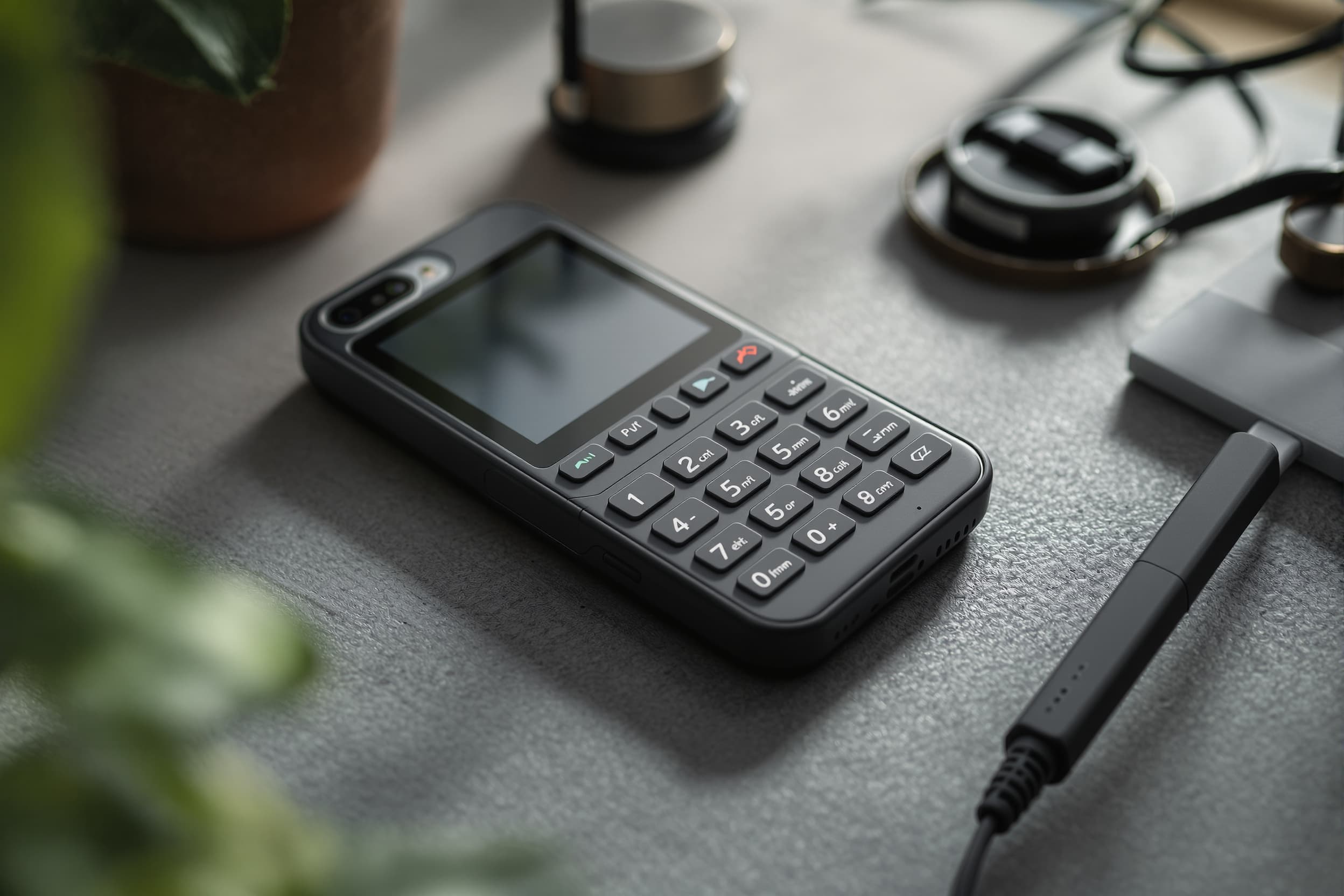
A feature phone built on Android that prioritizes offline living with swappable USB keypads and a curated app selection. Designed as a "dumbphone" alternative, it runs essential utilities and privacy-focused apps without Google Play Services. The device supports modular accessories including interchangeable keypads and silicone cases.

Feasibility at a glance
PT localization
3/10
Low
Only finishing and testing can be localised in Portugal.
Per unit
$250–350 USD
at 1-unit volume
Starter batch
1units
minimum viable run
To first batch
42weeks
8 phases, design to ship
Budget
€180–280k
all-in estimate
Bottom line
Smartphones and complex cellular devices require deep expertise in RF engineering, modem integration, regulatory certification (RED, CE), and Android OS customization. Portugal lacks dedicated smartphone ODMs or consumer electronics integrators with cellular certification labs. An EU co-development partnership with an established phone/IoT device manufacturer (e.g. Gigaset in Germany or a Nordic OEM) allows you to leverage their existing modem licenses, RED type-approvals, and supply chains for critical components (SoCs, modems, displays), while Portuguese partners handle injection molding (Salvador Caetano, Mold-Tech) and final assembly/QC (INL, RTE, Vortex). This hybrid model balances compliance speed, technical risk, and cost while keeping final assembly and branding in-market.
5 capabilities
Make and receive phone calls and SMS messages over cellular networks without smartphone distractions
Run a curated set of privacy-focused apps like encrypted email, VPN, and messaging without Google services
Swap physical keypads via USB to match your typing style or use case
Capture photos with a simple camera designed for offline, print-ready memories
Stay offline longer by limiting app selection and avoiding addictive social feeds
5 stations · build route
Fabricate and populate main PCB
Manufacture FR-4 circuit board, then use SMT and through-hole assembly to mount processor, modem, memory, and power circuits.
Injection mold plastic housing
Create front and back case halves from ABS or polycarbonate using precision molds.
Integrate display, camera, and battery
Mount LCD screen, camera sensor, speaker/mic, and lithium-ion battery into the housing.
Install custom Android OS and app suite
Flash the Android-based firmware with preloaded essentials and configure for non-Google operation.
Final assembly, testing, and QC
Attach USB keypad connector, run cellular and functional tests, package with keypad and accessories.
Fabricate and populate main PCB
Manufacture FR-4 circuit board, then use SMT and through-hole assembly to mount processor, modem, memory, and power circuits.
Injection mold plastic housing
Create front and back case halves from ABS or polycarbonate using precision molds.
Integrate display, camera, and battery
Mount LCD screen, camera sensor, speaker/mic, and lithium-ion battery into the housing.
Install custom Android OS and app suite
Flash the Android-based firmware with preloaded essentials and configure for non-Google operation.
Final assembly, testing, and QC
6 identified · 4 blocking
Critical
Cellular Modem Licensing and RED Certification
Cellular modems (e.g. Qualcomm, MediaTek, or UNISOC chipsets) require vendor licensing agreements that typically demand high-volume commitments (50k+ units/year) and upfront fees. In parallel, EU Radio Equipment Directive (RED) type-approval requires accredited lab testing for RF emissions, SAR (specific absorption rate), and EMC compliance—a 12–18 month process costing €300k–600k. Missing or incomplete RED certification blocks legal sale in the EU, and delays cascade into carrier certifications (Vodafone, Orange, etc.) needed for network interoperability. A first-time phone maker without an existing modem relationship faces high rejection risk and cost overruns.
Mitigation — Partner with an EU ODM (Gigaset, Nordic integrators) that holds existing modem licenses and RED certifications for similar platforms. Structure a co-development agreement where the partner provides a certified mainboard reference design and you customize the mechanical/firmware layers. Alternatively, hire a specialized RF consultancy (e.g. Telefication, Cetecom) early in the design phase to scope certification timelines and budget, and secure a modem evaluation kit from MediaTek or UNISOC under NDA to de-risk chipset availability.
High
Component Shortages for Displays, SoCs, and Modems
Global supply chains for smartphone-grade components (LCD modules, Android-capable SoCs, cellular modems, camera sensors) are controlled by a handful of Asian suppliers (BOE, Tianma, MediaTek, Qualcomm). Lead times for custom or low-volume orders can exceed 16–20 weeks, and minimum order quantities (MOQs) often start at 5k–10k units per SKU. Shortages or allocation during demand spikes (seen during COVID-19 and ongoing for mature-node chips) can delay production by 6+ months. Securing component supply without a proven track record or volume commitment is extremely difficult.
Mitigation — Design around catalog or 'longevity' components with known availability (e.g. MediaTek MT6739 or similar mature SoC, standard 4–5 inch IPS LCDs). Work with European distributors (Avnet, Arrow, Rutronik) to lock in forecasted allocation early, and consider dual-sourcing for critical parts (e.g. two display vendors). If co-developing with an EU ODM, leverage their existing component relationships and bulk purchasing power. For first pilot run (500–1k units), accept slight cost premium to use distributor stock rather than wait for factory lead times.
High
Firmware and Tooling IP Leakage
Custom Android builds (especially de-Googled ROMs with privacy-focused apps) and the mechanical design for the swappable USB keypad are core differentiators. If manufactured in China or co-developed without strong NDA and IP clauses, ODMs may reuse your firmware, tooling, or industrial design for competing products or white-label catalogs. Injection mold tooling, once cut, can be duplicated or repurposed. Firmware source code and signing keys, if hosted on partner servers, are vulnerable to exfiltration. Loss of exclusivity undermines brand positioning and competitive moat.
Mitigation — Retain ownership of injection mold tooling by contracting directly with Portuguese mold makers (Mold-Tech Portugal, Salvador Caetano) and storing tools in-country. For firmware, maintain signing keys and proprietary app code in-house; only share Android BSP integration layers with ODM partners under strict NDA. Use escrow agreements for critical design files. If working with a Chinese ODM, split production: let them build the mainboard/display subassembly, but ship semi-finished units to Portugal for final firmware flashing, keypad integration, and QC—this limits their access to the complete product and makes cloning harder.
High
Battery Safety and Regulatory Compliance (UN 38.3, IEC 62133)
Lithium-ion batteries are classified as dangerous goods for transport (UN 38.3) and must meet IEC 62133 safety standards (overcharge, short-circuit, thermal abuse testing). Non-compliant batteries can cause fires, trigger product recalls, and result in customs seizures. If sourcing batteries from low-cost suppliers without proper certification, you risk failed safety audits, liability claims, and reputational damage. EU market surveillance authorities actively test battery-powered devices, and non-conformities can lead to market bans and fines.
Mitigation — Source batteries only from tier-1 suppliers with full IEC 62133-2 and UN 38.3 test reports (e.g. VARTA, Samsung SDI, or reputable cell integrators). Request third-party test certificates from accredited labs (TÜV, UL, Intertek). Design battery management system (BMS) with overcharge/over-discharge protection and thermal cutoff. Include battery compliance documentation in your technical file for CE/RED certification. For initial batches, consider slightly higher-cost EU or Japanese cells to de-risk safety and customs clearance.
Medium
Extended Lead Times for Injection Mold Tooling
Precision injection molds for consumer electronics housings (with snap-fits, internal ribs, and cosmetic finishes) require 8–12 weeks of design, CNC machining, polishing, and sampling. Portuguese tool shops (Mold-Tech, Salvador Caetano) are experienced but may have backlogs, especially if automotive or industrial clients take priority. Mold revisions (common after first samples reveal fit or cosmetic issues) add another 3–4 weeks per iteration. If tooling is delayed, final assembly and testing cannot proceed, and launch dates slip.
Mitigation — Start mold design in parallel with PCB layout; freeze industrial design (CAD) by week 4 to allow tooling RFQ. Pre-qualify 2–3 Portuguese mold makers and choose based on lead time commitment, not just price. Budget for one revision cycle (T1 samples at week 12, feedback, T2 samples at week 16). Use rapid prototyping (SLA or SLS 3D prints) for early fit-checks and user testing to catch design issues before cutting steel. Consider a 'soft tooling' aluminum prototype mold for first 500 units if speed is critical, then transition to hardened steel for production runs.
Medium
Quality Control for Multi-Vendor Assembly
The Sidephone involves multiple subassemblies: PCB from one vendor, injection-molded housing from another, display/camera modules from distributors, and final integration at a Portuguese assembly house (INL, RTE, Vortex). Each handoff introduces risk of component damage, mismatched tolerances, or missing QC steps. If the assembly partner lacks experience with consumer electronics (many Portuguese houses focus on automotive or industrial), they may miss critical tests (cellular signal strength, camera focus, keypad actuation force). Field failures due to poor assembly (loose connectors, mis-seated batteries) damage brand reputation and drive returns/warranty costs.
Mitigation — Develop a detailed assembly work instruction (AWI) with photos, torque specs, and go/no-go gauges for every step. Require the final assembly partner to build and QC 20–50 pilot units under your supervision before scaling. Implement a three-stage test regime: (1) PCB electrical test at SMT house, (2) functional test (modem, camera, display, keypad) post-assembly, (3) final cosmetic and packaging QC. Use poka-yoke fixtures to prevent reversed connectors or wrong screws. Assign a resident quality engineer during ramp-up, and audit weekly until process is stable. For modem/RF testing, invest in a simple conducted test setup (call box) or partner with ISQ Group for in-line cellular checks.
42 weeks to first batch
Industrial Design Freeze and Modem Platform Selection
wk 1–4Injection Mold Tooling Design and Fabrication
wk 5–16PCB Design, Fabrication, and SMT Assembly
wk 17–26Component Sourcing and Pre-Assembly Kitting
wk 27–34Custom Android Firmware Development and Testing
wk 35–44RED and CE Certification Testing
wk 45–58Pilot Production and Process Validation
wk 59–64Serial Production, Final QC, and Packaging
wk 65–68Industrial Design Freeze and Modem Platform Selection
Injection Mold Tooling Design and Fabrication
wk 45–58 is the longest stretch — RED and CE Certification Testing takes 14 weeks of the 68 weeks on this build.
7 materials · 7 processes
Materials
Processes
589 Portuguese manufacturers matched
None cover the whole build — it splits across steps.
13 tasks · 12 weeks to first batch
Week 1
2 tasks
Select and sign LOI with EU ODM partner
waits on ODM partners may require high-volume commitments or exclusive agreements
Identify 2–3 candidate ODMs (Gigaset Germany, Nordic integrators) with existing Android phone platforms and RED certifications. Evaluate their modem chipset (MediaTek/UNISOC), willingness to support USB keypad interface, and NRE/revenue-share terms. Sign Letter of Intent with preferred partner, defining scope: they provide certified mainboard reference design and Android BSP; Sidephone owns mechanicals, firmware customization, and branding.
Freeze industrial design (CAD) for housing and keypad interface
waits on ODM mainboard dimensions not yet confirmed
Finalize 3D CAD models for front/back housing halves, internal component layout, USB keypad connector placement, and antenna clearance zones. Lock down dimensions for display cutout, camera lens, speaker grilles, and battery compartment. Export STEP files and 2D drawings for injection mold RFQ. Validate fit with ODM's mainboard outline and connector positions.
Weeks 2–3
3 tasks
RFQ and contract Portuguese injection mold maker
waits on Mold maker capacity/backlog, Tooling budget approval
Send housing CAD and production volume estimate (pilot 200 units, scale to 2k–5k) to Mold-Tech Portugal and Salvador Caetano. Request quotes for P20 steel molds, T1/T2 sample shots, and per-unit molding cost. Negotiate payment terms (50% deposit, 50% on T2 approval). Award contract and trigger mold design phase. Confirm 10–12 week lead time for first samples.
Kick off ODM mainboard customization
waits on ODM contract finalization, USB keypad connector spec not yet defined
Work with ODM engineering to adapt their reference PCB design: add USB keypad connector, remove unnecessary I/O (e.g., dual-SIM if not needed), and optimize power tree for battery life. Review schematic and layout for antenna placement and RF trace integrity. Agree on component sourcing (ODM bulk-buys SoC/modem/display, Sidephone sources battery/camera if preferred). Lock BOM and trigger PCB fabrication.
Source lithium-ion battery with IEC 62133 certs
waits on Battery dimensional spec depends on housing finalization
Contact tier-1 battery suppliers (VARTA, Samsung SDI EU distributors, or reputable cell integrators) for 2500–3500 mAh Li-ion pack with protection PCB. Request IEC 62133-2 and UN 38.3 test reports. Verify dimensions fit housing CAD. Order 300 cells (pilot + buffer) with 8–10 week lead time. Secure pricing for future batches.
Weeks 4–7
3 tasks
Develop de-Googled Android firmware and keypad driver
waits on ODM BSP delivery timeline, USB keypad hardware prototype availability
Set up AOSP or LineageOS build environment. Integrate ODM's BSP (kernel, modem drivers, display HAL). Remove Google Play Services, GMS packages. Pre-load privacy apps (Signal, ProtonMail, VPN client). Write USB keypad driver supporting hot-swap detection and button remapping. Flash test builds onto ODM dev boards and validate modem registration, SMS, and camera capture.
Receive and approve T1 injection mold samples
waits on Mold fabrication delays, Mainboard outline changes from ODM
Portuguese mold maker delivers T1 sample shots (front/back housing) at week ~8. Inspect for dimensional accuracy, snap-fit alignment, cosmetic finish (texture, gate marks, sink marks). Test-fit with ODM mainboard dummy, battery, and display module. Document any issues (tight tolerances, ejector pin marks). Provide feedback for mold revisions and approve T2 run.
Procure display, camera, and accessory components
waits on Component MOQs may exceed pilot qty, Supplier lead-time variability
Weeks 8–16
4 tasks
Assemble and test 20 engineering validation units
waits on T2 mold samples not ready, ODM mainboard delivery delay, Firmware stability issues
Receive ODM mainboards (with SoC, modem, soldered). Combine with T2 injection-molded housings, batteries, displays, cameras. Assemble 20 EVT units at INL or RTE under engineering supervision. Flash firmware, run cellular registration test, verify camera focus, test USB keypad hot-swap. Identify assembly issues (connector alignment, screw torque, antenna tuning). Refine work instructions.
Submit RED delta testing for certification
waits on EVT units not available, Lab booking lead time, Budget for test fees
Since ODM platform already has RED approval, conduct delta testing for modified housing and antenna configuration. Send 3 EVT samples to accredited lab (Telefication, Cetecom). Run focused RF tests (LTE/GSM transmit power, spurious emissions) and SAR with new housing. If non-conformities found, tweak antenna or shielding. Obtain updated RED Declaration of Conformity.
Run pilot production of 200 units
waits on Component shortages, Assembly partner capacity, RED cert not yet issued
Ongoing
1 task
Establish warranty and RMA process
Define 1-year hardware warranty terms and 30-day return policy per product spec. Set up reverse-logistics with assembly partner or 3PL for defective unit intake. Train support team on common issues (modem registration, battery drain, keypad detection). Create repair/replace decision tree. Track failure modes to feed back into design and QC improvements.
4 roles to fill before month one
Co-development partner providing certified mainboard, Android BSP, and modem platform
ODM Partnership Manager (Gigaset or Nordic integrator)
Critical to leverage their existing RED certification, modem chipset licenses, and RF engineering expertise. They reduce time-to-market from 18+ months to ~12 weeks for electronics platform, sharing NRE and compliance risk.
Tooling design and production molding for front/back housing
Injection Molding Engineer (Mold-Tech Portugal or Salvador Caetano)
Local Portuguese mold maker ensures IP control, faster iteration on mechanical design, and cost-effective tooling. Their 10–12 week lead time for steel molds is on the critical path; strong relationship prevents delays.
Accredited test lab for delta RED testing and CE compliance
RF/RED Certification Consultant (Telefication, Cetecom, or DEKRA)
Even with ODM's base certification, modified housing and antenna require delta testing to maintain RED approval. Early engagement scopes test plan, budget, and timeline; they guide any non-conformity fixes (shielding, tuning) before production ramp.
Portuguese contract manufacturer for pilot and serial assembly
5 things to avoid in this plan
certification
Watch for ODM NRE scope creep—lock down exactly which certifications and BSP features are included vs. billable add-ons before contract signature.
certification
Lock in battery supplier with IEC 62133 certs by week 3; non-compliant cells will block RED certification and trigger recalls.
watch-out
Injection mold revisions can add 3–4 weeks per cycle—use 3D-printed housings for EVT fit-checks before cutting steel to catch issues early.
lead time
Component lead times (displays, cameras) often slip—dual-source where possible and order 20% buffer stock for pilot to avoid line-down delays.
quality
RED delta testing may reveal antenna tuning issues in the new housing—budget €10k–15k contingency for RF engineering fixes (shielding tape, antenna repositioning, second test cycle).
2 tasks in week 1
Select and sign LOI with EU ODM partner
Attach USB keypad connector, run cellular and functional tests, package with keypad and accessories.
PCB Design, Fabrication, and SMT Assembly
Component Sourcing and Pre-Assembly Kitting
Custom Android Firmware Development and Testing
RED and CE Certification Testing
Pilot Production and Process Validation
Serial Production, Final QC, and Packaging
Order LCD display modules (4–5 inch IPS, resolution per ODM spec) from European distributors (Avnet, Rutronik) or ODM's recommended supplier. Source camera sensor module, speaker/mic assemblies, USB connectors, and fasteners. Request RoHS/REACH declarations. Consolidate shipments to Portuguese assembly partner. Lead time 6–8 weeks, so order by week 4.
Scale assembly at Portuguese partner (INL, RTE, Vortex). Injection-mold 250 housing sets. Assemble mainboards into housings, install displays/cameras/batteries, flash firmware, run functional test suite (modem, camera, keypad, power-on). Perform final cosmetic QC. Package with USB keypad, cable, manual. Produce serial number labels and traceability log. Output 200 pilot units ready for beta users or first sales.
Secure CE/RED compliance documentation and EU DoC
waits on Incomplete test reports, ODM unwilling to share certification files
Compile technical file: RED test reports, ODM's original certification plus delta results, battery IEC 62133 certs, RoHS/REACH declarations, user manual, risk assessment. Draft EU Declaration of Conformity listing all applicable directives (RED, EMC, LVD, RoHS, REACH, Battery, WEEE). Appoint EU authorized representative if needed. Affix CE mark to product label and packaging.
Final Assembly & QC Partner (INL, RTE, or Vortex CoLab)
Handles integration of mainboard, display, battery, and housing; performs functional testing (modem, camera, keypad) and final packaging. Local presence allows founder oversight during ramp-up and rapid response to quality issues.
589 matched · 8 shown, ranked by coverage
Covers, left to right: SMT Assembly · Through-Hole Assembly · PCB Fabrication · Injection Molding · Final Assembly · Testing & Inspection · Packaging
Manufacturer
Location
Covers
Certifications
People
Portuguese producers per required step
Final Assembly
369
Testing & Inspection
178
Injection Molding
174
SMT Assembly
36
Through-Hole Assembly
7
PCB Fabrication
6
Packaging
0
How many cover more than one step
The gap
Smartphones and complex cellular devices require deep expertise in RF engineering, modem integration, regulatory certification (RED, CE), and Android OS customization. Portugal lacks dedicated smartphone ODMs or consumer electronics integrators with cellular certification labs. An EU co-development partnership with an established phone/IoT device manufacturer (e.g. Gigaset in Germany or a Nordic OEM) allows you to leverage their existing modem licenses, RED type-approvals, and supply chains for critical components (SoCs, modems, displays), while Portuguese partners handle injection molding (Salvador Caetano, Mold-Tech) and final assembly/QC (INL, RTE, Vortex). This hybrid model balances compliance speed, technical risk, and cost while keeping final assembly and branding in-market.
Send one RFQ to the top 4
Keenfinity EMS, Uartrónica, Proto-Electronics, Exatronic — same package, one click.