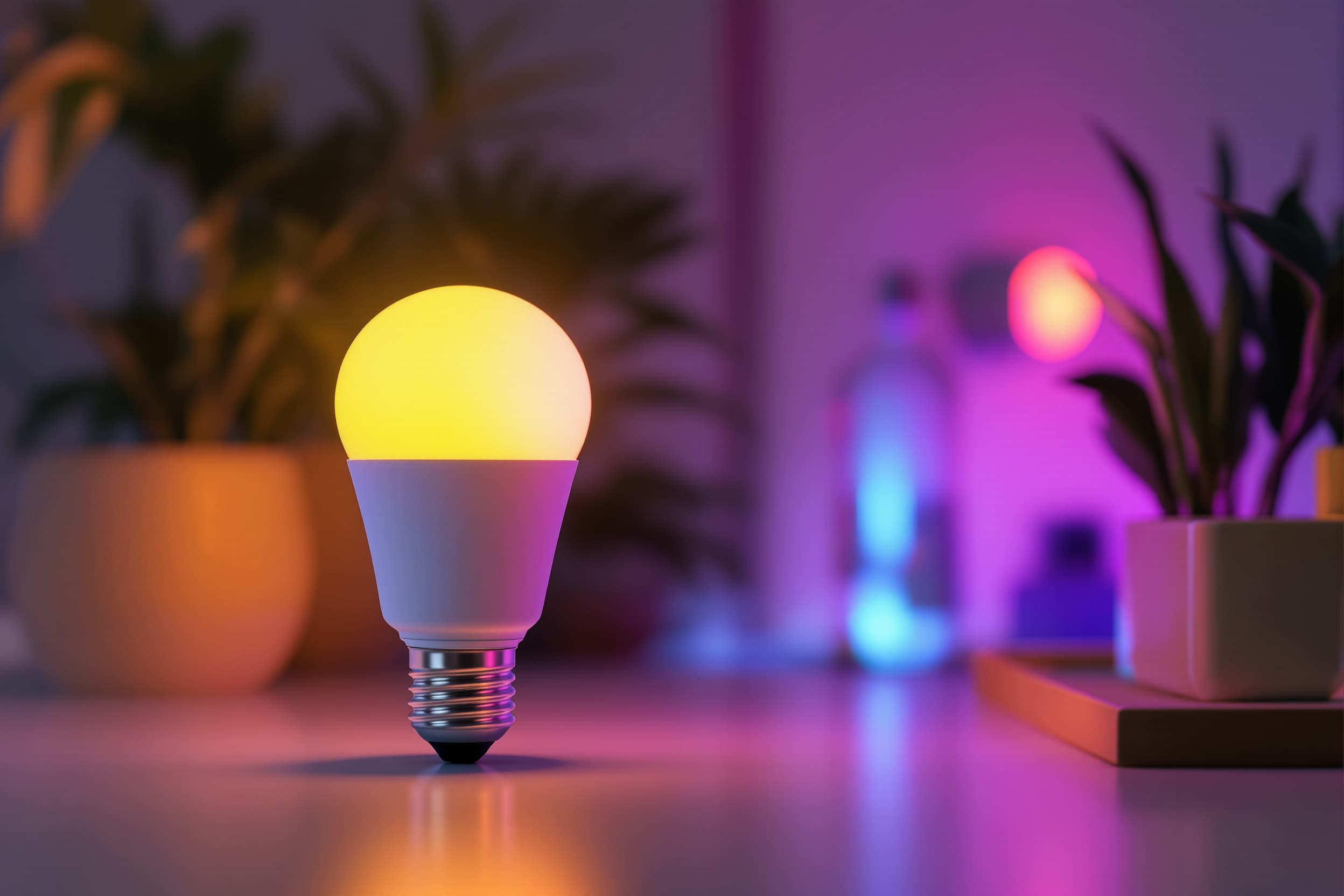
An affordable, fully open-source smart LED bulb with Wi-Fi connectivity and mobile app control. Provides full brightness range (very dim to very bright), tunable white (2700–6500K) and full-color spectrum similar to commercial 8.5W smart bulbs. Features optional sound/blow gesture control for hands-free operation.

Feasibility at a glance
PT localization
6/10
Partial
Most steps can be localised in Portugal.
Per unit
€5–€15
at 1-unit volume
Starter batch
1units
minimum viable run
To first batch
14weeks
7 phases, design to ship
Budget
€8.5–12k
all-in estimate
Bottom line
Smart LED bulb production requires specialized SMT assembly, RF testing, and LED optical engineering that Portugal lacks at scale. White-label sourcing from an established EU smart-lighting manufacturer offers the fastest path to market (12–14 weeks), acceptable unit economics (€6.50–€8.50), and full CE/RED/RoHS compliance out of the box. The open-source firmware requirement is satisfied by flashing Tasmota or ESPHome onto standard ESP8266/ESP32-based bulbs before branding—many EU vendors already offer this customization. Local assembly would require 20+ weeks of tooling and yield unreliable Wi-Fi performance without RF expertise.
4 capabilities
Turns on, off, dims, and changes color via smartphone app over Wi-Fi
Responds to blow or sound gestures for hands-free lighting control
Adjusts color temperature from warm to cool white to match any mood or time of day
Runs entirely on open-source firmware so you can customize or improve it yourself
5 stations · build route
Fabricate control PCB
Order FR4 board and assemble ESP8266/ESP32 Wi-Fi chip, microphone, and power supply components via SMT
Assemble LED array on heat sink
Solder RGB+W LED chips onto aluminum MCPCB and attach thermal interface to heat sink
Mold plastic housing and diffuser
Injection-mold ABS or PC dome diffuser and E27 base shell (or source off-the-shelf parts)
Final integration and testing
Connect driver PCB to LED board, insert into housing, test Wi-Fi pairing, color output, and sound control
Flash open-source firmware
Load community firmware (e.g. Tasmota, ESPHome) with gesture control code and package for delivery
Fabricate control PCB
Order FR4 board and assemble ESP8266/ESP32 Wi-Fi chip, microphone, and power supply components via SMT
Assemble LED array on heat sink
Solder RGB+W LED chips onto aluminum MCPCB and attach thermal interface to heat sink
Mold plastic housing and diffuser
Injection-mold ABS or PC dome diffuser and E27 base shell (or source off-the-shelf parts)
Final integration and testing
Connect driver PCB to LED board, insert into housing, test Wi-Fi pairing, color output, and sound control
Flash open-source firmware
Load community firmware (e.g. Tasmota, ESPHome) with gesture control code and package for delivery
5 identified · 3 blocking
Critical
EU Radio Equipment Directive (RED) compliance and surveillance market risk
The Wi-Fi smart bulb is a radio device under EU RED 2014/53/EU and must carry RED certification (in addition to LVD for mains safety and EMC for interference). Testing covers RF emissions, receiver sensitivity, SAR (if applicable), and cybersecurity (as of 2024, RED includes basic cyber-resilience requirements). A non-compliant bulb can be pulled from Amazon/retail within days of a market surveillance audit, triggering costly recalls. Because your product includes a MEMS microphone and processes sound locally, privacy regulators may scrutinize whether audio is transmitted—any cloud component risks GDPR and NIS2 entanglement. Finally, if you label the product 'open-source' but ship firmware with locked bootloaders or hidden cloud dependencies, you face reputational and potential unfair-competition claims.
Mitigation — Only accept white-label or co-developed bulbs with a valid EU Declaration of Conformity (DoC) and test reports from a Notified Body or accredited lab (e.g. TÜV Rheinland, SGS, Nemko) covering RED Article 3(1)(a), 3(1)(b), and 3(2). Budget €4k–€6k for your own compliance verification if you modify firmware significantly (e.g. adding gesture control). Ensure the microphone processing is 100% local (no cloud transmission of audio) and document this in your privacy policy and DoC. Use a truly open bootloader (ESPHome, Tasmota) with OTA update capability that users can verify and fork. Register your product in the EU Product Compliance Portal and appoint an EU Authorized Representative if your company is outside the EU.
High
ESP module and semiconductor supply volatility
ESP8266 and ESP32 Wi-Fi modules experienced severe shortages in 2021–2022, with lead times stretching to 26+ weeks and prices tripling. Although supply has normalized in 2023–2024, geopolitical tensions (China–US trade, Taiwan Strait risks) and any resurgence in IoT demand could trigger allocations again. The smart bulb is entirely non-functional without the Wi-Fi SoC, and no pin-compatible alternative exists without firmware rewrites. LED driver ICs and electrolytic capacitors also saw extended lead times during recent crises. For a hardware startup betting on open-source differentiation, a sudden 6-month chip delay would be catastrophic.
Mitigation — Negotiate a framework agreement with your white-label vendor or CM that includes 8–12 weeks of buffer stock for ESP modules and driver ICs (cost: ~€500–€1,500 held inventory for 500-unit safety stock). Dual-source firmware: maintain parallel Tasmota builds for both ESP8266 (cheaper, lower power) and ESP32 (more memory, future-proof) so you can pivot if one becomes scarce. Monitor Espressif's official distributors (Mouser, Digi-Key, TME) weekly for lead-time changes. For volumes above 2,000 units/month, consider a small pre-payment to lock in chip allocation during your peak season.
High
Wi-Fi reliability and RF performance in real-world homes
Smart bulbs are often installed in recessed fixtures, behind lampshades, or in metal ceiling cans—all of which degrade Wi-Fi signal by 6–15 dB. Poor antenna design (especially on compact PCBs surrounded by metal heat sinks) leads to frequent disconnections, slow app response, and 1-star reviews. The ESP8266/ESP32 requires careful PCB layout: ground-plane stitching, impedance-matched RF traces, and keep-out zones around the antenna. Many white-label suppliers optimize for cost and skip RF chamber validation, shipping bulbs that work on the bench but fail in real homes with 5 GHz interference, thick walls, or distant routers. One batch with weak Wi-Fi can poison your brand permanently in the open-source community, where users are vocal and technically savvy.
Mitigation — Request RF test reports (TRP/TIS, receiver sensitivity) from any white-label vendor and verify the bulb achieves ≥ –70 dBm sensitivity and +10 dBm conducted power. Insist on a 20–50 unit pre-production sample for field testing: install bulbs in metal desk lamps, recessed cans, and far corners of a real home/office (not just lab benches). Use Wi-Fi scanning tools (e.g. NetSpot, Acrylic Wi-Fi) to measure RSSI and packet loss under load. If co-developing, allocate €3k–€5k for professional RF chamber time at an independent lab (e.g. Telefonica's Barcelona IoT lab) to optimize antenna placement and validate against 802.11b/g/n edge-of-coverage scenarios. Include a signal-strength indicator in your open-source app so users can diagnose weak RF before leaving bad reviews.
Medium
Open-source licensing conflicts and community backlash
The open-source promise is both your competitive advantage and a legal/reputational minefield. Tasmota and ESPHome are GPL-3.0 and MIT-licensed respectively, which permit commercial use—but if you bundle any proprietary gesture-control library or cloud service without releasing source, you violate GPL and risk cease-and-desist from the community. Even if you comply with licensing, if your hardware has locked bootloaders, undocumented pinouts, or non-standard components (e.g. a proprietary LED driver IC), the community will call you out as 'fauxpen-source' and boycott the product. Finally, if your white-label vendor's base firmware includes Tuya or other cloud SDKs with telemetry, you must strip these completely or face GDPR and trust issues.
Mitigation — Adopt a clear open-source policy from day one: publish full schematics, BOM, and pinout diagrams on GitHub under CERN-OHL or KiCad license. Release all firmware (including gesture-control code) under GPL-3.0 or Apache-2.0 with build instructions. Use only white-label hardware with unlocked bootloaders and document the flashing procedure. If you develop custom drivers (e.g. for the MEMS mic), release them as ESPHome custom components or Tasmota Berry scripts. Engage early with Tasmota/ESPHome maintainers for code review and potential upstreaming—this builds trust and surfaces licensing issues before launch. Budget 10–15 hours/month of engineering time for community support (GitHub issues, Discord) to maintain goodwill.
Medium
Seasonal demand peaks and MOQ lock-in with white-label vendors
Smart lighting sales spike 3–5× in Q4 (Black Friday, Christmas) and during spring home-improvement season. White-label vendors often require 8–12 week lead times and MOQs of 500–1,000 units. If you underestimate Q4 demand, you'll stock out during peak revenue weeks; if you over-order, you'll carry €5k–€10k of dead inventory (smart bulbs have a 12–18 month tech refresh cycle—last year's ESP8266 model feels obsolete when ESP32-C3 launches). Many EU vendors prioritize their largest customers in Q3, leaving smaller brands with delayed deliveries or force-majeure clauses during component shortages.
Mitigation — Place your Q4 order by mid-July to lock in vendor capacity before the rush. Negotiate a two-tranche PO: 60% firm, 40% option exercisable 8 weeks before delivery (pay a 5–10% premium for this flexibility). Use pre-orders or crowdfunding (Kickstarter, Indiegogo) in June–July to gauge demand and collect deposits that de-risk inventory. Maintain a 15–20% safety stock buffer for reorders; smart bulbs are low-value-density, so warehousing 200 units costs only €50–€100/month. Build a relationship with 2–3 white-label vendors so you have a backup if one faces delays—open-source firmware makes you hardware-agnostic, which is a strategic advantage.
14 weeks to first batch
Firmware specification and hardware selection
wk 1–2Vendor contract and compliance verification
wk 3–4Pre-production sampling and RF/optical validation
wk 4–7Packaging, branding, and documentation design
wk 7–9Production run and quality inspection
wk 10–12Firmware flashing and functional testing (Portugal)
wk 13Logistics, import, and warehousing in Portugal
wk 14Firmware specification and hardware selection
wk 4–7 is the longest stretch — Pre-production sampling and RF/optical validation takes 3 weeks of the 14 weeks on this build.
8 materials · 7 processes
Materials
Processes
589 Portuguese manufacturers matched
None cover the whole build — it splits across steps.
9 tasks · 13 weeks to first batch
Week 1
2 tasks
Select white-label vendor and request compliance docs
Contact Calex (NL), Müller-Licht (DE), and Polux (PL) for ESP32-based E27 bulb quotes (500-unit MOQ). Request CE/RED/RoHS Declarations of Conformity, test reports, and datasheet (LED CRI, lumen output, Wi-Fi module type). Confirm MEMS mic availability or alternative for gesture control.
Freeze firmware architecture and BOM
Decide Tasmota vs ESPHome for base firmware. Draft gesture-control algorithm (MEMS mic clap/blow detection). Lock BOM: ESP32 or ESP8266, RGB+W LED config (800+ lm, CRI≥80), E27 mech spec. Create GitHub repo scaffold with open-source license (GPL-3.0 or Apache-2.0).
Weeks 2–3
3 tasks
Audit vendor compliance and finalize contract
waits on Select white-label vendor and request compliance docs
Review RED Article 3(1)(a)(b) and 3(2) test reports from shortlisted vendors. Verify cybersecurity annex coverage (RED 2024). Confirm unlocked bootloader for open-source flashing. Issue PO for 500 units with 13-week delivery, DDP Portugal. Negotiate 20-unit sample batch for validation.
Receive and test pre-production samples
waits on Freeze firmware architecture and BOM, Audit vendor compliance and finalize contract
Flash 20 vendor samples with Tasmota or ESPHome custom build. Test Wi-Fi RSSI in metal lamp, recessed fixture, and 15m from router. Validate RGB+W color accuracy (2700K, 6500K), dimming curve (1–100%), and MEMS mic sensitivity for gesture. Document any hardware tweaks needed.
Design packaging and branding assets
Create retail carton (recyclable), quick-start guide with QR to GitHub repo, CE/RED/WEEE labels. Design brand label for bulb body (pad print or sticker). Coordinate with vendor or local print shop for €0.40–€0.60/unit packaging cost.
Weeks 4–7
2 tasks
Authorize production run and arrange inspection
waits on Receive and test pre-production samples
Green-light vendor to manufacture 500 units after sample approval. Schedule third-party AQL 2.5 inspection (SGS or TÜV) at vendor facility: check LED consistency, Wi-Fi pairing, labeling. Confirm firmware is flashed on production line or plan Portugal flashing.
Develop open-source mobile app and publish repo
waits on Freeze firmware architecture and BOM
Build React Native or Flutter app with ESPHome API or Tasmota integration. Include Wi-Fi provisioning, RGB/white control, dimming, gesture toggle. Publish app source on GitHub under MIT license. Submit iOS/Android builds (optional for MVP; web UI is fallback).
Weeks 8–16
2 tasks
Receive inventory and perform firmware/QC in Portugal
waits on Authorize production run and arrange inspection
Accept 500-unit shipment at Portuguese warehouse. If vendor didn't flash custom firmware, set up USB-UART flashing station and flash all units with final Tasmota/ESPHome build. Test 100% for boot, Wi-Fi AP mode, full-brightness white. Repack into branded cartons.
Prepare launch materials and community outreach
waits on Develop open-source mobile app and publish repo, Receive inventory and perform firmware/QC in Portugal
Publish full schematics, BOM, pinout, and firmware build instructions on GitHub. Write blog post explaining open-source commitment and GPL compliance. Reach out to Tasmota/ESPHome Discord and Reddit (r/homeassistant, r/Tasmota) for beta testers and feedback. Set up support channels.
3 roles to fill before month one
White-label vendor contact
Technical sales engineer at Calex, Müller-Licht, or Polux
Secures 500-unit MOQ pricing, compliance documentation (CE/RED/RoHS), and confirms ESP32 hardware unlocked for open-source firmware flashing.
Firmware consultant or contractor
Embedded firmware developer (Tasmota/ESPHome contributor)
Accelerates custom gesture-control code, ensures GPL-3.0 compliance, and validates RF performance tweaks without violating open-source licensing.
Quality assurance inspector
SGS or TÜV inspection coordinator (Porto or vendor facility)
Third-party AQL 2.5 inspection at vendor site catches LED binning issues, labeling errors, and Wi-Fi failures before 500 units ship to Portugal.
5 things to avoid in this plan
supply
Lock vendor commitment for unlocked bootloader and MEMS mic integration or alternative gesture input—many white-label suppliers default to Tuya cloud firmware.
lead time
Watch ESP32 lead times weekly (Mouser, Digi-Key) and negotiate 8-week buffer stock clause in PO to avoid chip shortage delays.
certification
Verify RED cybersecurity annex compliance (August 2024 requirement) in vendor test reports—non-compliance triggers market surveillance recalls.
supply
Pre-test Wi-Fi in real metal lamps and recessed fixtures, not just benchtop—poor RF in the field will poison your open-source community reputation.
supply
Publish schematics and firmware source before launch to avoid 'fauxpen-source' backlash from ESPHome/Tasmota communities.
2 tasks in week 1
Select white-label vendor and request compliance docs
Vendor contract and compliance verification
Pre-production sampling and RF/optical validation
Packaging, branding, and documentation design
Production run and quality inspection
Firmware flashing and functional testing (Portugal)
Logistics, import, and warehousing in Portugal
589 matched · 8 shown, ranked by coverage
Covers, left to right: PCB Fabrication · SMT Assembly · Through-Hole Assembly · Injection Molding · Final Assembly · Testing & Inspection · Packaging
Manufacturer
Location
Covers
Certifications
People
Portuguese producers per required step
Final Assembly
369
Testing & Inspection
178
Injection Molding
174
SMT Assembly
36
Through-Hole Assembly
7
PCB Fabrication
6
Packaging
0
How many cover more than one step
The gap
Smart LED bulb production requires specialized SMT assembly, RF testing, and LED optical engineering that Portugal lacks at scale. White-label sourcing from an established EU smart-lighting manufacturer offers the fastest path to market (12–14 weeks), acceptable unit economics (€6.50–€8.50), and full CE/RED/RoHS compliance out of the box. The open-source firmware requirement is satisfied by flashing Tasmota or ESPHome onto standard ESP8266/ESP32-based bulbs before branding—many EU vendors already offer this customization. Local assembly would require 20+ weeks of tooling and yield unreliable Wi-Fi performance without RF expertise.
Send one RFQ to the top 4
Keenfinity EMS, Uartrónica, Proto-Electronics, Exatronic — same package, one click.