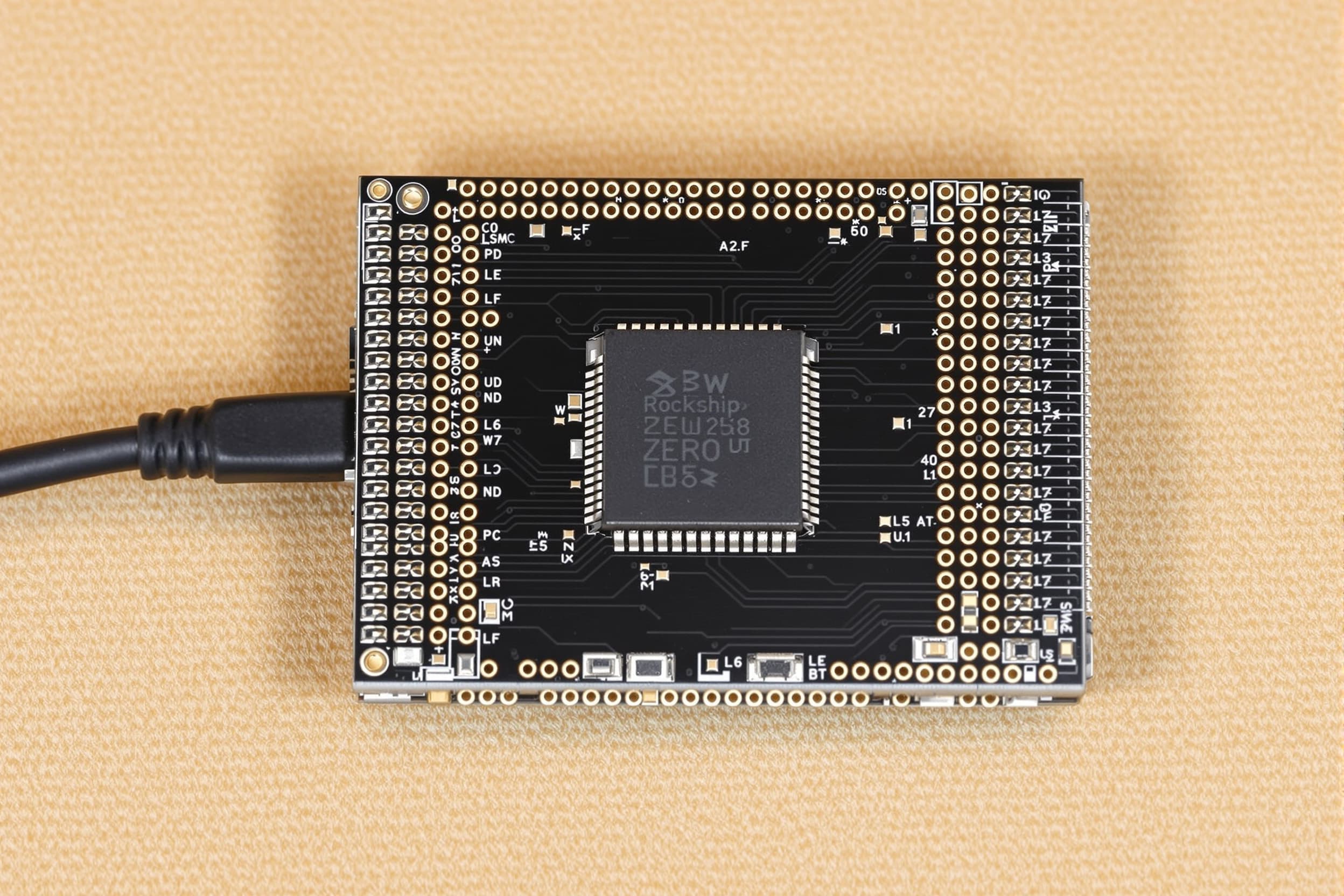
A single-board computer (SBC) featuring the Rockchip RK3566 quad-core Cortex-A55 processor (up to 1.6 GHz) with Mali-G52 2EE GPU in an ultra-compact 65mm × 30mm form factor. Designed for embedded computing, edge applications, and multimedia projects with support for 1080p@60fps HDMI output, onboard Wi-Fi 6 / BT 5.4, flexible booting from eMMC or microSD, and comprehensive GPIO expansion options (40-pin or headerless).

Feasibility at a glance
PT localization
3/10
Low
Only finishing and testing can be localised in Portugal.
Per unit
$40–$90
at 100-unit volume
Starter batch
100units
minimum viable run
To first batch
20weeks
7 phases, design to ship
Budget
€18,000–28,000 total project cost
all-in estimate
Bottom line
The Radxa ZERO 3W is a complex single-board computer requiring advanced PCB fabrication, SMT assembly of high-pin-count BGA components (RK3566 SoC, LPDDR4), and specialized testing infrastructure. Portugal lacks mature turnkey SBC manufacturing capability at this complexity level. EU co-development with an established partner—leveraging Eastern European PCB houses (Poland, Czech Republic) combined with German or Austrian contract manufacturers for assembly and test—offers the best balance of lead time (16–20 weeks), quality assurance, IP protection under EU law, and cost competitiveness (~€42–52/unit at 100 pcs). This route ensures CE/RoHS compliance, avoids long Asia shipping delays, and builds a scalable relationship for future revisions. White-label is not viable because no EU vendor offers a pin-compatible RK3566 SBC form factor at 65×30mm. China remains the cost floor but adds 6+ weeks shipping, higher IP risk, and communication overhead.
5 capabilities
Runs a full Linux operating system to support software development, media playback, and embedded applications
Decodes 4K@60fps H.264/H.265 video and encodes 1080p@60fps video using hardware acceleration for streaming and recording
Connects wirelessly to networks and Bluetooth devices with Wi-Fi 6 and BT 5.4 for fast, low-latency communication
Captures high-definition images and video from a camera module attached to the MIPI CSI port
Interfaces with sensors, motors, displays, and other electronics through the 40-pin GPIO header
5 stations · build route
PCB fabrication and solder mask
A multilayer FR-4 PCB is etched, drilled, and coated with solder mask and silkscreen for component placement.
Surface-mount component placement
The SoC, RAM, eMMC, power ICs, and passive components are placed by pick-and-place machines.
Reflow soldering
The populated PCB passes through a reflow oven to melt solder paste and form electrical connections.
Connector and header assembly
USB Type-C, micro HDMI, MIPI CSI, and optional GPIO headers are soldered or press-fit onto the board.
Functional testing and quality inspection
Each board is powered on, flashed with test firmware, and checked for functionality and defects before packaging.
PCB fabrication and solder mask
A multilayer FR-4 PCB is etched, drilled, and coated with solder mask and silkscreen for component placement.
Surface-mount component placement
The SoC, RAM, eMMC, power ICs, and passive components are placed by pick-and-place machines.
Reflow soldering
The populated PCB passes through a reflow oven to melt solder paste and form electrical connections.
Connector and header assembly
USB Type-C, micro HDMI, MIPI CSI, and optional GPIO headers are soldered or press-fit onto the board.
Functional testing and quality inspection
Each board is powered on, flashed with test firmware, and checked for functionality and defects before packaging.
5 identified · 2 blocking
High
Critical Component Shortage (Rockchip SoC, LPDDR4, eMMC)
The Rockchip RK3566 SoC, LPDDR4 RAM, and eMMC flash are single-source or limited-source components with 12–16 week lead times from Asian foundries and distributors. A spike in demand (e.g., automotive, IoT markets) or supply chain disruption (geopolitical tensions, fab outages) can delay procurement by 8–20 weeks. At 100-unit volumes, GETMILK has limited purchasing power with distributors (Arrow, Avnet), risking allocation shortages or minimum order quantity (MOQ) penalties. If the EMS cannot secure components on time, the entire production schedule slips, missing market windows or customer commitments.
Mitigation — Pre-order long-lead components (SoC, RAM, eMMC) 16+ weeks before assembly start. Establish accounts with multiple authorized distributors (Arrow EU, Avnet EMEA, Mouser) and request allocation guarantees in writing. For volumes above 500 units, negotiate consignment inventory or forward contracts. Maintain a 10–15% safety stock of critical ICs in bonded warehouse. Design the board with footprint compatibility for alternative LPDDR4 vendors (Micron, Samsung, SK Hynix) to enable second-sourcing if one supplier falters.
High
CE, RED, RoHS Non-Compliance and Market Access Delays
The ZERO 3W contains a Wi-Fi 6 / Bluetooth 5.4 radio module, triggering RED (Radio Equipment Directive) 2014/53/EU in addition to LVD (Low Voltage Directive) and EMC (Electromagnetic Compatibility). Achieving CE marking requires EMC testing (EN 55032, EN 55035), RF testing (EN 300 328 for 2.4/5 GHz), SAR evaluation, and RoHS/REACH material compliance for all components. If the EMS or module supplier provides incomplete test reports, GETMILK cannot legally place the product on the EU market, risking customs seizures, retailer rejections, or fines (up to €100k+ per violation). Pre-certified modules may still require system-level integration testing, adding 4–6 weeks and €5k–15k in lab fees.
Mitigation — Select a Wi-Fi/BT module pre-certified under RED with modular approval (e.g., Murata Type 1MW, AzureWave AW-CM256SM) to minimize system-level RF testing. Engage an EU notified body or accredited test lab (TÜV Rheinland, SGS, Telefication) early in the design phase for pre-compliance consultation. Budget €8k–18k and 6–8 weeks for full CE/RED conformity assessment. Request certificate of conformity and RoHS/REACH declarations from all component suppliers and the EMS. Maintain a technical construction file (TCF) with schematics, BOM, test reports, and risk assessments for market surveillance audits. Label the PCB with CE mark, notified body ID (if required), and WEEE disposal symbol.
Medium
Intellectual Property and Design File Leakage
The Radxa ZERO 3W design is based on publicly available reference schematics, but any custom firmware, BSP patches, or hardware modifications represent GETMILK's IP. Sharing Gerber files, BOM, and firmware images with an EMS (especially in China) creates risk of unauthorized copying, resale of clones under different brands, or leakage to competitors. Even within the EU, subcontractors or temporary workers at the EMS may mishandle design files. A leaked design can flood the market with cheaper clones within 3–6 months, eroding GETMILK's pricing power and brand differentiation.
Mitigation — Sign comprehensive NDA and IP assignment agreements with the EMS, specifying data handling, access control, and penalties for breach. Use watermarked or revision-controlled design files with unique serial numbers. Encrypt firmware binaries and implement secure boot (eFuse OTP keys) on the RK3566 to prevent unauthorized cloning of software. For high-value IP (custom FPGA logic, proprietary drivers), consider keeping final integration in-house or at a trusted tier-1 partner. Audit the EMS's ISO 27001 information security practices and require segregated project workspaces. Register design patents or utility models in the EU if novel features exist.
Medium
BGA Assembly Yield Loss and Functional Test Escapes
The RK3566 SoC and LPDDR4 RAM are fine-pitch BGA packages (0.5mm ball pitch) requiring precise reflow profiles, X-ray inspection, and functional test to detect solder voids, shorts, or cold joints. At 100-unit volumes, the EMS may not optimize reflow recipes, leading to 5–15% yield loss (5–15 boards scrapped or reworked). Hidden defects (intermittent boot failures, eMMC corruption, Wi-Fi dropouts) may escape factory testing and surface in the field, triggering warranty returns (€30–50 per RMA) and reputational damage. A single batch with 10% field failures costs €300–500 in logistics and replacement units, wiping out profit margins.
Mitigation — Specify 100% X-ray inspection of BGA joints and 100% functional test with scripted Linux boot, memory stress test (memtester), eMMC I/O benchmarking, Wi-Fi association test, and HDMI output validation. Require the EMS to provide first-article inspection (FAI) reports and process capability (Cpk ≥ 1.33) data for BGA reflow. Implement in-circuit test (ICT) or flying probe for shorts/opens detection before powering boards. Perform incoming inspection on a 10% sample at GETMILK's facility, testing boot, thermal stability (0–50°C chamber), and peripheral functionality. Negotiate a 2–5% yield allowance in the contract, with the EMS absorbing scrap costs above that threshold.
Medium
Schedule Slippage Due to Multi-Tier Supply Chain
The ZERO 3W production timeline involves sequential dependencies: PCB fabrication (2–3 weeks), component procurement (12–16 weeks for SoC), SMT assembly (1–2 weeks), functional test/BSP flash (1 week), and final packaging (1 week). Any delay in one stage cascades through the schedule. For example, if the Rockchip distributor ships SoCs 3 weeks late, the entire project slips by 3+ weeks, missing a product launch or trade show deadline. At 100-unit volumes, GETMILK lacks leverage to expedite orders, and the EMS may deprioritize small runs when larger customers demand capacity.
Mitigation — Build a 3–4 week schedule buffer into the project timeline (target 16 weeks, plan for 20 weeks to first batch). Front-load component procurement by placing purchase orders 18–20 weeks before intended ship date, even if design is not finalized; accept risk of minor BOM changes. Use a project management tool (Gantt chart, critical path analysis) to track each supplier's lead time weekly. Negotiate contractual delivery penalties (e.g., 2% price reduction per week of delay) with the EMS to incentivize on-time performance. For urgent orders, pay expedite fees (air freight, rush PCB fabrication) to compress lead time by 2–4 weeks. Maintain alternative EMS relationships in case the primary partner cannot meet deadlines.
20 weeks to first batch
Design Finalization and Component Procurement
wk 1–2PCB Fabrication and Incoming Inspection
wk 3–5Component Receipt and Kitting
wk 6–17SMT Assembly and Reflow Soldering
wk 18Through-Hole Connector Assembly
wk 19Functional Test and BSP Flashing
wk 19–20Final Assembly, Packaging, and Documentation
wk 20Design Finalization and Component Procurement
wk 6–17 is the longest stretch — Component Receipt and Kitting takes 12 weeks of the 20 weeks on this build.
8 materials · 5 processes
Materials
Processes
463 Portuguese manufacturers matched
None cover the whole build — it splits across steps.
10 tasks · 13 weeks to first batch
Week 1
2 tasks
Finalize Radxa ZERO 3W reference design and BOM
Lock schematic, PCB layout (6-layer Gerber files), and bill of materials based on Radxa open-source reference. Verify footprint compatibility for alternative LPDDR4 vendors (Micron, Samsung). Generate manufacturing work instructions, test procedure checklist, and Linux BSP boot image for factory flashing.
Request RFQs from 3–4 EU EMS partners
Send complete design package (Gerber, BOM, assembly drawings, test requirements) to Lacroix Electronics, Katek SE, PRIMUX Poland, and one backup vendor. Request detailed quotes for 100-unit pilot including NRE, per-unit cost, lead time, and component procurement terms. Schedule kick-off calls within 5 days.
Weeks 2–3
3 tasks
Select EMS partner and sign manufacturing agreement
waits on Request RFQs from 3–4 EU EMS partners
Evaluate RFQ responses on cost (target €42–52/unit), lead time (≤18 weeks), BGA assembly capability, X-ray inspection, Linux BSP flashing, and Rockchip supply chain access. Negotiate NRE fee, yield terms (EMS absorbs >5% scrap), and IP protection clauses. Sign NDA, manufacturing service agreement, and purchase order for 100 units.
Pre-order long-lead components (SoC, RAM, eMMC)
waits on Select EMS partner and sign manufacturing agreement
Open accounts with Arrow EU and Avnet EMEA. Place purchase orders for Rockchip RK3566 SoC (110 pcs), LPDDR4 RAM (110 pcs), eMMC flash (110 pcs), and Wi-Fi 6/BT 5.4 pre-certified module (110 pcs). Confirm 12–16 week lead times and request allocation guarantee in writing. Coordinate delivery to EMS warehouse.
Engage CE/RED compliance test lab
waits on Finalize Radxa ZERO 3W reference design and BOM
Contact TÜV Rheinland, SGS, or Telefication for pre-compliance consultation. Submit design files and Wi-Fi/BT module certificates for review. Request quote for EMC (EN 55032/55035), RED (EN 300 328), and RoHS testing. Schedule test slot for week 14–16 (after first articles available). Budget €8k–15k and 6 weeks for full conformity assessment.
Weeks 4–7
1 task
Review and approve first-article inspection (FAI) report
waits on Pre-order long-lead components (SoC, RAM, eMMC)
EMS fabricates 5 pilot PCBs and populates with components. Receive FAI report documenting X-ray BGA inspection, AOI results, dimensional checks, and electrical continuity. Engineering reviews for design rule compliance, component placement accuracy, and solder joint quality. Approve for full production or issue ECO (engineering change order) for corrections.
Weeks 8–16
3 tasks
Validate functional test procedures with EMS
waits on Review and approve first-article inspection (FAI) report
Work with EMS test engineering to implement automated Linux boot test, memory stress (memtester), eMMC I/O benchmark, Wi-Fi association, HDMI output, and USB 3.0 throughput validation. Verify test jig design, scripted pass/fail criteria, and serial number laser marking. Conduct 10-board pilot run and review test logs for escapes or false failures.
Execute CE/RED conformity assessment and obtain certificates
waits on Review and approve first-article inspection (FAI) report, Engage CE/RED compliance test lab
Ship 3 first-article boards to test lab for EMC emission/immunity, RF spectrum analysis, and safety evaluation. Review test reports and address any non-conformities (PCB layout changes, shielding, ferrite beads). Receive Declaration of Conformity and technical construction file (TCF) for CE marking. Verify WEEE and RoHS declarations from all suppliers.
Approve final production batch and initiate shipment
waits on Validate functional test procedures with EMS, Execute CE/RED conformity assessment and obtain certificates
Ongoing
1 task
Monitor component lead times and secure inventory for next batch
Track Rockchip SoC, LPDDR4, and eMMC availability weekly via distributor portals. If lead times extend beyond 16 weeks or allocation tightens, escalate procurement or pre-order safety stock (50–100 units worth). Maintain relationship with alternative LPDDR4 suppliers (SK Hynix, Micron) for second-sourcing. Plan for 500–1k unit scaling to unlock volume pricing (€35–42/unit).
4 roles to fill before month one
Turnkey EMS partner with BGA assembly, X-ray inspection, and ARM SBC experience
Katek SE – Senior Account Manager (Germany)
Katek offers end-to-end manufacturing from PCB fab coordination to functional test and CE compliance support. Their Bavarian facility has experience with Rockchip SoCs and can manage component procurement, reducing GETMILK's coordination overhead. Critical for negotiating NRE terms, yield guarantees, and scaling roadmap to 1k+ units.
Authorized Rockchip distributor for SoC and memory procurement
Arrow Electronics EU – FAE (Field Application Engineer)
Arrow is one of the few EU distributors with direct Rockchip allocation and can provide genuine RK3566 SoCs with 12–16 week lead times. The FAE can advise on alternative memory vendors, expedite options, and negotiate consignment inventory for future orders. Essential for avoiding counterfeit components and securing supply at low volumes.
Notified body for CE/RED conformity assessment and testing
TÜV Rheinland – Compliance Engineer (Portugal or Spain office)
TÜV provides accredited EMC, RF, and safety testing required for CE marking and EU market access. Early engagement (pre-compliance review) can identify design risks before production, avoiding costly rework. Their technical construction file (TCF) support ensures audit-ready documentation for customs and market surveillance.
5 things to avoid in this plan
lead time
Watch for Rockchip SoC and LPDDR4 lead-time creep beyond 16 weeks—pre-order components 18–20 weeks ahead and maintain 10% safety stock to avoid production delays.
watch-out
Lock IP protection with the EMS via NDA, encrypted firmware, and secure boot (eFuse keys) to prevent design leakage or unauthorized clones flooding the market.
certification
Verify Wi-Fi/BT module RED certification and budget €8k–15k + 6 weeks for system-level CE conformity assessment to avoid customs holds or market access delays.
quality
Ensure 100% X-ray BGA inspection and scripted functional test (Linux boot, memory, Wi-Fi, HDMI, USB 3.0) to catch yield defects early—target ≥95% first-pass yield to stay within budget.
lead time
Build 3–4 week schedule buffer into the 18-week timeline for component delays, test escapes, or ECO rework—plan for 20 weeks to first batch delivery.
2 tasks in week 1
Finalize Radxa ZERO 3W reference design and BOM
PCB Fabrication and Incoming Inspection
Component Receipt and Kitting
SMT Assembly and Reflow Soldering
Through-Hole Connector Assembly
Functional Test and BSP Flashing
Final Assembly, Packaging, and Documentation
EMS completes assembly, test, and packaging of 100 units. Receive batch traceability report, test yield summary (target ≥95%), and certificates of conformity. Perform incoming inspection on 10% sample at GETMILK facility: boot test, thermal stability, peripheral functionality. Approve release and arrange road freight to Portugal warehouse (2–5 days transit).
BSP (board support package) and Linux kernel porting assistance
Radxa Community or Rockchip FAE (Shenzhen, remote support)
Radxa's open-source community and Rockchip's technical team can provide reference BSP images, device tree configurations, and troubleshooting for boot issues, Wi-Fi drivers, or HDMI output. Critical for ensuring the EMS can flash a working Linux image during functional test and for debugging any hardware-software integration problems.
463 matched · 8 shown, ranked by coverage
Covers, left to right: SMT Assembly · PCB Fabrication · Testing & Inspection · Final Assembly · Packaging
Manufacturer
Location
Covers
Certifications
People
—
—
—
Portuguese producers per required step
Final Assembly
369
Testing & Inspection
178
SMT Assembly
36
PCB Fabrication
6
Packaging
0
How many cover more than one step
The gap
The Radxa ZERO 3W is a complex single-board computer requiring advanced PCB fabrication, SMT assembly of high-pin-count BGA components (RK3566 SoC, LPDDR4), and specialized testing infrastructure. Portugal lacks mature turnkey SBC manufacturing capability at this complexity level. EU co-development with an established partner—leveraging Eastern European PCB houses (Poland, Czech Republic) combined with German or Austrian contract manufacturers for assembly and test—offers the best balance of lead time (16–20 weeks), quality assurance, IP protection under EU law, and cost competitiveness (~€42–52/unit at 100 pcs). This route ensures CE/RoHS compliance, avoids long Asia shipping delays, and builds a scalable relationship for future revisions. White-label is not viable because no EU vendor offers a pin-compatible RK3566 SBC form factor at 65×30mm. China remains the cost floor but adds 6+ weeks shipping, higher IP risk, and communication overhead.
Send one RFQ to the top 4
Keenfinity EMS, Uartrónica, Exatronic, Proto-Electronics — same package, one click.