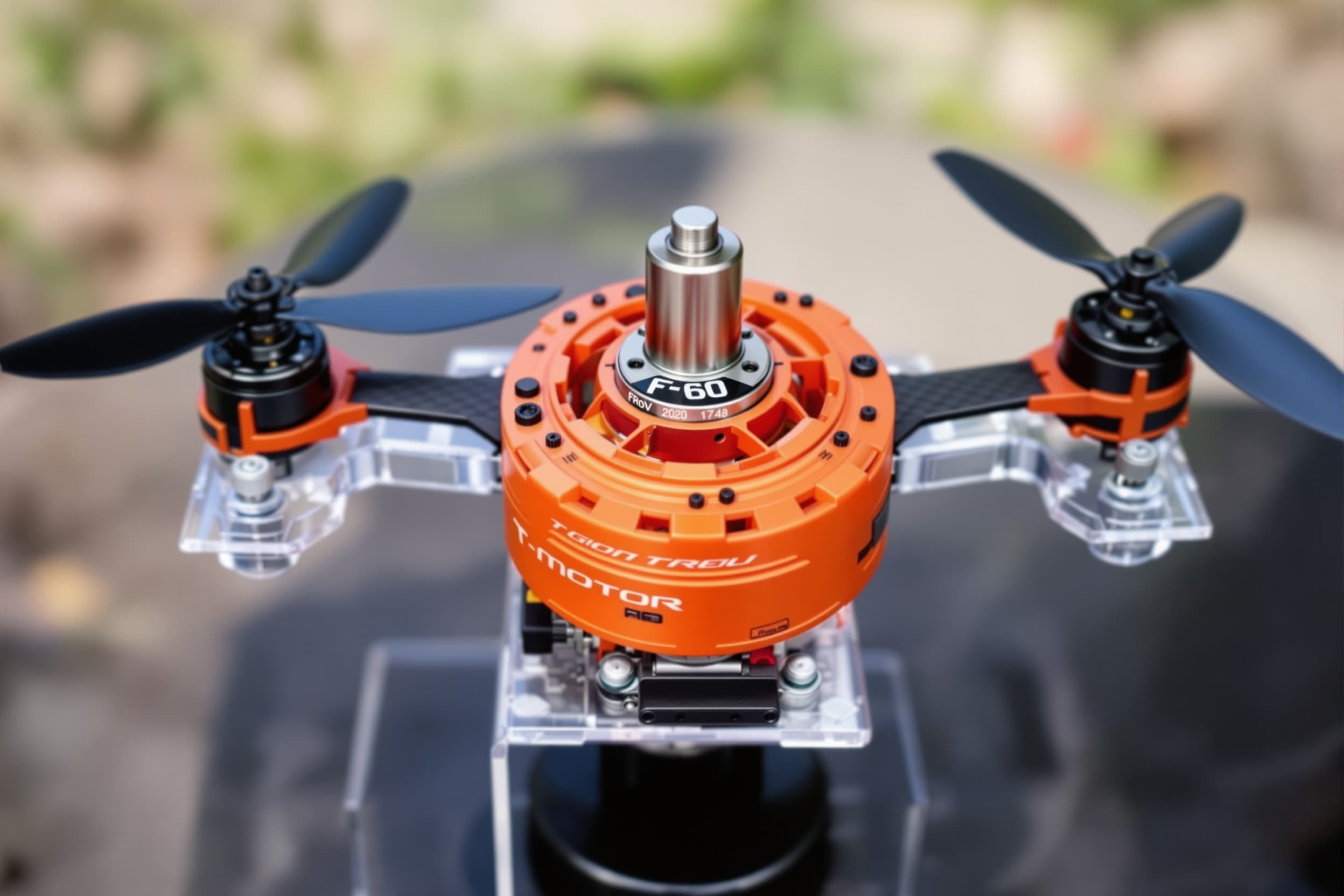
A 2020KV brushless outrunner motor designed for 4S FPV racing drones. Features a 12N14P configuration with titanium shaft, EZO bearings, and 26.8×31.7mm stator delivering up to 825W peak power. Weighs 33.3g with cables and uses 20 AWG silicone leads.

Feasibility at a glance
PT localization
3/10
Low
Only finishing and testing can be localised in Portugal.
Per unit
€15–25
at 4-unit volume
Starter batch
4units
minimum viable run
To first batch
16weeks
7 phases, design to ship
Budget
€35,000–50,000 total
all-in estimate
Bottom line
A high-performance 2020KV brushless motor with 12N14P configuration, titanium shaft, and EZO bearings demands precision winding, CNC machining, magnet bonding, and rigorous QC testing. Portugal lacks specialized motor winding houses with the required KV calibration and balancing equipment. Co-developing with an established EU motor partner (e.g. Austrian or German specialist) leverages existing stator winding lines, bearing press tooling, and dynamometer test benches while keeping IP control, shorter lead times than China, and full CE/RoHS compliance. This approach balances cost (~€18–22/unit in mid-volume) with the technical difficulty of achieving ±5% KV tolerance and 33.3g weight target.
3 capabilities
Converts electrical energy from the battery into rotational motion to spin the propellers.
Generates thrust by driving propellers at high RPM for FPV drone flight.
Responds rapidly to throttle changes for agile maneuvers and precise control.
5 stations · build route
Wind the stator
Copper wire is machine-wound around the laminated steel stator poles and coated with epoxy.
Machine the rotor bell and base
Aluminum stock is CNC-turned to form the bell and base, then anodized for finish.
Turn the titanium shaft
Titanium rod is precision-turned and threaded to match bearing inner races and rotor fit.
Glue magnets and assemble
Arc magnets are bonded inside the bell, bearings pressed onto the shaft, and everything assembled.
Solder leads and test
Silicone wires are soldered to the stator terminals; motor is spun under load to verify KV and balance.
Wind the stator
Copper wire is machine-wound around the laminated steel stator poles and coated with epoxy.
Machine the rotor bell and base
Aluminum stock is CNC-turned to form the bell and base, then anodized for finish.
Turn the titanium shaft
Titanium rod is precision-turned and threaded to match bearing inner races and rotor fit.
Glue magnets and assemble
Arc magnets are bonded inside the bell, bearings pressed onto the shaft, and everything assembled.
Solder leads and test
Silicone wires are soldered to the stator terminals; motor is spun under load to verify KV and balance.
6 identified · 2 blocking
High
Neodymium magnet supply and REACH compliance
The motor requires 14× N52 neodymium arc magnets, a rare-earth material subject to REACH Annex XVII restrictions in the EU. China dominates global neodymium production (80%+ market share), and EU-sourced magnets cost 20–30% more. Supply chain disruptions (export quotas, geopolitical tension) can delay magnet deliveries by 4–8 weeks. Additionally, neodymium magnets imported from China must carry REACH-compliant documentation proving they meet Annex XVII substance limits (lead, cadmium). If the EU partner sources magnets from a non-compliant supplier, the entire motor batch may be held at customs or rejected.
Mitigation — Contractually require the EU motor partner to source neodymium magnets from REACH-certified EU or North American suppliers (e.g. Arnold Magnetic Technologies in the US, or a European rare-earth processor). Maintain a 4–6 week buffer stock of magnets in the partner's warehouse. Include magnet REACH compliance as a line item in the NRE agreement and request supplier declarations of conformity (DoC) before production ramp. For long-term resilience, explore samarium-cobalt magnets (EU supply chains exist) as a backup, though they add ~€2/unit cost.
High
Rotor balancing and vibration QC
An unbalanced rotor causes vibration, which degrades flight controller performance, accelerates bearing wear, and can lead to catastrophic motor failure in flight. The 2020 KV motor spinning at 40,000+ RPM on 4S LiPo must be dynamically balanced to <0.5 gram-millimeter residual imbalance. If the EU partner's assembly process does not include a precision balancing rig or if magnet bonding tolerances are loose, 10–20% of motors may exhibit excessive vibration. FPV pilots will immediately notice 'motor jello' in video feeds and demand replacements, leading to high RMA rates and brand damage.
Mitigation — Require the EU partner to implement 100% dynamic balancing inspection using a computer-controlled balancing machine (e.g. Schenck or CEMB). Set acceptance criteria: residual imbalance <0.5 g·mm and vibration amplitude <0.2mm/s at 30,000 RPM. Include balancing test reports in the first-article inspection (FAI) package. Conduct periodic audits (every 500 units) to verify balancing process capability. If the partner's balancing rig is shared across product lines, request dedicated time slots for GETMILK motors to avoid drift from tool wear. Implement a 'golden sample' program: keep 5 reference motors that pass all vibration tests and use them to validate the balancing rig calibration monthly.
Medium
Winding IP and KV tolerance leakage
The 2020 KV rating is achieved by a specific combination of winding turns, wire gauge, and magnet strength. If the EU partner reverse-engineers the winding recipe or shares it with competitors, GETMILK loses differentiation. Similarly, if the partner uses the same winding jig for multiple customers, there is risk of cross-contamination or accidental disclosure of turn counts and slot-fill factors. A competitor could clone the motor within 6–9 months if winding specs leak. Additionally, the 12N14P configuration is well-known in the FPV community, so the IP is in the execution (balancing, epoxy coating, bearing press-fit tolerances) rather than the topology.
Mitigation — Sign an NDA and include exclusivity clauses in the co-development contract: the EU partner may not produce the same 26.8×31.7mm stator with 2020 KV for other brands. Request dedicated winding jigs marked with GETMILK branding and stored separately from other customers' tooling. Audit the partner's facility to verify physical separation of winding lines. Retain ownership of the winding program (turn counts, wire gauge, slot-fill) in the contract, so GETMILK can port the design to another winder if the relationship sours. Consider trademarking the motor name and filing a design registration for the rotor bell shape in the EU.
Medium
CE/RED compliance and EMC testing
Brushless motors generate electromagnetic interference (EMI) during switching, which can affect the drone's flight controller, GPS, or radio link. Although the motor itself is not a radio device, the complete drone system must meet RED 2014/53/EU electromagnetic compatibility (EMC) requirements. If the motor's silicone leads are not properly shielded or routed, or if the ESC switching noise couples into the motor, the drone may fail EMC testing and be unmarketable in the EU. Additionally, the motor must meet the Low Voltage Directive (LVD) 2014/35/EU for electrical safety, even though it operates at <50V DC (4S LiPo = 16.8V max). The rotor bell and base must be grounded or insulated to prevent shock hazards if a winding short occurs.
Mitigation — Work with the EU motor partner to conduct pre-compliance EMC testing (radiated emissions, conducted emissions) of the motor + ESC combination in a certified lab. Use twisted-pair or coaxial silicone leads to minimize EMI. Specify that the motor base be anodized (insulating layer) or grounded via a motor mounting screw to the drone frame. Include CE marking and DoC as deliverables in the contract. If the partner has existing CE certification for similar motors, request a copy and verify it covers the 2020 KV / 825W power level. Budget €2k–4k for third-party EMC testing and CE technical file preparation.
Medium
EZO bearing procurement delays
The motor spec calls for EZO-grade ball bearings (Japanese precision standard, equivalent to ABEC-7 or better). EZO bearings are manufactured by a limited number of suppliers (NSK, NTN, Minebea Mitsumi in Japan; SKF in Europe). Lead times for small-batch bearing orders can stretch to 8–12 weeks, especially for non-standard sizes (4mm ID shaft). If the EU motor partner does not maintain bearing inventory or if the bearing supplier has a production backlog, the entire motor assembly timeline slips. A single missing bearing batch can delay 500–1000 motors by 4–6 weeks.
Mitigation — Specify in the contract that the EU partner must carry 8–12 weeks of EZO bearing safety stock or provide evidence of a long-term supply agreement with SKF or NSK. Include bearing procurement lead time in the project timeline and request weekly updates on bearing stock levels during the ramp phase. As a contingency, pre-qualify an alternative bearing grade (e.g. ABEC-5 or EZO equivalent from a European supplier like Schaeffler) that meets the motor's load and RPM requirements. The partner should dual-source bearings to avoid single-supplier risk.
Low
NRE and tooling cost overruns
Co-development with an EU motor partner requires upfront investment in custom winding jigs (€3k–6k), CNC programs for the rotor bell and base (€2k–4k), magnet bonding fixtures (€1k–2k), and test bench calibration (€2k–3k). Total NRE is estimated at €8k–15k. If the partner underestimates tooling complexity or if design iterations require re-cutting jigs, NRE can balloon to €20k–25k, eroding margins on the first 500–1000 units. Additionally, the partner may amortize NRE over a longer production run than GETMILK plans, leading to disputes over per-unit pricing.
Mitigation — Negotiate a fixed-price NRE contract with clear deliverables: winding jig drawings, CNC G-code, FAI report, and 10 golden sample motors. Cap NRE at €15k and require the partner to absorb cost overruns unless GETMILK requests scope changes. Structure per-unit pricing to include NRE amortization over 1000 units, with a step-down price at 2000+ units. Request monthly NRE spend reports during the 14-week development phase. Retain ownership of all tooling (jigs, fixtures, CNC programs) in the contract so GETMILK can transfer production to another partner if needed. Escrow 50% of NRE payment until FAI approval to incentivize on-time, on-spec delivery.
16 weeks to first batch
Design freeze and CAD handoff
wk 1–2Tooling and jig fabrication
wk 2–6Stator winding and epoxy potting
wk 6–8Rotor assembly and magnet bonding
wk 9–11Final motor assembly
wk 12–13Dynamic balancing and QC testing
wk 13–15Packaging and batch shipment to Portugal
wk 15–16Design freeze and CAD handoff
wk 2–6 is the longest stretch — Tooling and jig fabrication takes 4 weeks of the 16 weeks on this build.
6 materials · 6 processes
Materials
Processes
568 Portuguese manufacturers matched
None cover the whole build — it splits across steps.
12 tasks · 16 weeks to first batch
Week 1
2 tasks
Finalize motor spec and issue RFQ to 3 EU motor partners
Lock the F60 ProV design: 26.8×31.7mm stator, 12N14P, 2020 KV ±5%, titanium shaft, EZO bearings, 14× N52 magnets, ≤33.5g. Export STEP files and 2D drawings with GD&T. Issue RFQ to Austrian FPV motor specialist, German precision motor OEM, and Northern Italy winding house. Request NRE breakdown, per-unit pricing (500 MOQ), lead time, and winding/balancing process capability.
Select EU co-development partner and negotiate NRE contract
waits on Finalize motor spec and issue RFQ to 3 EU motor partners
Evaluate RFQ responses on NRE cost (target ≤€15k), per-unit price (€18–23 range), lead time (14–16 weeks), and technical capability (winding precision, balancing rig, REACH-certified magnet supplier). Conduct video calls to review partner's facility, winding equipment, and past FPV motor projects. Select the lead partner and negotiate fixed-price NRE contract with deliverables: winding jig, CNC programs, FAI report, 10 golden samples. Include exclusivity clause and tooling ownership terms.
Weeks 2–3
2 tasks
Sign NRE contract and transfer CAD files to partner
waits on Select EU co-development partner and negotiate NRE contract
Execute the co-development agreement with the selected EU motor partner. Transfer STEP files, 2D manufacturing drawings, BOM, and electrical schematic (winding diagram, phase connections). Schedule kickoff meeting to review GD&T callouts, KV tolerance (±5%), weight budget (≤33.5g), and balancing requirements (<0.5 g·mm). Establish weekly progress calls and shared project tracker. Pay 50% NRE deposit (€4k–7.5k) to initiate tooling fabrication.
Partner procures stator laminations, magnets, bearings, and wire
waits on Sign NRE contract and transfer CAD files to partner
EU partner orders silicon steel stator laminations (26.8mm dia, laser-cut), 14× N52 neodymium arc magnets from REACH-certified supplier, EZO ball bearings (4mm ID, 2 per motor), titanium alloy bar stock (4mm dia shaft), and 20 AWG silicone wire spools. Partner provides supplier declarations of conformity (DoC) for REACH compliance on magnets. Lead time for magnets and bearings: 4–6 weeks; stator laminations: 3 weeks.
Weeks 4–7
2 tasks
Partner fabricates winding jigs and CNC programs rotor bell
waits on Partner procures stator laminations, magnets, bearings, and wire
EU partner machines custom winding jigs to hold stator laminations and guide copper wire for 12N14P configuration. Program automated winder for turn count targeting 2020 KV. CNC-turn aluminum rotor bell and base from stock, then run first-article trial and anodize (Type II). CNC-turn titanium shaft to 4mm dia with threaded propeller mount. Conduct dimensional inspection and verify GD&T tolerances on bell, base, and shaft.
Review first-article rotor bell and shaft samples
waits on Partner fabricates winding jigs and CNC programs rotor bell
Partner ships 3 first-article rotor bells, 3 stator bases, and 3 titanium shafts to GETMILK for dimensional verification. Measure stator ID/OD, shaft diameter, bearing seat tolerances, and anodizing thickness. Check weight (bell + base + shaft + bearings ≤ 28g to leave 5.5g for stator/wire/magnets). Provide go/no-go feedback within 3 days. If dimensions drift, partner re-cuts CNC program and ships revised samples.
Weeks 8–16
6 tasks
Partner winds stators and bonds magnets in rotor bells
waits on Review first-article rotor bell and shaft samples
Partner runs first batch of 100 stators: machine-wind copper wire on laminations (8–10 turns/pole), solder phase leads, epoxy-pot windings, and cure. Bond 14× N52 magnets inside rotor bells using Loctite 9466, cure 24h. Press EZO bearings onto titanium shafts. Assemble stator base + shaft + bearings + rotor bell. Solder 150mm silicone leads (20 AWG) to phase terminals. Apply threadlocker to propeller mount threads.
Partner performs dynamic balancing and KV testing on 100% of motors
waits on Partner winds stators and bonds magnets in rotor bells
Mount each motor on balancing rig, spin to 30k RPM, measure residual imbalance. Correct to <0.5 g·mm by drilling balance holes or adding weights. Transfer to dynamometer: connect ESC + 4S LiPo, ramp throttle, measure KV (RPM/V), idle current, peak current, peak power. Accept only motors in 1919–2121 KV range (2020 ±5%). Log serial numbers and test data. Reject rate target <5%. Partner provides test report CSV with KV, imbalance, and current for each unit.
Conduct first-article inspection (FAI) on 10 golden sample motors
4 roles to fill before month one
Co-development partner: winding process, KV calibration, balancing
Austrian or German FPV motor engineering lead
You need a motor specialist who owns precision winding equipment, dynamometer test benches, and balancing rigs to hit 2020 KV ±5% and <0.5 g·mm imbalance. This contact translates your stator dimensions and weight budget into winding turn counts, magnet placement, and bearing press-fit tolerances. They also manage procurement of REACH-certified neodymium magnets and EZO bearings, which have 6–8 week lead times.
REACH-compliant N52 neodymium arc magnet supplier
EU rare-earth magnet supplier (e.g. Arnold Magnetic or European distributor)
Neodymium magnets are subject to REACH Annex XVII restrictions, and 80% of global supply is in China. You need a certified EU or North American supplier who can provide declarations of conformity (DoC) proving lead and cadmium limits. This contact ensures your motor won't be held at customs and provides 4–6 week delivery of 14× arc magnets per motor (7,000 magnets for 500 motors).
CE marking and EMC pre-compliance testing
TÜV, SGS, or similar notified body EMC test engineer
Brushless motors generate EMI that can interfere with the drone's flight controller and GPS. You need a test lab to run radiated/conducted emissions tests per RED 2014/53/EU and LVD 2014/35/EU, plus RoHS XRF analysis. This contact issues the test report and supports your CE technical file so you can legally sell the motor (and drone) in the EU market.
5 things to avoid in this plan
certification
Neodymium magnet lead time blowout: 14× N52 magnets per motor (7,000 total) have 6–8 week procurement. If the EU partner's REACH-certified supplier has backlog, the entire timeline slips. Mitigation: Pre-order magnets in week 2 and require 4-week buffer stock.
quality
KV tolerance failure: Achieving 2020 KV ±5% (1919–2121) demands precise winding turn counts and magnet strength. If the partner's winding jig drifts or magnet grade varies, 10–20% of motors may fall outside spec. Mitigation: Require 100% dynamometer testing and accept only motors with logged KV data; build 10% scrap allowance into the 500-unit order.
lead time
Dynamic balancing capacity bottleneck: Balancing 500 motors to <0.5 g·mm at 30k RPM is labor-intensive (5–10 min per motor). If the partner's balancing rig is shared across customers, throughput may be 20–30 motors/day, delaying final shipment by 2–3 weeks. Mitigation: Confirm dedicated balancing rig time slots in the NRE contract and request weekly throughput reports.
2 tasks in week 1
Finalize motor spec and issue RFQ to 3 EU motor partners
Tooling and jig fabrication
Stator winding and epoxy potting
Rotor assembly and magnet bonding
Final motor assembly
Dynamic balancing and QC testing
Packaging and batch shipment to Portugal
waits on Partner performs dynamic balancing and KV testing on 100% of motors
Partner ships 10 motors from the first batch to GETMILK. Engineering conducts FAI: weigh each motor (target ≤33.5g), measure lead length (150mm), verify mounting hole pattern, spin test on bench ESC, check for smooth bearing rotation and no cogging. Record KV on bench dynamometer. Compare to partner's test data. If all 10 pass, approve production release for remaining 490 motors. If >2 fail, request partner rework and ship new samples.
Arrange CE/RoHS compliance testing with notified body
waits on Conduct first-article inspection (FAI) on 10 golden sample motors
Ship 3 sample motors + ESC + drone frame to an EU EMC test lab (e.g. TÜV or SGS). Request pre-compliance EMC testing (radiated emissions, conducted emissions per RED 2014/53/EU) and LVD electrical safety check. Verify RoHS compliance via XRF analysis of solder, wire insulation, and anodizing. Partner provides REACH declarations for neodymium magnets. Lab issues test report and supports CE technical file preparation. Budget €2.5k–3.5k for testing.
Partner completes production of remaining 490 motors and ships to PT
waits on Conduct first-article inspection (FAI) on 10 golden sample motors
After FAI approval, partner completes winding, assembly, balancing, and testing of remaining 490 motors (total 500). Package in anti-static foam, 4 motors per box (125 boxes for 125 drone kits). Include mounting screws, spec sheet, and QR code to online manual. Arrange truck shipping from partner facility (Austria/Germany/Italy) to GETMILK warehouse in Portugal. Transit time 3–5 days. Partner provides packing list and test data export for all 500 units.
Receive motors in Portugal and conduct incoming QC on 10% sample
waits on Partner completes production of remaining 490 motors and ships to PT
Unpack 125 boxes at GETMILK warehouse. Select 50 motors (10% sample) for incoming inspection: weigh, measure lead length, verify mounting hole alignment, spin test on bench ESC. Check for shipping damage (bent shafts, loose magnets). Compare sample KV data to partner's test logs. If <2% defect rate, accept the batch. If >2%, escalate to partner for investigation and potential rework. Store motors in ESD-safe bins, ready for drone kit assembly.
Logistics from EU partner to Portugal warehouse
Portuguese freight forwarder or intra-EU trucking operator
Once the 500 motors are packaged in Austria/Germany/Italy, you need reliable 3–5 day trucking to your Portugal facility. This contact handles palletization, customs paperwork (even within EU, you need pro forma invoices), and ensures motors arrive undamaged. They also coordinate any future replenishment shipments if you scale to 1,000+ units.
cost
NRE cost overrun: Winding jigs, CNC programs, and magnet bonding fixtures are estimated at €12k. If design iterations require re-cutting (e.g., stator diameter adjustment), NRE can reach €20k. Mitigation: Cap NRE at €15k in the contract and freeze the design after first-article approval; any further changes are GETMILK-funded scope additions.
watch-out
First-article weight miss: Target is ≤33.5g including cables. If rotor bell, magnets, or epoxy add unexpected mass, motors may exceed 35g, affecting drone flight performance. Mitigation: Request component weight breakdown in week 4 (bell, base, shaft, bearings, stator, magnets, wire) and iterate bell wall thickness or magnet count before production ramp.
568 matched · 8 shown, ranked by coverage
Covers, left to right: Motor Winding · CNC Machining · CNC Turning · Anodizing · Final Assembly · Testing & Inspection
Manufacturer
Location
Covers
Certifications
People
Portuguese producers per required step
Final Assembly
369
CNC Machining
212
Testing & Inspection
178
CNC Turning
28
Anodizing
3
Motor Winding
0
How many cover more than one step
The gap
A high-performance 2020KV brushless motor with 12N14P configuration, titanium shaft, and EZO bearings demands precision winding, CNC machining, magnet bonding, and rigorous QC testing. Portugal lacks specialized motor winding houses with the required KV calibration and balancing equipment. Co-developing with an established EU motor partner (e.g. Austrian or German specialist) leverages existing stator winding lines, bearing press tooling, and dynamometer test benches while keeping IP control, shorter lead times than China, and full CE/RoHS compliance. This approach balances cost (~€18–22/unit in mid-volume) with the technical difficulty of achieving ±5% KV tolerance and 33.3g weight target.
Send one RFQ to the top 4
Quickmold, Epsilon Composite, REROM, Frantecer Lda — same package, one click.