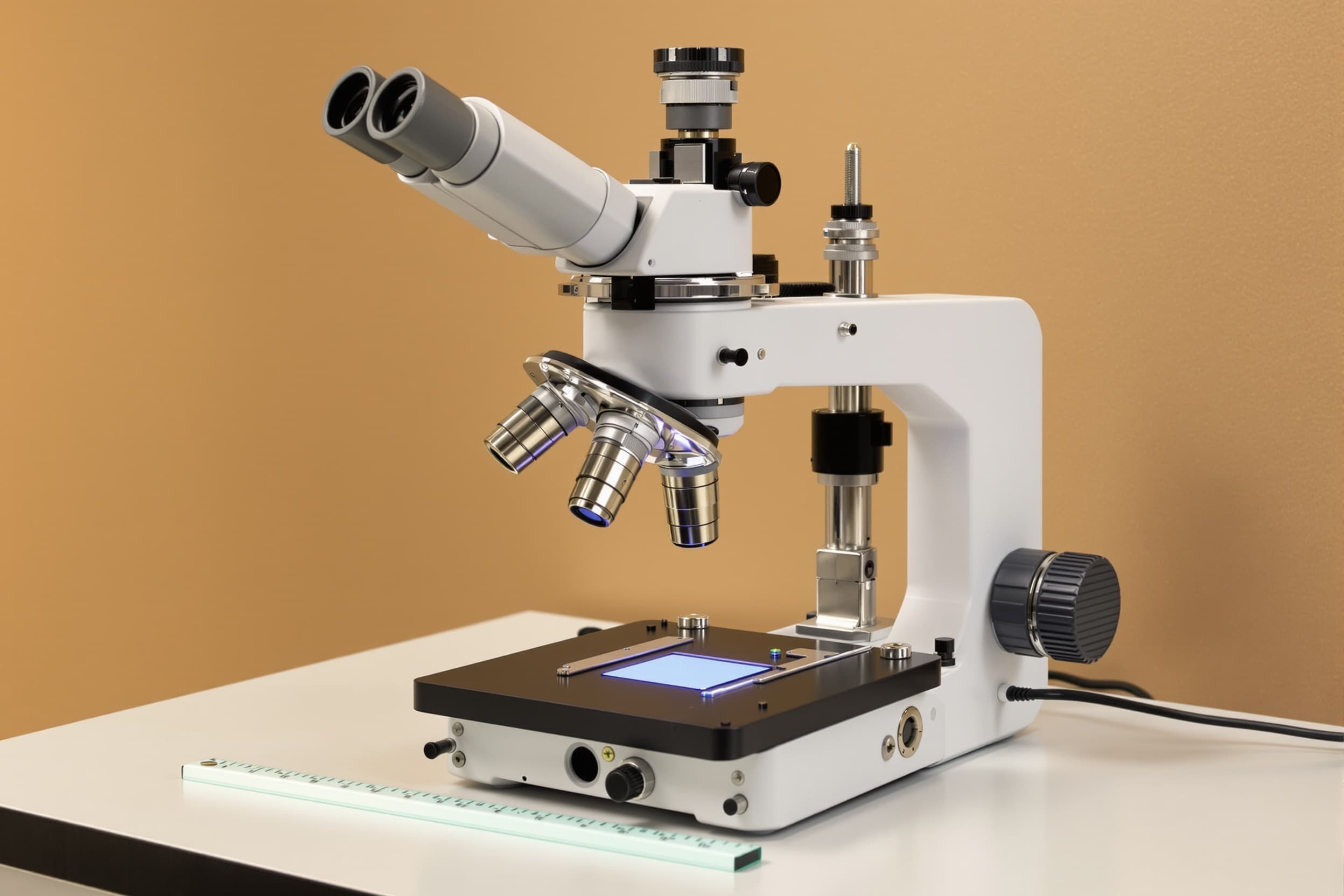
A benchtop microinjection system for genetic engineering research, combining a 3-axis piezo-leadscrew micromanipulator with pneumatic injection control. Designed as an affordable alternative to commercial systems for zebrafish, fruit-fly, and C. elegans labs, it mounts to standard inverted microscopes and provides sub-micron repeatability with open firmware and Python SDK for automated workflows.

Feasibility at a glance
PT localization
7/10
High
Most steps can be localised in Portugal.
Per unit
€3,000–€4,500 per unit
at 30-unit volume
Starter batch
30units
minimum viable run
To first batch
24weeks
8 phases, design to ship
Budget
€85,000–€115,000 total
all-in estimate
Bottom line
A CRISPR microinjection rig requires deep integration of precision motion (Renishaw encoders, piezo actuators), medical-grade pneumatics (Festo valves), and custom firmware—no single Portuguese facility has this capability end-to-end. Co-development with a specialized EU partner (such as a Swiss or German precision motion integrator) leverages proven sub-micron positioning expertise, gives access to certified pneumatic suppliers, and ensures regulatory compliance for lab equipment sold across Europe. This route balances lead time (20–26 weeks), IP control (joint development maintains open-source licensing), and quality (validated motion performance) while keeping the product "Made in EU."
5 capabilities
Positions a glass needle with sub-micron accuracy so it can pierce individual eggs or embryos under a microscope.
Injects tiny volumes of CRISPR reagents by pulsing compressed air through the needle at controlled pressure and duration.
Accepts foot-pedal commands to trigger injections, freeing the researcher's hands to adjust the microscope focus.
Mounts onto standard inverted microscopes from Olympus, Nikon, and Leica without custom adapters.
Runs automated injection grids via Python scripts, moving to pre-programmed coordinates and injecting in sequence.
5 stations · build route
Machine and anodize aluminium stage
CNC-mill the base from 6061-T6 aluminium, then hard-anodize for wear and corrosion resistance.
Assemble motion axes
Mount each lead-screw stage, attach piezo benders, and install Renishaw encoders with precision alignment.
Populate controller PCB
Fabricate and SMT-assemble the STM32G4 board with power regulation, encoder interfaces, and solenoid driver.
Integrate pneumatics
Connect the compressor, pressure regulator, Festo solenoid valve, and tubing to the capillary holder.
Flash firmware and test
Load open-source firmware, calibrate encoders, verify sub-micron repeatability, and validate pressure-pulse timing under microscope.
Machine and anodize aluminium stage
CNC-mill the base from 6061-T6 aluminium, then hard-anodize for wear and corrosion resistance.
Assemble motion axes
Mount each lead-screw stage, attach piezo benders, and install Renishaw encoders with precision alignment.
Populate controller PCB
Fabricate and SMT-assemble the STM32G4 board with power regulation, encoder interfaces, and solenoid driver.
Integrate pneumatics
Connect the compressor, pressure regulator, Festo solenoid valve, and tubing to the capillary holder.
Flash firmware and test
Load open-source firmware, calibrate encoders, verify sub-micron repeatability, and validate pressure-pulse timing under microscope.
6 identified · 2 blocking
High
Supply disruption: Renishaw encoders and Festo valves
Renishaw linear encoders are single-source components with lead times that can stretch to 12–16 weeks during semiconductor shortages or automotive demand spikes. Festo MHE2 solenoid valves have shorter lead times (6–8 weeks) but are also single-source. If either supplier faces allocation or a facility disruption, the entire assembly line halts because no drop-in substitute exists for sub-micron encoder resolution or the millisecond-response solenoid.
Mitigation — Negotiate a 6-month blanket purchase order with Renishaw for 100 encoders (covering ~30 rigs plus spares) and hold safety stock of 10 Festo valves. Simultaneously qualify Heidenhain encoders (DE) as a secondary source, accepting a firmware update to support their different protocol. For the solenoid, evaluate SMC or Bürkert alternatives and validate pressure-pulse timing on a test rig within the first 8 weeks of the project.
High
Regulatory classification ambiguity (MDR vs. lab equipment)
Although the microinjection rig is intended for research use only, the inclusion of medical-grade components (compressor, silicone tubing) and potential future use in clinical gene-therapy prep labs could trigger MDR (Medical Device Regulation 2017/745) classification as a Class I or IIa device. If a national authority (e.g., INFARMED in Portugal, BfArM in Germany) later deems the rig in-scope for MDR, the manufacturer would need a full quality-management system (ISO 13485), technical file, and EU Declaration of Conformity—a 12–18 month retroactive process that blocks sales until complete.
Mitigation — Proactively draft a 'research use only' declaration and labeling that explicitly excludes clinical use, and restrict distribution channels to academic and non-clinical research labs. Simultaneously begin ISO 13485 pre-certification with the EU co-development partner (who likely already holds it), so that if MDR classification is later required, the technical file and QMS documentation can be completed within 6 months rather than starting from scratch. Consult a notified body (e.g., TÜV SÜD, BSI Group) during the design phase to obtain a preliminary classification opinion in writing.
Medium
IP leakage in open-source ecosystem
Publishing full CAD files, firmware source, and BOM on GitHub (as required for open-source scientific hardware) means competitors or clone manufacturers can replicate the design within weeks. While the open-source license (likely CERN-OHL-S or GPL) mandates attribution and share-alike, enforcement is costly and slow. A well-funded competitor could launch a closed-source variant before the project gains traction, eroding first-mover advantage and undermining the community goodwill that drives adoption in academic labs.
Mitigation — Retain closed-source control over the Python SDK and calibration algorithms (release only compiled binaries under a dual-license model: open for academic use, commercial license required for for-profit entities). Trademark the product name and logo to prevent direct clones from using identical branding. Build a strong community early by seeding 10 rigs in high-visibility labs (e.g., Wellcome Sanger, EMBL, Pasteur) and publishing peer-reviewed validation papers. This creates a 'reference standard' that clones struggle to match in credibility.
Medium
Lead-time cascade from STM32G4 chip shortages
The STM32G4 microcontroller, while widely available today, saw lead times balloon to 52+ weeks during the 2021–2022 semiconductor shortage. Because the firmware is tightly coupled to the G4's advanced timer peripherals (for encoder quadrature decode and solenoid PWM), swapping to a different MCU family (e.g., STM32F4 or ESP32) requires substantial firmware rework—2–3 months of development and revalidation. A sudden allocation squeeze would delay production by a full year unless alternatives are pre-qualified.
Mitigation — Purchase 100 STM32G4 microcontrollers upfront (covering 30 rigs plus rework spares) and store at controlled humidity. In parallel, port the firmware to STM32F7 (pin-compatible in some packages) and validate basic motion-control and solenoid functions, creating a 'plan B' branch in the Git repository. Monitor lead times weekly via distributor APIs (Mouser, Digi-Key, Farnell) and trigger a second purchase if lead times exceed 16 weeks. Consider designing the PCB with footprints that accept both STM32G4 and F7 variants, using conditional BOM stuffing.
Medium
Quality variance in piezo bender stacks
Piezoelectric actuators from different suppliers—or even different production lots from the same supplier—can exhibit 10–20 % variation in displacement vs. voltage and hysteresis behavior. Because the firmware's motion control relies on a calibration lookup table, a batch of piezo benders with out-of-spec linearity will cause positioning errors exceeding the ±0.5 µm repeatability target. Discovering this during final test means scrapping the benders and waiting another 8–10 weeks for replacements, delaying customer shipments.
Mitigation — Require the piezo supplier (e.g., PI Ceramic, Noliac, or CoreMorrow) to provide per-unit displacement-vs-voltage curves and hysteresis plots for every bender shipped, and reject any unit outside ±5 % of nominal. Invest in a laser interferometer test fixture (e.g., Renishaw XL-80 or Micro-Epsilon optoNCDT) at the partner facility to validate each piezo axis before integration. Build firmware with an auto-calibration wizard that measures actual displacement at 10 voltage steps and generates a per-axis correction table, allowing the system to self-compensate for moderate variance.
Low
Microscope compatibility edge cases
While Olympus, Nikon, and Leica inverted microscopes share similar stage dimensions and mounting-hole patterns, older models and specialized variants (e.g., Zeiss Axio Observer with motorized XY stage) use proprietary interfaces. If early customers have these edge-case microscopes, the adapter plate will not fit, leading to returns, custom machining requests, and negative reviews that damage adoption.
Mitigation — Survey 20 target labs during the design phase to catalog their exact microscope models (manufacturer, model number, and stage type). Design the adapter plate with a modular bolt pattern—three separate adapter variants (Olympus/Nikon, Leica, Zeiss) that share the same rig-side interface but differ on the microscope-side holes. Publish 3D-printable adapter templates on GitHub so labs with unusual microscopes can fabricate their own adapters, and offer a paid custom-machining service (€150, 2-week lead time) for one-off requests.
24 weeks to first batch
Design freeze and CAD release
wk 1–3Long-lead component procurement
wk 4–15CNC machining and anodizing of base stage
wk 16–19PCB assembly and firmware bring-up
wk 20–22Motion-axis integration and encoder calibration
wk 23–24Pneumatic system integration
wk 25Final assembly, cabling, and foot-pedal integration
wk 26Functional test, calibration, and QC
wk 27–28wk 4–15 is the longest stretch — Long-lead component procurement takes 12 weeks of the 28 weeks on this build.
5 materials · 7 processes
Materials
Processes
586 Portuguese manufacturers matched
None cover the whole build — it splits across steps.
12 tasks · 13 weeks to first batch
Week 1
2 tasks
Select and contract EU precision-motion partner
Evaluate proposals from PI (Physik Instrumente), Aerotech Europe, OWIS, and SmarAct. Confirm ISO 13485 certification, encoder integration experience, and willingness to co-develop under open-source license (CERN-OHL-S with joint IP for firmware). Negotiate NRE budget (€20k–€35k), per-unit pricing for 30 rigs, and 24-week delivery. Sign letter of intent.
Lock BOM and place long-lead orders
Finalize bill of materials: 90 Renishaw encoders (3 per rig + spares), 35 Festo MHE2 valves, 90 piezo bender stacks from PI Ceramic or Noliac, 90 lead-screw stages, 100 STM32G4 microcontrollers, 30 medical-grade compressors. Place purchase orders directly or via EU partner procurement. Confirm lead times: Renishaw 12 weeks, piezo 8 weeks, Festo 6 weeks.
Weeks 2–3
2 tasks
Design freeze: CAD, PCB, and firmware architecture
Finalize mechanical CAD for aluminium base stage (6061-T6, anodized), microscope adapters (Olympus/Nikon, Leica, Zeiss variants), and pneumatic manifold with GD&T callouts. Complete STM32G4 schematic and PCB layout (encoder interfaces, solenoid driver, USB-C). Define firmware architecture: closed-loop motion control, encoder quadrature decode, solenoid PWM, foot-pedal interrupt, USB Python SDK interface. Release manufacturing drawings.
Qualify Heidenhain encoders as secondary source
waits on Lock BOM and place long-lead orders
Procure sample Heidenhain linear encoders and validate as drop-in substitute for Renishaw (may require firmware update for protocol differences). Run bench test measuring displacement vs. encoder counts over 10 mm travel. Document qualification results and update BOM with dual-source option to mitigate Renishaw allocation risk.
Weeks 4–7
2 tasks
CNC-machine and anodize aluminium base stages
waits on Design freeze: CAD, PCB, and firmware architecture
Machine 35 base stages from 6061-T6 billet (30 production + 5 spares/test) on 5-axis CNC mill, holding flatness ≤10 µm and hole positions ±25 µm. Deburr, clean, and send for Type III hard anodizing (50 µm black). Machine microscope adapter plates (3 variants) and pneumatic manifolds. Incoming inspection checks dimensions before shipment to EU partner for assembly.
Fabricate and assemble STM32G4 controller PCBs
waits on Design freeze: CAD, PCB, and firmware architecture
Order PCB fabrication (2-week lead), stencils, and SMT assembly for 35 controller boards. Populate STM32G4, power regulation, encoder interface ICs, solenoid MOSFET driver, and USB-C connector. Program bootloader via SWD. Validate power rails, encoder signals (quadrature A/B), and solenoid PWM on oscilloscope. Ship to EU partner for integration.
Weeks 8–16
6 tasks
Motion-axis integration and encoder calibration at partner facility
waits on CNC-machine and anodize aluminium base stages, Fabricate and assemble STM32G4 controller PCBs, Lock BOM and place long-lead orders
EU partner mounts lead-screw stages, piezo benders, and Renishaw encoders onto anodized base stages with sub-micron alignment fixtures. Connect encoder cables to controller PCB. Run automated calibration routine measuring backlash, hysteresis, and repeatability over full travel. Generate per-axis correction tables stored in firmware EEPROM. Validate ≤0.5 µm repeatability using laser interferometer (Renishaw XL-80 or equivalent).
Integrate pneumatics and validate injection timing
waits on Motion-axis integration and encoder calibration at partner facility
Install medical-grade compressor, pressure regulator (0.1–500 hPa), Festo solenoid valve, silicone tubing, and borosilicate capillary holder at partner facility. Pressure-test at 600 hPa for leaks. Flash firmware with solenoid-pulse timing logic. Validate injection-pulse repeatability (volume and duration) using calibrated flow sensor and high-speed camera. Document pressure curves.
Develop and validate Python SDK
4 roles to fill before month one
Co-development partner and ISO 13485 certification holder
Precision motion integration lead at PI, Aerotech, OWIS, or SmarAct
You need a partner with proven sub-micron motion expertise, encoder calibration testbeds, and existing ISO 13485 certification to accelerate regulatory readiness. This contact negotiates NRE, validates piezo-leadscrew integration, and performs factory acceptance testing—de-risking the hardest technical and compliance challenges.
Linear encoder supplier and technical support
Sales engineer at Renishaw or Heidenhain
Renishaw encoders are single-source with 12-week lead times; this contact secures blanket PO for 90 units, provides calibration documentation, and helps qualify Heidenhain as secondary source. Critical for avoiding supply disruption (Risk R001) and ensuring encoder signal integrity during firmware bring-up.
Early-adopter lab lead and validation partner
Application scientist at a Wellcome Sanger, EMBL, or Institut Pasteur zebrafish/Drosophila core facility
This contact validates real-world injection performance on live embryos, co-authors peer-reviewed publications proving sub-micron repeatability, and provides credibility that clones cannot match. Their feedback shapes Python SDK features and microscope adapter design, while their publications drive academic adoption—your primary go-to-market channel.
5 things to avoid in this plan
lead time
Watch for Renishaw encoder lead-time inflation beyond 12 weeks—trigger Heidenhain secondary-source qualification and firmware port immediately if lead times hit 16 weeks or allocation is imposed.
lead time
Lock in STM32G4 microcontroller stock (100 units upfront) and maintain a firmware port to STM32F7 as hot backup; semiconductor shortages can add 12+ months to lead time without warning.
lead time
Validate piezo bender displacement curves per unit on arrival—reject any batch with >5% linearity variance to prevent positioning errors discovered only at final test, which would delay shipments by 8–10 weeks.
certification
Secure written regulatory classification from a notified body within 8 weeks; ambiguity between research-use-only and MDR scope can block sales or trigger retroactive ISO 13485 certification that halts production for 12–18 months.
2 tasks in week 1
Select and contract EU precision-motion partner
Design freeze and CAD release
Long-lead component procurement
CNC machining and anodizing of base stage
PCB assembly and firmware bring-up
Motion-axis integration and encoder calibration
Pneumatic system integration
Final assembly, cabling, and foot-pedal integration
Functional test, calibration, and QC
waits on Motion-axis integration and encoder calibration at partner facility
Write Python SDK for USB control: move-to-position commands, automated injection grids, foot-pedal event callbacks, encoder readout, and pressure-pulse configuration. Compile closed-source calibration algorithms as binaries (dual-license: open for academic, commercial license for for-profit). Test SDK on first completed rig with automated 10×10 injection grid. Publish documentation and example scripts to GitHub.
Factory acceptance test and QC on first 5 rigs
waits on Integrate pneumatics and validate injection timing, Develop and validate Python SDK
Mount first 5 completed rigs on reference Olympus, Nikon, and Leica inverted microscopes. Load test capillaries with fluorescent dye and inject into droplets under 40× magnification. Measure positioning error across 10×10 grid with laser interferometer. Validate Python SDK control. Run 100-cycle endurance test (move, inject, retract). Generate calibration certificates. Fix any integration issues before scaling to 30 units.
Draft research-use-only declaration and consult notified body
Write labeling and documentation explicitly stating 'Research Use Only—Not for Clinical Use' to avoid MDR classification. Prepare preliminary technical file with risk analysis (ISO 14971), BOM with RoHS/REACH declarations, and EMC test plan (EN 61326-1). Submit to notified body (TÜV SÜD, BSI Group) for preliminary classification opinion. Document response for future ISO 13485 path.
Seed 10 rigs to high-visibility early-adopter labs
waits on Factory acceptance test and QC on first 5 rigs
Identify and contract 10 early-adopter labs (target: Wellcome Sanger Institute, EMBL Heidelberg, Institut Pasteur, Max Planck, or equivalent). Ship first 10 validated rigs with user manuals, Python SDK installer, spare capillaries, and calibration certificates. Provide on-site or remote training (2-hour session per lab). Collect feedback on positioning accuracy, injection repeatability, and SDK usability for peer-reviewed validation papers.
Regulatory classification and MDR pre-certification advisor
Notified body consultant at TÜV SÜD, BSI Group, or equivalent
Open-source scientific instruments sit in a regulatory gray zone between lab equipment and medical devices. This contact provides a written preliminary classification opinion (research-use-only vs. MDR Class I/IIa), guides the technical file and risk analysis (ISO 14971), and maps the path to ISO 13485 if clinical-lab sales emerge—avoiding 12–18 month retroactive compliance (Risk R003).
supply
Protect first-mover advantage by trademarking the product name and dual-licensing the Python SDK (open for academic, commercial for for-profit)—publishing full open-source CAD invites clones within weeks, so build community credibility through seeded labs and peer-reviewed validation papers before GitHub release.
586 matched · 8 shown, ranked by coverage
Covers, left to right: CNC Machining · Anodizing · PCB Fabrication · SMT Assembly · Final Assembly · Testing & Inspection · Cable Assembly
Manufacturer
Location
Covers
Certifications
People
Portuguese producers per required step
Final Assembly
369
CNC Machining
212
Testing & Inspection
178
SMT Assembly
36
Cable Assembly
12
PCB Fabrication
6
Anodizing
3
How many cover more than one step
The gap
A CRISPR microinjection rig requires deep integration of precision motion (Renishaw encoders, piezo actuators), medical-grade pneumatics (Festo valves), and custom firmware—no single Portuguese facility has this capability end-to-end. Co-development with a specialized EU partner (such as a Swiss or German precision motion integrator) leverages proven sub-micron positioning expertise, gives access to certified pneumatic suppliers, and ensures regulatory compliance for lab equipment sold across Europe. This route balances lead time (20–26 weeks), IP control (joint development maintains open-source licensing), and quality (validated motion performance) while keeping the product "Made in EU."
Send one RFQ to the top 4
Keenfinity EMS, Uartrónica, Exatronic, REROM — same package, one click.