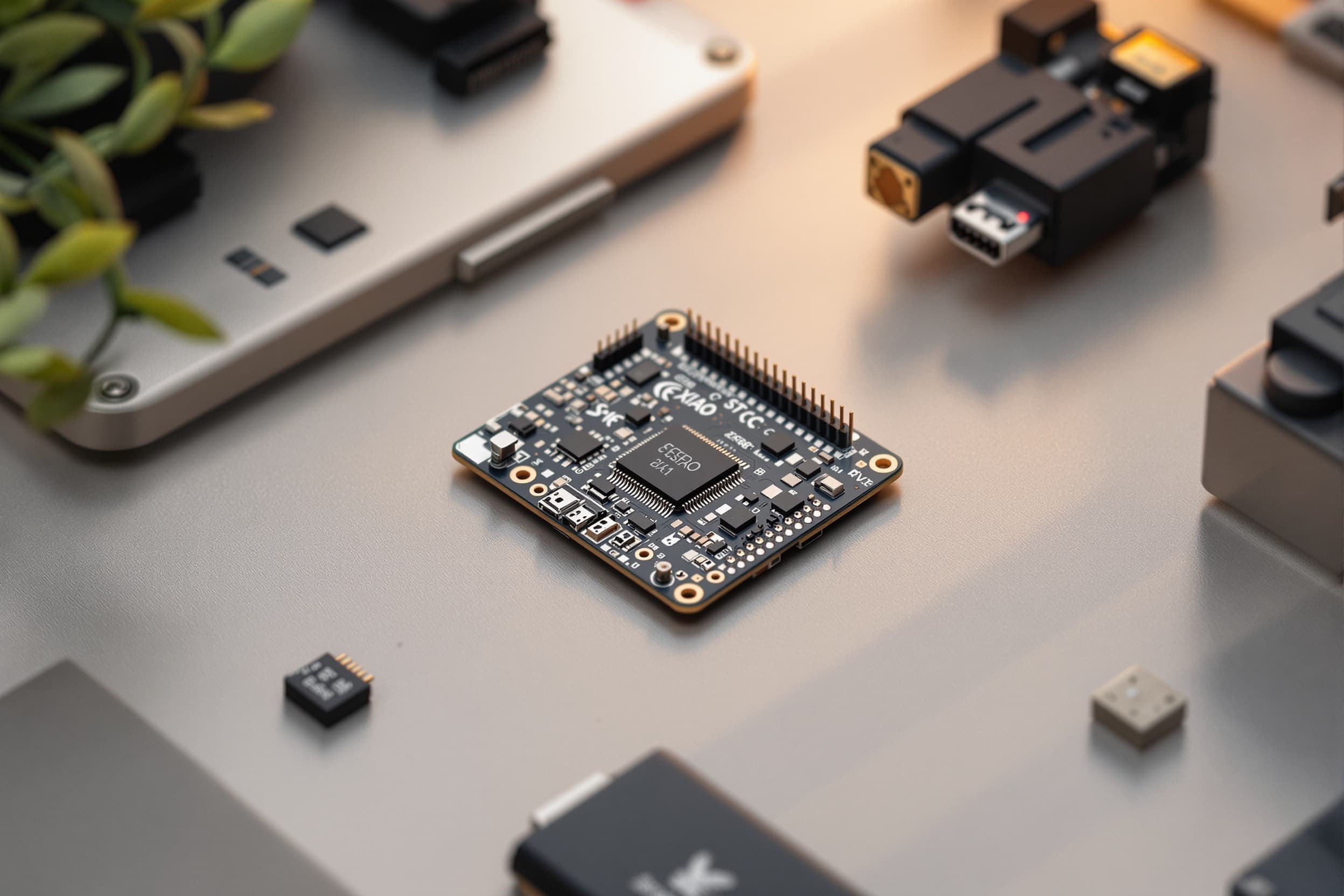
A compact WiFi and Bluetooth LE development board built around the ESP32-C3 RISC-V microcontroller. The board features USB-C connectivity, castellated pads for embedding, and multiple GPIO pins for sensors and peripherals. Designed for IoT prototyping and low-power wireless applications.

Feasibility at a glance
PT localization
3/10
Low
Only finishing and testing can be localised in Portugal.
Per unit
€5-15
at 100-unit volume
Starter batch
100units
minimum viable run
To first batch
16weeks
6 phases, design to ship
Budget
€18–28k
all-in estimate
Bottom line
For an ESP32-C3 development board, EU co-development is recommended because Portugal lacks specialized electronics assembly at the scale and expertise required for advanced PCB manufacturing and SMT assembly of microcontrollers. While Portuguese manufacturers excel in mechanical parts and final assembly, the critical PCB fabrication and component placement require partnerships with established European electronics manufacturers. This approach allows firmware customization, quality control, and faster iteration than Chinese imports, while maintaining CE/RED compliance and protecting IP within EU jurisdiction.
3 capabilities
Runs custom firmware for IoT and embedded applications using WiFi or Bluetooth connectivity
Interfaces with sensors, LEDs, and other peripherals through digital and analog GPIO pins
Enables wireless data collection and remote control for prototypes and production devices
5 stations · build route
PCB fabrication
Multi-layer circuit board is etched and drilled with castellated edges for mounting.
SMT component placement
Pick-and-place machines position the ESP32-C3 chip, resistors, capacitors, and connectors.
Reflow soldering
The board passes through an oven to melt solder paste and bond all components.
Firmware flashing and testing
Each board is programmed with bootloader firmware and tested for WiFi and USB function.
Final packaging
Boards are inspected, labeled, and packaged with anti-static protection for shipping.
PCB fabrication
Multi-layer circuit board is etched and drilled with castellated edges for mounting.
SMT component placement
Pick-and-place machines position the ESP32-C3 chip, resistors, capacitors, and connectors.
Reflow soldering
The board passes through an oven to melt solder paste and bond all components.
Firmware flashing and testing
Each board is programmed with bootloader firmware and tested for WiFi and USB function.
Final packaging
Boards are inspected, labeled, and packaged with anti-static protection for shipping.
5 identified · 3 blocking
Critical
RED Wireless Certification Complexity
The EU Radio Equipment Directive (RED) 2014/53/EU requires rigorous testing for WiFi and Bluetooth LE functionality, including RF emissions, immunity, SAR testing, and cybersecurity requirements (as of August 2024). Any design change to the antenna, PCB layout, or enclosure invalidates certification and requires costly retesting (€15k-30k per variant). Using a pre-certified ESP32-C3 module reduces but does not eliminate compliance burden—you must still demonstrate conformity when integrated into your final product. Non-compliance blocks market access across all EU member states and exposes you to penalties up to €100k.
Mitigation — Use a pre-certified ESP32-C3 module (such as ESP32-C3-MINI-1) with RED certification already completed by Espressif, rather than placing the bare chip on your PCB. Engage an EU notified body (e.g., TÜV, Intertek, or SGS) early in design to review your integration plan and antenna implementation. Perform pre-compliance testing (€2k-4k) before formal certification to catch issues early. Maintain detailed technical documentation (TCF) including schematics, BOM, test reports, and risk assessments as required by RED Article 10. Budget €20k-35k for full RED + CE certification on first production run.
High
ESP32-C3 Component Availability
The ESP32-C3 microcontroller is a single-source component from Espressif Systems, making it vulnerable to allocation shortages, extended lead times (currently 12-26 weeks), and price volatility. Global semiconductor shortages have repeatedly impacted ESP32 availability, forcing production delays or design revisions. Unlike commodity ICs, there are no pin-compatible alternatives, so any supply disruption halts production entirely. Distributors may impose allocation limits or minimum order quantities during tight supply periods.
Mitigation — Establish dual-channel procurement: secure committed inventory through authorized EU distributors (Mouser, Farnell) with 6-month rolling forecasts, and maintain a safety stock of 500-1,000 ICs for buffer. Negotiate consignment agreements with your EU manufacturing partner to share inventory risk. Monitor Espressif's quarterly allocation announcements and consider pre-purchasing ICs during periods of stable supply. For long-term resilience, develop a roadmap to support ESP32-S3 or ESP32-C6 variants as backup platforms.
High
Firmware and Design IP Theft
Custom firmware, bootloader configurations, and PCB design files represent significant IP investment. If shared with untrusted manufacturing partners (especially outside the EU), there is risk of unauthorized copying, leakage to competitors, or counterfeit production runs. Chinese manufacturers have been documented producing 'ghost shifts' where identical products are sold through alternate channels. Once IP is compromised, legal recourse is expensive and often ineffective across jurisdictions.
Mitigation — Retain all firmware development and source code management within EU jurisdiction (Portugal or trusted EU partners). Use code signing and secure boot features of ESP32-C3 to prevent unauthorized firmware modification. Implement flash encryption and disable JTAG/debug interfaces in production firmware. Require NDAs and IP ownership clauses in all manufacturing contracts, with jurisdiction specified as Portuguese or EU courts. For sensitive applications, perform final firmware flashing and testing in Portugal (e.g., at INL or GMV Portugal) after receiving bare boards from EU assembly partner. Watermark PCB designs with unique identifiers to track provenance.
Medium
PCB Fabrication and SMT Assembly Defects
Multi-layer PCBs with fine-pitch components (0402 passives, QFN packages) are prone to manufacturing defects including solder bridges, tombstoning, voiding, and delamination. The ESP32-C3's QFN32 package requires precise thermal management and controlled reflow profiles; poor process control leads to cold joints or thermal damage. Castellated edges (required for the XIAO form factor) add complexity and failure modes if not properly routed and plated. First-pass yield below 85% drives up unit costs and delays production.
Mitigation — Require IPC-A-610 Class 2 or Class 3 acceptance criteria in manufacturing contracts and perform first article inspection (FAI) on first 50 boards with X-ray inspection of QFN package and BGA joints. Use automated optical inspection (AOI) and in-circuit testing (ICT) to catch assembly defects before firmware flashing. Select EU manufacturers with ISO 9001 and IATF 16949 certifications demonstrating process control maturity. Implement design-for-manufacturing (DFM) review with your CM to optimize pad geometry, stencil design, and reflow profiles before committing to production tooling.
Medium
Extended Lead Times and Logistics Delays
Component lead times for passives, regulators, and USB-C connectors have ranged from 2 to 52 weeks depending on market conditions. PCB fabrication in Central Europe typically runs 3-4 weeks, but capacity constraints can push this to 8+ weeks during peak demand. Air freight from China (if used for components) faces unpredictable customs delays, documentation errors, and capacity shortages during peak seasons. These variables make it difficult to commit delivery dates to customers, risking penalties or lost sales.
Mitigation — Build lead time buffers into customer commitments: quote 18-20 weeks for first orders and 12-14 weeks for repeat runs. Establish framework agreements with 2-3 EU distributors for commodity components (passives, connectors, regulators) with committed stock and trigger-based replenishment. Use vendor-managed inventory (VMI) arrangements where possible to shift forecasting risk to suppliers. For critical ICs like ESP32-C3, place non-cancellable orders with extended payment terms (e.g., 90 days) to secure allocation. Monitor supply chain visibility platforms (e.g., Sourcengine, Findchips) weekly for early warning of shortages.
16 weeks to first batch
Design Freeze and DFM Review
wk 1–2Component Procurement and PCB Fabrication
wk 3–7SMT Assembly and Reflow
wk 8–9Functional Testing and Firmware Flashing
wk 10–12Quality Inspection and RED Compliance Documentation
wk 13–14Final Packaging and Logistics
wk 15–16Design Freeze and DFM Review
wk 3–7 is the longest stretch — Component Procurement and PCB Fabrication takes 5 weeks of the 16 weeks on this build.
6 materials · 5 processes
Materials
Processes
463 Portuguese manufacturers matched
None cover the whole build — it splits across steps.
12 tasks · 12 weeks to first batch
Week 1
2 tasks
Freeze PCB design and generate manufacturing data package
Lock schematic, 4-layer PCB layout with castellated edges, and BOM. Export Gerber files, pick-and-place centroid data, and assembly drawings. Document design intent for DFM review including impedance requirements for WiFi antenna traces.
Request quotes from 3 EU electronics CMs for 100-unit pilot
Send RFQ package to LACROIX Electronics, GPV, and Neways Electronics specifying turnkey assembly including PCB fab, SMT assembly, AOI, ICT, and basic functional test. Request NRE breakdown, lead time, and unit cost at 100/500/1k volumes.
Weeks 2–3
3 tasks
Conduct DFM review with selected EU manufacturing partner
waits on Freeze PCB design and generate manufacturing data package, Request quotes from 3 EU electronics CMs for 100-unit pilot
Schedule technical call with chosen CM's engineering team to review PCB stackup, QFN pad geometry, castellated edge plating, stencil design for 0402 passives, and reflow profile for ESP32-C3. Incorporate feedback and release Rev 1.0 manufacturing files.
Secure ESP32-C3 ICs and long-lead components
Place firm orders for 120 ESP32-C3-MINI-1 modules (20% buffer) via Mouser or Farnell with delivery to CM. Verify stock availability for USB-C connectors, voltage regulators, and 0402 passives. Confirm lead times and request expedited shipping if standard is >4 weeks.
Engage RED compliance consultant for pre-assessment
Contract with EU notified body (TÜV, Intertek, or SGS) for pre-compliance consultation. Share PCB layout, antenna design, and enclosure plan (if any) for preliminary RED/EMC risk review. Get estimate and timeline for formal RED testing once pilot boards are available.
Weeks 4–7
2 tasks
Kick off PCB fabrication and component kitting
waits on Conduct DFM review with selected EU manufacturing partner, Secure ESP32-C3 ICs and long-lead components
CM initiates 4-layer PCB production with ENIG finish and castellated edges (3–4 week lead). Incoming components are inspected, moisture-sensitive devices baked per J-STD-033, and kitted for SMT line. Verify stencil has been manufactured to DFM-reviewed specifications.
Develop and test bootloader firmware locally
Write ESP32-C3 bootloader with secure boot enabled, flash encryption, and JTAG disabled for production. Test on ESP32-C3 DevKitM-1 reference board to verify USB enumeration, WiFi initialization, and GPIO control. Prepare binary and flashing procedure document for CM.
Weeks 8–16
5 tasks
Complete SMT assembly and AOI for pilot batch
waits on Kick off PCB fabrication and component kitting
CM runs pick-and-place for all components, reflow soldering, and automated optical inspection. X-ray inspection of ESP32-C3 QFN package on first 10 boards to verify voiding <25%. Rework any boards with solder bridges or tombstoned passives. Target >90% first-pass yield.
Perform first-article inspection on 10 pilot boards
waits on Complete SMT assembly and AOI for pilot batch
Founder or engineering representative travels to CM for FAI. Verify dimensions, castellated edge quality, solder joint integrity per IPC-A-610 Class 2, and component placement. Document any deviations and approve production continuation or request rework/design tweaks.
Flash bootloader and run functional tests on all boards
waits on Develop and test bootloader firmware locally, Complete SMT assembly and AOI for pilot batch
CM uses programming fixture to flash bootloader via USB-C on all 100 boards. Functional test checks: USB enumeration, 3.3V rail stability, WiFi scan for 5+ networks, BLE advertising visible on scanner, GPIO toggle on all pins, and reset/boot button operation. Log serial numbers for traceability.
4 roles to fill before month one
EU Manufacturing Partner Technical Lead
Senior Electronics Engineer at LACROIX Electronics or GPV
You need a DFM expert who understands QFN package assembly, castellated edge fabrication, and impedance-controlled PCB design. This person will troubleshoot first-pass yield issues, optimize reflow profiles for ESP32-C3, and coordinate component procurement and kitting.
Wireless Certification Specialist
RED Compliance Consultant at TÜV Rheinland, Intertek, or SGS
RED compliance is critical-path and high-risk for wireless products. You need a notified body consultant who can perform pre-assessment of your antenna design, guide you through Article 10 documentation requirements, and execute formal RED testing without costly re-spins.
Component Supply Chain Manager
EU Authorized Distributor Account Manager (Mouser or Farnell)
ESP32-C3 availability is volatile with 12–26 week lead times. An account manager will provide allocation visibility, negotiate consignment terms for safety stock, and alert you to supply disruptions before they halt production.
Firmware Development and IP Protection Advisor
Portuguese Electronics R&D Contact at INL or GMV Portugal
5 things to avoid in this plan
supply
Watch for ESP32-C3 allocation shortages—lock in 6 months of inventory with distributor consignment agreements and monitor Espressif's quarterly forecasts.
certification
Pre-compliance RED testing must happen before formal certification; budget €5k–8k and 3–4 weeks for this or risk €20k+ rework if antenna design fails.
quality
First-pass SMT yield below 85% will blow budget and timeline—insist on X-ray inspection of QFN packages and AOI on first 20 boards before full run.
lead time
Component lead time volatility (especially USB-C connectors and voltage regulators) can push timelines by 4–8 weeks—order long-lead parts immediately after design freeze.
certification
Technical construction file (TCF) for RED compliance must be audit-ready from day one—incomplete documentation blocks market access and exposes you to €100k penalties.
2 tasks in week 1
Freeze PCB design and generate manufacturing data package
Component Procurement and PCB Fabrication
SMT Assembly and Reflow
Functional Testing and Firmware Flashing
Quality Inspection and RED Compliance Documentation
Final Packaging and Logistics
Conduct RED pre-compliance RF testing on 5 sample boards
waits on Flash bootloader and run functional tests on all boards
Send 5 pilot boards to compliance lab for pre-compliance testing: radiated emissions (EN 300 328 for WiFi, EN 300 440 for BLE), immunity (EN 301 489), and SAR if applicable. Review test report for any failures and document required design changes for next revision or formal certification.
Package boards and prepare technical construction file
waits on Flash bootloader and run functional tests on all boards
CM or Portuguese packaging partner seals boards in anti-static bags with desiccant, applies batch labels and CE marking stickers. Compile technical construction file (TCF) including schematics, BOM, test reports, risk assessment, and declaration of conformity draft. Store TCF for regulatory audit readiness.
For firmware IP protection and potential future in-house testing/flashing, you need a local technical partner who can handle secure boot implementation, flash encryption configuration, and act as Portuguese-based final assembly node if you need to de-risk IP exposure to foreign CMs.
463 matched · 8 shown, ranked by coverage
Covers, left to right: PCB Fabrication · SMT Assembly · Testing & Inspection · Final Assembly · Packaging
Manufacturer
Location
Covers
Certifications
People
—
—
—
Portuguese producers per required step
Final Assembly
369
Testing & Inspection
178
SMT Assembly
36
PCB Fabrication
6
Packaging
0
How many cover more than one step
The gap
For an ESP32-C3 development board, EU co-development is recommended because Portugal lacks specialized electronics assembly at the scale and expertise required for advanced PCB manufacturing and SMT assembly of microcontrollers. While Portuguese manufacturers excel in mechanical parts and final assembly, the critical PCB fabrication and component placement require partnerships with established European electronics manufacturers. This approach allows firmware customization, quality control, and faster iteration than Chinese imports, while maintaining CE/RED compliance and protecting IP within EU jurisdiction.
Send one RFQ to the top 4
Keenfinity EMS, Uartrónica, Exatronic, Proto-Electronics — same package, one click.