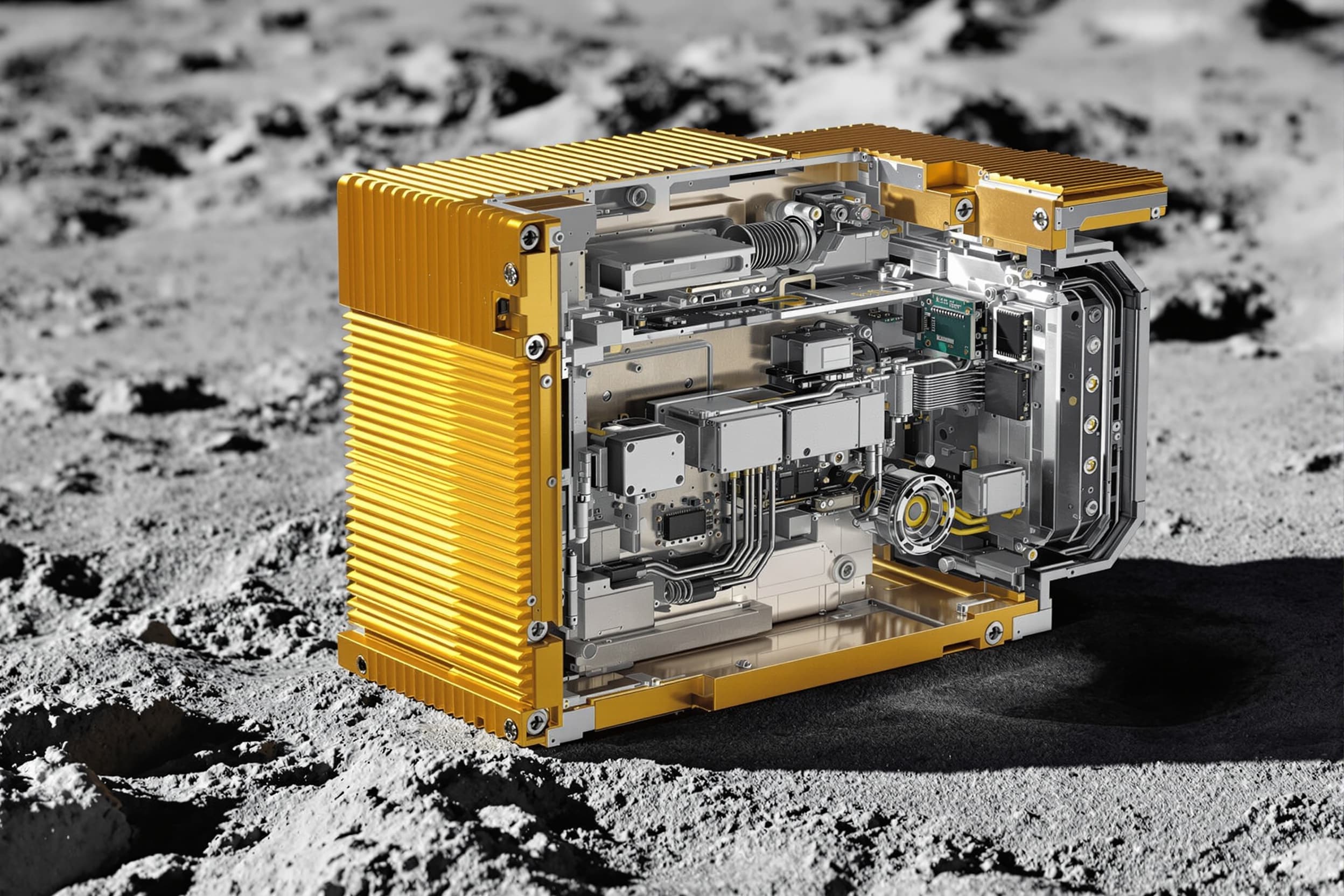
A standardized mechanical and electrical interface module designed to integrate customer payloads onto Firefly's Blue Ghost lunar lander. This module provides mounting, power distribution, thermal management, and data connectivity for instruments and equipment deployed on the lunar surface. It enables rapid payload integration for annual Moon missions while supporting operations through lunar night cycles.

Feasibility at a glance
PT localization
7/10
High
Most steps can be localised in Portugal.
Per unit
€150,000–€400,000
at 4-unit volume
Starter batch
4units
minimum viable run
To first batch
8 phases, design to ship
Budget
€65–95k
all-in estimate
Bottom line
A Blue Ghost lunar lander payload interface module demands space-grade manufacturing with extensive heritage in harsh environments, thermal-vacuum testing, and compliance with planetary protection protocols. No Portuguese facility currently holds the necessary spaceflight-qualification infrastructure. EU co-development with established aerospace primes (Thales Alenia Space, Airbus Defence and Space, or OHB) leverages proven supply chains for titanium machining, space-qualified PCB fabrication, and environmental testing. This approach balances lead time (~52 weeks), regulatory alignment (EU export control, ITAR-free options), and access to Class 100 cleanrooms and thermal-vacuum chambers essential for lunar qualification.
4 capabilities
Securely attach scientific instruments and equipment to the lunar lander
Deliver electrical power and data signals from the lander to each payload
Protect payloads from extreme lunar temperatures and dust
Allow quick swapping of payloads between missions without redesigning the lander
5 stations · build route
Machine frame and radiator plates
CNC-mill aluminum or titanium to create lightweight structural mounting brackets and thermal plates.
Fabricate and populate PCBs
Manufacture multilayer circuit boards and place surface-mount components for power and data handling.
Build cable harnesses
Crimp connectors onto Kapton flex cables and route them through the frame for EMI-shielded connections.
Apply surface treatments
Anodize aluminum parts and apply thermal coatings to survive lunar thermal extremes.
Integrate and test
Assemble all subcomponents, run thermal-vacuum and vibration tests to qualify for spaceflight.
Machine frame and radiator plates
CNC-mill aluminum or titanium to create lightweight structural mounting brackets and thermal plates.
Fabricate and populate PCBs
Manufacture multilayer circuit boards and place surface-mount components for power and data handling.
Build cable harnesses
Crimp connectors onto Kapton flex cables and route them through the frame for EMI-shielded connections.
Apply surface treatments
Anodize aluminum parts and apply thermal coatings to survive lunar thermal extremes.
Integrate and test
Assemble all subcomponents, run thermal-vacuum and vibration tests to qualify for spaceflight.
5 identified · 3 blocking
Critical
Export control and planetary-protection compliance
Lunar landers fall under ITAR (U.S. International Traffic in Arms Regulations) and EU Dual-Use export controls (Regulation 2021/821, Annex I category 9). Any hardware manufactured in the EU for a U.S. lunar mission requires Technical Assistance Agreements (TAA) and export licenses, adding 8–16 weeks to the schedule. Failure to obtain clearance can halt shipment of the completed module. Furthermore, NASA's planetary-protection policy (NPR 8020.7G) mandates bioburden limits (<300 spores/m²) and material cleanliness (IEST-STD-CC1246E Level 100A), requiring the EU integrator to operate a certified cleanroom and document all cleaning and bakeout procedures. Non-compliance discovered late can force expensive rework or quarantine.
Mitigation — Engage an export-control attorney at project start to file TAA applications with the U.S. State Department (DDTC) and obtain EU export authorizations in parallel. Budget 12 weeks for government review and include contingency for Commodity Jurisdiction (CJ) requests if ITAR/EAR classification is ambiguous. Select an EU integrator with existing ITAR-registration and a track record of U.S. collaboration (e.g., Thales Alenia Space has TAAs for ISS and Orion work). For planetary protection, require the integrator to hold ISO 14644-1 Class 5 (100) cleanroom certification and conduct witness inspections of cleaning and particulate-count verification. Incorporate bioburden sampling into the test plan and allow 2–3 weeks for remediation if limits are exceeded.
High
Space-grade material supply shortages
Aluminum 7075-T73 plate, Ti-6Al-4V bar stock, and Kapton-E polyimide flex cables are controlled materials with limited suppliers and long lead times (16–24 weeks). Space-qualified fasteners (NAS, MS standards) and connectors (DSUB, micro-D) face similar constraints. A single supplier disruption—common in the post-COVID aerospace market—can delay the entire program by 12+ weeks. Additionally, thermal-interface materials (e.g., Cho-Therm, Sil-Pad) require NASA low-outgassing certification (ASTM E595), and only a handful of EU distributors stock certified lots.
Mitigation — Establish dual-source agreements for all Class-A materials at project kickoff. Pre-purchase long-lead items (titanium, Kapton, connectors) and store in bonded inventory. Work with the EU integrator's approved-vendor list (AVL) to ensure traceability and maintain buffer stock of fasteners and thermal materials. Include material-availability clauses in the prime contract with pass-through of supplier delays.
High
Thermal-vacuum and vibration test-facility availability
Qualification of the payload interface module requires thermal-vacuum cycling (typically 8 cycles from -180°C to +120°C per ECSS-Q-ST-70-04C) and random-vibration testing to NASA-STD-7001A (14.1 Grms for lunar landers). Only a handful of EU facilities can accommodate 1-meter-class hardware: ESTEC (Netherlands), IABG (Germany), CSL Liège (Belgium), and Thales Alenia Space Cannes. Test chambers are booked 6–9 months in advance, and any hardware failure during a test run (e.g., connector delamination, PCB solder-joint cracking) requires repair, retest, and re-scheduling—potentially adding 12+ weeks. COVID and the surge in smallsat launches have further constrained capacity.
Mitigation — Reserve thermal-vacuum and vibration test slots at contract signature, even if hardware delivery dates are uncertain; accept cancellation fees as a cost of doing business. Build and qualify an engineering model (EM) 16 weeks ahead of the flight unit to flush out design weaknesses and avoid consuming the flight test slot with a failure. Use detailed finite-element analysis (FEA) and thermal modeling to predict performance and reduce the likelihood of test failures. Negotiate priority access or cost-plus expedited scheduling with the test facility. As a fallback, identify secondary test sites (e.g., Airbus Toulouse, Kongsberg Norway) and budget for transportation.
Medium
Intellectual property and interface-specification leakage
The payload interface module embodies Firefly's proprietary mechanical mounting geometry, power-bus architecture, and data-protocol specifications. Sharing detailed CAD models and electrical schematics with an EU co-development partner or subcontractors creates risk of IP migration to competing lunar-lander programs (e.g., ispace Europe, ESA's EL3). Additionally, connector pinouts and command protocols could be reverse-engineered by payload customers, enabling them to bypass the interface module in future missions and erode Firefly's recurring revenue.
Mitigation — Require the EU integrator to sign a comprehensive NDA with carve-outs preventing work on competing lunar-lander projects for 36 months. Modularize CAD deliverables so subcontractors receive only the geometry necessary for their scope (e.g., PCB fabricator gets board outline and mounting holes, but not full system integration drawings). Watermark all technical documentation and limit distribution to named individuals. Consider filing design patents in the EU and U.S. for the novel connector arrangement and thermal-radiator mounting scheme.
Medium
Multi-tier supply-chain quality escapes
The payload interface module comprises parts from dozens of suppliers: raw-material mills, CNC job shops, PCB fabricators, connector manufacturers, coating applicators, and cable assemblers. Each tier introduces risk of non-conformance—wrong alloy temper, under-spec anodize thickness, counterfeit components on PCBs, FOD (foreign object debris) in cable assemblies. A single quality escape discovered during final integration or, worse, on-orbit, can trigger a mission failure or costly payload-swap delay. The multi-national EU supply chain complicates traceability and corrective-action enforcement.
Mitigation — Require the prime EU integrator to flow down NASA workmanship standards (IPC-A-610 Class 3 for electronics, NASA-STD-8739 series for mechanical assembly) to all subcontractors and conduct source inspections at critical tiers (raw-material receipt, post-machining, post-coating, PCB final test). Demand certificate of conformance (C of C) and material test reports (MTRs) for every serialized part, with traceability to raw-material heat/lot numbers. Implement a robust non-conformance reporting (NCR) process with root-cause analysis and corrective/preventive action (CAPA). Conduct a pre-shipment acceptance review with witness testing of key interfaces (connector mating cycles, thermal-conductivity spot checks, visual inspection under magnification). Budget 5% of contract value for Quality Assurance oversight and third-party audits.
52 weeks to first batch
Requirements review and interface specification freeze
wk 1–4Preliminary design and analysis (CAD, FEA, thermal modeling)
wk 5–12Detailed design and drawing release for manufacturing
wk 13–18Procurement of long-lead materials and components
wk 19–30Fabrication and surface treatment of structural and thermal hardware
wk 31–36PCB fabrication and SMT assembly
wk 37–43Cable harness assembly and integration
wk 44–48Environmental qualification testing and acceptance
wk 49–52Requirements review and interface specification freeze
Preliminary design and analysis (CAD, FEA, thermal modeling)
wk 19–30 is the longest stretch — Procurement of long-lead materials and components takes 12 weeks of the 52 weeks on this build.
6 materials · 8 processes
Materials
Processes
592 Portuguese manufacturers matched
None cover the whole build — it splits across steps.
12 tasks · 12 weeks to first batch
Week 1
2 tasks
Select and engage EU tier-1 space integrator
waits on Integrator availability and willingness to work with a small lunar-lander program
Issue RFI to Thales Alenia Space (FR/IT), OHB System (DE), and Airbus Defence and Space. Request capability statements, heritage in lunar/deep-space hardware, cleanroom and test-facility access, ITAR registration status, and rough order-of-magnitude (ROM) pricing for 4 units. Schedule video calls with business-development and engineering leads. Down-select to one prime partner by end of week.
Retain export-control attorney for ITAR/TAA
waits on Legal retainer and upfront filing fees (~€8k–12k)
Hire a U.S.-based export-control law firm (e.g., Berliner Corcoran, Crowell & Moring) with DDTC experience. Initiate Technical Assistance Agreement (TAA) application to cover transfer of Firefly interface specifications to the EU integrator. Request Commodity Jurisdiction (CJ) determination if unsure whether the module is ITAR or EAR 600-series. Budget 12 weeks for DDTC review.
Weeks 2–3
2 tasks
Negotiate and sign co-development contract with EU integrator
waits on Integrator contract approval cycle; currency-hedging strategy for multi-year EUR exposure
Finalize statement of work (SOW), milestones (PDR, CDR, first article delivery), payment terms (30% at kickoff, 30% at CDR, 40% at acceptance), IP ownership, and liability clauses. Include NDA with 36-month non-compete on lunar-lander projects. Lock in lead time (52 weeks from PDR) and per-unit cost (€280k–€380k). Execute contract and transfer kickoff payment.
Conduct interface-specification freeze workshop with Firefly
waits on Firefly availability; alignment on requirements that may shift as Blue Ghost design matures
Travel to Firefly Aerospace (Austin, TX) or host virtual design review. Finalize mechanical envelope, bolt pattern, mass budget (target <15 kg), power rails (28V primary, 5V/3.3V secondary), data bus (CAN or RS-422), connector types (Omnetics Nano-D), and thermal dissipation (radiator area, operational limits). Generate Interface Control Document (ICD) v1.0 and obtain Firefly sign-off. Deliver ICD to EU integrator to start PDR.
Weeks 4–7
3 tasks
Submit TAA and EU export-license applications
waits on Government review timelines (8–16 weeks); potential for Commodity Jurisdiction requests adding delay
Working with export-control attorney, file TAA with U.S. State Department (DDTC) covering EU integrator access to Firefly interface data. In parallel, file EU Dual-Use export authorization (if required by integrator's country) for eventual shipment of completed module to U.S. Include technical descriptions, end-user statements, and no-retransfer commitments. Track application status weekly.
Kickoff preliminary design review (PDR) with EU integrator
waits on Availability of Firefly CAD data for lander deck interface; definition of worst-case thermal scenarios
EU integrator initiates CAD modeling (CATIA/NX) of frame, radiator plates, and mounting brackets; develops PCB schematics for power distribution and data interface; performs FEA for launch/landing loads (20g quasi-static, 14.1 Grms random vibe); runs thermal-desktop modeling for lunar day/night survival. Founder participates in weekly design sync and reviews trade studies (Al vs Ti frame, passive vs active thermal). PDR scheduled for Week 8.
Identify and pre-qualify space-grade material suppliers
Weeks 8–16
4 tasks
Conduct and close preliminary design review (PDR)
waits on Design issues requiring iteration; Firefly feedback turnaround time
EU integrator presents PDR package: 3D CAD models, FEA results (structural margins >1.4), thermal analysis (radiator sizing, survival margins), PCB block diagrams, mass/power budgets, preliminary test plan, and risk register. Founder and Firefly review and provide comments. Resolve action items within 2 weeks. Obtain PDR sign-off from Firefly, authorizing integrator to proceed to detailed design (CDR phase). Update project schedule and confirm critical-path items.
Reserve thermal-vacuum and vibration test slots
waits on Test-facility availability 9–12 months out; budget for deposits
EU integrator books test-chamber time at ESTEC, IABG, or CSL Liège for Week 50 (thermal-vac, 8 cycles -180°C to +120°C) and shaker-table time for Week 51 (random vibe per NASA-STD-7001A). Founder approves test-facility choice based on cost, schedule, and integrator's heritage. Pay non-refundable deposit (~€15k–20k) to secure slots. Confirm engineering-model (EM) build will precede flight-unit test by 16 weeks to flush out issues.
Define planetary-protection and cleanroom protocols
Ongoing
1 task
Monthly status reviews and risk monitoring
Hold monthly video calls with EU integrator project manager to review schedule, budget burn, technical progress, and risk register. Track TAA approval status with export-control attorney. Monitor material deliveries and test-slot confirmations. Escalate blockers (e.g., supplier delays, Firefly requirement changes, government license hold-ups) immediately. Update Firefly with progress reports and flag any impacts to Blue Ghost integration timeline. Maintain decision log and change-control process.
4 roles to fill before month one
Prime EU integrator partner
Thales Alenia Space business-development director (lunar programs)
Thales has flight-proven heritage on ESA lunar Gateway and ExoMars, operates ISO Class 5 cleanrooms, holds ITAR registration, and can deliver end-to-end: CNC machining (Al/Ti), space-grade PCB fab, thermal coating, cable assembly, and full environmental qualification (thermal-vac, vibe, EMC). They are the likely prime contractor for this 4-unit build.
Legal counsel for TAA and export licenses
U.S. export-control attorney (ITAR/DDTC specialist)
ITAR compliance is mission-critical—any misstep blocks hardware shipment to the U.S. and derails the Blue Ghost schedule. An experienced attorney navigates DDTC, files the TAA, handles Commodity Jurisdiction if needed, and ensures both U.S. and EU Dual-Use regulations are satisfied. Budget €10k–15k for this engagement.
Customer interface and ICD authority
Firefly Aerospace payload-integration lead
This person owns the Blue Ghost lander deck mechanical and electrical interfaces. You need their sign-off on the ICD (bolt pattern, connectors, power rails, data bus) at every milestone—freeze, PDR, CDR. They also coordinate planetary-protection requirements and integration timelines at KSC. Weekly contact during design phases is essential.
Environmental test execution
5 things to avoid in this plan
documentation
Lock in export licenses early—ITAR/TAA approval can slip 16+ weeks if DDTC requests clarifications; file applications in Week 2 and track obsessively.
lead time
Reserve thermal-vac and vibration test slots now (Week 50–51 target)—facilities are booked solid, and a missed slot pushes delivery by 3+ months.
lead time
Pre-purchase space-grade titanium, Kapton cable, and connectors at PDR—suppliers quote 12–16 week lead times, and a single stock-out cascades through the schedule.
quality
Build and test an engineering model 16 weeks ahead of the flight units—design flaws discovered during qualification testing can add 12+ weeks if you only have one shot.
supply
Insist on dual-source agreements for Class-A materials (Al 7075, Ti-6Al-4V, NAS fasteners)—post-COVID aerospace supply chain remains fragile, and single-supplier disruptions are common.
2 tasks in week 1
Select and engage EU tier-1 space integrator
Detailed design and drawing release for manufacturing
Procurement of long-lead materials and components
Fabrication and surface treatment of structural and thermal hardware
PCB fabrication and SMT assembly
Cable harness assembly and integration
Environmental qualification testing and acceptance
waits on Supplier willingness to support low-volume (4-unit) order; minimum-order quantities
EU integrator provides draft Bill of Materials (BOM). Founder reviews and approves sources for Al 7075-T73, Ti-6Al-4V, Kapton-E flex cable, Omnetics connectors, NAS fasteners, and thermal-interface materials (Cho-Therm). Verify ASTM E595 low-outgassing certs are available. Request lead-time quotes from two suppliers per critical material. Establish dual-source agreements where feasible. Flag any single-source items (e.g., specific connector series).
waits on Integrator's existing cleanroom protocols may need tailoring for lunar planetary protection
Review NASA NPR 8020.7G bioburden limits (<300 spores/m²) and IEST-STD-CC1246E Level 100A cleanliness requirements with EU integrator. Confirm integrator holds ISO 14644-1 Class 5 cleanroom cert. Establish cleaning and bakeout procedures for all parts (120°C vacuum bake, precision clean per IEST). Plan bioburden sampling at final assembly and budget 2–3 weeks for remediation if needed. Document compliance in the Quality Assurance Plan.
Place long-lead material purchase orders
waits on Material supplier lead times; currency fluctuations affecting EUR pricing
Following PDR, authorize EU integrator to order Al 7075-T73 plate, Ti-6Al-4V bar stock, Kapton-E flex cable, space-qualified connectors, and NAS fasteners. Verify material certs (AMS 4045, AMS 4911, ASTM E595) will accompany delivery. Track lead times (12–16 weeks typical). Pay deposits where required. Maintain buffer stock of connectors and fasteners to avoid single-point delays. Store materials in bonded inventory if integrator facility is not yet ready.
ESTEC or IABG test-facility project manager
Thermal-vacuum and vibration qualification are the critical-path long-lead items (test slots book 9 months ahead). The test-facility PM schedules your chamber time, coordinates instrumentation (thermocouples, accelerometers), witnesses tests, and delivers the final qualification report. Early relationship-building secures priority access and contingency slots if the first test run fails.
592 matched · 8 shown, ranked by coverage
Covers, left to right: CNC Machining · Sheet Metal · Anodizing · PCB Fabrication · SMT Assembly · Cable Assembly · Testing & Inspection · Final Assembly
Manufacturer
Location
Covers
Certifications
People
Portuguese producers per required step
Final Assembly
369
CNC Machining
212
Testing & Inspection
178
SMT Assembly
36
Sheet Metal
21
Cable Assembly
12
PCB Fabrication
6
How many cover more than one step
The gap
A Blue Ghost lunar lander payload interface module demands space-grade manufacturing with extensive heritage in harsh environments, thermal-vacuum testing, and compliance with planetary protection protocols. No Portuguese facility currently holds the necessary spaceflight-qualification infrastructure. EU co-development with established aerospace primes (Thales Alenia Space, Airbus Defence and Space, or OHB) leverages proven supply chains for titanium machining, space-qualified PCB fabrication, and environmental testing. This approach balances lead time (~52 weeks), regulatory alignment (EU export control, ITAR-free options), and access to Class 100 cleanrooms and thermal-vacuum chambers essential for lunar qualification.
Send one RFQ to the top 4
Keenfinity EMS, Uartrónica, Exatronic, 3DWays — same package, one click.
Anodizing
3