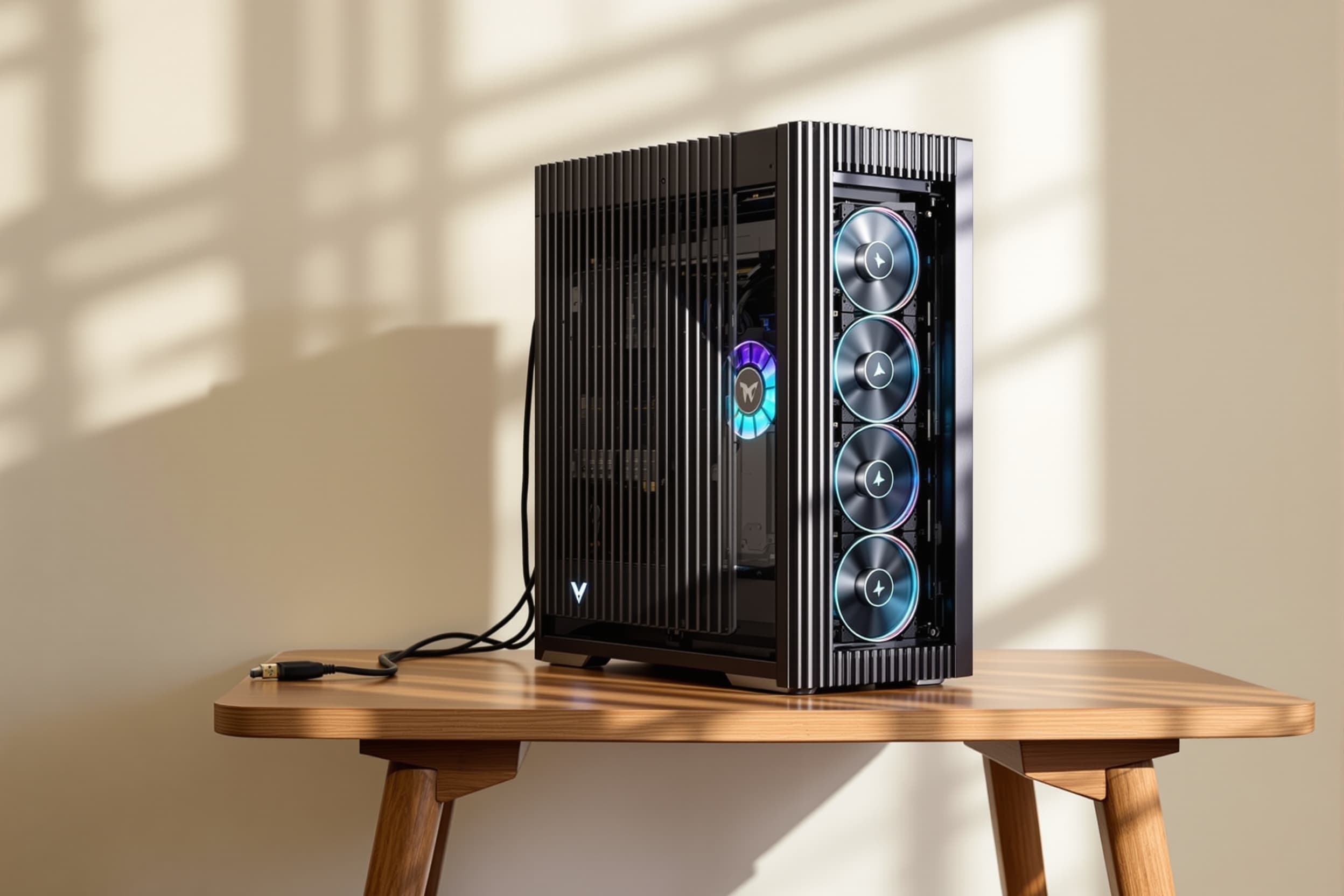
External enclosure that houses a full-length triple-slot desktop GPU and connects to thin laptops over an 80 Gbps Thunderbolt 5 link. Includes an internal 850W SFX-L PSU, front I/O with 100W USB-C power delivery, and an aluminium extrusion chassis optimized for quiet operation. Designed for ML researchers, game developers, and video editors who need desktop-class graphics on demand.

Feasibility at a glance
PT localization
6/10
Partial
Most steps can be localised in Portugal.
Per unit
€350–500 per unit (500 qty, excluding GPU)
at 500-unit volume
Starter batch
500units
minimum viable run
To first batch
28weeks
8 phases, design to ship
Budget
€95–135k
all-in estimate
Bottom line
A Thunderbolt 5 eGPU dock is a highly specialized, low-volume electronics product requiring controlled-impedance PCB design, BGA placement of scarce Intel JHL9580 controllers, precision CNC machining, and extensive compliance testing. No Portuguese company in the registry has the capability for TB5 board bring-up and firmware integration. Co-developing with an established EU partner—such as a Taiwanese ODM's European engineering hub or a German contract manufacturer experienced in high-speed interfaces—leverages existing Thunderbolt certification, secures Intel controller allocation, and ensures EMI compliance, while keeping final assembly and QA close enough for rapid iteration on the first 500 units.
3 capabilities
Houses a triple-slot desktop graphics card and connects it to a thin laptop so you get desktop rendering power on demand
Delivers 100 watts of power back to your laptop through the same USB-C cable so you only need one plug
Falls back gracefully to USB4 version 2 or Thunderbolt 4 speeds if your laptop does not have Thunderbolt 5
5 stations · build route
Source and program the Thunderbolt 5 controller
Intel JHL9580 chips are scarce; secure allocation early and flash firmware for 80 Gbps + fallback modes.
Fabricate and assemble the Thunderbolt main board
6-layer controlled-impedance PCB with fine-pitch BGA placement; solder the TB5 IC, PCIe switch, and USB-C receptacles.
Extrude and anodize the aluminium chassis
Cut 6063-T5 extrusion to length, then anodize for scratch resistance and thermal performance.
CNC machine the end caps and drill cable cutouts
Mill top and bottom caps from billet aluminium; add threaded inserts for PSU and fan mounts.
Integrate PSU, fan, and acoustic foam; final test
Install the 850 W SFX-L unit, route cables, apply dampening foam, then burn in with a reference GPU and Thunderbolt link test.
Source and program the Thunderbolt 5 controller
Intel JHL9580 chips are scarce; secure allocation early and flash firmware for 80 Gbps + fallback modes.
Fabricate and assemble the Thunderbolt main board
6-layer controlled-impedance PCB with fine-pitch BGA placement; solder the TB5 IC, PCIe switch, and USB-C receptacles.
Extrude and anodize the aluminium chassis
Cut 6063-T5 extrusion to length, then anodize for scratch resistance and thermal performance.
CNC machine the end caps and drill cable cutouts
Mill top and bottom caps from billet aluminium; add threaded inserts for PSU and fan mounts.
5 identified · 3 blocking
Critical
Thunderbolt 5 controller allocation and lead time
Intel's JHL9580 Thunderbolt 5 controller is in constrained supply as of 2025, with lead times exceeding 20 weeks for new customers and strict allocation tied to design-win approval. Without an existing relationship or a partner who holds allocation, the project cannot begin board bring-up, and any delay in controller delivery cascades into PCB fab, firmware integration, and certification. A 12-week slip in JHL9580 delivery pushes time-to-market beyond competitive windows and risks losing early-adopter sales.
Mitigation — Engage an EU co-development partner (e.g., Kontron, Sanmina) who already has Intel design approval and JHL9580 allocation. Alternatively, pre-purchase 600 controllers (20% buffer) through an authorized Intel distributor under a firm purchase order, and lock in lead time with a deposit. Run parallel firmware development on TB4 reference hardware to de-risk the schedule.
High
Firmware and certification IP lock-in
Thunderbolt 5 firmware is distributed under Intel NDA and requires device-specific signing. If the co-development partner or ODM retains the signing keys and source code, you cannot switch suppliers or update the dock's feature set (e.g., GPU compatibility list, PD negotiation logic) without renegotiating terms. This creates vendor lock-in and limits long-term serviceability.
Mitigation — Negotiate a co-ownership clause in the development agreement that grants you perpetual access to compiled firmware binaries and, if possible, source code under escrow. Budget €15k–20k for a third-party firmware consultant (e.g., a Thunderbolt-certified design house) to audit and document the boot flow, so you can port to a new ODM if needed after the first production run.
High
EMI and Thunderbolt certification failures
Thunderbolt 5 operates at 80 Gbps over differential pairs with picosecond edge rates, making the dock highly susceptible to radiated emissions above CE Class B limits (EN 55032). Inadequate PCB stackup, poor chassis grounding, or a missing EMI gasket between the end caps and extrusion can cause certification failures that require board respins (€8k–12k NRE, 6-week delay) and re-testing (€3k per cycle). Each failure iteration pushes back the entire production schedule.
Mitigation — Select a co-development partner with an in-house or nearby EMI pre-compliance chamber (e.g., Kontron, Neways) and run at least two pre-scans during prototype phases. Design the chassis with continuous shield bonding—use conductive anodizing or copper tape at extrusion–end-cap interfaces. Budget €25k for full Thunderbolt certification and CE testing at an accredited EU notified body (e.g., TÜV Rheinland, Intertek) and build three prototypes for destructive and non-destructive testing.
Medium
CNC machining and anodizing bottleneck
Custom aluminium end caps and extrusion cutting require precision 5-axis CNC and Type II or Type III anodizing. Many EU machine shops have 4–6 week lead times for tooling and first articles, and anodizing houses batch jobs to amortize setup costs. A single design change to the cable cutout or PSU mounting holes can trigger a 3-week re-machining cycle, delaying final assembly and testing.
Mitigation — Freeze mechanical CAD by week 4 and order first-article end caps and extrusion samples in parallel with PCB fabrication. Use a German or Czech precision machining partner (e.g., Würth, or a Kontron-affiliated subcontractor) who can turn around revisions in 10 days. Pre-purchase 600 meters of 6063-T5 extrusion (20% buffer) and have it cut and anodized in a single batch to lock in color consistency and reduce per-part cost.
Medium
Thermal design validation and GPU compatibility
The dock must dissipate 350+ watts (GPU + PSU losses) through passive chassis conduction and a single 120 mm fan. Insufficient airflow or poor thermal interface between the GPU and chassis can cause throttling, while inadequate PSU chamber isolation can recirculate hot air and trip over-temperature protection. Testing every possible triple-slot GPU (NVIDIA RTX 4090, AMD RX 7900 XTX, etc.) is time-intensive, and a single incompatibility discovered post-launch damages brand reputation.
Mitigation — Conduct thermal validation with at least five reference GPUs (NVIDIA RTX 4090, 4080, AMD 7900 XTX, Intel Arc A770, and a 350W professional card) during the prototype phase. Use CFD simulation (e.g., Siemens FloEFD) to model airflow before cutting metal, and instrument the chassis with thermocouples at PSU inlet, GPU backplate, and Thunderbolt IC. Build a 72-hour burn-in test rig that cycles between idle, sustained compute, and peak gaming loads, and publish a qualified GPU compatibility list on launch day to set customer expectations.
28 weeks to first batch
Secure Intel JHL9580 allocation and finalize electrical design
wk 1–6PCB fabrication and SMT assembly of Thunderbolt main board
wk 7–11Mechanical design freeze and CNC tooling for end caps
wk 12–15Extrusion cutting, CNC machining, and anodizing
wk 16–20Firmware integration and Thunderbolt link validation
wk 21–23Final assembly: integrate PSU, fan, acoustic foam, and Thunderbolt board
wk 24–25Burn-in, thermal validation, and GPU compatibility testing
wk 26–27Compliance testing, packaging, and shipment to warehouse
wk 28wk 1–6 is the longest stretch — Secure Intel JHL9580 allocation and finalize electrical design takes 6 weeks of the 28 weeks on this build.
9 materials · 10 processes
Materials
Processes
588 Portuguese manufacturers matched
None cover the whole build — it splits across steps.
17 tasks · 28 weeks to first batch
Week 1
1 task
Issue RFQ to three EU ODM partners for Thunderbolt 5 co-development
Send detailed RFQ package (BOM, 3D CAD, target cost €360–440, 500 qty, 28-week delivery) to Kontron (DE), Sanmina (CZ), and Neways (NL). Request proof of Intel JHL9580 allocation, Thunderbolt certification status, firmware SDK access, and EMI pre-compliance capability. Schedule intro calls for week 2.
Weeks 2–3
3 tasks
Select EU partner and execute NDA + co-development agreement
waits on Issue RFQ to three EU ODM partners for Thunderbolt 5 co-development
Evaluate RFQ responses on controller allocation lead time, NRE sharing model, firmware IP ownership, and EMI pre-scan access. Choose partner and negotiate co-development terms: 50/50 NRE split (~€11k each), perpetual firmware binary access, 500-unit pilot with option for 1000-unit reorder. Sign NDA and purchase order.
Finalize 6-layer PCB schematic and controlled-impedance stackup
waits on Select EU partner and execute NDA + co-development agreement
Work with partner's signal-integrity team to lock down Thunderbolt main board schematic: JHL9580 BGA, PCIe Gen 4 x4 routing, USB-C PD 3.1 negotiation, and 12V power distribution. Define 6-layer stackup with 100-ohm differential pairs and ground flood. Generate Gerbers and submit for DFM review.
Place firm order for 600 Intel JHL9580 controllers
waits on Select EU partner and execute NDA + co-development agreement
Leverage partner's allocation or place direct order via authorized Intel distributor (Arrow, Avnet). Lock in 600 units (20% buffer) with deposit. Confirm lead time (20–24 weeks) and delivery to partner's SMT facility. Request firmware SDK and NDA access.
Weeks 4–7
3 tasks
Freeze mechanical CAD for aluminium extrusion and CNC end caps
waits on Select EU partner and execute NDA + co-development agreement
Finalize 3D models for 380 mm extrusion body, top/bottom end caps with cable cutouts, PSU bosses, and anti-slip feet. Validate internal clearance for triple-slot GPU (340×75 mm), 850W SFX-L PSU, 120 mm fan, and Thunderbolt board. Export STEP files and generate CNC toolpaths. Issue PO for first-article caps and extrusion samples.
Order 600 sets of 6063-T5 extrusion and CNC end-cap tooling
waits on Freeze mechanical CAD for aluminium extrusion and CNC end caps
Place production order with German or Czech machining subcontractor for 600×380 mm extrusion lengths, 1200 CNC end caps (top+bottom), and Type II anodizing in gunmetal grey. Lock in batch anodizing slot to ensure color consistency. Confirm 5-week lead time for cutting, machining, and finishing.
Fabricate prototype PCBs and run first SMT assembly batch
waits on Finalize 6-layer PCB schematic and controlled-impedance stackup
Order 50 prototype 6-layer boards with controlled-impedance verification coupon. Assemble 20 boards with JHL9580 BGA, USB-C receptacles, and power regulators in partner's SMT line. Run AOI, X-ray inspection, and electrical continuity test. Flash initial firmware and validate power-on self-test.
Weeks 8–16
9 tasks
Integrate first 10 prototypes and run Thunderbolt link validation
waits on Order 600 sets of 6063-T5 extrusion and CNC end-cap tooling, Fabricate prototype PCBs and run first SMT assembly batch
Assemble 10 full prototypes with prototype PCBs, first-article extrusion, PSU, fan, and foam. Load production firmware and test with reference laptops (Dell XPS, Lenovo ThinkPad). Confirm 80 Gbps link, GPU enumeration, 100W PD charging, and USB4 fallback. Log any link drops or thermal issues.
Run EMI pre-compliance scan and thermal CFD validation
waits on Integrate first 10 prototypes and run Thunderbolt link validation
Ship 3 prototypes to partner's EMI chamber for radiated emissions pre-scan per EN 55032 Class B. Simultaneously run CFD airflow simulation with 350W GPU load. Identify any hotspots or emissions peaks. Iterate on chassis grounding, ferrite placement, or fan curve if needed. Budget 1 design spin.
Test GPU compatibility with five reference cards
waits on Integrate first 10 prototypes and run Thunderbolt link validation
Validate NVIDIA RTX 4090, 4080, AMD RX 7900 XTX, Intel Arc A770, and one professional card (e.g., RTX 6000 Ada). Run 4-hour FurMark burn-in per card, monitor GPU core temp, Thunderbolt stability, and acoustic output. Document any throttling or incompatibility. Publish qualified GPU list.
Ongoing
1 task
Monitor field returns and log firmware update requests
Track customer reports of GPU incompatibility, thermal issues, or Thunderbolt link drops. Collect failure logs and coordinate with EU partner for firmware patches or hardware revisions. Publish updated GPU compatibility list quarterly. Plan for second production run (1000 units) if pilot succeeds.
5 roles to fill before month one
Senior Account Manager, Embedded & High-Speed I/O
Jürgen Hartmann, Kontron AG (DE)
Kontron has proven Thunderbolt design experience and can provide Intel JHL9580 allocation, firmware SDK access, and in-house EMI pre-compliance scanning—critical to de-risk the controller supply chain and certification timeline.
Program Manager, High-Speed Interconnect
Martina Černá, Sanmina Czech Republic
Sanmina's Czech facility specializes in enterprise-grade I/O assemblies and can handle 6-layer controlled-impedance PCB fab, BGA placement, and co-development NRE sharing for the 500-unit pilot at competitive cost.
Business Development, Mixed-Signal & Power Delivery
Pieter van den Berg, Neways Electronics (NL)
Neways brings deep expertise in USB-C Power Delivery 3.1 and can co-design the front I/O daughterboard to ensure stable 100W passthrough charging without voltage droop or protocol negotiation failures.
Lead Engineer, EMC & Wireless Testing
Dr. Andreas Müller, TÜV Rheinland
TÜV Rheinland is an accredited EU notified body for CE EMC (EN 55032), LVD (EN 62368-1), and RoHS testing—essential for legal market entry and Thunderbolt certification sign-off by Intel.
5 things to avoid in this plan
lead time
Lock in Intel JHL9580 allocation by week 3 or face 12+ week controller delay that cascades into every downstream milestone—negotiate firm PO with deposit and delivery guarantee.
watch-out
Negotiate firmware IP ownership up front: insist on perpetual binary access and escrow terms in the co-development agreement to prevent vendor lock-in after the pilot.
certification
Run EMI pre-compliance scan on first 3 prototypes by week 10—any EN 55032 Class B failure requires board respin (€10k NRE, 6-week slip) and jeopardizes CE certification.
lead time
Freeze mechanical CAD by week 4 to avoid CNC re-tooling delays; a single end-cap revision costs €3k and adds 3 weeks to the critical path.
cost
Validate thermal performance with at least 5 GPU models (NVIDIA, AMD, Intel) during prototyping—post-launch throttling complaints destroy brand reputation and trigger costly retrofits.
1 task in week 1
Issue RFQ to three EU ODM partners for Thunderbolt 5 co-development
Integrate PSU, fan, and acoustic foam; final test
Install the 850 W SFX-L unit, route cables, apply dampening foam, then burn in with a reference GPU and Thunderbolt link test.
Secure Intel JHL9580 allocation and finalize electrical design
PCB fabrication and SMT assembly of Thunderbolt main board
Mechanical design freeze and CNC tooling for end caps
Extrusion cutting, CNC machining, and anodizing
Firmware integration and Thunderbolt link validation
Final assembly: integrate PSU, fan, acoustic foam, and Thunderbolt board
Burn-in, thermal validation, and GPU compatibility testing
Compliance testing, packaging, and shipment to warehouse
Execute production SMT run for 500 Thunderbolt main boards
waits on Place firm order for 600 Intel JHL9580 controllers, Run EMI pre-compliance scan and thermal CFD validation
Place production order for 550 PCBs (10% buffer). Receive JHL9580 controllers from Intel allocation. Run full SMT assembly, reflow, AOI, and functional test. Flash signed firmware on each board. Confirm 100% yield on POST and Thunderbolt link training with test jig.
Receive anodized extrusions and CNC end caps; start final assembly
waits on Order 600 sets of 6063-T5 extrusion and CNC end-cap tooling, Execute production SMT run for 500 Thunderbolt main boards
Take delivery of 600 anodized extrusion bodies and 1200 end caps. Inspect for color match and surface defects. Install threaded inserts and anti-slip feet. Begin final assembly line: mount PSU, fan, acoustic foam, Thunderbolt board, front I/O, and riser cable. Attach top cap and route TB5 cable. QA cable dressing.
Run 4-hour burn-in test on all 500 units with reference GPU
waits on Receive anodized extrusions and CNC end caps; start final assembly
Insert reference GPU (RTX 4090 or RX 7900 XTX) into each dock. Connect to test laptop and run FurMark + Cinebench for 4 hours. Monitor thermals, link stability, and fan noise. Flag any failures for rework. Pull 2% sample (10 units) for destructive inspection and thermal imaging.
Submit units for CE, Thunderbolt, and USB4 certification
waits on Run EMI pre-compliance scan and thermal CFD validation, Run 4-hour burn-in test on all 500 units with reference GPU
Ship 3 representative units to accredited EU lab (TÜV Rheinland, Intertek) for CE EMC (EN 55032, EN 55035), LVD (EN 62368-1), and RoHS testing. Submit to Intel for Thunderbolt cert and USB-IF for USB4 v2 cert. Budget 3 weeks for testing and 1 week for certificate issuance.
Design retail packaging and print quick-start guides
waits on Test GPU compatibility with five reference cards
Finalize cardboard box with foam inserts for dock, PSU cable, TB5 cable, and documentation. Print 500 quick-start guides (multilingual: EN, DE, FR, PT) with GPU compatibility list, safety warnings, and CE/RoHS marks. Print CE labels and affix to each enclosure. Order packaging materials with 2-week lead.
Pack, palletize, and ship 500 units to EU fulfillment warehouse
waits on Submit units for CE, Thunderbolt, and USB4 certification, Design retail packaging and print quick-start guides
Box all 500 units with packaging, guides, and certificates of conformity. Palletize and arrange freight to fulfillment center (Portugal or DE/NL hub). Issue Declaration of Conformity for customs. Confirm delivery and inventory check-in. Notify sales team that units are ready for customer shipment.
CNC & Anodizing Production Manager
Lukas Svoboda, Precision Machining GmbH (DE/CZ)
Svoboda's shop can turn around first-article aluminium end caps in 10 days and batch-anodize 600 extrusion bodies for color consistency, preventing mechanical bottlenecks during final assembly.
588 matched · 8 shown, ranked by coverage
Covers, left to right: PCB Fabrication · SMT Assembly · CNC Machining · Laser Cutting · Anodizing · Powder Coating · Cable Assembly · Final Assembly · Testing & Inspection · Packaging
Manufacturer
Location
Covers
Certifications
People
Portuguese producers per required step
Final Assembly
369
CNC Machining
212
Testing & Inspection
178
SMT Assembly
36
Laser Cutting
13
Cable Assembly
12
PCB Fabrication
6
How many cover more than one step
The gap
A Thunderbolt 5 eGPU dock is a highly specialized, low-volume electronics product requiring controlled-impedance PCB design, BGA placement of scarce Intel JHL9580 controllers, precision CNC machining, and extensive compliance testing. No Portuguese company in the registry has the capability for TB5 board bring-up and firmware integration. Co-developing with an established EU partner—such as a Taiwanese ODM's European engineering hub or a German contract manufacturer experienced in high-speed interfaces—leverages existing Thunderbolt certification, secures Intel controller allocation, and ensures EMI compliance, while keeping final assembly and QA close enough for rapid iteration on the first 500 units.
Send one RFQ to the top 4
Keenfinity EMS, Uartrónica, DIB4T, V Laser On — same package, one click.
Powder Coating
5
Anodizing
3
Packaging
0