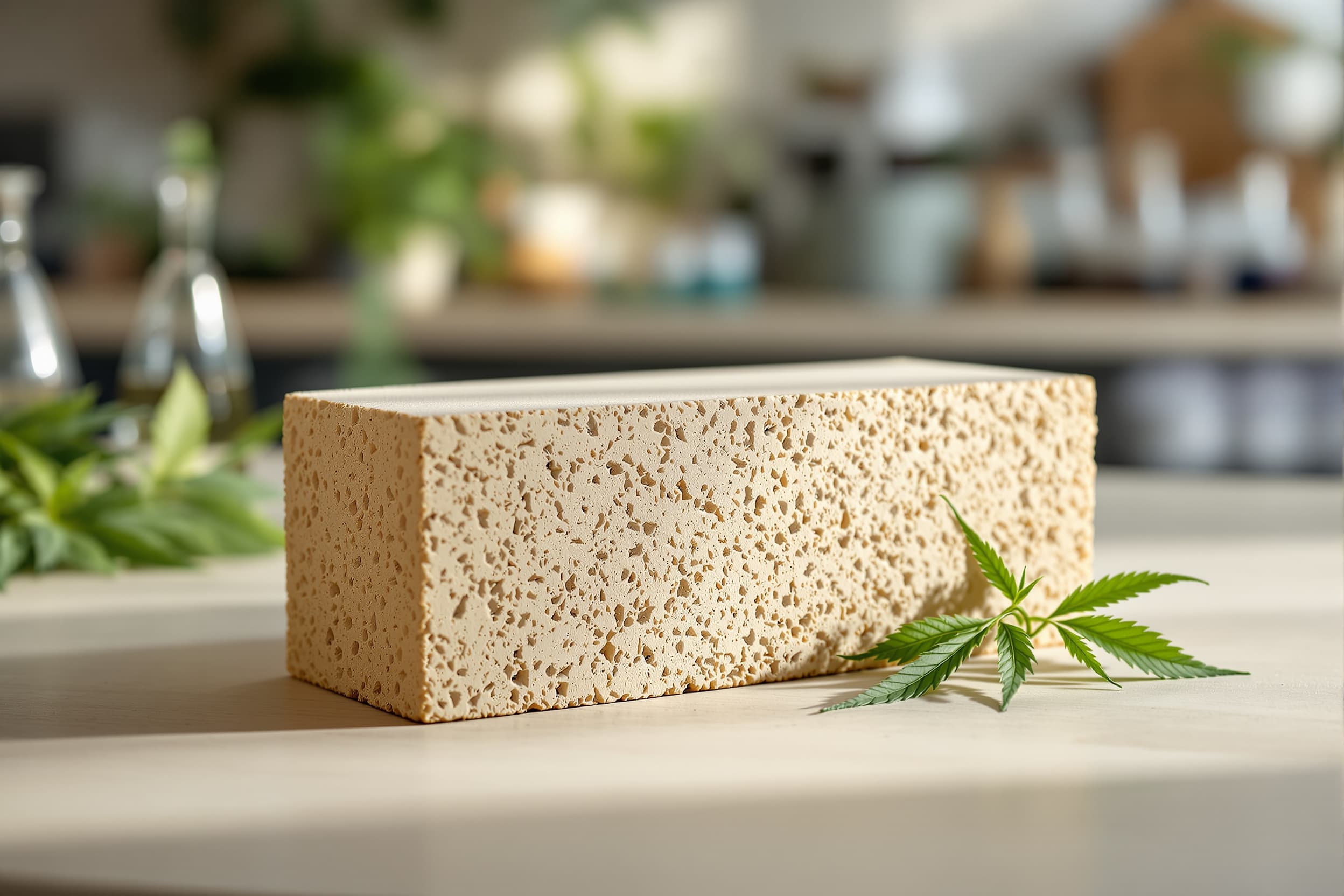
A bio-composite insulation material made from hemp hurd (woody inner core particles 6–22 mm) bonded with mineral lime binder. Provides thermal mass, moisture buffering, and a near-carbon-neutral footprint while meeting EU thermal regulations at 300–400 mm wall thickness. Non-load-bearing; requires timber or steel structural frame.

Feasibility at a glance
PT localization
8/10
High
The whole build can be sourced in Portugal.
Per unit
$1.50–$4.00 per sq ft (installed, 350 mm wall)
at 100-unit volume
Starter batch
100units
minimum viable run
To first batch
18weeks
6 phases, design to ship
Budget
€28–42k
all-in estimate
Bottom line
Hempcrete production is highly localized by nature: raw materials (hemp hurd and lime) are bulky, low-value commodities best sourced regionally; the composite is heavy, fragile when wet, and uneconomical to ship long distances. Portugal has strong agricultural capacity for industrial hemp cultivation, established lime quarries in central regions, and a growing green-building sector. A local production model minimizes transport emissions—critical for maintaining the product's carbon-sequestration advantage—and allows iterative refinement of mixing ratios and curing protocols alongside architects and contractors. Lead time is longer than white-label import, but the margin structure, supply security, and alignment with EU circular-economy goals make local production the strategic winner.
5 capabilities
Insulates building walls with thermal conductivity of 0.06–0.07 W/m·K (R-2.2 to R-2.5 per inch)
Absorbs, stores, and slowly releases heat to smooth indoor temperature swings
Buffers indoor humidity by absorbing and releasing moisture without losing insulation value
Resists fire naturally for at least one hour due to mineral lime binder
Sequesters atmospheric carbon during hemp growth, offsetting 18–38% of binder emissions over the wall's lifetime
5 stations · build route
Calcine limestone to quicklime
Limestone is heated in a kiln to drive off CO₂ and produce calcium oxide (CaO).
Hydrate and blend binder
Quicklime is mixed with water to form Ca(OH)₂; pozzolans are added to accelerate setting without Portland cement.
Wet hurd, then add lime
Hemp hurd is pre-wetted first so the lime coats evenly; reversing the order causes premature bonding.
Cast, spray, or mold composite
The wet mix is placed into formwork around a structural frame, spray-applied to walls, or pre-cast into blocks.
Cure and dry 4–8 weeks
The binder carbonates slowly in air, hardening while moisture content drops to 15–20%.
Calcine limestone to quicklime
Limestone is heated in a kiln to drive off CO₂ and produce calcium oxide (CaO).
Hydrate and blend binder
Quicklime is mixed with water to form Ca(OH)₂; pozzolans are added to accelerate setting without Portland cement.
Wet hurd, then add lime
Hemp hurd is pre-wetted first so the lime coats evenly; reversing the order causes premature bonding.
Cast, spray, or mold composite
The wet mix is placed into formwork around a structural frame, spray-applied to walls, or pre-cast into blocks.
Cure and dry 4–8 weeks
The binder carbonates slowly in air, hardening while moisture content drops to 15–20%.
5 identified · 2 blocking
High
Hemp hurd supply volatility
Industrial hemp cultivation in Portugal remains limited; most EU hurd comes from France, Belgium, and Romania. Harvest is seasonal (late summer), and a poor growing season or regulatory changes in a supplier country can delay material availability by 6–12 months. Additionally, hurd quality (particle size 6–22 mm, low dust content) is critical for consistent thermal performance, and not all hemp processors meet construction-grade specs. Dependency on a single-country supplier (e.g. France) creates a bottleneck.
Mitigation — Establish supply agreements with at least two hurd processors in different EU countries (e.g. IsoHemp in Belgium, Chanvréco in France). Pre-purchase and store 3–6 months of hurd inventory in a dry warehouse before the production season. Simultaneously, pilot small-scale hemp cultivation trials with Portuguese farmers in Alentejo or Beira regions to build domestic supply over 2–3 years, leveraging EU Common Agricultural Policy subsidies for industrial hemp.
High
Inconsistent curing and moisture content
Hempcrete blocks require 4–8 weeks of controlled curing in ambient air (15–25°C, 50–70% RH) to carbonate the lime binder and reduce moisture content to 15–20%. If curing is rushed or humidity is too high, blocks remain soft, mold-prone, and dimensionally unstable. Conversely, if curing is too fast (hot, dry wind), surface cracking and uneven carbonation occur, reducing thermal and fire performance. Variability in local climate (coastal humidity vs. inland dryness) makes it hard to standardize protocols.
Mitigation — Design a covered curing shed with controlled ventilation (fans, louvered walls) to buffer ambient humidity swings. Implement real-time moisture monitoring (capacitance sensors) in a sample of every batch, and establish a go/no-go moisture threshold (<20%) before blocks leave the facility. For the first six months, co-locate an independent testing lab visit monthly to validate carbonation depth (phenolphthalein test) and compressive strength, building a dataset to refine curing schedules by season.
Medium
CE marking and Construction Products Regulation compliance
Hempcrete blocks must carry CE marking under EU Regulation 305/2011 (CPR) and meet harmonized standard EN 15101 or obtain a European Technical Assessment (ETA) if no harmonized standard applies. This requires factory production control (FPC), third-party testing of thermal conductivity, fire resistance (Euroclass), and moisture behavior, plus a Declaration of Performance (DoP). The process can take 6–9 months and costs €20k–50k. Without CE marking, the product cannot legally be sold for permanent construction in the EU.
Mitigation — Engage a notified body (e.g. LNEC in Portugal, CSTB in France) early in the development phase to define the testing roadmap and FPC requirements. Budget €40k and 8 months for full ETA if no harmonized standard applies. Alternatively, partner with an existing CE-marked hempcrete supplier (white-label or co-development route) to inherit their certification while you build your own dossier in parallel.
Medium
Seasonal bottlenecks in hemp harvest and lime kiln capacity
Hemp is harvested once per year (August–September in southern Europe), so hurd availability is concentrated in autumn. If production ramps in spring or summer, you face 6–9 months of lead time waiting for the next harvest. Similarly, lime kilns may run at reduced capacity in winter (energy costs, maintenance shutdowns), limiting binder supply. This creates a 'feast or famine' production cycle unsuitable for steady project pipelines.
Mitigation — Shift to a batch-production model aligned with the agricultural calendar: procure 12 months of hurd in autumn, store in a dry, ventilated warehouse, and produce blocks year-round. Secure annual contracts with lime suppliers (Secil, Cimpor) that guarantee off-peak delivery. For urgent projects, maintain a strategic reserve of 500–1,000 blocks (1–2 months of demand) in finished-goods inventory, accepting the working-capital cost as insurance against construction-site delays.
Medium
Low market awareness and builder resistance
Hempcrete is still niche in Portugal; most architects and contractors are unfamiliar with handling, installation (non-load-bearing infill only), and integration with structural frames. Builders accustomed to concrete blocks or EPS insulation may reject hempcrete due to long cure times, perceived fragility, or lack of installation training. This limits initial sales velocity and increases the risk of field failures (improper installation, moisture ingress) that damage brand reputation.
Mitigation — Launch a parallel technical-support program: offer free half-day workshops for architects and contractors covering hempcrete properties, installation best practices, and case studies (e.g. Flat House, UK; La Maison de la Terre, France). Partner with 2–3 pioneering architecture firms in Lisbon or Porto to co-develop demonstration projects, providing blocks at cost in exchange for detailed performance monitoring and testimonials. Publish installation guides and video tutorials in Portuguese, and maintain a technical hotline (phone/WhatsApp) for job-site troubleshooting during the first 18 months.
18 weeks to first batch
Raw material sourcing and supplier qualification
wk 1–4Formulation development and small-batch trials
wk 5–9Facility setup and equipment installation
wk 10–15Pilot production run and process validation
wk 16–23CE marking dossier and factory production control setup
wk 24–33Scale-up to full production and first commercial batch
wk 34–40Raw material sourcing and supplier qualification
Formulation development and small-batch trials
wk 24–33 is the longest stretch — CE marking dossier and factory production control setup takes 10 weeks of the 40 weeks on this build.
4 materials · 4 processes
Materials
Processes
449 Portuguese manufacturers matched
None cover the whole build — it splits across steps.
12 tasks · 12 weeks to first batch
Week 1
2 tasks
Qualify Portuguese lime supplier and lock pricing
Contact Secil and Cimpor to request hydrated lime (Ca(OH)₂ ≥90% purity) samples, MSDS, and pricing for 2-tonne initial order. Confirm lead time and storage requirements. Select primary supplier and negotiate 6-month price lock.
Source hemp hurd from EU suppliers
Request construction-grade hurd samples (6–22 mm, <5% dust) from IsoHemp (Belgium) and Chanvréco (France). Verify particle-size distribution and moisture content. Order 1.5 tonnes split across two suppliers to de-risk single-source dependency.
Weeks 2–3
3 tasks
Run small-batch formulation trials
waits on Qualify Portuguese lime supplier and lock pricing, Source hemp hurd from EU suppliers
Mix 5 trial batches (10–15 L each) varying binder:hurd ratio (1:2.5 to 1:3.5) and water content. Cast mini-blocks, cure in controlled environment (20°C, 60% RH), and measure density, workability, and 2-week compressive strength. Document optimal recipe.
Engage LNEC for preliminary CE compliance consultation
Schedule meeting with LNEC (Portuguese notified body) to outline ETA pathway for hempcrete blocks, understand testing requirements (thermal, fire, moisture), and clarify factory production control expectations for pilot phase.
Lease pilot production space and procure mixing equipment
Secure 200–300 m² covered warehouse in central Portugal (Coimbra or Leiria region) with ventilation for curing. Rent or purchase forced-paddle mixer (150–250 L), timber molds for 350×200×600 mm blocks, pallet racking, and moisture meters.
Weeks 4–7
3 tasks
Produce pilot batch of 100 blocks
waits on Run small-batch formulation trials, Lease pilot production space and procure mixing equipment
Using validated formulation, cast 100 blocks over 2 production days. Pre-wet hurd, add lime binder blend, mix thoroughly, pour into molds, tamp lightly. Demold after 48 hours, stack on pallets with spacers for airflow, and begin 6-week curing cycle. Log ambient temp/humidity daily.
Send samples for thermal conductivity testing
waits on Produce pilot batch of 100 blocks
After 2 weeks of curing, extract 3 sample blocks and ship to independent lab (LNEC or CTCV) for ISO 8301 guarded-hot-plate thermal conductivity test. Target: λ = 0.06–0.07 W/m·K. Request 3-week turnaround for preliminary results.
Identify two demonstration project partners
Reach out to sustainable-architecture firms in Lisbon and Porto working on residential or small commercial projects. Offer 50 blocks at cost for installation in non-load-bearing infill walls in exchange for performance monitoring, testimonials, and case-study rights.
Weeks 8–16
4 tasks
Complete 6-week cure and final QC
waits on Produce pilot batch of 100 blocks
At week 6 post-casting, measure moisture content (target <20% by weight), inspect blocks for cracks or surface defects, weigh and dimension-check 10% sample. Document batch traceability (lot number, casting date, curing conditions). Approve blocks for shipment or flag issues for formulation adjustment.
Deliver blocks to demonstration sites and provide installation support
waits on Identify two demonstration project partners, Complete 6-week cure and final QC
Transport 50 blocks to each partner project. Conduct on-site training session covering hempcrete handling, integration with timber frame, protection from rain during installation, and finish plaster compatibility. Collect installer feedback and photograph construction progress.
Draft factory production control (FPC) procedures
waits on Engage LNEC for preliminary CE compliance consultation, Complete 6-week cure and final QC
Document incoming inspection (hurd moisture, lime purity), in-process checks (mix ratios, batch weights), curing logs (temp/RH, duration), and final inspection (moisture, dimensions). Align procedures with LNEC feedback from T04. Prepare FPC manual for future ETA submission.
3 roles to fill before month one
Senior researcher, LNEC Building Physics Department
Dr. Inês Flores-Colen
Guide CE marking pathway for bio-based insulation, interpret EN 15101 vs. ETA requirements, and connect GETMILK to accredited labs for thermal and fire testing in Portugal.
Technical director, IsoHemp (Belgium)
Marc Peeters
Supply construction-grade hemp hurd, share best-practice mixing protocols for lime-hemp composites, and advise on seasonal procurement strategy to avoid harvest bottlenecks.
Sustainable architecture lead, Lisbon-based firm
Arqt. João Carrilho da Graça
Champion early adopter for demonstration project, provide real-world installation feedback, and co-develop case studies that validate hempcrete performance in Portuguese climate and building practice.
5 things to avoid in this plan
lead time
Watch for hemp hurd supply delays—harvest is seasonal (late summer EU), so lock in 6-month inventory from two countries (Belgium + France) to de-risk single-source bottleneck.
watch-out
Inconsistent curing is the #1 quality killer—invest in daily temp/humidity logging and moisture meters; don't ship blocks above 20% moisture or carbonation will stall on-site.
certification
CE marking takes 6–9 months full cycle—start LNEC consultation now to define testing roadmap, but accept that this pilot batch will be sold as 'demonstration material' under project-specific approval, not full CPR compliance.
documentation
Architect/builder unfamiliarity will slow adoption—budget time for hands-on training at demo sites and create photo/video documentation of proper installation to build confidence for next wave of projects.
2 tasks in week 1
Qualify Portuguese lime supplier and lock pricing
Facility setup and equipment installation
Pilot production run and process validation
CE marking dossier and factory production control setup
Scale-up to full production and first commercial batch
Review thermal test results and refine formulation
waits on Send samples for thermal conductivity testing
Analyze lab report from T07. If λ > 0.07 W/m·K, adjust pozzolan content or hurd grade and plan second trial batch. If results meet target, finalize formulation for scale-up and update technical data sheet with measured R-value per inch.
lead time
Lime kiln or hurd processor shutdowns (winter, maintenance) can add 4–8 weeks lead time—establish backup suppliers and maintain 2-month raw-material buffer once production rhythm is established.
449 matched · 8 shown, ranked by coverage
Covers, left to right: Composite Layup · Final Assembly · Testing & Inspection · Packaging
Manufacturer
Location
Covers
Certifications
People
Aveiro
—
—
Portuguese producers per required step
Final Assembly
369
Testing & Inspection
178
Composite Layup
15
Packaging
0
How many cover more than one step
The gap
Hempcrete production is highly localized by nature: raw materials (hemp hurd and lime) are bulky, low-value commodities best sourced regionally; the composite is heavy, fragile when wet, and uneconomical to ship long distances. Portugal has strong agricultural capacity for industrial hemp cultivation, established lime quarries in central regions, and a growing green-building sector. A local production model minimizes transport emissions—critical for maintaining the product's carbon-sequestration advantage—and allows iterative refinement of mixing ratios and curing protocols alongside architects and contractors. Lead time is longer than white-label import, but the margin structure, supply security, and alignment with EU circular-economy goals make local production the strategic winner.
Send one RFQ to the top 4
Almadesign, Fapomed, Medicinalia Cormédica, Pulmocor — same package, one click.