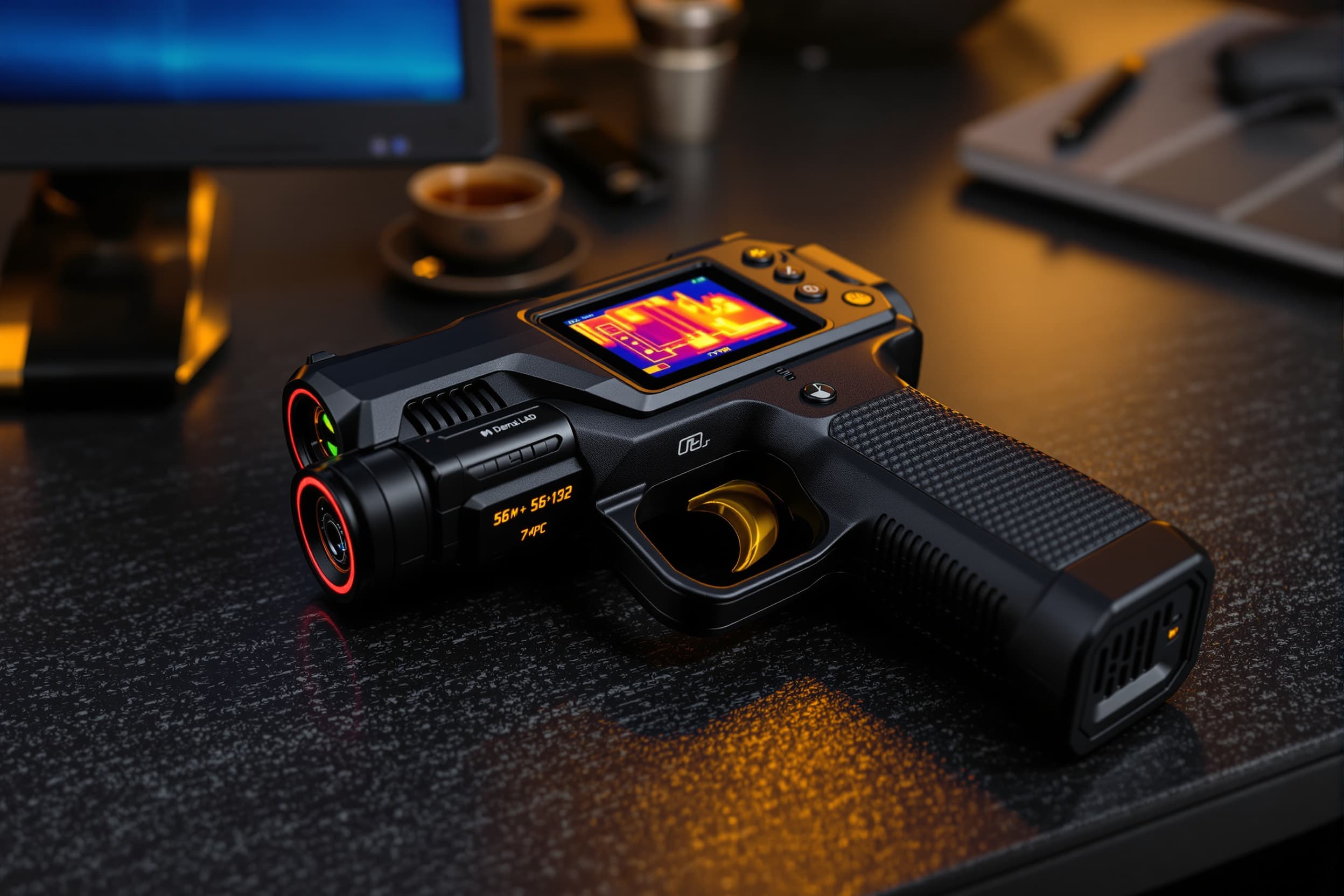
Professional-grade handheld thermal camera featuring a 256×192 microbolometer sensor that exports raw radiometric TIFF frames via USB-C and microSD, targeting energy auditors, electronics troubleshooters, and building inspectors. Blends thermal imagery with 5 MP visible-light overlay in a pistol-grip form factor with 3.5-inch 720p display and 4-hour runtime on replaceable 18650 battery.

Feasibility at a glance
PT localization
4/10
Partial
Only finishing and testing can be localised in Portugal.
Per unit
€800–1,400
at 150-unit volume
Starter batch
150units
minimum viable run
To first batch
28weeks
8 phases, design to ship
Budget
€65–95k
all-in estimate
Bottom line
The thermal imaging camera requires specialized components—particularly the microbolometer sensor module—that are not manufactured in Portugal and are subject to ITAR export controls. EU co-development partnerships allow access to European thermal sensor distributors (ULIS in France, InfraTec in Germany) while keeping final assembly and integration within reach. At 150-unit volumes, white-label options are limited and lack the customization needed for radiometric TIFF export and MSX overlay features. A co-development approach balances compliance, technical capability, and time-to-market.
4 capabilities
Captures thermal images showing temperature differences across a scene, helping spot heat leaks or hot components.
Exports raw temperature data files so users can analyze exact readings in spreadsheet or specialist software.
Overlays a regular photo onto the thermal view so you can tell which wall or circuit board you are inspecting.
Runs for four hours on a single battery that pops out and swaps in seconds when it runs low.
5 stations · build route
Injection-mold pistol-grip shell and overmold TPE grip
Two-shot molding or separate overmold pass creates the ergonomic, shock-resistant housing.
Fabricate and populate main processor PCB with SMT components
Reflow soldering places microcontroller, power regulators, and interface chips onto the board.
Integrate microbolometer module and visible camera
Mount sensor modules with precise alignment and attach heatsink for thermal stability.
Assemble display, battery compartment, and I/O connectors into housing
Snap or screw LCD, USB-C port, microSD slot, and battery door into the molded case halves.
Calibrate thermal sensor and run functional tests
Expose the camera to known-temperature targets and validate radiometric accuracy before packaging.
Injection-mold pistol-grip shell and overmold TPE grip
Two-shot molding or separate overmold pass creates the ergonomic, shock-resistant housing.
Fabricate and populate main processor PCB with SMT components
Reflow soldering places microcontroller, power regulators, and interface chips onto the board.
Integrate microbolometer module and visible camera
Mount sensor modules with precise alignment and attach heatsink for thermal stability.
Assemble display, battery compartment, and I/O connectors into housing
Snap or screw LCD, USB-C port, microSD slot, and battery door into the molded case halves.
6 identified · 4 blocking
Critical
Microbolometer sensor supply and export-control bottleneck
Microbolometer thermal sensors are dual-use items controlled under EU Regulation 428/2009 and U.S. ITAR. Only a handful of European suppliers (ULIS/Lynred in France, Xenics in Belgium, InfraTec in Germany) can legally export these modules, and lead times currently stretch 16–24 weeks due to semiconductor substrate shortages and clean-room capacity constraints. A single point of failure in sensor supply will halt all production. Chinese modules may not carry valid EU import documentation, exposing GETMILK to customs seizures and regulatory penalties.
Mitigation — Secure a multi-year supply agreement or framework contract with ULIS/Lynred before committing to production tooling. Request an export license pre-check from the supplier and maintain a safety stock of at least 50 sensor modules in an EU bonded warehouse. Build a secondary qualification path with InfraTec or Xenics to de-risk single-supplier dependence. Work with a customs broker experienced in dual-use items to ensure proper End-Use Certificates and Catch-All clause compliance.
High
Firmware and radiometric algorithm IP leakage
Radiometric TIFF export and MSX-style overlay algorithms represent core competitive differentiators. If these are co-developed with an EMS partner or shared with a Chinese ODM for customization, GETMILK risks losing control of the IP. The partner may reuse the algorithms in competing products or share them with other clients. Once leaked, thermal calibration profiles and image-processing pipelines are difficult to protect through patents alone, especially in jurisdictions with weak enforcement.
Mitigation — Structure the co-development contract with clear IP ownership clauses: GETMILK retains all rights to firmware, calibration data, and image-processing algorithms. Use a modular software architecture where the proprietary radiometric engine runs on a secured microcontroller with code-read protection enabled. Perform final firmware flashing and calibration in-house in Portugal rather than at the EMS partner's facility. Require NDAs with liquidated damages and conduct regular IP audits of partner facilities.
High
CE and Radio Equipment Directive (RED) compliance delays
The thermal camera includes USB-C data transfer and potentially Bluetooth/Wi-Fi modules for wireless image export, triggering both the Low Voltage Directive (LVD) and RED 2014/53/EU. Achieving CE marking requires electromagnetic compatibility (EMC) testing, electrical safety validation, and radio-frequency conformity if wireless is implemented. A failed EMC test due to poor PCB grounding or inadequate shielding can push market entry back by 8–12 weeks while re-spins are conducted. The lithium-ion 18650 cell also requires UN38.3 transport testing and Battery Directive compliance.
Mitigation — Engage a notified-body test lab (e.g., TÜV Rheinland, SGS, Intertek) early in the design phase for pre-compliance EMC scans and radio testing. Budget €12k–18k and 4–6 weeks for full CE certification. Design the main PCB with EMC best practices: continuous ground plane, ferrite beads on I/O lines, and shielded enclosure sections. Source 18650 cells from EU-certified suppliers (e.g., Samsung SDI, LG Chem with EU distribution) that provide UN38.3 and IEC 62133 certificates. Prepare a Technical Construction File (TCF) and Declaration of Conformity in parallel with prototype builds.
High
Thermal calibration drift and radiometric accuracy variation
Achieving ±2°C or ±2% temperature measurement accuracy across the operational range (-20°C to +400°C) demands rigorous factory calibration using blackbody reference sources and environmental chambers. Calibration coefficients are sensor-specific and can drift over time due to thermal cycling, mechanical stress, or component aging. Without a robust calibration process and traceability to NIST or PTB standards, field measurements may be unreliable, damaging GETMILK's reputation with professional users. A single bad calibration batch (e.g., 50 units) could trigger costly field recalls and re-calibration.
Mitigation — Partner with a calibration lab accredited to ISO/IEC 17025 for thermal imaging (e.g., InfraTec's in-house lab, or third-party labs like Fluke Calibration). Develop a calibration SOP that includes multi-point blackbody references at 0°C, 50°C, 100°C, and 200°C, with environmental chamber cycling to validate temperature coefficient compensation. Serialize each unit and store calibration data in non-volatile memory with tamper detection. Implement a post-assembly functional test that verifies radiometric accuracy on every unit before shipment. Offer customers a yearly re-calibration service to maintain accuracy and build recurring revenue.
Medium
Injection-molding tooling lead time for pistol-grip housing
The pistol-grip housing with TPE overmold requires a multi-cavity steel tool with slides for undercuts and a separate TPE overmold tool or two-shot capability. Portuguese and Spanish toolmakers quote 8–12 weeks for steel tooling and 2–3 weeks for first-article samples. Any design changes after tool cutting (e.g., snap-fit adjustments, button clearances) trigger expensive and time-consuming tool modifications, potentially adding 4–6 weeks to the schedule. Delayed housing availability will block final assembly even if all electronics are ready.
Mitigation — Freeze the mechanical CAD design and conduct DFM (design for manufacturability) reviews with the chosen molder before committing to steel tooling. Produce 3D-printed or CNC-machined housings for alpha/beta builds to validate ergonomics, thermal dissipation, and assembly fitment. Consider aluminum tooling for the first 150-unit batch if speed is critical; aluminum tools cost 40–50% less and are cut in 4–5 weeks, though they wear faster. Run mold-flow simulation to catch warping, sink marks, and gate-vestige issues before steel is cut. Negotiate a tool-modification contingency clause in the molder's contract.
Medium
Geopolitical and semiconductor supply-chain disruption
Thermal sensors, high-performance ARM processors, and power-management ICs are built on mature semiconductor nodes (90–180 nm) that compete for wafer capacity with automotive and industrial customers. Geopolitical tensions, export bans, or natural disasters (e.g., Taiwan earthquake, China lockdowns) can suddenly extend lead times from 12 weeks to 40+ weeks. The Russia-Ukraine conflict has also disrupted neon gas supplies critical for semiconductor lithography. A sudden shortage of any key IC on the main processor board will halt production mid-batch.
Mitigation — Design the main processor board with pin-compatible alternates for critical ICs (e.g., STM32 vs. NXP i.MX RT, TI vs. Analog Devices power regulators). Maintain a 3-month buffer stock of long-lead ICs (microcontrollers, power stages, USB-C controllers) in an EU warehouse. Use a component-shortage monitoring service (e.g., Sourcengine, Octopart) to track allocation and price trends. Negotiate consignment inventory agreements with distributors like Avnet or Würth Elektronik so parts are reserved without upfront payment. Build flexibility into the firmware to accommodate different sensor modules (e.g., ULIS vs. InfraTec) if primary supply is disrupted.
28 weeks to first batch
Industrial design freeze and CAD release
wk 1–3Injection-molding tooling fabrication and first-article samples
wk 4–12Main processor PCB design, fabrication, and SMT assembly
wk 13–20Microbolometer and visible-camera module procurement and integration
wk 21–38LCD display and battery subsystem integration
wk 39–42Firmware development and radiometric TIFF export implementation
wk 43–52Final assembly, thermal calibration, and functional test
wk 53–56CE certification testing and first production batch packaging
wk 57–62Industrial design freeze and CAD release
Injection-molding tooling fabrication and first-article samples
wk 21–38 is the longest stretch — Microbolometer and visible-camera module procurement and integration takes 18 weeks of the 62 weeks on this build.
5 materials · 5 processes
Materials
Processes
587 Portuguese manufacturers matched
None cover the whole build — it splits across steps.
13 tasks · 12 weeks to first batch
Week 1
2 tasks
Freeze pistol-grip housing CAD and heatsink mounting interface
Lock down the mechanical design for the injection-molded housing, TPE overmold geometry, battery compartment, and aluminum heatsink attachment points. Conduct internal DFM review for snap-fits, wall thickness, and optical alignment of thermal and visible cameras. Release STEP files for tooling quotes.
Issue RFQ to ULIS/Lynred and InfraTec for microbolometer modules
Request formal quotations for 256×192 microbolometer sensor modules with 50 mK NETD, ITAR export licenses, and EU dual-use compliance. Specify lead time, MOQ, calibration support, and technical documentation. Ask for sample availability and supply-agreement terms for 150+ units.
Weeks 2–3
3 tasks
Sign co-development NDA and framework agreement with EU integrator
waits on Issue RFQ to ULIS/Lynred and InfraTec for microbolometer modules
Negotiate IP ownership, NRE scope, and pricing with selected German or French partner (Jenoptik, Zollner, or ULIS-recommended integrator). Ensure contract includes sensor procurement support, calibration SOP development, and modular firmware architecture with GETMILK IP protection.
Place purchase order for microbolometer sensors and reserve buffer stock
waits on Issue RFQ to ULIS/Lynred and InfraTec for microbolometer modules, Sign co-development NDA and framework agreement with EU integrator
Commit to 200 microbolometer modules (150 production + 50 buffer) from ULIS/Lynred or InfraTec. Confirm export licenses and arrange EU bonded warehouse storage for buffer stock. Lock in 16–18 week delivery schedule and request expedited sample units for alpha builds.
Award injection-molding tooling contract for housing and overmold
waits on Freeze pistol-grip housing CAD and heatsink mounting interface
Select Portuguese or Spanish molder and commit to aluminum or steel tooling for pistol-grip housing, battery door, and TPE overmold. Run mold-flow simulation to validate gate placement and cooling channels. Agree on 8–10 week tool delivery and first-article inspection schedule.
Weeks 4–7
3 tasks
Design main processor PCB with EU integrator and order long-lead ICs
waits on Sign co-development NDA and framework agreement with EU integrator
Co-design the main processor board (ARM Cortex-M7, USB-C PD, MIPI CSI/DSI, power management) with the EU partner. Route high-speed differential pairs and EMC shielding. Procure long-lead components (MCU, power ICs, USB-C controller) from Avnet or Würth Elektronik with 12-week leadtimes.
Procure 5 MP visible-camera modules and LCD display assemblies
Order MIPI CSI camera modules and 3.5-inch 720p TFT LCD displays from Asian or European distributors. Verify interface compatibility with main processor board and request samples for alpha integration testing. Confirm lead times align with PCB assembly schedule.
Engage CE notified-body lab for pre-compliance EMC consultation
Contact TÜV Rheinland, SGS, or Intertek for pre-compliance EMC scans and schedule full CE testing (LVD, EMC, RED if wireless, RoHS). Review PCB layout and housing shielding strategy. Budget €12k–15k and reserve 4-week test slot for week 20–24.
Weeks 8–16
4 tasks
Develop firmware for radiometric TIFF export and MSX overlay
waits on Design main processor PCB with EU integrator and order long-lead ICs
Code embedded firmware for thermal image acquisition, real-time thermal/visible blending, radiometric TIFF generation with per-pixel temperature data, USB-C mass storage, and microSD file system. Integrate NUC algorithms and calibration LUTs. Conduct alpha testing on prototype hardware.
Receive first-article injection-molded housings and validate fitment
waits on Award injection-molding tooling contract for housing and overmold
Inspect first-article samples from molder using CMM or optical scanning. Check snap-fit clearances, battery door latch, TPE overmold adhesion, and Shore A hardness. Validate thermal sensor and heatsink mounting alignment. Approve tool or request minor adjustments before production run.
Assemble and calibrate 10 alpha units with EU partner
waits on Place purchase order for microbolometer sensors and reserve buffer stock, Develop firmware for radiometric TIFF export and MSX overlay, Receive first-article injection-molded housings and validate fitment
Ongoing
1 task
Monitor microbolometer supply and geopolitical export-control changes
Track lead times and allocation for microbolometer sensors via supplier portals and component-shortage monitoring services. Review EU Regulation 428/2009 and ITAR updates quarterly. Maintain contact with secondary suppliers (InfraTec, Xenics) to de-risk single-source dependence.
4 roles to fill before month one
Microbolometer procurement and export-license coordination
Thermal sensor supply manager at ULIS/Lynred (FR) or InfraTec (DE)
Critical gating item—only a handful of EU suppliers can legally export ITAR-compliant 256×192 microbolometer modules. This contact secures 16–18 week lead-time commitments, buffer stock arrangements, and ensures dual-use export documentation is valid for customs.
Co-development partner for sensor integration and calibration
Engineering program manager at Jenoptik, Zollner, or Kimball Electronics EU
Brings specialized expertise in thermal sensor mounting, heatsink design, blackbody calibration, and radiometric accuracy validation that Portuguese EMS providers lack. Manages NRE scope, IP clauses, and split manufacturing workflow (sensor integration in DE/FR, final assembly in PT).
Tooling fabrication and TPE overmold process owner
Injection-molding project engineer at Portuguese or Spanish molder
Responsible for 8–10 week steel tooling delivery, mold-flow simulation, and first-article validation of pistol-grip housing. Ensures snap-fit tolerances, battery door latch robustness, and TPE adhesion meet field-use requirements without costly tool revisions.
5 things to avoid in this plan
lead time
Lock in microbolometer sensor supply with ULIS/Lynred or InfraTec in week 1–2; 16–24 week lead times and ITAR/dual-use export controls make this the critical-path bottleneck that can halt all production.
documentation
Protect firmware IP with modular architecture and code-read protection; ensure co-development contract assigns GETMILK full ownership of radiometric algorithms and calibration profiles to prevent partner leakage or reuse.
certification
Reserve CE test-lab capacity by week 4 and conduct pre-compliance EMC scans on alpha PCBs; a single failed EMC test adds 8–12 weeks for re-spin, tooling, and re-testing.
lead time
Freeze housing CAD and run mold-flow simulation before cutting steel tooling; post-tool design changes (snap-fits, button clearances) trigger expensive 4–6 week modifications that delay final assembly.
2 tasks in week 1
Freeze pistol-grip housing CAD and heatsink mounting interface
Calibrate thermal sensor and run functional tests
Expose the camera to known-temperature targets and validate radiometric accuracy before packaging.
Main processor PCB design, fabrication, and SMT assembly
Microbolometer and visible-camera module procurement and integration
LCD display and battery subsystem integration
Firmware development and radiometric TIFF export implementation
Final assembly, thermal calibration, and functional test
CE certification testing and first production batch packaging
Integrate microbolometer modules, visible cameras, main PCBs, displays, and battery assemblies into alpha housings at EU partner facility. Perform multi-point blackbody calibration in environmental chamber. Record per-unit calibration coefficients and validate ±2°C accuracy. Flash firmware and run functional tests.
Submit golden samples for CE certification testing
waits on Assemble and calibrate 10 alpha units with EU partner, Engage CE notified-body lab for pre-compliance EMC consultation
Ship 3 calibrated alpha units to notified-body lab for EMC (EN 61326), electrical safety (EN 61010), and RoHS testing. Provide Technical Construction File and BOM with material declarations. Track test progress and prepare for any re-spins if EMC fails.
Notified-body testing and compliance documentation
CE certification project manager at TÜV Rheinland, SGS, or Intertek
Guides pre-compliance EMC strategy, schedules full LVD/EMC/RED testing, and issues CE certificates and Declaration of Conformity required for EU market entry. Prevents 8–12 week delays from failed EMC tests by advising on PCB layout and shielding early in design.
quality
Validate ±2°C radiometric accuracy with ISO/IEC 17025 accredited blackbody calibration on every unit; a bad calibration batch risks field recalls and professional-user trust damage.
587 matched · 8 shown, ranked by coverage
Covers, left to right: Injection Molding · PCB Fabrication · SMT Assembly · Final Assembly · Testing & Inspection
Manufacturer
Location
Covers
Certifications
People
Portuguese producers per required step
Final Assembly
369
Testing & Inspection
178
Injection Molding
174
SMT Assembly
36
PCB Fabrication
6
How many cover more than one step
The gap
The thermal imaging camera requires specialized components—particularly the microbolometer sensor module—that are not manufactured in Portugal and are subject to ITAR export controls. EU co-development partnerships allow access to European thermal sensor distributors (ULIS in France, InfraTec in Germany) while keeping final assembly and integration within reach. At 150-unit volumes, white-label options are limited and lack the customization needed for radiometric TIFF export and MSX overlay features. A co-development approach balances compliance, technical capability, and time-to-market.
Send one RFQ to the top 4
Keenfinity EMS, Uartrónica, Exatronic, Codica Cables — same package, one click.