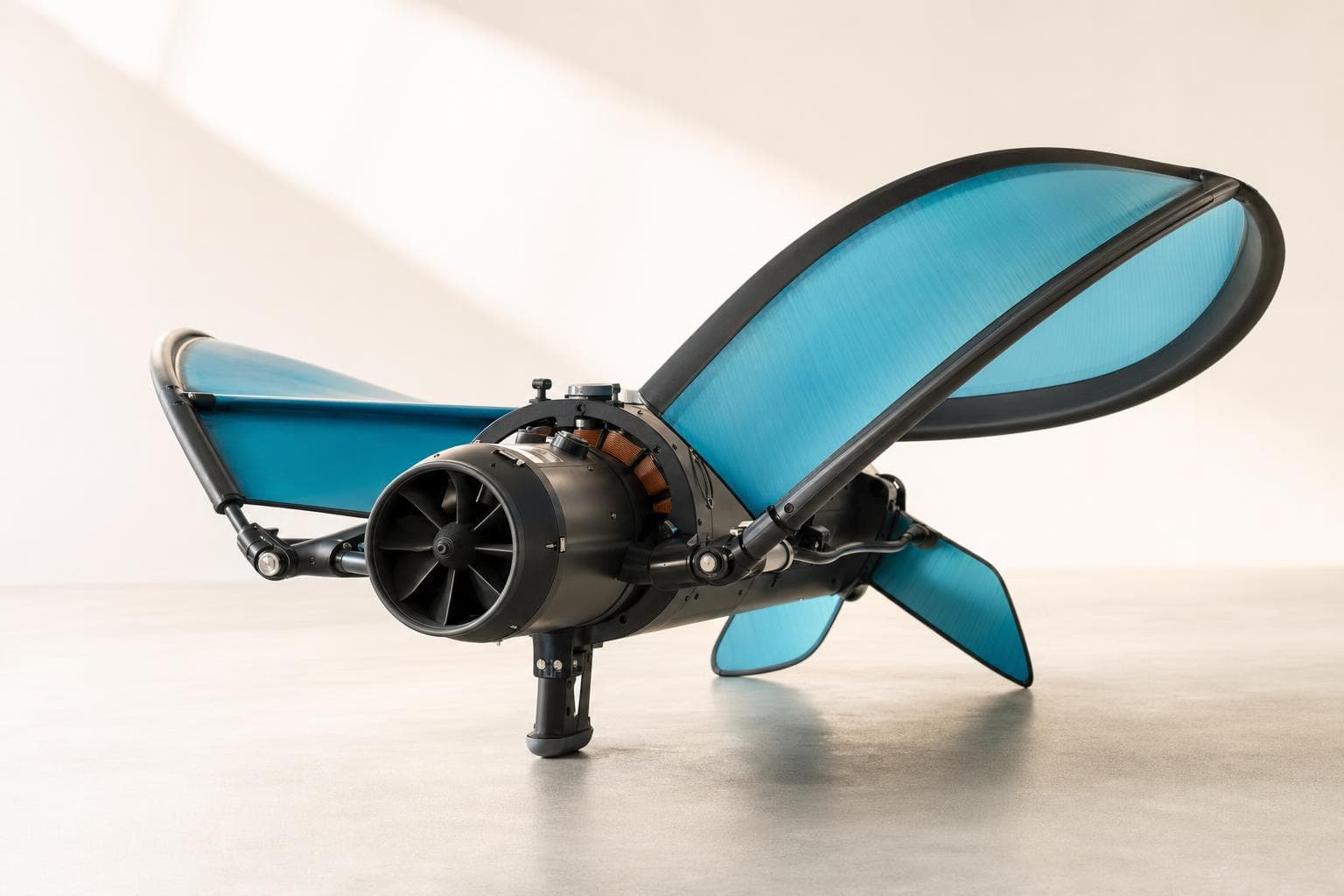
An underwater kite system that flies in figure-of-eight trajectories through tidal streams to generate renewable electricity from ocean currents. Designed by Minesto with SKF-engineered components, the system operates tethered to the seabed and converts kinetic energy from water—830 times denser than air—into 9,500 kWh average daily output, sufficient to power 200 Faroese homes annually. Critical components include the rudder, turbine, and generator optimized for minimal friction and maximum energy conversion in deep-ocean conditions.

Feasibility at a glance
PT localization
4/10
Partial
Only finishing and testing can be localised in Portugal.
Per unit
€500,000–€2,000,000
at 1-unit volume
Starter batch
1units
minimum viable run
To first batch
78weeks
8 phases, design to ship
Budget
€85,000–€140,000 for 90-day foundation phase
all-in estimate
Bottom line
A tidal kite turbine system requires deep marine engineering expertise, precision composite fabrication, and subsea-rated electrical systems that no Portuguese manufacturer currently possesses. Co-development with established EU marine energy partners—such as composite specialists, bearing suppliers like SKF, and offshore system integrators—provides access to proven subsea technology, certification pathways (including marine classification societies), and field deployment experience in North Atlantic conditions. While white-label options do not exist for such specialized equipment, and local production lacks the necessary domain knowledge and supply chains for marine-grade magnets, seals, and pressure-rated housings, an EU partnership leverages existing tidal energy programs (Scotland, France, Netherlands) and shared R&D funding. China offers cost savings but introduces critical IP risks for proprietary hydrodynamic designs and exposes the project to complex dual-use export controls on subsea technology.
4 capabilities
Converts tidal stream energy into renewable electricity by flying underwater like a kite
Generates an average of 9,500 kilowatt-hours per day to power approximately 200 homes year-round
Operates predictably by following the moon's gravitational cycle that drives ocean tides
Maximizes energy capture by flying at speeds several times faster than the actual water current
5 stations · build route
Composite kite wing fabrication
Carbon fiber and epoxy are laid up in molds to create the hydrodynamic wing structure that withstands deep-sea forces.
Precision bearing and shaft machining
SKF engineers marine-grade bearings and CNC-machines shafts for the rudder, turbine, and generator with minimal friction tolerances.
Generator winding and magnet assembly
Copper coils are wound around stators and neodymium magnets installed to convert mechanical rotation into electrical power.
Subsea integration and sealing
All mechanical and electrical components are assembled into sealed housings rated for deep-ocean pressure and saltwater corrosion.
Tidal stream testing and commissioning
The complete system is deployed offshore, tethered to the seabed, and tested through full tidal cycles to validate power output.
Composite kite wing fabrication
Carbon fiber and epoxy are laid up in molds to create the hydrodynamic wing structure that withstands deep-sea forces.
Precision bearing and shaft machining
SKF engineers marine-grade bearings and CNC-machines shafts for the rudder, turbine, and generator with minimal friction tolerances.
Generator winding and magnet assembly
Copper coils are wound around stators and neodymium magnets installed to convert mechanical rotation into electrical power.
Subsea integration and sealing
All mechanical and electrical components are assembled into sealed housings rated for deep-ocean pressure and saltwater corrosion.
5 identified · 3 blocking
Critical
Intellectual Property Exposure in Hydrodynamic Design
The kite's figure-of-eight flight control algorithms, wing hydrodynamics, and turbine blade profiles represent core competitive IP. Sharing CAD models and control system specifications with offshore manufacturers—especially in jurisdictions with weak IP enforcement—risks reverse engineering and direct competition in the emerging tidal energy market. Chinese manufacturers have documented history of copying marine technology (e.g., offshore wind turbine designs), and legal recourse is limited and expensive. Loss of IP advantage would undermine the business model and investor confidence, particularly if competitors enter the same tidal sites with cloned technology.
Mitigation — Structure co-development agreements with strict EU-jurisdiction governing law and binding arbitration clauses. Partition IP by subsystem: release only interface specifications (mounting points, power output curves, pressure ratings) to sub-suppliers, retaining flight control software, blade geometry, and hydrodynamic modeling in-house or with trusted Tier-1 partners under NDA and escrow arrangements. Use watermarking and geometric fingerprinting in CAD files to trace leaks. Physically separate final integration, control system programming, and sea trials to EU facilities where proprietary tuning and calibration occur. File defensive patents in key markets (EU, US, China, Japan) before engaging manufacturers.
High
Neodymium Magnet Supply Chain Concentration
Neodymium magnets for the generator assembly depend on rare-earth elements where China controls >80% of global refining capacity. Supply disruptions, export quotas, or geopolitical tensions could halt production or spike costs unpredictably. EU sources exist (e.g., Vacuumschmelze in Germany, Less Common Metals in UK) but at 40–60% cost premiums and longer lead times. Without secured magnet supply agreements, the entire generator assembly timeline is at risk, and performance de-rating (switching to ferrite magnets) would significantly reduce power output and economic viability.
Mitigation — Establish dual-source agreements: primary supply from EU-based rare-earth processors (Vacuumschmelze, Solvay rare-earth division) with contractual volume commitments, and secondary contingency through North American suppliers (USA Rare Earth, MP Materials). Negotiate 12-month forward pricing contracts to hedge against volatility. Design the generator with modular magnet cassettes to allow rapid supplier switching without redesigning the entire rotor assembly. Allocate 15% cost contingency for magnet procurement and maintain 6-month strategic inventory once production starts.
High
Marine Classification and Grid Connection Delays
Tidal energy systems require certification from marine classification societies (DNV, Lloyd's Register, Bureau Veritas) for seaworthiness, plus grid connection approvals from transmission system operators (TSOs). The process involves design reviews, witness testing of pressure housings and seals, fatigue analysis of composite structures, and offshore commissioning inspections—all of which can extend 12–18 months. Any design changes during testing restart portions of the certification cycle. Without certification, the system cannot be insured, financed, or connected to national grids, rendering it commercially useless despite technical functionality.
Mitigation — Engage a marine classification society (DNV-GL recommended for tidal energy experience) at the preliminary design phase to align specifications with certification standards before fabrication begins. Use pre-certified components where possible (SKF bearings with subsea service history, pressure housings with existing approvals for similar depth ratings). Build certification milestones into the project timeline with 20% schedule buffer. Conduct pre-certification testing (pressure cycling, salt spray, vibration) in accredited EU labs to identify issues early. Assign a dedicated certification manager to liaise with the society and TSO, ensuring documentation and witness test scheduling proceed in parallel with manufacturing rather than sequentially.
Medium
Composite Tooling and Cure Cycle Bottlenecks
The carbon fiber wing structure requires custom molds (tooling) that take 12–16 weeks to machine and validate, followed by layup and autoclave cure cycles that can only process one or two units per week depending on part size. Composite suppliers (Gurit, Sicomin, Hexcel) often have 8–12 week lead times for prepreg materials in specialized marine-grade resins. Any design iteration that changes wing geometry forces tooling rework, adding 10–14 weeks. Bottlenecks in autoclave capacity (shared with aerospace and defense customers) can further delay delivery, especially in Q4 when aerospace demand peaks.
Mitigation — Freeze the wing geometry CAD as early as possible and validate hydrodynamics via CFD and scale-model testing before committing to full-size tooling. Order prepreg materials and schedule autoclave slots immediately upon design sign-off, even before tooling completion. Negotiate priority access agreements with composite fabricators by offering volume commitments or co-investment in dedicated tooling. Design the wing with modular sections (if feasible) to parallelize production across multiple molds and reduce single-part cure time. Maintain close communication with the fabricator's production scheduler to anticipate capacity constraints and adjust timelines proactively.
Medium
Offshore Testing Weather Windows and Logistics
Final commissioning requires deploying the tidal kite in open water during suitable weather and tidal conditions. North Atlantic sea states limit safe deployment windows to ~150 days per year, typically spring and summer. Mobilizing support vessels, divers, ROVs, and installation crews costs €15,000–€30,000 per day; delays due to weather can consume contingency budgets rapidly. If initial deployment reveals performance issues (e.g., turbine cavitation, control instability, cable chafing), retrieval, modification, and redeployment add 6–12 weeks. Grid connection and power quality testing add further sea-time requirements.
Mitigation — Conduct extensive onshore and tank testing (tow-tank facilities, pressure chambers, benchtop turbine dynamometers) to validate subsystems before offshore deployment. Schedule first deployment early in the spring weather window with 4-week buffer before summer storm season. Pre-position support vessels and equipment through framework contracts with offshore wind service providers who already operate in target tidal zones. Use ROVs with real-time telemetry to monitor performance during initial runs, allowing rapid diagnosis without full retrieval. Design the system with quick-release tether mechanisms and modular subsea connectors to minimize vessel time per deployment cycle. Build a second prototype in parallel so engineering changes don't stall the entire program.
78 weeks to first batch
Hydrodynamic Design Finalization and CAD Freeze
wk 1–14Composite Tooling Fabrication and Material Procurement
wk 15–30Wing and Rudder Composite Layup and Curing
wk 31–40Turbine and Generator Assembly
wk 41–52Control System Integration and Pressure Testing
wk 53–60System Integration and Onshore Testing
wk 61–66Marine Classification Witness Testing and Certification
wk 67–72Offshore Deployment and Commissioning
wk 73–78Hydrodynamic Design Finalization and CAD Freeze
Composite Tooling Fabrication and Material Procurement
wk 15–30 is the longest stretch — Composite Tooling Fabrication and Material Procurement takes 16 weeks of the 78 weeks on this build.
6 materials · 8 processes
Materials
Processes
591 Portuguese manufacturers matched
None cover the whole build — it splits across steps.
12 tasks · 12 weeks to first batch
Week 1
2 tasks
Freeze wing and rudder CAD geometry for tooling release
Complete final CFD validation runs on kite wing profile, rudder assembly, and turbine blade geometry. Lock down CAD models with interface specifications for SKF bearings, cable glands, and mounting points. Generate manufacturing drawings and initiate internal design review.
Identify and contact three EU composite fabricators
Research and reach out to marine-grade composite specialists in France, Germany, or UK with subsea experience (offshore wind, naval). Request capability statements, lead times for custom tooling, and NDA execution for preliminary geometry sharing.
Weeks 2–3
3 tasks
Engage DNV-GL for preliminary certification roadmap
Schedule kickoff meeting with DNV-GL marine energy division to present Luna 12 design concept, operational parameters, and deployment depth. Obtain preliminary gap analysis against IEC 62600 standards and marine classification requirements. Clarify witness testing expectations and timeline.
Secure SKF Sweden bearing specification and lead-time commitment
waits on Freeze wing and rudder CAD geometry for tooling release
Formalize technical discussions with SKF marine division for 12× subsea-rated precision bearings (rudder pivot, turbine shaft, generator rotor). Lock in specifications for pressure rating, corrosion resistance, and expected service life. Obtain binding lead-time quote and negotiate priority production slot.
Draft IP protection framework for partner agreements
Work with legal counsel to create master co-development agreement template with EU jurisdiction, arbitration clauses, and IP partitioning (interface specs shared, flight control algorithms retained). Include geometric watermarking provisions for CAD file tracking.
Weeks 4–7
2 tasks
Issue RFQ for composite wing tooling and fabrication
waits on Freeze wing and rudder CAD geometry for tooling release, Identify and contact three EU composite fabricators
Send frozen wing CAD geometry to three shortlisted EU composite suppliers. Request quotes for aluminum mold fabrication (12–16 weeks), carbon fiber prepreg layup, autoclave curing, and NDT inspection. Specify marine-grade resin systems and anti-fouling coating requirements. Set target delivery week 28.
Initiate EU rare-earth magnet supplier qualification
Contact Vacuumschmelze (DE) and Less Common Metals (UK) for neodymium magnet supply quotations. Request material certifications, Curie temperature specs, and corrosion coating options for marine environment. Negotiate 6-month forward pricing to hedge volatility. Establish backup source in North America (MP Materials).
Weeks 8–16
3 tasks
Award composite fabrication contract and order prepreg materials
waits on Issue RFQ for composite wing tooling and fabrication, Draft IP protection framework for partner agreements
Select EU composite partner based on certification experience, tooling lead time, and cost. Execute co-development agreement with IP protections. Authorize tooling fabrication start and place purchase orders for Gurit or Hexcel marine-grade carbon fiber prepreg (16-week lead time).
Secure initial EU Horizon or regional ocean energy grant application
Prepare and submit grant application to EU Horizon Europe Clean Energy or national ocean energy programs (Scottish Wave Energy, French Ocean Energy, Dutch Topsector Energy). Emphasize co-development with established EU marine suppliers and tidal site access in Portugal or Faroe Islands.
Begin scale-model tow-tank testing for control algorithm validation
waits on Freeze wing and rudder CAD geometry for tooling release
Contract with marine engineering university or research institute (e.g., MARIN in Netherlands, IFREMER in France) for 1:10 or 1:5 scale-model tow-tank testing. Validate figure-of-eight flight dynamics, control response, and hydrodynamic loads before committing to full-scale fabrication.
Ongoing
2 tasks
Monitor composite tooling progress and autoclave capacity
waits on Award composite fabrication contract and order prepreg materials
Establish weekly check-ins with composite fabricator to track mold machining, prepreg delivery, and autoclave scheduling. Proactively flag any capacity conflicts with aerospace customers in Q4. Maintain 2-week buffer on critical path.
Track marine classification documentation requirements
waits on Engage DNV-GL for preliminary certification roadmap
Maintain certification task list aligned with DNV-GL preliminary roadmap. Ensure all material certifications, test reports, and design change logs are documented in format acceptable to classification society. Schedule quarterly witness test planning sessions.
4 roles to fill before month one
Marine energy advisor / former Siemens Wind CTO
Dr. Henrik Stiesdal
Brings decades of offshore renewable energy commercialization experience and critical networks within EU marine classification societies, transmission system operators, and offshore wind supply chains. Can open doors to co-development partners (SKF, Gurit, Navantia) and provide strategic guidance on certification pathways that have derailed prior tidal projects.
Classification society technical lead
Marine Certification Engineer at DNV-GL
Essential gatekeeper for prototype deployment—every design decision from seal selection to control fail-safes must align with IEC 62600 and DNV marine energy standards. Early and continuous engagement prevents costly redesigns during witness testing and ensures the 78-week timeline remains achievable.
Wing structure fabrication partner
Composite Production Manager at Gurit or Hexcel
Controls the critical path for tooling and layup—composite lead times (16+ weeks) dominate the prototype schedule. Direct relationship ensures priority autoclave access, proactive capacity planning, and rapid iteration if tow-tank testing reveals geometry changes. Their marine certification history (offshore wind blades, naval structures) de-risks first-article approval.
Grant funding and consortium coordinator
5 things to avoid in this plan
lead time
Lock in SKF bearing and rare-earth magnet supply within 30 days—long lead times (12–16 weeks) and capacity constraints at specialized marine suppliers will dictate composite assembly schedule. Dual-source magnets (Vacuumschmelze + MP Materials) to hedge geopolitical and pricing risk.
quality
Freeze wing geometry by day 7 and resist design changes—every iteration restarts 12-week tooling cycle and jeopardizes 78-week prototype timeline. Validate via CFD and scale-model tow-tank testing before releasing manufacturing drawings.
certification
Engage DNV-GL certification by week 3—marine classification witness testing and documentation requirements (pressure cycling, fatigue analysis, control fail-safes) have sunk prior tidal projects. Build certification milestones into timeline with 20% buffer; do not treat as back-end activity.
documentation
2 tasks in week 1
Freeze wing and rudder CAD geometry for tooling release
Tidal stream testing and commissioning
The complete system is deployed offshore, tethered to the seabed, and tested through full tidal cycles to validate power output.
Wing and Rudder Composite Layup and Curing
Turbine and Generator Assembly
Control System Integration and Pressure Testing
System Integration and Onshore Testing
Marine Classification Witness Testing and Certification
Offshore Deployment and Commissioning
EU Horizon Clean Energy Program Officer
EU co-development funding (€500k–€2M available under ocean energy calls) is essential to bridge the prototype budget gap and validate the business model. Program officer guidance on consortium structuring, milestone definitions, and reporting requirements maximizes award probability and ensures compliance with state aid rules.
Protect flight control IP ruthlessly—partition CAD files so composite and generator partners receive only interface specs (bolt patterns, cable pass-throughs), never blade profiles or control algorithms. Execute binding EU-jurisdiction NDAs with escrow and geometric watermarking before any file transfer.
lead time
Secure weather window for offshore deployment—North Atlantic limits safe testing to ~150 days/year. Schedule first deployment early in spring weather window (April–May) with pre-positioned ROV support and contingency budget (€30k/day vessel costs) for retrieval and tuning cycles.
591 matched · 8 shown, ranked by coverage
Covers, left to right: Composite Layup · CNC Machining · Motor Winding · Sheet Metal · Welding · Final Assembly · Testing & Inspection · Cable Assembly
Manufacturer
Location
Covers
Certifications
People
Portuguese producers per required step
Final Assembly
369
CNC Machining
212
Testing & Inspection
178
Welding
92
Sheet Metal
21
Composite Layup
15
Cable Assembly
12
How many cover more than one step
The gap
A tidal kite turbine system requires deep marine engineering expertise, precision composite fabrication, and subsea-rated electrical systems that no Portuguese manufacturer currently possesses. Co-development with established EU marine energy partners—such as composite specialists, bearing suppliers like SKF, and offshore system integrators—provides access to proven subsea technology, certification pathways (including marine classification societies), and field deployment experience in North Atlantic conditions. While white-label options do not exist for such specialized equipment, and local production lacks the necessary domain knowledge and supply chains for marine-grade magnets, seals, and pressure-rated housings, an EU partnership leverages existing tidal energy programs (Scotland, France, Netherlands) and shared R&D funding. China offers cost savings but introduces critical IP risks for proprietary hydrodynamic designs and exposes the project to complex dual-use export controls on subsea technology.
Send one RFQ to the top 4
SMF, CEFAMOL, Aernnova Aerospace, Lacovale — same package, one click.
Motor Winding
0