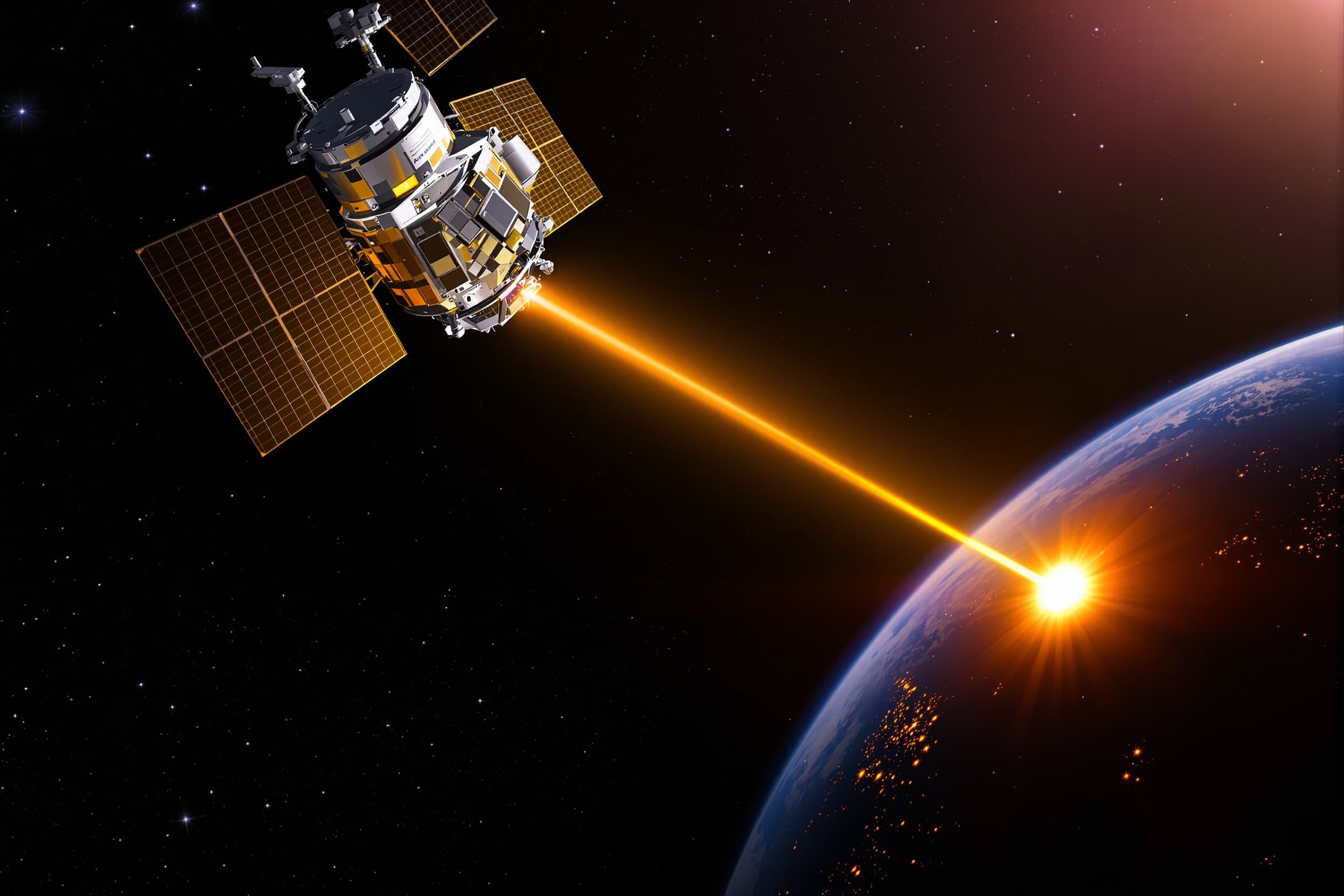
A geosynchronous orbit satellite that captures sunlight continuously using terrestrial photovoltaic cells with concentrators, converts electricity into near-infrared laser light via hundreds of laser diode modules, and beams energy to ground-based solar receivers on Earth. The system uses an optical array to direct output from multiple laser diodes to receivers across continents, enabling 24/7 renewable energy delivery to the grid.

Feasibility at a glance
PT localization
2/10
Low
Only finishing and testing can be localised in Portugal.
Per unit
$500M–$2B per satellite
at 1-unit volume
Starter batch
1units
minimum viable run
To first batch
156weeks
6 phases, design to ship
Budget
€180,000–€320,000 for Phase 0 feasibility
all-in estimate
Bottom line
Space-based solar power satellites require deep aerospace prime-contractor expertise, export-controlled propulsion and attitude control systems, and precision optical/laser integration that no Portuguese facility can deliver independently. A co-development partnership with an established European space-systems integrator (Airbus Defence and Space, Thales Alenia Space, or OHB) leverages their heritage satellite bus platforms, thermal-vacuum test infrastructure, launch-vehicle interfaces, and regulatory compliance while enabling Portugal to participate in subsystem supply (optics via Zeiss PT, power electronics, testing). The EU option balances ITAR-free access to GEO propulsion and laser-steering IP with reasonable lead times and leverages ESA New Space funding streams. Local or white-label options are infeasible; China offers lower cost but introduces unacceptable export-control, IP theft, and dual-use scrutiny risks for a gigawatt-scale energy infrastructure satellite.
6 capabilities
Captures sunlight continuously in geosynchronous orbit where the sun is visible over 99 percent of the time
Converts solar energy into electricity using standard photovoltaic cells enhanced with concentrators
Transforms electricity into safe near-infrared laser light that is invisible and harmless to humans and animals
Beams energy precisely to large ground-based solar receivers that convert light back into grid electricity
Rapidly redirects energy between multiple receivers across continents based on real-time demand
Delivers gigawatt-scale power to the grid without requiring new transmission lines or additional land
5 stations · build route
Fabricate satellite bus and structural frame
Machine aluminum and composite structures, integrate propulsion and avionics into the bus platform.
Assemble solar panel arrays with concentrators
Mount terrestrial PV cells onto deployable structures with optical concentrators to boost light capture.
Integrate laser diode modules and radiators
Install hundreds of laser diode modules with advanced thermal radiators to manage heat dissipation in space.
Install optical beam steering array
Assemble precision optics and steering mechanisms that combine and direct laser output to ground receivers.
Final integration, testing, and launch preparation
Conduct thermal-vacuum, vibration, and beam targeting tests; package satellite for launch to geosynchronous orbit.
Fabricate satellite bus and structural frame
Machine aluminum and composite structures, integrate propulsion and avionics into the bus platform.
Assemble solar panel arrays with concentrators
Mount terrestrial PV cells onto deployable structures with optical concentrators to boost light capture.
Integrate laser diode modules and radiators
Install hundreds of laser diode modules with advanced thermal radiators to manage heat dissipation in space.
Install optical beam steering array
Assemble precision optics and steering mechanisms that combine and direct laser output to ground receivers.
6 identified · 5 blocking
Critical
Export control and dual-use technology restrictions
Space-based power satellites integrate laser diode arrays capable of multi-kilowatt to megawatt-class power transmission, precision beam-steering optics, and orbital propulsion—all controlled under EU Regulation 428/2009 (dual-use items), ITAR (if any US components are used), and national export-licensing regimes. Laser power beaming to Earth is scrutinized as potential dual-use directed-energy technology. Any collaboration with non-EU or non-allied partners (especially China or Russia) triggers automatic export-license denial. Even intra-EU transfers of certain optical components and attitude-control systems require notification. Failure to secure proper licenses halts the project, exposes the company to criminal penalties, and can trigger EIB/ESA funding clawback.
Mitigation — Engage specialist export-control legal counsel (e.g., Baker McKenzie Brussels, Hogan Lovells) at project kickoff. Submit Technical Assistance Agreements (TAA) and dual-use export notifications to Portuguese and EU authorities before any technical-data exchange. Maintain 100% EU+allied supply chain for all controlled subsystems (propulsion, laser diodes, beam-steering software). Obtain ESA and national space-agency endorsement letters affirming civilian energy-infrastructure purpose. Establish a dedicated compliance officer and implement ITAR-like access controls for controlled technical data within the consortium.
Critical
Capital availability and financing risk
A single satellite costs $500M–$2B, with development phase requiring $100M–$300M before first hardware delivery. Traditional venture capital and private equity cannot underwrite this scale; the project requires sovereign or multilateral guarantees. ESA ARTES, EIB infrastructure loans, Horizon Europe grants, and national space-agency co-investment are all conditional on technical feasibility review, ESA Member State consensus, and multi-year budget commitments. Delays in government appropriations, shifts in ESA priorities, or political opposition to large-scale space infrastructure can freeze funding mid-program. Cost overruns (common in first-of-kind GEO missions) trigger renegotiation or program cancellation.
Mitigation — Structure the program as a public-private partnership with anchor off-take agreements from major European utilities (EDF, Iberdrola, Enel) guaranteeing power purchase at fixed rates for 15+ years. Secure ESA ARTES Advanced Research in Telecommunications Systems co-funding and EIB Innovation Finance Advisory support before committing to prime-contractor contracts. Negotiate milestone-based payments and risk-sharing clauses with the prime (Airbus DS, Thales Alenia Space) so that cost overruns are capped. Establish a Special Purpose Vehicle (SPV) under Luxembourg or Dutch law to ring-fence project debt and attract institutional investors (pension funds, sovereign wealth funds) via green bonds.
High
Launch availability and orbital-slot allocation
Geostationary orbit slots are allocated by the International Telecommunication Union (ITU) and are heavily subscribed; securing a GEO slot with favorable visibility over Europe requires filing 3–5 years in advance and coordinating with neighboring satellite operators to avoid frequency interference. Launch-vehicle availability is constrained: Ariane 6 is ramping production, and alternative providers (SpaceX Falcon Heavy, ULA, Rocket Lab Neutron) may impose ITAR restrictions or long queues. A missed launch window delays revenue generation by 6–18 months and incurs storage, re-testing, and insurance costs. Launch failures (1–2% risk) destroy the satellite and require complete rebuild.
Mitigation — File ITU GEO slot application through Portuguese national telecom authority (ANACOM) as soon as mission concept is frozen; pay ITU coordination fees and engage frequency-coordination consultancy (e.g., ITU Space Services Department advisors). Contract launch services early with dual-provider backup: book Ariane 6 as primary via Arianespace and secure secondary option on Falcon Heavy or future European launchers. Purchase launch and in-orbit insurance (typically 10–15% of satellite value) from syndicates like AXA XL Space or Allianz Global Corporate & Specialty. Conduct full satellite environmental qualification (thermal-vacuum, vibration, acoustic, EMC) at prime contractor's facility (Airbus Toulouse, Thales Cannes) to derisk launch campaign.
High
Laser safety and ground-receiver regulatory approval
Transmitting gigawatt-scale near-infrared laser power from GEO to ground receivers crosses multiple regulatory domains: IEC 60825 / EN 60825 (laser safety), aviation safety (EASA, ICAO no-fly zones during beam operation), environmental impact (EIA directives for large ground installations), and grid interconnection (EU Network Codes). Even though the design claims 'eye-safe' energy densities, any beam misalignment or tracking failure could expose aircraft, wildlife, or populated areas to harmful power densities. National aviation authorities may restrict beam transmission corridors. Ground receivers (multi-square-kilometer solar farms) require land-use permits, grid-connection studies, and public consultation, each taking 12–36 months.
Mitigation — Commission independent laser-safety analysis per IEC 60825-1:2014 and submit to TÜV Rheinland or BSI for third-party certification before flight. Design triple-redundant beam-tracking with automatic safe-mode shutdown if attitude sensors detect off-nominal pointing (>0.01° tolerance). Coordinate with EASA and EUROCONTROL to establish temporary segregated airspace (TSA) or NOTAMs (Notice to Airmen) during beam operations. Pre-identify 3–5 candidate ground-receiver sites in Portugal, Spain, or Southern France with existing grid interconnections (substations >500 kV) and initiate environmental impact assessments and local stakeholder engagement in parallel with satellite development. Establish a Laser Safety Officer role within the consortium and conduct annual safety audits.
High
Thermal management and laser diode reliability in space
Operating 300 high-power laser diode modules continuously in GEO orbit generates tens to hundreds of kilowatts of waste heat. Radiative cooling is the only option (no convection in vacuum); radiator panels must reject heat at 200–400 K to maintain diode junction temperatures below 60–80°C for rated 10–15 year lifespan. Any thermal-design error, radiator deployment failure, or micrometeorite damage to radiator surfaces reduces cooling capacity, causing diode efficiency drop, wavelength drift, and premature failure. Laser diodes are also sensitive to radiation-induced degradation (total ionizing dose, displacement damage) in the GEO radiation environment. Loss of >10% of diode modules reduces transmitted power below contracted levels and can trigger off-take agreement penalties.
Mitigation — Partner with proven space-qualified laser-diode suppliers (e.g., OSRAM Opto Semiconductors space-grade product line, or Trumpf high-power diode arrays) that provide radiation-hardness test data and extended-temperature qualification. Over-design radiator area by 30–40% margin and use deployable panels with redundant actuators. Conduct full thermal-vacuum testing at prime contractor's facilities simulating worst-case GEO thermal environment (+120°C sunlit, –180°C eclipse). Implement on-orbit thermal telemetry with closed-loop power throttling: if any diode module exceeds thermal limits, the power-distribution unit reduces drive current. Design modular diode architecture so that <15% module loss still meets minimum contracted power delivery. Include in-orbit spares (10–15% extra diode modules) and software-reconfigurable beam-combining optics to route around failed units.
Medium
Prime contractor dependency and IP lock-in
Co-development with a Tier-1 prime (Airbus DS, Thales Alenia Space, OHB) concentrates technical authority, mission-critical IP, and operational control in the prime's hands. The satellite bus, propulsion, flight software, and mission-operations ground segment remain proprietary; Portugal's role is limited to Tier-2 supplier of optics, power electronics, and ground receivers. If the prime exits the program, raises prices, or prioritizes other customers (government/military missions), Portugal has no fallback and cannot independently operate or refurbish the satellite. Future constellation scale-up (10–100 satellites) remains dependent on the prime's capacity and pricing. IP developed under ESA co-funding may be subject to ESA IP policies that grant access rights to other Member States, limiting commercialization freedom.
Mitigation — Negotiate a teaming agreement with explicit IP ownership clauses: Portugal retains full rights to ground-receiver technology, power-conditioning units, and optical component designs developed by Portuguese entities (Zeiss PT, local EMS). Require prime to escrow critical flight software (attitude control, beam-steering algorithms) and provide source-code access under conditions of prime insolvency or program cancellation. Structure the ESA contract as a Public-Private Partnership with Portugal holding majority governance rights in a joint SPV. Plan a second-source strategy: after first satellite success, negotiate license to integrate subsequent units with alternate prime (e.g., switch from Airbus to OHB) to introduce competition and cost reduction. Invest in building Portuguese satellite-integration competence by co-locating Portuguese engineers at prime's facility during development and requiring knowledge transfer and training as contract deliverables.
156 weeks to first batch
Mission architecture design and ITU/regulatory filing
wk 1–26Critical Design Review and long-lead procurement
wk 27–46Satellite bus and structural subsystem fabrication
wk 47–78Laser diode module and optical array integration
wk 79–102Full satellite integration and system-level testing
wk 103–130Flight acceptance, launch campaign, and orbital commissioning
wk 131–156Mission architecture design and ITU/regulatory filing
Critical Design Review and long-lead procurement
wk 47–78 is the longest stretch — Satellite bus and structural subsystem fabrication takes 32 weeks of the 156 weeks on this build.
7 materials · 11 processes
Materials
Processes
608 Portuguese manufacturers matched
None cover the whole build — it splits across steps.
13 tasks · 12 weeks to first batch
Week 1
2 tasks
Engage export-control and space-law counsel
Retain specialist law firm (Baker McKenzie Brussels or Hogan Lovells) to advise on EU Dual-Use Regulation 428/2009, ITAR exposure, laser power-beaming classification, and teaming-agreement structure. Obtain preliminary export-control opinion on feasibility of EU-only supply chain for propulsion, laser diodes, and beam-steering optics.
Draft mission-requirements brief and RFI package
Founder and engineering prepare a 15-page mission-requirements document (power output target, GEO slot preferences, laser-safety constraints, preliminary cost/schedule targets) and Request for Information (RFI) to send to Airbus Defence and Space, Thales Alenia Space, and OHB. Include Portuguese industrial participation targets (optics, power electronics, ground receivers) and ask for preliminary teaming interest and cost ROM.
Weeks 2–3
3 tasks
Initiate contact with Airbus DS, Thales Alenia Space, and OHB
waits on Draft mission-requirements brief and RFI package
Founder schedules introductory calls/meetings with business-development leads at each prime contractor. Present mission concept, discuss heritage satellite-bus options (Eurostar, Spacebus), identify technical feasibility concerns, and gauge willingness to co-develop under ESA ARTES framework. Request NDA and technical interchange meeting within 30 days.
File ITU GEO orbital-slot application via ANACOM
Engage ANACOM (Portuguese national telecom/spectrum authority) and ITU frequency-coordination consultant to prepare and submit advance publication (API) and coordination request for a GEO slot with favorable European coverage. Pay ITU filing fees (~CHF 2,000–5,000) and initiate 3–5 year coordination timeline.
Map Portuguese Tier-2 supplier landscape
Engineering identifies and vets candidate Portuguese suppliers: Zeiss PT (precision optics), local EMS houses for power-conditioning PCBs, and composite fabricators for non-critical structures. Request capability statements, ECSS/AS9100 certification status, and capacity estimates. Prepare supplier-readiness brief for prime-contractor teaming discussions.
Weeks 4–7
3 tasks
Conduct technical interchange meetings with prime contractors
waits on Initiate contact with Airbus DS, Thales Alenia Space, and OHB
Founder and engineering team travel to prime-contractor sites (Toulouse, Cannes, Munich) for detailed technical discussions. Review satellite-bus heritage platforms, propulsion options, laser-diode thermal-management approaches, and beam-steering architecture. Clarify IP ownership, Portuguese work-share %, and ESA co-funding mechanisms. Document findings and ROMs for each prime option.
Commission independent laser-safety feasibility study
Hire specialized consultant (e.g., TÜV Rheinland laser-safety group or Fraunhofer IOF) to assess IEC 60825 compliance for multi-kilowatt near-IR beam from GEO, model worst-case misalignment scenarios, and recommend triple-redundant tracking architecture. Deliverable: preliminary hazard analysis (PHA) suitable for EASA and ESA safety review.
Prepare ESA ARTES or Horizon Europe funding proposal outline
waits on Conduct technical interchange meetings with prime contractors
Ops drafts a 10-page concept note for ESA ARTES Future Preparation or Horizon Europe Cluster 5 (Climate, Energy) call, outlining mission objectives, consortium structure (prime + Portuguese Tier-2s), TRL advancement plan, budget (€100M–€200M Phase A/B), and alignment with EU Green Deal. Coordinate with Portuguese Space Agency (Portugal Space) for national endorsement letter.
Weeks 8–16
4 tasks
Negotiate and sign teaming MOU with selected prime
waits on Conduct technical interchange meetings with prime contractors, Engage export-control and space-law counsel
Based on TIM outcomes and ROM cost/schedule, founder selects lead prime contractor and negotiates Memorandum of Understanding covering: roles & responsibilities, Portuguese work-share target (15–25%), IP ownership, ESA co-funding application, and pathway to binding contract. Legal counsel reviews and both parties sign MOU.
Submit ESA ARTES or Horizon Europe proposal with prime as co-applicant
waits on Prepare ESA ARTES or Horizon Europe funding proposal outline, Negotiate and sign teaming MOU with selected prime
Finalize and submit full proposal to ESA or European Commission, with prime contractor as co-applicant and Portuguese entities (founder company, Zeiss PT, local EMS) as consortium partners. Include letters of support from ANACOM (ITU filing), Portugal Space, and anchor utility off-taker (EDP, Iberdrola). Request €100M–€150M for Phase A/B (preliminary and detailed design).
Identify and pre-engage anchor utility off-taker
Founder approaches major European utilities (EDP Renováveis, Iberdrola, EDF, Enel Green Power) to gauge interest in long-term power-purchase agreement (PPA) for GW-scale space solar power. Conduct preliminary techno-economic briefings and request non-binding letter of interest to strengthen ESA/EIB funding applications.
Ongoing
1 task
Monitor ITU coordination and regulatory developments
waits on File ITU GEO orbital-slot application via ANACOM
Ops maintains liaison with ANACOM and ITU consultant to track GEO slot coordination progress, respond to frequency-interference queries from neighboring satellite operators, and monitor updates to EASA space-systems regulations and laser-safety standards. Monthly status review with founder.
6 roles to fill before month one
Export-control and space-law counsel
Senior Partner, Space & Export Control Practice (Baker McKenzie Brussels or Hogan Lovells)
Space-based power satellites integrate dual-use laser, propulsion, and attitude-control tech under EU Reg 428/2009 and potential ITAR. You need specialist counsel to structure teaming agreements, secure export licenses, navigate ESA IP policies, and avoid criminal penalties or funding clawback—no general commercial lawyer can handle this.
Prime satellite integrator and co-development partner
Business Development Director – Telecommunications & Space Systems (Airbus Defence and Space, Thales Alenia Space, or OHB)
You cannot build a GEO satellite independently. The prime brings flight-proven bus platforms, propulsion, avionics, thermal-vacuum test infrastructure, launch contracts, insurance relationships, and regulatory credibility. This person is your gateway to a viable technical solution and the mandatory co-applicant for ESA ARTES funding.
ESA/EU funding authority
Head of New Space Programmes (ESA ARTES or Horizon Europe Programme Officer)
The €500M–€1.2B satellite cost requires sovereign or multilateral co-funding. ESA ARTES and Horizon Europe offer up to 50% cost-share for demonstrators. This contact guides proposal requirements, consortium structure, Member State endorsements, and connects you to complementary ESA initiatives (e.g., Solaris space-based solar power study).
5 things to avoid in this plan
certification
Lock in export-control compliance from day one: any misstep with dual-use laser/propulsion tech triggers criminal penalties and funding clawback; retain specialist counsel before technical data exchange.
watch-out
Secure prime-contractor MOU within 60 days: without Airbus DS, Thales, or OHB co-signature, ESA will not consider your funding proposal—no heritage satellite bus = no credibility.
lead time
File ITU GEO slot application immediately: 3–5 year coordination timeline means delay now kills the 2028–2030 launch window; orbital-slot loss ends the project.
watch-out
Pre-engage anchor utility off-taker early: ESA and EIB require credible revenue model; without a PPA letter of interest from EDP, Iberdrola, or equivalent, the business case collapses and institutional investors walk.
2 tasks in week 1
Engage export-control and space-law counsel
Final integration, testing, and launch preparation
Conduct thermal-vacuum, vibration, and beam targeting tests; package satellite for launch to geosynchronous orbit.
Satellite bus and structural subsystem fabrication
Laser diode module and optical array integration
Full satellite integration and system-level testing
Flight acceptance, launch campaign, and orbital commissioning
Establish governance SPV and prepare EIB engagement
waits on Negotiate and sign teaming MOU with selected prime
Legal counsel incorporates Special Purpose Vehicle (Luxembourg or Dutch law) to ring-fence project debt and attract institutional investors. Prepare preliminary business case and financial model for EIB Innovation Finance Advisory; request exploratory meeting to discuss infrastructure-loan eligibility (€200M–€500M debt tranche) contingent on ESA co-funding award.
Infrastructure debt and project finance
Director, Innovation Finance Advisory (European Investment Bank)
After securing ESA co-funding, you need €200M–€500M debt to reach financial close. EIB specializes in EU infrastructure mega-projects and offers favorable rates with green-bond alignment. This contact assesses project bankability, coordinates with national promotional banks (e.g., ICF Portugal), and structures senior debt tranches contingent on utility off-take agreements.
Independent laser-safety and regulatory-compliance advisor
Laser Safety & Photonics Consultant (TÜV Rheinland or Fraunhofer IOF)
Beaming gigawatt-scale laser power from space to Earth is unprecedented and crosses IEC 60825, EASA aviation safety, and environmental-impact boundaries. You need a third-party expert to produce a credible preliminary hazard analysis (PHA), model beam-misalignment risks, and validate your triple-redundant tracking architecture—mandatory for insurance underwriting and ESA safety review.
ITU GEO slot and frequency coordination
Frequency Coordination Specialist (ITU Space Services or equivalent consultancy)
GEO slots are scarce and require 3–5 year advance filing with the ITU via your national authority (ANACOM). This specialist prepares the technical filing, coordinates with neighboring satellite operators to avoid interference, and navigates ITU regulatory procedures—mistakes or delays can forfeit your orbital slot and block the entire mission.
cost
Budget €500M–€1.2B for satellite development in Phase 1: this 90-day plan is feasibility only; transitioning to hardware requires sovereign guarantees, ESA/EIB/utility consortium, and multi-year appropriations—undercapitalization is the #1 killer of space infrastructure projects.
608 matched · 8 shown, ranked by coverage
Covers, left to right: PCB Fabrication · SMT Assembly · Composite Layup · CNC Machining · Laser Cutting · Welding · Wire Harness · Motor Winding · Testing & Inspection · Final Assembly · Packaging
Manufacturer
Location
Covers
Certifications
People
Portuguese producers per required step
Final Assembly
369
CNC Machining
212
Testing & Inspection
178
Welding
92
SMT Assembly
36
Composite Layup
15
Laser Cutting
13
How many cover more than one step
The gap
Space-based solar power satellites require deep aerospace prime-contractor expertise, export-controlled propulsion and attitude control systems, and precision optical/laser integration that no Portuguese facility can deliver independently. A co-development partnership with an established European space-systems integrator (Airbus Defence and Space, Thales Alenia Space, or OHB) leverages their heritage satellite bus platforms, thermal-vacuum test infrastructure, launch-vehicle interfaces, and regulatory compliance while enabling Portugal to participate in subsystem supply (optics via Zeiss PT, power electronics, testing). The EU option balances ITAR-free access to GEO propulsion and laser-steering IP with reasonable lead times and leverages ESA New Space funding streams. Local or white-label options are infeasible; China offers lower cost but introduces unacceptable export-control, IP theft, and dual-use scrutiny risks for a gigawatt-scale energy infrastructure satellite.
Send one RFQ to the top 4
Keenfinity EMS, Uartrónica, Proto-Electronics, DIB4T — same package, one click.
PCB Fabrication
6
Wire Harness
5
Motor Winding
0
Packaging
0