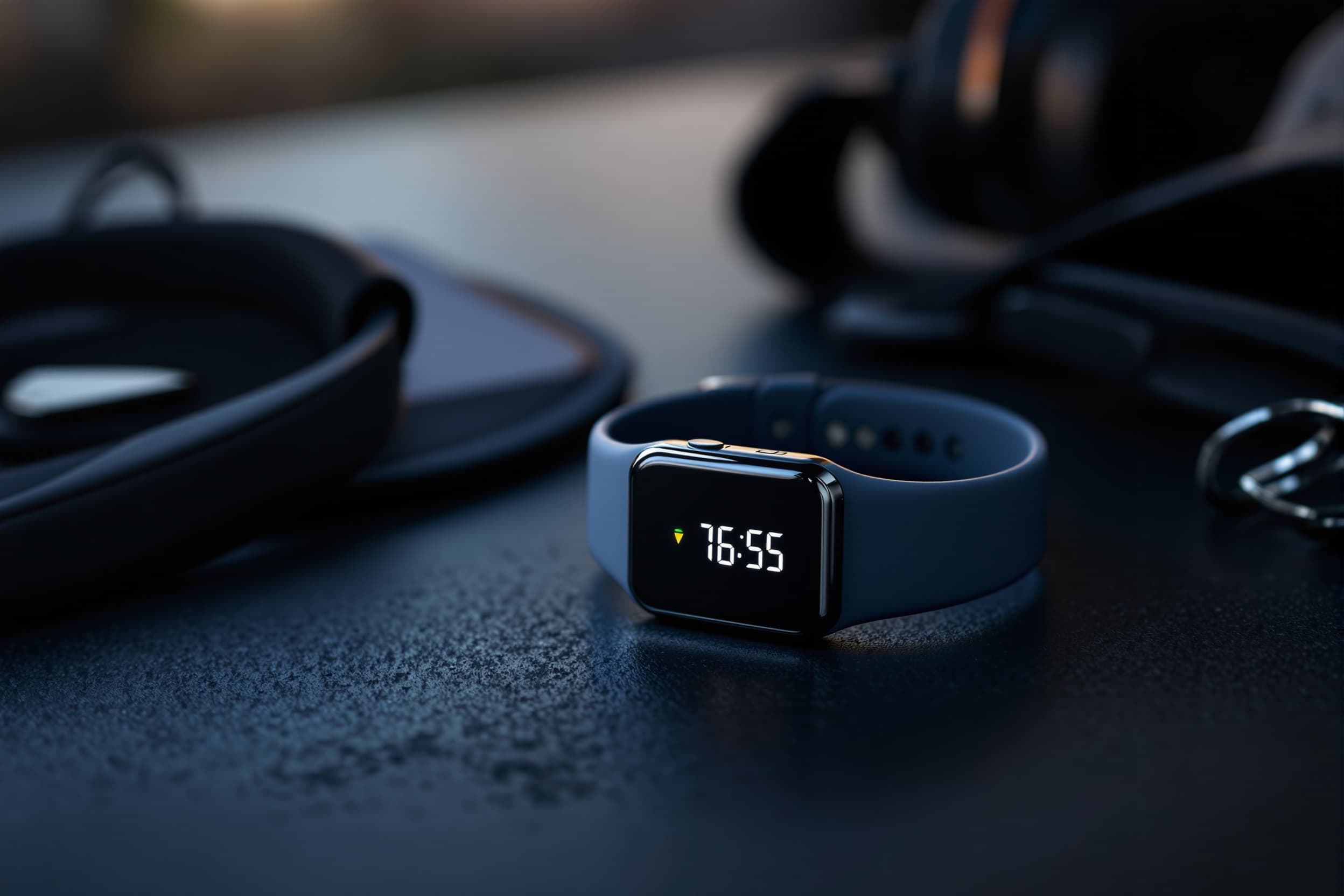
A wearable fitness tracking bracelet that monitors health and activity data. The device captures biometric information such as heart rate, steps, and movement patterns. It features a compact electronics assembly housed in a flexible wristband form factor.

Feasibility at a glance
PT localization
3/10
Low
Only finishing and testing can be localised in Portugal.
Per unit
€25-€60
at 1000-unit volume
Starter batch
1,000units
minimum viable run
To first batch
16weeks
5 phases, design to ship
Budget
€35–50k
all-in estimate
Bottom line
For a fitness data bracelet, white-labeling from an established EU electronics manufacturer is the optimal entry strategy. This product requires specialized capabilities—SMT assembly with fine-pitch BGA components, optical heart-rate sensor calibration, BLE radio testing, and IPX7 water-resistance validation—that exceed the scope of the Portuguese manufacturers in the registry, who specialize primarily in mechanical fabrication. A white-label approach allows GETMILK to bring a proven, certified product to market in 12–16 weeks with minimal NRE, avoiding the 9–12 month timeline and significant tooling investment of a ground-up local build or co-development project. Once market traction is proven, co-development or local final assembly can be phased in for differentiation.
4 capabilities
Tracks the number of steps you take throughout the day by sensing your movement.
Measures your heart rate continuously by reading blood flow through your wrist.
Records sleep patterns by monitoring your movement and heart rate during the night.
Sends all collected fitness data to your smartphone so you can review your progress.
5 stations · build route
Surface-mount the main PCB
Place tiny sensors, processor, and Bluetooth chip onto the circuit board using automated pick-and-place machines.
Mold the housing and band
Inject silicone and plastic into shaped molds to create the waterproof case and flexible wristband.
Assemble battery and display
Connect the rechargeable battery and attach the small screen to the main circuit board.
Seal and test the unit
Close the housing to make it water-resistant, then test sensor accuracy and wireless connectivity.
Package with charger
Place the finished bracelet with its charging cable and instructions into retail packaging.
Surface-mount the main PCB
Place tiny sensors, processor, and Bluetooth chip onto the circuit board using automated pick-and-place machines.
Mold the housing and band
Inject silicone and plastic into shaped molds to create the waterproof case and flexible wristband.
Assemble battery and display
Connect the rechargeable battery and attach the small screen to the main circuit board.
Seal and test the unit
Close the housing to make it water-resistant, then test sensor accuracy and wireless connectivity.
Package with charger
Place the finished bracelet with its charging cable and instructions into retail packaging.
6 identified · 4 blocking
Critical
Sensor Accuracy and Water-Resistance Validation
The two most common failure modes in fitness trackers are inaccurate heart-rate readings (due to poor skin contact, motion artifacts, or uncalibrated sensors) and water ingress (compromised gaskets, inadequate sealing, or improper assembly). Customers expect ±5% heart-rate accuracy vs. chest strap, and IPX7 rating (submersion to 1m for 30 minutes). If sensors fail or device shorts after contact with water, returns can exceed 15–20%, destroying unit economics and brand reputation. Calibration requires population testing (diverse skin tones, wrist sizes, activity levels) and is time-intensive. Water resistance requires both good design (O-rings, adhesive seals, conformal coating) and process control (torque specs, cure times).
Mitigation — For white-label: require vendor to provide sensor accuracy test data (comparison to clinical-grade reference) and IPX7 test certificates (per IEC 60529) from accredited lab. Conduct incoming QC on first batch with sample submersion and sensor spot-checks. For local/co-dev: invest in IP testing chamber (or outsource to SGS/Intertek) and perform design validation with 20+ test units across 3 submersion cycles. Use proven sensor modules (Maxim MAX30102, AMS AS7000) with reference firmware from vendor; budget 3–4 weeks for calibration testing with 15–20 volunteers across skin tones. Implement go/no-go heart-rate test in final QC (compare device reading to known pulse generator or reference device). Train assembly staff on proper gasket placement and torque limits.
High
Component Shortage and Lead-Time Volatility
Fitness bracelets depend on specialized components with concentrated supply: heart-rate sensor modules (dominated by Maxim/Analog Devices, AMS OSRAM), low-power Bluetooth SoCs (Nordic Semi, Dialog/Renesas), and small-format lithium-polymer cells. Global semiconductor shortages (2021–2023) demonstrated that lead times for BLE SoCs can balloon from 8 weeks to 40+ weeks, and heart-rate sensors face allocation. A single missing component can halt production. For white-label, the vendor absorbs some buffer, but still exposed. For local or co-dev, direct procurement exposes GETMILK to allocation queues and MOQ pressures (e.g., 3k–5k for sensor reels).
Mitigation — For white-label: establish dual-source agreements with two EU vendors to derisk single-vendor dependency. For local/co-dev: pre-order long-lead components (BLE SoC, sensor modules, displays) with 16–20 week horizon once design is frozen; negotiate consignment inventory with distributors like Avnet or Würth Elektronik; design in second-source sensors (e.g., both Maxim MAX30102 and AMS AS7000 heart-rate modules) to maintain flexibility.
High
CE/RED Certification and Medical Device Classification Risk
Fitness trackers with heart-rate monitoring fall under the Radio Equipment Directive (RED 2014/53/EU) for Bluetooth, RoHS/REACH for materials, and potentially the Medical Device Regulation (MDR 2017/745) if health claims are made. If the device is marketed for medical purposes (e.g., atrial fibrillation detection, clinical-grade heart rate), it must be certified as a Class IIa medical device, requiring a Notified Body audit, clinical validation, and technical documentation—adding 6–12 months and €50k–200k in costs. Even general wellness devices must pass RED EMC and RF testing (EN 300 328, EN 301 489), plus safety (EN 62368-1). Non-compliance risks market withdrawal, fines, and customs seizure.
Mitigation — Position the product strictly as a general wellness/fitness tracker (not medical) to avoid MDR; use language like 'tracks activity' rather than 'diagnoses' or 'monitors health conditions.' For white-label, require vendor to supply full CE Declaration of Conformity, RED test reports (from accredited EU lab), and RoHS/REACH material declarations. For local/co-dev, engage an EU Notified Body or test lab (e.g., TÜV, Intertek, SGS) early in design phase for pre-compliance guidance; budget €15k–25k for RED + RoHS testing. Ensure product manual and packaging include all required markings and disposal (WEEE) symbols.
High
Battery Life, Safety, and UN38.3 Compliance
Lithium-polymer batteries under 100mAh (typical for fitness bands: 60–120mAh) must comply with UN38.3 for transport, IEC 62133 for safety, and the EU Battery Directive (2006/66/EC, updated by Battery Regulation 2023/1542). Overcharging, physical damage, or manufacturing defects can cause thermal runaway, fire, or swelling—leading to product recalls and liability. Additionally, achieving multi-day battery life (3–7 days) requires careful firmware optimization (BLE duty cycling, sensor sampling rates, display sleep modes). Poor power management results in daily charging, a major customer complaint.
Mitigation — Source battery cells from reputable EU/tier-1 suppliers with IEC 62133 and UN38.3 certificates (e.g., Varta, Renata, or Samsung SDI). Avoid no-name Chinese cells. Implement battery protection IC (overcharge, over-discharge, short-circuit) on PCBA. For local/co-dev, conduct power profiling during DVT: measure current draw in all states (active HR sensing, BLE sync, sleep) and validate against target battery capacity. Use low-power BLE SoC (e.g., Nordic nRF52832 or Dialog DA14531) and optimize firmware for <1mA average current. Include battery recycling information in packaging per Battery Regulation; register with national battery compliance scheme (e.g., ERP Portugal).
Medium
Intellectual Property Leakage and Firmware Security
Wearable fitness trackers embed significant IP in firmware (sensor fusion algorithms, heart-rate signal processing, sleep-stage classification) and cloud backend (data analytics, user insights). If sourcing from a white-label vendor or ODM, GETMILK risks limited control over firmware source code, and the same platform may be sold to competitors with only cosmetic differentiation. Additionally, BLE-connected devices are vulnerable to reverse engineering, cloning, and man-in-the-middle attacks if encryption and secure boot are not implemented. China-sourced products carry higher risk of firmware backdoors or data exfiltration.
Mitigation — For white-label: negotiate exclusive regional rights (EU) and require firmware customization (unique device IDs, GETMILK-branded OTA update server). For co-dev/local: retain ownership of firmware source code and sensor algorithms; use secure boot and encrypted BLE pairing (AES-128+). Conduct third-party security audit before launch. Implement app-side certificate pinning and end-to-end encryption for cloud sync. File design patents on unique enclosure/band features and trademark the product name and UI.
Medium
Tooling and Certification Delays in Local/Co-Dev Scenarios
Building a fitness bracelet from scratch in Portugal or via EU co-development requires injection mold tooling (8–12 weeks), PCB design and prototyping (4–6 weeks), sensor calibration (3–4 weeks), firmware development (8–12 weeks), and compliance testing (4–6 weeks). Any design iteration—e.g., enclosure doesn't meet IPX7, heart-rate sensor has poor signal quality, or RED test fails on radiated emissions—can add 4–8 weeks per cycle. First-time hardware teams often underestimate integration challenges (battery life, sensor placement, antenna tuning), leading to 3–6 month overruns.
Mitigation — Adopt a phased prototyping approach: (1) EVT (Engineering Validation Test) with off-the-shelf sensors and 3D-printed enclosures to validate form factor and sensor placement; (2) DVT (Design Validation Test) with pre-production PCBAs and silicone prototypes to test waterproofing and battery life; (3) PVT (Production Validation Test) with production tooling. Run RED pre-compliance testing during DVT to catch EMC issues early. Use experienced EU design partners (e.g., OXYBLACK, Avnet's design services) who have wearable reference designs and can shortcut common pitfalls. Build 4–6 week contingency buffer into project plan.
16 weeks to first batch
Requirements Finalization and Vendor Selection
wk 1–2Branding, Packaging, and App Customization
wk 3–5Tooling, Component Procurement, and Pre-Production
wk 6–11Assembly, QC, and Compliance Testing
wk 12–14Final Packaging and Logistics to Warehouse
wk 15–16Requirements Finalization and Vendor Selection
Branding, Packaging, and App Customization
wk 6–11 is the longest stretch — Tooling, Component Procurement, and Pre-Production takes 6 weeks of the 16 weeks on this build.
7 materials · 7 processes
Materials
Processes
590 Portuguese manufacturers matched
None cover the whole build — it splits across steps.
10 tasks · 14 weeks to first batch
Week 1
2 tasks
Audit and select white-label vendor
Request samples, CE/RED/RoHS certificates, and sensor test reports from 2–3 EU white-label vendors (OXYBLACK, Avnet, Arrow). Compare heart-rate accuracy data, battery life specs, and IPX7 certificates. Negotiate 1k MOQ, branding terms, and 14-week delivery.
Define branding and packaging requirements
Finalize GETMILK logo placement on device and wristband, select retail box design, and specify charging cable, user manual, and quick-start guide content. Prepare compliance labeling (CE, WEEE, RoHS, batch number) for packaging artwork.
Weeks 2–3
2 tasks
Customize companion mobile app
waits on Audit and select white-label vendor
White-label the vendor's SDK or contract a developer to customize the app UI with GETMILK branding, privacy policy, and data sync endpoints. Ensure GDPR compliance for user data (heart rate, sleep, activity logs). Test BLE pairing and data display with vendor sample units.
Order branded prototypes and packaging artwork
waits on Define branding and packaging requirements
Submit logo files and packaging artwork to vendor for 3–5 branded prototypes. Order retail box samples from packaging supplier (Portuguese printer if localizing, or vendor's supplier). Validate fit, print quality, and compliance labeling.
Weeks 4–7
3 tasks
Validate CE/RED/RoHS documentation
waits on Audit and select white-label vendor
Review vendor's CE Declaration of Conformity, RED test reports (EN 300 328, EN 301 489), RoHS material declarations, and UN38.3 battery certificates. Engage compliance consultant or EU lab (TÜV, Intertek) to audit documentation and flag gaps.
Conduct incoming QC on pre-production samples
waits on Order branded prototypes and packaging artwork
Test 5–10 branded prototypes: measure heart-rate accuracy vs. reference device (chest strap or clinical monitor), perform IPX7 submersion test (1m depth, 30 min), verify BLE pairing with app, and run 3-day battery life test. Document pass/fail criteria.
Issue purchase order for 1,000 units
waits on Validate CE/RED/RoHS documentation, Conduct incoming QC on pre-production samples
Lock final specs (sensor model, battery capacity, wristband color/size options) and issue PO to vendor. Confirm lead time (6–8 weeks for component procurement and assembly), payment terms (30% deposit, 70% before shipment), and Incoterms (DDP to EU warehouse preferred).
Weeks 8–16
3 tasks
Monitor production and request progress updates
waits on Issue purchase order for 1,000 units
Request weekly status from vendor: component arrivals, PCBA assembly completion, enclosure molding, final assembly start, and QC results. Flag any delays (e.g., BLE SoC lead-time slip, sensor allocation) and adjust logistics plan if needed.
Arrange freight and customs clearance
waits on Monitor production and request progress updates
Coordinate road freight from vendor facility to GETMILK's EU warehouse (Portugal or other). Prepare import documentation (even for intra-EU, verify VAT and WEEE registration). Plan receiving inspection: sample 5% of units for power-on test, sensor check, and packaging integrity.
Perform final QC and prepare for launch
waits on Arrange freight and customs clearance
Upon delivery, open 2–3 retail boxes per 50-unit carton, power on devices, pair with app, verify heart-rate display and step counting. Check packaging for correct labeling (CE, WEEE, batch number). Clear any non-conforming units with vendor. Transfer accepted inventory to fulfillment for e-commerce orders.
3 roles to fill before month one
EU certification auditor
Compliance consultant (TÜV, Intertek, or SGS)
Audit vendor's CE/RED/RoHS documentation to ensure it meets EU legal requirements and flag any gaps before launch. Essential to avoid market withdrawal or customs seizure.
White-label app customization
Mobile app developer (freelance or agency)
Rebrand vendor's SDK or build custom app UI with GETMILK identity, GDPR-compliant data handling, and cloud sync. Critical for brand differentiation and user experience.
EU road freight and warehousing
Freight forwarder or logistics partner
Coordinate shipment from vendor to GETMILK's warehouse, handle VAT/customs (if cross-border), and manage receiving inspection. Ensures on-time delivery and inventory readiness for launch.
5 things to avoid in this plan
lead time
Watch for vendor component delays — BLE SoCs and heart-rate sensors face 8–16 week lead times; request weekly procurement updates and build 2-week buffer into launch timeline.
certification
Lock in CE/RED compliance early — audit vendor certificates in week 4; any missing test reports or non-conforming materials can delay market entry by 4–6 weeks for re-testing.
quality
Validate sensor accuracy and IPX7 on samples — 15–20% return rates from poor heart-rate readings or water damage will destroy unit economics; test 5–10 prototypes rigorously before issuing PO.
watch-out
Secure exclusive regional rights — negotiate EU exclusivity or unique branding to prevent vendor from selling identical product to competitors under different brand.
certification
2 tasks in week 1
Audit and select white-label vendor
Tooling, Component Procurement, and Pre-Production
Assembly, QC, and Compliance Testing
Final Packaging and Logistics to Warehouse
Plan for battery compliance — ensure vendor provides UN38.3 and IEC 62133 certificates for lithium-polymer cells, and register with national WEEE/battery take-back scheme before first sale.
590 matched · 8 shown, ranked by coverage
Covers, left to right: SMT Assembly · PCB Fabrication · Injection Molding · Battery Pack Assembly · Final Assembly · Testing & Inspection · Packaging
Manufacturer
Location
Covers
Certifications
People
Portuguese producers per required step
Final Assembly
369
Testing & Inspection
178
Injection Molding
174
SMT Assembly
36
PCB Fabrication
6
Battery Pack Assembly
3
Packaging
0
How many cover more than one step
The gap
For a fitness data bracelet, white-labeling from an established EU electronics manufacturer is the optimal entry strategy. This product requires specialized capabilities—SMT assembly with fine-pitch BGA components, optical heart-rate sensor calibration, BLE radio testing, and IPX7 water-resistance validation—that exceed the scope of the Portuguese manufacturers in the registry, who specialize primarily in mechanical fabrication. A white-label approach allows GETMILK to bring a proven, certified product to market in 12–16 weeks with minimal NRE, avoiding the 9–12 month timeline and significant tooling investment of a ground-up local build or co-development project. Once market traction is proven, co-development or local final assembly can be phased in for differentiation.
Send one RFQ to the top 4
Keenfinity EMS, Uartrónica, Exatronic, Proto-Electronics — same package, one click.