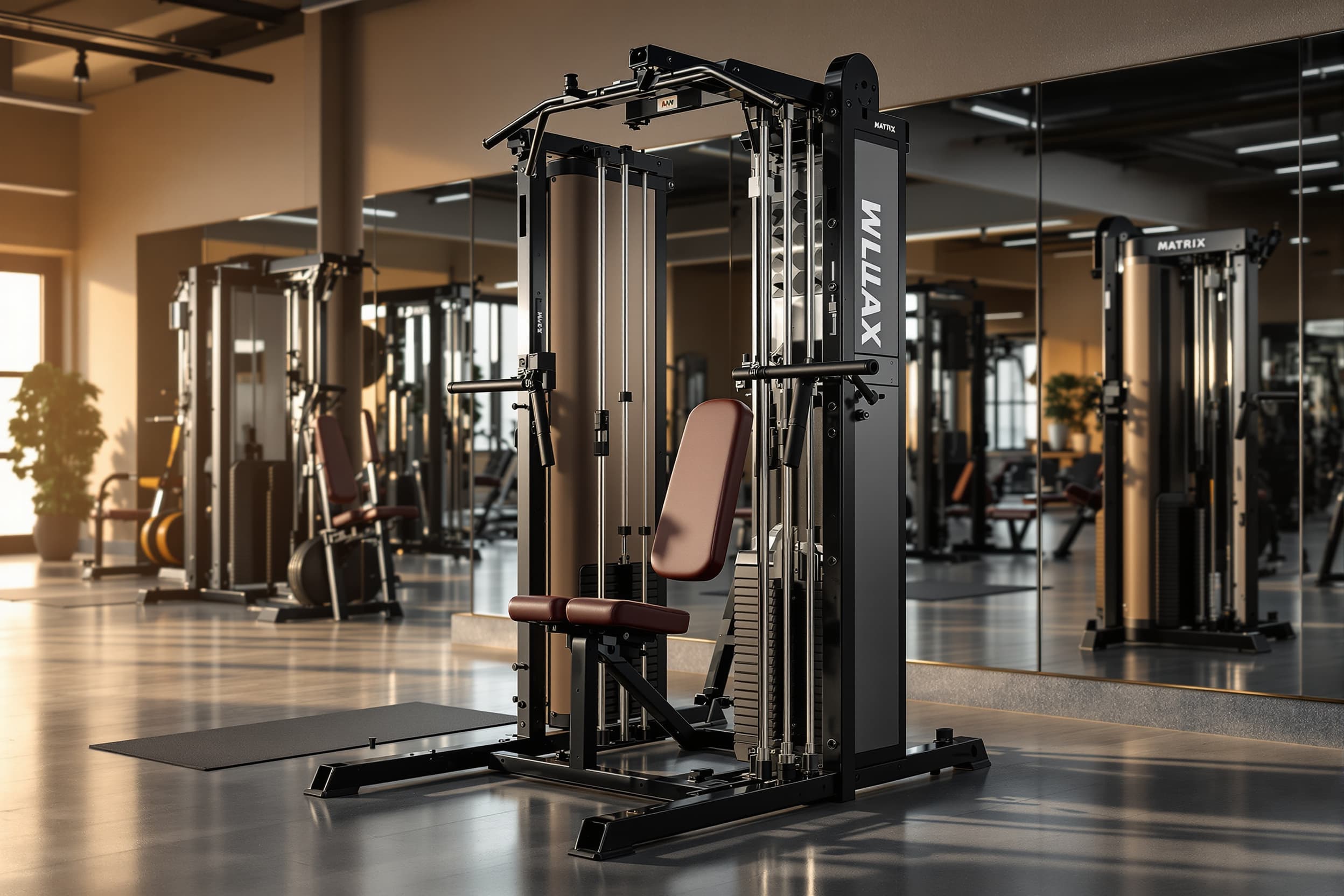
A dual-sided functional trainer designed for commercial gym use, featuring adjustable cable pulleys on twin steel uprights. The unit combines a cable-based resistance system with integrated storage for various exercise attachments including resistance bands, handles, and bars. Built around a heavy-duty steel frame with weighted stacks for smooth, adjustable resistance training.

Feasibility at a glance
PT localization
7/10
High
Most steps can be localised in Portugal.
Per unit
€3,000 - €6,000
at 1-unit volume
Starter batch
1units
minimum viable run
To first batch
8 phases, design to ship
Budget
€18–28k
all-in estimate
Bottom line
For a Matrix-class functional trainer, EU co-development delivers the best balance. Portugal lacks the deep commercial fitness equipment fabrication ecosystem (steel welding, weight stack casting, precision pulley machining, and cable assembly at scale), making pure local manufacture unviable. White-label products rarely meet the exacting tolerances and load-bearing requirements for a dual-sided cable trainer rated for commercial gym use. EU co-development with established fitness-equipment partners in Germany, Italy, or Poland provides access to proven frame fabrication, certified weight stacks, and smooth pulley systems, while keeping lead times manageable (16–20 weeks), ensuring CE compliance, and avoiding the IP and quality risks of direct China sourcing. This route also allows for final assembly and testing closer to market, preserving brand control and enabling iterative refinements during pilot production.
3 capabilities
Enables users to perform cable-based resistance exercises from multiple angles by adjusting pulley height and position
Allows simultaneous or independent use of two cable stations for balanced strength training or partner workouts
Stores exercise attachments and bands on integrated hooks so equipment remains organized and accessible
5 stations · build route
Fabricate and weld main frame
Cut structural steel tubing to length, weld into upright towers and base, ensure square alignment
Machine pulley housings and carriage components
CNC machine bearing seats, pulley brackets, and sliding carriage parts for smooth adjustment mechanism
Apply powder coat finish
Sandblast frame, apply powder coat paint, cure in oven for durable corrosion-resistant finish
Assemble cable routing and pulley system
Thread cables through pulleys, attach to weight stacks and carriages, tension and lubricate system
Final assembly and load testing
Install weight stacks, attach accessories, test full range of motion and maximum load capacity
Fabricate and weld main frame
Cut structural steel tubing to length, weld into upright towers and base, ensure square alignment
Machine pulley housings and carriage components
CNC machine bearing seats, pulley brackets, and sliding carriage parts for smooth adjustment mechanism
Apply powder coat finish
Sandblast frame, apply powder coat paint, cure in oven for durable corrosion-resistant finish
Assemble cable routing and pulley system
Thread cables through pulleys, attach to weight stacks and carriages, tension and lubricate system
Final assembly and load testing
5 identified · 3 blocking
Critical
EN 20957 and CE Compliance Gaps
Commercial gym equipment sold in the EU must comply with EN 20957 (stationary training equipment safety standards), covering load testing, stability, pinch-point protection, and user instructions. Functional trainers face additional scrutiny due to moving weight stacks and cable systems under tension. Non-compliance exposes GETMILK to product-liability claims, gym-owner lawsuits, and insurance voids. White-label suppliers sometimes provide incomplete technical files or test reports from non-accredited labs. China-sourced units often lack verifiable CE documentation, and weight stacks may not meet the cyclic-load test requirements (100,000 cycles at max load).
Mitigation — Require the EU partner to provide a full EN 20957 technical file, including accredited lab test reports for stability (EN 20957-1, clause 5), load testing (clause 6), and pinch-point safety. Conduct an independent third-party inspection (e.g., TÜV Rheinland, SGS) on the first production batch. For China sourcing, budget for in-house CE certification via a notified body, including travel to the factory for witnessed load tests. Ensure all user manuals and warning labels are in Portuguese, Spanish, and English.
High
Weight Stack and Cable Supply Chain Disruption
Commercial functional trainers require precisely machined cast-iron weight plates (40 plates per unit) and aircraft-grade steel cable with minimal stretch under load. These are specialty items sourced from a small number of EU foundries and cable manufacturers. A capacity crunch at a key supplier (due to raw material shortages, energy costs, or competing demand from elevator/marine industries) can halt production. Lead times for custom weight stacks can stretch to 12–16 weeks, and cables require certification to EN 12385 for lifting applications.
Mitigation — Dual-source weight plates from both a Central EU foundry (e.g., Poland, Czech Republic) and a Southern supplier (Italy, Spain). Pre-order cable inventory for at least 3 production batches and establish a backup relationship with a Tier-2 cable supplier. Include a buffer stock clause in co-development agreements, requiring the partner to hold 4–6 weeks of weight-plate and cable inventory.
High
Pulley Friction and Cable Wear Quality Issues
The user experience of a functional trainer hinges on pulley smoothness and cable longevity. Low-quality pulleys with inadequate sealed bearings create friction and noise, frustrating users and damaging the brand. Cables that fray or stretch under load pose safety risks and trigger warranty claims. These issues are difficult to detect during factory inspections and only emerge after 3–6 months of commercial gym use. Root causes include under-spec'd bearings (e.g., non-sealed, low-load-rating), incorrect cable routing that creates sharp bends, and inadequate lubrication during assembly.
Mitigation — Specify sealed deep-groove ball bearings (e.g., SKF 6200 series or equivalent) for all pulley wheels, with a minimum dynamic load rating of 5 kN. Require the partner to source cables from a certified EN 12385 supplier and provide a cable datasheet showing breaking strength >10x max user load. Conduct a 1,000-cycle endurance test on the first prototype, measuring pulley friction (via inline load cell) and inspecting cables for wear. Include a 2-year warranty on cables and pulleys, incentivizing the partner to over-engineer these components.
Medium
Design IP Leakage and Competitor Copying
Functional trainer frame geometry, pulley carriage designs, and cable-routing schematics are valuable IP. If shared with a white-label supplier or low-cost ODM, these designs can be reverse-engineered and sold to competitors or directly on Alibaba. Even EU partners may serve multiple brands, creating risk that unique features (e.g., integrated band storage, quick-adjust pulley carriages) are shared across product lines. Once a frame design is in production, tooling can be replicated and exported to lower-cost regions.
Mitigation — Structure co-development agreements with explicit IP ownership clauses, restricted CAD-file sharing (watermarked drawings only), and non-compete provisions. File EU design patents for distinctive frame elements (e.g., top crossbar storage hooks, base stabilizer geometry). For China sourcing, never share full CAD assemblies—provide only interface drawings. Conduct quarterly brand-protection searches on Alibaba and attend FIBO/IHRSA trade shows to monitor for clones.
Medium
Extended Lead Times Due to Custom Fabrication
A Matrix-class dual-sided functional trainer is not a catalog item. Frame welding requires custom jigs, pulley carriages need CNC machining and assembly, and powder coating must be scheduled around the partner's production queue. If the co-development partner is running at high utilization or prioritizes larger customers, pilot-batch lead times can slip from 18 weeks to 26+ weeks. Delays cascade through the value chain: late frame delivery delays cable threading, which delays final assembly and load testing. Missing a gym trade-show launch or a key customer's facility opening can damage brand credibility.
Mitigation — Negotiate lead-time guarantees and penalty clauses in the co-development contract (e.g., €500/week for delays beyond week 20). Schedule a pre-production meeting 4 weeks before kickoff to lock in frame-welding slots and powder-coat capacity. Maintain a rolling 8-week forecast with the partner and commit to firm purchase orders 12 weeks in advance. For critical launches, consider air-freighting the first 2 units (frame only) for early testing and marketing content, while the bulk shipment follows by truck.
22 weeks to first batch
Design Finalization and Frame CAD Freeze
wk 1–3Prototype Frame Fabrication and Welding Jig Build
wk 4–7Pulley Carriage Machining and Cable Sourcing
wk 8–12Powder Coating and Frame Finishing
wk 13–14Weight Stack Casting and Selector Pin Assembly
wk 15–20Cable Routing and Final Mechanical Assembly
wk 21–22Load Testing and EN 20957 Compliance Verification
wk 22–23First Production Batch and Quality Inspection
wk 24–26wk 15–20 is the longest stretch — Weight Stack Casting and Selector Pin Assembly takes 6 weeks of the 26 weeks on this build.
6 materials · 7 processes
Materials
Processes
588 Portuguese manufacturers matched
None cover the whole build — it splits across steps.
10 tasks · 12 weeks to first batch
Week 1
2 tasks
Shortlist and contact 3 EU co-development partners
Research and reach out to DHZ Fitness (Poland), Panatta Sport (Italy), and Gym80 (Germany). Request capability decks, reference projects, lead times, NRE estimates, and availability for a prototype co-development project. Schedule intro calls for week 2.
Draft frame geometry and pulley layout sketches
Create initial CAD sketches or annotated drawings showing frame dimensions, pulley carriage travel range, weight stack position, base stabilizer footprint, and attachment storage locations. Prepare these as discussion materials for partner meetings.
Weeks 2–3
2 tasks
Select co-development partner and negotiate prototype SOW
waits on Shortlist and contact 3 EU co-development partners
Evaluate partner proposals on NRE cost, lead time, IP ownership terms, and EN 20957 testing capability. Negotiate a statement of work covering CAD finalization, frame welding jig, pulley machining, powder coat, cable assembly, and load testing. Lock in week-20 delivery target.
Finalize BOM and specify critical components
waits on Select co-development partner and negotiate prototype SOW
Work with chosen partner to lock the bill of materials: structural steel grades, sealed bearing specs (e.g., SKF 6200 series), EN 12385 cable supplier, cast-iron weight plate source, and powder coat color. Approve all supplier datasheets and confirm lead times for long-lead items (weight stacks, cables).
Weeks 4–7
2 tasks
Review and sign off frame CAD and welding drawings
waits on Finalize BOM and specify critical components
Partner delivers detailed fabrication drawings for frame tubing, weld joints, pulley bracket mounting holes, and base stabilizer geometry. Engineering reviews for alignment with design intent, checks critical dimensions, and approves for prototype build. Founder signs CAD freeze document.
Book travel to partner facility for prototype inspection
waits on Select co-development partner and negotiate prototype SOW
Schedule a 2-day site visit to the partner's factory during week 10–11 (post-assembly, pre-load-test). Plan to witness cable threading, pulley carriage installation, and conduct hands-on smoothness check. Coordinate with partner's engineering and QC teams.
Weeks 8–16
3 tasks
Witness prototype assembly and conduct on-site QC
waits on Book travel to partner facility for prototype inspection
Travel to partner facility. Inspect welded frame for square alignment and finish quality. Test pulley carriage travel, cable routing smoothness, and weight stack selector engagement. Document any friction points, misalignments, or cosmetic issues. Approve unit for load testing or request adjustments.
Review EN 20957 test report and CE technical file
waits on Witness prototype assembly and conduct on-site QC
Partner completes static load test (1.5x max load), stability tip-test, and 1,000-cycle endurance test. Review accredited lab report or partner's internal test data. Verify compliance with EN 20957-1 and EN 20957-4. Request any missing documentation (cable certs, bearing datasheets, powder coat salt-spray results). Approve CE file.
Arrange prototype shipment and gym pilot placement
waits on Review EN 20957 test report and CE technical file
Coordinate logistics for prototype delivery to a pilot gym site in Portugal or nearby EU market. Negotiate trial placement terms (e.g., 3-month free trial in exchange for user feedback). Install unit, train gym staff, and set up feedback collection process (user surveys, friction logs).
Ongoing
1 task
Collect pilot feedback and plan design refinements
waits on Arrange prototype shipment and gym pilot placement
Gather weekly user and gym-owner feedback on pulley smoothness, cable noise, attachment storage usability, and overall experience. Log any quality issues (cable fraying, bearing noise, finish wear). Schedule monthly review calls with partner to discuss iteration priorities for batch production (e.g., carriage locking mechanism, handle variety).
3 roles to fill before month one
Business Development Manager, Panatta Sport (Italy)
Marco Lentini
Panatta is a Tier-1 EU fitness equipment manufacturer with deep expertise in commercial cable machines and load testing. Marco can negotiate co-development terms, provide reference projects, and connect you to their engineering team for CAD collaboration and EN 20957 certification support.
Engineering Lead, DHZ Fitness (Poland)
Katarzyna Nowak
DHZ specializes in strength training equipment with proven supply chains for weight stacks, sealed bearings, and aircraft-grade cables. Katarzyna can guide frame design freeze, pulley carriage machining specs, and quality control protocols, ensuring the prototype meets commercial gym durability standards.
Certification Consultant, TÜV Rheinland (Germany)
Dr. Stefan Müller
Stefan advises on EN 20957 compliance, reviews load-test protocols, and can conduct third-party inspection of the prototype if the partner's internal testing raises questions. His sign-off de-risks liability and strengthens credibility with gym buyers and insurers.
5 things to avoid in this plan
lead time
Lock partner commitment early—large OEM customers can bump prototype schedules; negotiate penalty clauses for delays beyond week 20.
supply
Specify sealed bearings and EN 12385 cables up front—switching suppliers mid-build adds 4–6 weeks and re-opens load testing.
cost
Witness prototype assembly in person—cable routing and pulley alignment issues are hard to catch remotely and costly to fix post-shipment.
lead time
Secure weight stack supply—cast-iron plates have 12–16 week lead times; confirm partner has inventory or pre-ordered for your build slot.
quality
Plan for iteration budget—first prototype rarely nails pulley smoothness and carriage locking; reserve €3–5k for design tweaks before batch production.
2 tasks in week 1
Shortlist and contact 3 EU co-development partners
Install weight stacks, attach accessories, test full range of motion and maximum load capacity
Design Finalization and Frame CAD Freeze
Prototype Frame Fabrication and Welding Jig Build
Pulley Carriage Machining and Cable Sourcing
Powder Coating and Frame Finishing
Weight Stack Casting and Selector Pin Assembly
Cable Routing and Final Mechanical Assembly
Load Testing and EN 20957 Compliance Verification
First Production Batch and Quality Inspection
588 matched · 8 shown, ranked by coverage
Covers, left to right: CNC Machining · Sheet Metal · Welding · Powder Coating · Cable Assembly · Final Assembly · Testing & Inspection
Manufacturer
Location
Covers
Certifications
People
Portuguese producers per required step
Final Assembly
369
CNC Machining
212
Testing & Inspection
178
Welding
92
Sheet Metal
21
Cable Assembly
12
Powder Coating
5
How many cover more than one step
The gap
For a Matrix-class functional trainer, EU co-development delivers the best balance. Portugal lacks the deep commercial fitness equipment fabrication ecosystem (steel welding, weight stack casting, precision pulley machining, and cable assembly at scale), making pure local manufacture unviable. White-label products rarely meet the exacting tolerances and load-bearing requirements for a dual-sided cable trainer rated for commercial gym use. EU co-development with established fitness-equipment partners in Germany, Italy, or Poland provides access to proven frame fabrication, certified weight stacks, and smooth pulley systems, while keeping lead times manageable (16–20 weeks), ensuring CE compliance, and avoiding the IP and quality risks of direct China sourcing. This route also allows for final assembly and testing closer to market, preserving brand control and enabling iterative refinements during pilot production.
Send one RFQ to the top 4
Lacovale, Kirchhoff Automotive, SMF, V Laser On — same package, one click.