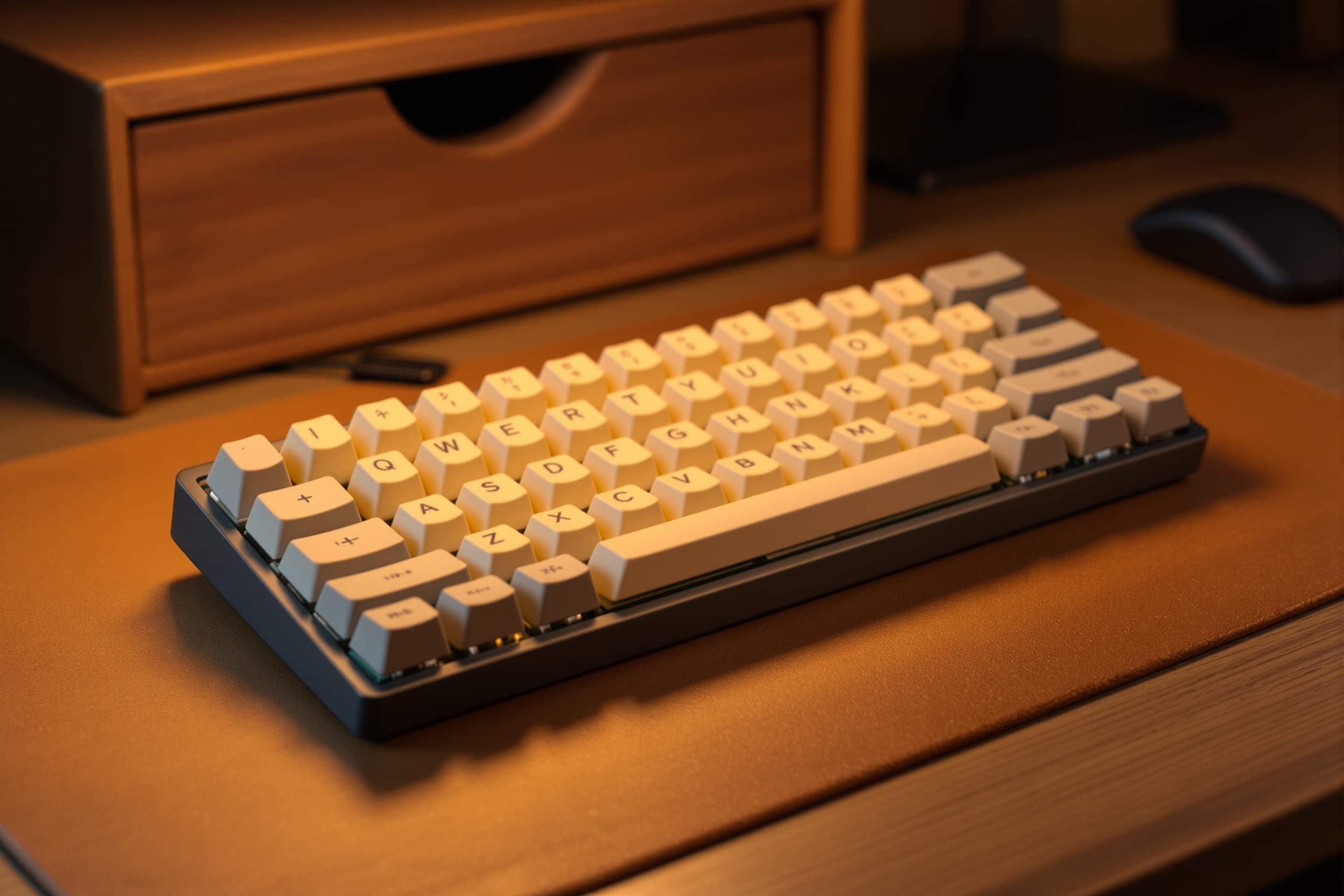
A 75% form-factor mechanical keyboard using magnetic Hall-effect switches that report 12-bit analog position data (0–4 mm) at 1 kHz instead of binary on/off. Users can configure per-key actuation points (0.1–3.5 mm), rapid-trigger reset, and dual-action behaviors. Hot-swappable with Lekker/Gateron Magnetic Jade sockets, gasket-mounted with FR4 plate and brass weight, running QMK-derived analog firmware over USB-C.

Feasibility at a glance
PT localization
4/10
Partial
Only finishing and testing can be localised in Portugal.
Per unit
€180–280
at 300-unit volume
Starter batch
300units
minimum viable run
To first batch
20weeks
7 phases, design to ship
Budget
€85–110k
all-in estimate
Bottom line
A 75% analog Hall-effect keyboard is a complex, high-precision product requiring deep electronic design expertise, advanced SMT assembly with 84 Hall sensors, custom firmware integration, and tight tolerances. No single Portuguese manufacturer in the registry has the combination of PCB+SMT, CNC machining, injection molding, anodizing, and firmware/testing capabilities needed. Co-developing with an established EU electronics partner (Germany, Czech Republic, Poland) offers access to proven PCB assembly lines, analog sensor integration know-how, and mechanical keyboard supply chains while keeping IP, lead times, and compliance manageable. The EU option balances quality, control, and time-to-market for this premium, low-volume (300-unit) product without the IP and regulatory risk of Chinese imports.
5 capabilities
Reports smooth analog travel distance for every keystroke instead of a simple on or off signal.
Lets you customize exactly how far down each key must go before it registers, plus advanced trigger modes.
Allows hot-swapping of compatible magnetic switches without any soldering or tools.
Delivers typing data to your computer at 1000 times per second for ultra-responsive gaming.
Uses gasket mounting and foam layers to create a quieter, more refined sound and feel.
5 stations · build route
Fabricate and assemble Hall-sensor PCB
84 Hall sensors are placed and soldered onto a multi-layer PCB using SMT assembly; firmware is flashed and validated.
CNC-machine and anodize aluminium top frame
Top case is machined from billet aluminium, then anodized for surface hardness and color.
Injection-mold polycarbonate bottom and brass weight integration
Bottom case is molded; brass weight is CNC-machined or cast and fitted into recesses or pockets.
Cut FR4 plate and foam layers
FR4 plate is CNC-routed or laser-cut to switch cutouts; EVA and PE foam sheets are die-cut to size.
Final assembly, switch-socket installation, and QC testing
Gaskets, foam, PCB, plate, and case are stacked; sockets are installed; each key is tested for analog response and actuation.
Fabricate and assemble Hall-sensor PCB
84 Hall sensors are placed and soldered onto a multi-layer PCB using SMT assembly; firmware is flashed and validated.
CNC-machine and anodize aluminium top frame
Top case is machined from billet aluminium, then anodized for surface hardness and color.
Injection-mold polycarbonate bottom and brass weight integration
Bottom case is molded; brass weight is CNC-machined or cast and fitted into recesses or pockets.
Cut FR4 plate and foam layers
FR4 plate is CNC-routed or laser-cut to switch cutouts; EVA and PE foam sheets are die-cut to size.
6 identified · 2 blocking
High
Hall Sensor Supply & Allocation
Analog Hall-effect sensors with 12-bit resolution and low hysteresis are specialized components, often allocated to automotive and industrial customers first. For 300 keyboards (25,200 sensors), supply shortages or long lead times (16+ weeks) could delay the entire project. Sensor price volatility and minimum order quantities may also force over-ordering or lock in unfavorable pricing. If the chosen EU partner lacks direct relationships with sensor manufacturers (e.g., Allegro, Infineon, Melexis), procurement becomes a critical bottleneck.
Mitigation — Pre-qualify and secure firm lead-time commitments from at least two sensor suppliers (Allegro MicroSystems, Infineon, or Melexis) before finalizing the PCB design. Consider designing the PCB to accommodate pin-compatible alternatives. Place sensor orders immediately after prototype validation to lock in allocation. For 300 units, negotiate consignment or vendor-managed inventory with the PCBA partner to spread risk. Maintain a 10% safety stock of sensors for rework and warranty repairs.
High
Mechanical Tolerance Stack-Up (Gasket Mount & Sensor Alignment)
Gasket-mount keyboards rely on precise tolerances between the plate, PCB, case, and gasket strips to achieve the desired typing feel without binding or rattling. Simultaneously, each of the 84 Hall sensors must maintain a consistent 1.5–2.0 mm air gap to the switch magnet; any misalignment degrades analog resolution or causes dead keys. CNC machining tolerances on the aluminium top frame, injection-molding shrinkage in the polycarbonate bottom, and gasket compression variability can compound into a >0.3 mm stack-up error—enough to cause interference or sensor dropout. For a 300-unit batch across multiple suppliers, achieving consistent build quality is challenging.
Mitigation — Perform a full tolerance analysis (GD&T) during DFM review with the CNC and molding partners; specify ±0.05 mm on critical mating surfaces (plate-to-case, PCB standoffs). Prototype 10 units with production-intent tooling and measure gasket compression, sensor gap, and plate deflection under load. Use fixture-based assembly jigs to ensure repeatable PCB-to-plate alignment. Implement a go/no-go gauge for sensor height during final assembly QC. Specify calibration firmware that auto-adjusts per-key ADC thresholds to compensate for minor mechanical variation (±0.2 mm).
Medium
Firmware IP & QMK Licensing
QMK firmware is GPL-licensed, which requires that any derivative work (including custom analog extensions and rapid-trigger logic) be open-sourced if distributed. This conflicts with the goal of maintaining proprietary differentiation in actuation algorithms and calibration routines. If firmware is not properly isolated or licensing is misunderstood, GETMILK risks either legal challenge or forced disclosure of competitive IP. Additionally, integrating 12-bit ADC polling at 1 kHz with QMK's event loop requires deep firmware expertise; bugs in analog processing can cause key chatter, latency spikes, or USB descriptor errors.
Mitigation — Engage a firmware consultant experienced in QMK analog forks (e.g., developers from Wooting's Lekker firmware or similar projects) to architect a dual-license model: GPL core + proprietary analog module as a loadable plugin. Alternatively, base firmware on a permissive license (MIT/Apache) analog stack and implement USB HID from scratch. Budget €8,000–12,000 for firmware development and validation. Conduct thorough USB-IF compliance testing (HID descriptor, enumeration, suspend/resume) and key-matrix stress tests (all 84 keys pressed simultaneously) before production.
Medium
Lead-Time Coordination Across 4+ Suppliers
Even within the EU, the keyboard requires coordination of at least four specialized suppliers: (1) PCB fabrication + SMT assembly, (2) CNC machining + anodizing for aluminium, (3) injection molding for polycarbonate, and (4) brass weight casting/machining. Each has different lead times (6–10 weeks), and any delay cascades through final assembly. Missing a single component—e.g., anodizing batch delayed by chemical supply issue, or brass weight held up in CNC queue—can idle the entire 300-unit batch and push delivery beyond the 20-week target. Communication overhead and lack of a single integrator increase schedule risk.
Mitigation — Appoint a single Tier-1 manufacturing partner (e.g., Würth Elektronik or Jabil Poland) to act as the integrator and own the BOM, scheduling, and final assembly. Have them subcontract PCB, CNC, and molding to their qualified vendor network, with contractual service-level agreements (SLAs) and penalty clauses for delays. Use a shared project management platform (e.g., Gantt chart in Monday.com or MS Project) with weekly status syncs. Front-load long-lead items: place PCB and sensor orders in Week 1, CNC tooling kickoff in Week 2, injection mold validation in Week 3. Build 2-week schedule buffers before final assembly and maintain a backup CNC supplier for the aluminium top frame.
Medium
Regulatory Compliance (CE, RED, RoHS, EMC)
As a wired USB peripheral with active electronics, the keyboard must meet CE marking requirements under the Low Voltage Directive (LVD) and Electromagnetic Compatibility (EMC) Directive. If the design includes wireless functionality in the future, the Radio Equipment Directive (RED) also applies. Hall-effect sensors and high-speed ADC polling (1 kHz) can generate EMI; poor PCB layout (lack of ground planes, inadequate decoupling) may cause the device to fail radiated emissions or conducted emissions tests (EN 55032, EN 55035). Failure discovered late (after tooling investment) requires expensive PCB re-spins, shielding, or ferrite bead additions. RoHS and REACH compliance for all materials (anodizing chemicals, foam adhesives, keycap plastics) must be documented; missing a single non-compliant part triggers batch rejection or market withdrawal.
Mitigation — Engage an accredited EU test lab (e.g., TÜV Rheinland, Nemko, or Intertek) early in the design phase for a pre-compliance EMC scan on the prototype PCB (~€2,000). Design with EMC best practices: 4-layer PCB with continuous ground plane, filtered USB lines, and 0.1 µF decoupling on every Hall sensor and ADC input. Source all materials (anodizing, foam, keycaps, gaskets) from suppliers with current RoHS/REACH declarations; maintain a BOM-level compliance dossier. Budget €4,000–6,000 for full CE testing (LVD + EMC) and technical file preparation. If any component changes post-certification, re-test affected modules before shipping.
Medium
Quality & Yield on Low-Volume (300 Units)
At 300 units, manufacturers often deprioritize setup optimization, and first-article yields can be as low as 70–80% due to sensor placement errors, anodizing cosmetic defects, or gasket/foam misalignment. Rework and scrap drive up effective cost per unit and can delay shipment by 2–4 weeks. Many EU PCBA houses have minimum batch sizes (500–1,000 units) or charge setup premiums for small runs, making per-unit economics unfavorable. Additionally, low-volume orders receive less rigorous process validation (e.g., reflow profiling, AOI threshold tuning), increasing the risk of latent defects (e.g., cold solder joints on Hall sensors) that surface only after customer use.
Mitigation — Negotiate a pilot-run agreement: manufacture 50 units as a engineering validation batch, conduct full functional testing (every key, 1,000 actuations per key), and use lessons learned to refine assembly procedures before scaling to 300. Specify a minimum 95% first-pass yield (FPY) target in the contract, with supplier responsibility for rework at no additional cost. Implement 100% end-of-line testing: automated script that validates all 84 keys at multiple actuation depths (0.5, 1.5, 2.5, 3.5 mm) and checks USB enumeration, polling rate, and key rollover. For anodized aluminium, request color-matching samples and approve a golden unit before batch anodizing. Plan for 5% attrition (15 units) and build spares accordingly.
20 weeks to first batch
Design Freeze & DFM Review
wk 1–2Tooling, Prototyping & Component Procurement
wk 3–6PCB Fabrication & SMT Assembly
wk 7–9CNC Machining & Anodizing (Aluminium Top Frame)
wk 10–13Injection Molding & Brass Weight Fabrication
wk 14–16FR4 Plate Cutting & Gasket Preparation
wk 17–18Final Assembly & QC Testing
wk 19–20Design Freeze & DFM Review
wk 3–6 is the longest stretch — Tooling, Prototyping & Component Procurement takes 4 weeks of the 20 weeks on this build.
7 materials · 8 processes
Materials
Processes
681 Portuguese manufacturers matched
None cover the whole build — it splits across steps.
18 tasks · 18 weeks to first batch
Week 1
2 tasks
Finalize PCB schematic and Hall-sensor layout
Lock 4-layer PCB design for 84 Hall sensors with ground plane, USB-C, and STM32/RP2040 controller. Generate Gerber files and BOM with RoHS/REACH declarations. Conduct internal design review for sensor trace routing and EMC best practices.
Issue RFQ to shortlisted EU PCBA partners
Send PCB Gerbers, BOM, and assembly specs to Würth Elektronik (DE), Jabil Poland, and Foxconn CZ. Request quotes for 350 units, lead times, and NRE tooling. Specify AOI, X-ray inspection, and ICT requirements for Hall sensor validation.
Weeks 2–3
4 tasks
Select and contract EU PCBA integrator
waits on Issue RFQ to shortlisted EU PCBA partners
Evaluate RFQ responses on cost, lead time, Hall-sensor experience, and ability to coordinate CNC/molding subcontractors. Negotiate contract with SLAs, yield targets (95% FPY), and penalty clauses. Designate as Tier-1 partner to own BOM and scheduling.
Secure Hall-sensor supply (25,200 units)
waits on Select and contract EU PCBA integrator
Place firm purchase orders with Allegro MicroSystems or Infineon for 84 sensors × 350 keyboards. Confirm lead time ≤10 weeks and lock allocation. Verify pin-compatible alternative exists as backup. Arrange consignment delivery to PCBA partner.
Commission CNC and injection-mold tooling
waits on Select and contract EU PCBA integrator
Finalize CAD for aluminium top frame and polycarbonate bottom case. Issue POs for CNC work-holding fixtures and single-cavity injection mold. Specify ±0.05 mm tolerances on plate-to-case mating surfaces. Target 4-week tooling delivery.
Draft QMK-derived analog firmware architecture
Design dual-license firmware model: GPL core + proprietary analog module. Spec 12-bit ADC polling at 1 kHz, per-key actuation (0.1–3.5 mm), rapid-trigger, and USB HID descriptor. Identify QMK consultant or Wooting/Lekker firmware developer for hire.
Weeks 4–7
4 tasks
Fabricate and assemble 10 prototype PCBs
waits on Select and contract EU PCBA integrator, Secure Hall-sensor supply (25,200 units)
Produce 10 Hall-sensor + controller PCB sets at EU partner. Hand-assemble with sensors, flash alpha firmware, and validate analog key sensing on bench. Measure sensor-to-magnet air gap and ADC linearity. Document any layout or component issues for design revision.
3D-print prototype cases for fit-check
waits on Fabricate and assemble 10 prototype PCBs
Print 5 top frames and bottom cases in SLS nylon or similar. Assemble with prototype PCBs, FR4 plate mock-up, and temporary gaskets. Verify mechanical stack-up, USB-C clearance, and plate-to-PCB alignment. Identify tolerance issues before tooling commits.
Conduct DFM review with all suppliers
waits on Select and contract EU PCBA integrator, Commission CNC and injection-mold tooling
Host joint review with PCBA partner, CNC shop, and injection molder. Walk through GD&T drawings, sensor placement AOI criteria, anodizing finish specs, and gasket compression targets. Approve final production drawings and lock BOM revision.
Weeks 8–16
8 tasks
Produce 350 PCBs with full SMT assembly
waits on Fabricate and assemble 10 prototype PCBs, Conduct DFM review with all suppliers
Fabricate 350 Hall-sensor + controller PCB sets. SMT-place all 84 sensors per board, microcontroller, ADC, USB-C, passives. Run AOI and X-ray inspection. Flash production firmware. Conduct ICT or flying-probe test. Target 95% first-pass yield; rework any failures.
CNC-machine and anodize 320 aluminium top frames
waits on Commission CNC and injection-mold tooling, Conduct DFM review with all suppliers
Machine frames from 6061 billet on 3-axis CNC. Mill switch pockets, USB-C cutout, screw bosses to ±0.05 mm. Deburr, polish, and batch-anodize (Type II, space gray or black). Inspect dimensions and surface finish; reject blemished units.
Injection-mold polycarbonate cases and fabricate brass weights
waits on Commission CNC and injection-mold tooling, Conduct DFM review with all suppliers
Mold 320 bottom cases (60–90 sec cycle). Inspect for warpage and sink marks. CNC or cast 320 brass weights; bead-blast finish. Press-fit or bond weights into case recesses. Die-cut 320 sets of EVA and PE foam layers.
6 roles to fill before month one
Lead PCB design review, Hall-sensor SMT process, and AOI/X-ray inspection setup
Senior Electronics Engineer (PCBA partner: Würth Elektronik or Jabil Poland)
Ensures 84-sensor placement accuracy, solder joint quality, and yield targets (95% FPY) are met; critical for analog signal integrity and first-article success.
Architect dual-license firmware, 12-bit ADC integration, and USB HID compliance
Firmware Consultant (ex-Wooting / QMK analog specialist)
Provides deep expertise in QMK analog forks, rapid-trigger algorithms, and GPL licensing strategy; de-risks firmware IP and ensures 1 kHz polling stability.
Tolerance stack-up analysis, gasket compression validation, and DFM for aluminium top frame and polycarbonate case
Mechanical Engineer (CNC + injection-mold supplier)
Prevents costly tooling revisions and assembly binding/rattle issues; ensures sensor-to-magnet air gap (1.5–2.0 mm) is maintained across 300 units.
Pre-compliance EMC scan, full CE testing (EN 55032/55035), and technical file preparation
5 things to avoid in this plan
lead time
Watch for Hall-sensor allocation delays (16+ weeks) from automotive demand—lock firm orders in Week 2 and qualify pin-compatible backup (Allegro vs. Infineon).
watch-out
Lock firmware IP strategy early—engage QMK consultant in Week 3 to architect dual-license model and avoid GPL disclosure of proprietary actuation algorithms.
quality
Validate mechanical tolerance stack-up in prototype phase—conduct GD&T analysis and build 10 pilot units with production tooling to catch gasket/sensor alignment issues before 300-unit commit.
certification
Front-load EMC pre-compliance testing (Week 5)—any radiated emissions failures discovered after PCB production trigger expensive re-spins and 4+ week delays.
lead time
Coordinate 4+ suppliers (PCBA, CNC, molding, brass) via single Tier-1 integrator with SLAs—missing one component (e.g., anodizing delay) idles entire 300-unit batch.
2 tasks in week 1
Finalize PCB schematic and Hall-sensor layout
Final assembly, switch-socket installation, and QC testing
Gaskets, foam, PCB, plate, and case are stacked; sockets are installed; each key is tested for analog response and actuation.
Tooling, Prototyping & Component Procurement
PCB Fabrication & SMT Assembly
CNC Machining & Anodizing (Aluminium Top Frame)
Injection Molding & Brass Weight Fabrication
FR4 Plate Cutting & Gasket Preparation
Final Assembly & QC Testing
Engage EU test lab for pre-compliance EMC scan
waits on Fabricate and assemble 10 prototype PCBs
Contract TÜV Rheinland or Nemko for pre-compliance radiated/conducted emissions test on prototype PCB. Budget €2,000. Identify any EMI hotspots or USB line filtering gaps. Implement design fixes (ferrite beads, decoupling) before production run.
Laser-cut FR4 plates and prepare gasket strips
waits on Commission CNC and injection-mold tooling
CNC-route or laser-cut 320 FR4 plates with 84 switch cutouts (14×14 mm, ±0.1 mm). Deburr and verify flatness. Die-cut 2,560 silicone/poron gasket strips (8 per unit, Shore A 30–50, 2–3 mm thick). Inspect batch consistency.
Develop and validate production firmware
waits on Draft QMK-derived analog firmware architecture, Fabricate and assemble 10 prototype PCBs
Complete analog firmware with 12-bit ADC polling, per-key actuation config, rapid-trigger, and dual-action modes. Validate USB HID descriptor, 1 kHz polling, and full 84-key rollover. Test on prototype hardware; iterate calibration routines for ±0.2 mm mechanical tolerance.
Assemble 50-unit pilot batch with full QC
waits on Produce 350 PCBs with full SMT assembly, CNC-machine and anodize 320 aluminium top frames, Injection-mold polycarbonate cases and fabricate brass weights, Laser-cut FR4 plates and prepare gasket strips, Develop and validate production firmware
Build 50 keyboards in fixture-guided stations: install gaskets, foam, PCB stack, plate, hot-swap sockets, USB-C daughterboard, case, brass weight. Run 100% functional test: all 84 keys at 5 actuation depths, USB enumeration, polling rate. Document assembly issues and refine procedures.
Conduct full CE compliance testing (LVD + EMC)
waits on Assemble 50-unit pilot batch with full QC
Submit pilot units to accredited lab for EN 55032 (emissions), EN 55035 (immunity), EN 62368-1 (safety). Budget €5,000. Obtain test reports and prepare technical file for CE marking. Address any non-conformities with PCB or shielding changes.
Complete final 250-unit production run
waits on Assemble 50-unit pilot batch with full QC, Conduct full CE compliance testing (LVD + EMC)
Scale assembly to remaining 250 keyboards using validated procedures. Maintain 100% functional testing. Inspect cosmetic finish (anodizing, case seams, keycap legends). Box-pack with USB-C cable, keycap puller, manual, and serialized QC sticker. Prepare for shipment.
EMC Test Engineer (TÜV Rheinland, Nemko, or Intertek)
Identifies EMI/RFI issues early (before production PCB commit) and ensures regulatory compliance for EU market entry; avoids expensive post-tooling re-spins.
Secure 25,200 Hall sensors, confirm lead times, and manage consignment to PCBA partner
Supply Chain Manager (Hall-sensor distributor: Allegro / Infineon)
Mitigates allocation risk and supply shortages that could delay the entire project; locks favorable pricing and ensures pin-compatible backup options.
Design 100% end-of-line test script, validate 84-key actuation at 5 depths, and oversee pilot-run lessons learned
Quality Assurance Lead (Tier-1 integrator or in-house)
Guarantees every unit meets analog performance specs and cosmetic standards; prevents field failures and warranty claims that erode margin and reputation.
681 matched · 8 shown, ranked by coverage
Covers, left to right: PCB Fabrication · SMT Assembly · CNC Machining · Anodizing · Injection Molding · Final Assembly · Testing & Inspection · Packaging
Manufacturer
Location
Covers
Certifications
People
Portuguese producers per required step
Final Assembly
369
CNC Machining
212
Testing & Inspection
178
Injection Molding
174
SMT Assembly
36
PCB Fabrication
6
Anodizing
3
How many cover more than one step
The gap
A 75% analog Hall-effect keyboard is a complex, high-precision product requiring deep electronic design expertise, advanced SMT assembly with 84 Hall sensors, custom firmware integration, and tight tolerances. No single Portuguese manufacturer in the registry has the combination of PCB+SMT, CNC machining, injection molding, anodizing, and firmware/testing capabilities needed. Co-developing with an established EU electronics partner (Germany, Czech Republic, Poland) offers access to proven PCB assembly lines, analog sensor integration know-how, and mechanical keyboard supply chains while keeping IP, lead times, and compliance manageable. The EU option balances quality, control, and time-to-market for this premium, low-volume (300-unit) product without the IP and regulatory risk of Chinese imports.
Send one RFQ to the top 4
Keenfinity EMS, Uartrónica, REROM, MOLDMAK — same package, one click.
Packaging
0