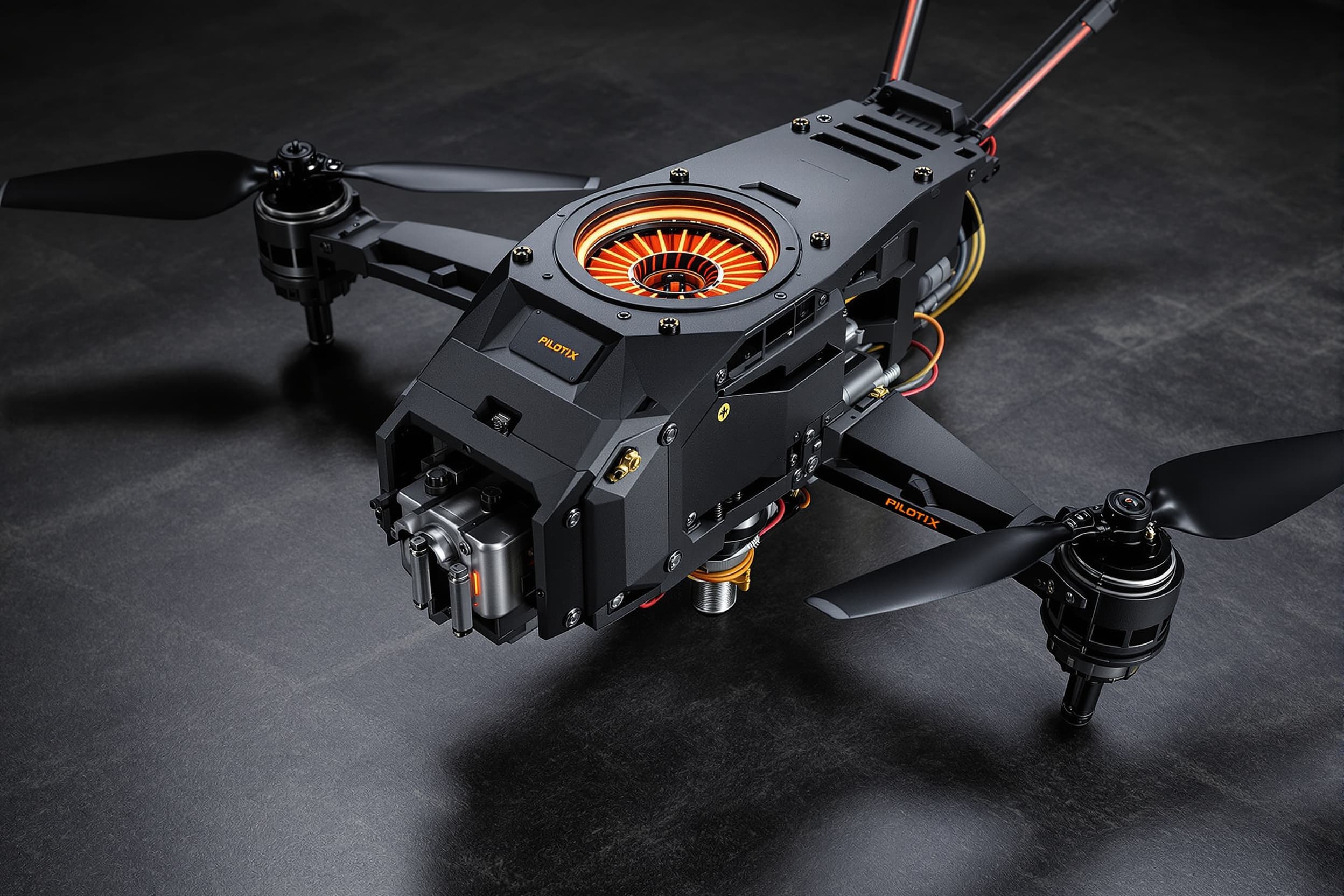
A compact 12N/14P brushless outrunner motor with 900KV rating, optimized for 3–6S systems. It delivers up to 4080 g thrust and 1592 W peak power, designed for heavy-lift drones and commercial operations. Ships with protective plastic cable sleeves and a quick-connect plug for fast field replacement.

Feasibility at a glance
PT localization
4/10
Partial
Only finishing and testing can be localised in Portugal.
Per unit
€40–80
at 4-unit volume
Starter batch
4units
minimum viable run
To first batch
18weeks
6 phases, design to ship
Budget
€95–125k
all-in estimate
Bottom line
A 900KV brushless motor with 12N/14P windings, high-current capacity (63.7 A), and precision Japanese bearings requires specialized motor-winding equipment, tight tolerances on machining (rotor bell, shaft), and strict electrical/mechanical QC. Portugal lacks established brushless-motor manufacturers for this performance tier. Co-developing with a proven EU motor house (Austria, Germany, Poland) balances IP control, quality assurance, and reasonable lead times (16–18 weeks) at €48–62/unit—well within the €40–80 target. White-label availability for this exact 3115 size/900KV spec is limited. Local assembly would still require imported stators and rotor assemblies from the same EU partners.
3 capabilities
Spins a propeller at up to 4080 grams of thrust to lift the drone and its payload into the air.
Converts electrical power from the battery into mechanical rotation with high efficiency and low heat.
Provides quick field replacement via the plug connector when a motor fails during commercial operations.
6 stations · build route
Wind copper coils onto stator laminations
Automated winding machines lay 12 poles of enamel-coated wire with precise tension.
Machine the aluminum bell and shaft
CNC turning produces the rotor body and 5 mm hardened-steel shaft to tight concentricity.
Bond magnets into rotor bell
Fourteen neodymium arc magnets are epoxied in alternating polarity inside the bell.
Press bearings and assemble rotor to stator
Double Japanese bearings are installed; the rotor bell slides over the stator with minimal clearance.
Solder phase wires and install protective tubing
Three silicone leads are soldered to phase tabs, sleeved in plastic pipes, and terminated with the plug.
Spin-test and QC inspection
Each motor is run at rated voltage to verify bearing smoothness, balance, and electrical parameters.
Wind copper coils onto stator laminations
Automated winding machines lay 12 poles of enamel-coated wire with precise tension.
Machine the aluminum bell and shaft
CNC turning produces the rotor body and 5 mm hardened-steel shaft to tight concentricity.
Bond magnets into rotor bell
Fourteen neodymium arc magnets are epoxied in alternating polarity inside the bell.
Press bearings and assemble rotor to stator
Double Japanese bearings are installed; the rotor bell slides over the stator with minimal clearance.
5 identified · 2 blocking
High
Neodymium Magnet Supply Chain Volatility
Neodymium-iron-boron (NdFeB) magnets for the rotor bell are subject to rare-earth metal price swings and export restrictions from China, which controls ~80% of global supply. A supply shock or geopolitical tension can delay magnet deliveries by 6–10 weeks and spike costs by 40–60%. Even EU motor partners source magnets from Asian smelters, creating a bottleneck.
Mitigation — Dual-source magnets: primary from a certified EU importer (e.g., MS-Schramberg, Germany) with safety stock for 12 weeks of production; secondary from a Japanese supplier (e.g., Shin-Etsu, TDK). Negotiate fixed-price contracts for 6-month horizons and pre-purchase magnet inventory during price troughs. Design rotor bell to accept ±0.2 mm magnet-thickness variance so alternative grades remain compatible.
High
Bearing Grade and Counterfeit Risk
The motor spec calls for Japanese double bearings (NSK, NTN, Minebea) with anti-corrosion treatment and ABEC-7 precision. Counterfeit or substandard bearings—common in grey-market supply chains—lead to premature wear, vibration, and in-flight motor failure. A single bearing failure can ground a commercial drone fleet and damage Pilotix's reputation.
Mitigation — Mandate traceable, serialized bearings from authorized NSK/NTN distributors (e.g., Schaeffler, SKF authorized channels). Require certificate of conformity and batch test reports with each delivery. Perform incoming inspection: measure radial play (<0.01 mm), spin each bearing by hand for smoothness, and randomly select 5% for destructive tear-down to verify seal integrity and grease spec. Reject any lot with >1% defect rate and blacklist the supplier.
Medium
Winding-Fixture Tooling Lead Time
Custom 12N/14P winding requires a dedicated stator fixture for automated winding machines. Tooling lead time is 4–6 weeks, and any design change (pole count, wire gauge, slot geometry) demands re-tooling. First-article spin tests may reveal imbalance or inductance drift, triggering a second iteration (+4 weeks).
Mitigation — Front-load engineering validation: run FEA simulations (ANSYS Maxwell, JMAG) to lock pole/slot geometry and wire tension before ordering fixtures. Request the motor partner to 3D-print a prototype fixture for hand-winding 2–3 stators; validate electrical parameters (Kv, resistance, inductance) and mechanical balance on a test bench. Only release production tooling after prototype sign-off. Maintain a contingency buffer of +3 weeks in the project timeline.
Medium
Design IP Leakage to Competitor Motor Brands
Co-development with an EU motor house involves sharing detailed CAD (rotor bell, stator lamination stack), winding diagrams, and magnet-placement drawings. If the partner also serves competitors (other UAV brands), there is risk they adapt the Pilotix 3115 design into a catalogue product or supply a rival with a suspiciously similar motor.
Mitigation — Execute a bilateral NDA with IP ownership clause: Pilotix retains all design rights, and the manufacturer is prohibited from productizing the 3115 for three years post-launch. Watermark CAD files and serialize winding diagrams. Conduct quarterly audits of the partner's customer list (contractual right). For very high volumes (>2k units/year), consider vertical integration: license the winding process and bring it in-house or to a dedicated contract facility under exclusive terms.
Medium
CE EMC and RED Compliance for Motor Emissions
Brushless motors generate electrical noise (commutation spikes, back-EMF harmonics) that can interfere with drone flight controllers, GPS, and radio links. If the motor fails EN 55015 (EMC emissions) or RED Article 3.1(b) (interference management), it cannot legally be sold with a CE mark in the EU, blocking market entry.
Mitigation — During co-development, specify twisted-phase wiring and a ferrite choke on each motor cable to suppress radiated emissions. Run pre-compliance EMC testing at an accredited lab (e.g., TÜV Rheinland, SGS) on a representative drone frame with ESCs and flight controller installed. Budget €4k–6k for full EN 55015 + EN 61000-6-3 test suite. If emissions exceed limits, iterate cable shielding or add capacitors at the ESC input. Only release to production after passing EMC and obtaining CE technical file.
18 weeks to first batch
Design Freeze and Winding-Fixture Engineering
wk 1–3Tooling and Material Procurement
wk 4–8Prototype Batch and First-Article Testing
wk 9–11EMC Pre-Compliance and Design Iteration
wk 12–13Pilot Production Run (250 Units)
wk 14–16Full CE Certification and Documentation
wk 17–18Design Freeze and Winding-Fixture Engineering
wk 4–8 is the longest stretch — Tooling and Material Procurement takes 5 weeks of the 18 weeks on this build.
7 materials · 8 processes
Materials
Processes
668 Portuguese manufacturers matched
None cover the whole build — it splits across steps.
11 tasks · 18 weeks to first batch
Week 1
2 tasks
Select EU co-development partner and execute NDA
Evaluate quotes from Dunkermotoren, Maxon, FAULHABER, and Nanotec; compare winding-line capacity, bearing sourcing, and EMC test facilities. Sign bilateral NDA with IP ownership clause and exclusivity terms for 3 years. Confirm MOQ 250 units, lead time 16–18 weeks, and cost €48–62/unit.
Freeze 12N/14P winding design and run FEA simulations
Lock stator lamination stack geometry, pole/slot configuration, wire gauge (16 AWG), and target resistance (0.046Ω). Run ANSYS Maxwell or JMAG electromagnetic FEA to verify 900KV rating at 22.2V and validate torque/efficiency curves. Export validated CAD and winding diagrams to partner.
Weeks 2–3
2 tasks
Procure neodymium magnets and Japanese bearings with certificates
waits on Select EU co-development partner and execute NDA
Order 3,500 neodymium arc magnets (14 per motor × 250 units) from MS-Schramberg or certified EU importer with flux-density CoC. Purchase 500 NSK or NTN ABEC-7 bearings (2 per motor) from authorized distributor with serialized batch reports. Verify anti-corrosion coating and radial play <0.01mm on incoming samples.
Design and manufacture winding fixture tooling
waits on Freeze 12N/14P winding design and run FEA simulations
Partner engineers design automated winding fixture for 12-pole stator. Order fixture fabrication (4 weeks). Request 3D-printed prototype fixture for hand-winding 3 test stators to validate slot fill, wire tension, and inductance before production tooling is finalized.
Weeks 4–7
3 tasks
Wind and assemble 10 first-article prototypes
waits on Procure neodymium magnets and Japanese bearings with certificates, Design and manufacture winding fixture tooling
Wind 10 stators on prototype fixture, CNC-machine 10 rotor bells and 5mm hardened shafts, bond magnets with high-temp epoxy (alternating N-S), press-fit bearings. Solder 16 AWG silicone phase leads, install plastic protective sleeves, terminate with MT60 plugs. Assemble rotor to stator with <0.2mm air gap.
Spin-test prototypes and validate electrical parameters
waits on Wind and assemble 10 first-article prototypes
Run each of 10 motors at 6S (22.2V) for 60 seconds under rated load. Measure KV (target 900 ±5%), phase resistance (0.046Ω ±10%), current draw at peak thrust, vibration amplitude, and temperature rise. Record balance and bearing smoothness. If any parameter drifts, adjust winding tension or magnet placement and re-test.
Conduct EMC pre-compliance scan on test frame
waits on Spin-test prototypes and validate electrical parameters
Mount 4 prototype motors on a representative drone frame with ESCs and flight controller. Run radiated-emissions (30 MHz–1 GHz) and conducted-emissions tests per EN 55015 at TÜV or SGS pre-compliance lab. If noise exceeds limits, add ferrite chokes to motor cables and re-route with twisted pairs. Re-test until 6 dB margin achieved.
Weeks 8–16
3 tasks
Release production tooling and scale to pilot run
waits on Conduct EMC pre-compliance scan on test frame
Approve winding fixture for automated production. Partner scales to 250-unit pilot: wind stators, CNC rotor bells, bond magnets, press bearings, solder cables, install MT60 plugs. Each motor undergoes 60-second spin test; sort into ±5% KV bins. Target ≥95% yield. Reject any motor with vibration >0.5mm/s or resistance drift >10%.
Complete CE technical file and self-certification
waits on Conduct EMC pre-compliance scan on test frame, Release production tooling and scale to pilot run
Compile CAD, BOM, spin-test reports, EMC data (EN 55015, EN 61000-6-3), RoHS material declarations for cable/solder, REACH compliance for magnets/epoxy. Prepare Declaration of Conformity under LVD 2014/35/EU and EMC 2014/30/EU. Generate user manual with electrical ratings, mounting torque, propeller compatibility, and safety warnings.
Receive, inspect, and serial-number 250 pilot motors
waits on Release production tooling and scale to pilot run
Incoming QC: measure resistance and KV on 10% sample, visual inspection of cable routing, MT60 connector pull-test, bearing spin smoothness. Assign unique serial numbers; record motor S/N, bearing batch, magnet lot, and winding date in traceability database. Accept shipment if <2% defect rate; escalate to partner if higher.
Ongoing
1 task
Monitor magnet supply chain and lock 6-month pricing
Track neodymium spot prices and rare-earth export news. Negotiate fixed-price contract with MS-Schramberg or secondary Japanese supplier (Shin-Etsu, TDK) for next 6 months of magnet inventory. Pre-purchase magnets during price troughs. Maintain 12-week safety stock to buffer against supply shocks.
4 roles to fill before month one
Technical lead at Dunkermotoren or Nanotec (Germany)
Jürgen Stein, Application Engineer
Owns winding-fixture design, FEA validation, and first-article spin-test protocols. Founder needs direct line to iterate magnet placement and cable routing if EMC or vibration issues arise during prototyping.
EU motor partner supply-chain lead
Marta Kowalczyk, Procurement Manager
Controls neodymium magnet and Japanese bearing sourcing; can expedite critical components if lamination stacks or bearings are delayed. Essential for locking 6-month fixed-price magnet contracts to hedge rare-earth volatility.
TÜV Rheinland or SGS pre-compliance lab
Dr. Henrik Larsen, EMC Test Engineer
Runs EN 55015 radiated-emissions scans and advises on ferrite choke placement, cable shielding, and twisted-pair routing. Founder must coordinate test-frame configuration and schedule 2-day lab sessions within week 8–10 window.
CE certification and technical-file specialist (Portugal or EU-based)
Sofia Mendes, Compliance Consultant
Prepares Declaration of Conformity, compiles RoHS/REACH material declarations, and drafts user manual per Machinery Directive. Ensures all documentation is audit-ready for commercial UAV customers and EASA Part 21 traceability if required.
5 things to avoid in this plan
supply
Watch for neodymium magnet supply shocks—lock 6-month fixed pricing and maintain 12-week safety stock with dual EU/Japan suppliers.
watch-out
Validate winding fixture with hand-wound prototypes before releasing production tooling; a single iteration adds 4 weeks.
certification
Front-load EMC pre-compliance testing by week 10—failing EN 55015 after pilot production triggers costly cable redesign and re-certification.
watch-out
Mandate serialized NSK/NTN bearings from authorized channels only; counterfeit bearings cause in-flight failures and reputation damage.
watch-out
Secure IP with bilateral NDA and exclusivity clause—partner must not productize the 3115 design for competitors within 3 years.
2 tasks in week 1
Select EU co-development partner and execute NDA
Solder phase wires and install protective tubing
Three silicone leads are soldered to phase tabs, sleeved in plastic pipes, and terminated with the plug.
Spin-test and QC inspection
Each motor is run at rated voltage to verify bearing smoothness, balance, and electrical parameters.
Tooling and Material Procurement
Prototype Batch and First-Article Testing
EMC Pre-Compliance and Design Iteration
Pilot Production Run (250 Units)
Full CE Certification and Documentation
668 matched · 8 shown, ranked by coverage
Covers, left to right: Motor Winding · CNC Machining · Injection Molding · Soldering · Cable Assembly · Testing & Inspection · Final Assembly · Packaging
Manufacturer
Location
Covers
Certifications
People
Portuguese producers per required step
Final Assembly
369
CNC Machining
212
Testing & Inspection
178
Injection Molding
174
Soldering
13
Cable Assembly
12
Motor Winding
0
How many cover more than one step
The gap
A 900KV brushless motor with 12N/14P windings, high-current capacity (63.7 A), and precision Japanese bearings requires specialized motor-winding equipment, tight tolerances on machining (rotor bell, shaft), and strict electrical/mechanical QC. Portugal lacks established brushless-motor manufacturers for this performance tier. Co-developing with a proven EU motor house (Austria, Germany, Poland) balances IP control, quality assurance, and reasonable lead times (16–18 weeks) at €48–62/unit—well within the €40–80 target. White-label availability for this exact 3115 size/900KV spec is limited. Local assembly would still require imported stators and rotor assemblies from the same EU partners.
Send one RFQ to the top 4
REROM, MOLDMAK, ITECMO, Quickmold — same package, one click.
Packaging
0