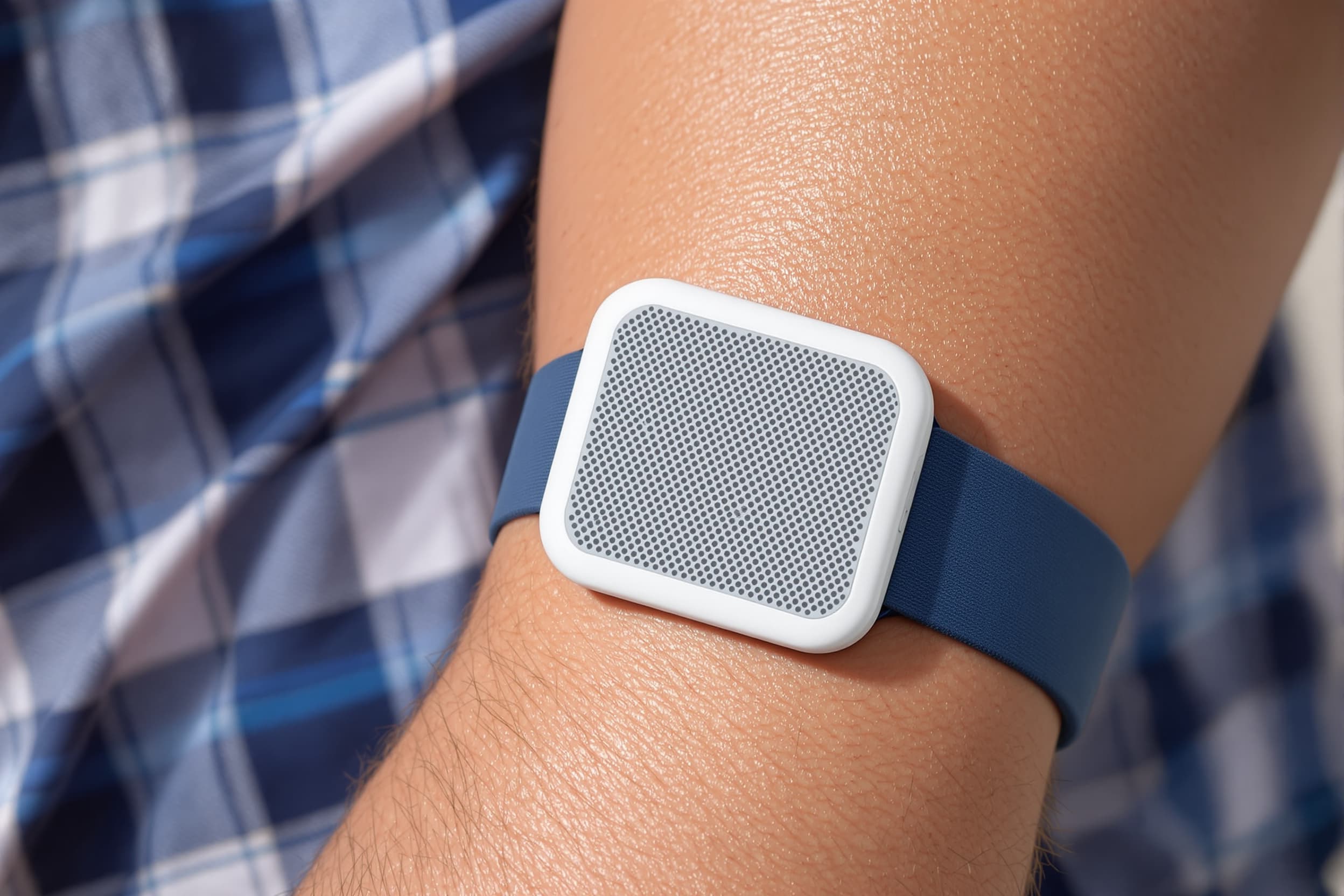
An adhesive wearable patch that uses enzymatic micro-needles to sample interstitial fluid and measure blood lactate levels every 30 seconds. Pairs via Bluetooth Low Energy with cycling computers and smartphones to deliver real-time lactate data (mmol/L) for zone-based training. Designed for 10-day continuous wear on the upper trapezius or deltoid with sweat-resistant adhesive.

Feasibility at a glance
PT localization
4/10
Partial
Only finishing and testing can be localised in Portugal.
Per unit
€45–75 per disposable patch + €80–120 for reusable BLE module
at 5000-unit volume
Starter batch
5,000units
minimum viable run
To first batch
38weeks
8 phases, design to ship
Budget
€185,000–260,000 covering: microneedle tooling
all-in estimate
Bottom line
A wearable continuous lactate monitor is a Class IIb medical device requiring CE-MDR certification, enzymatic biosensor expertise, microneedle fabrication, and potentiostat design. Portugal lacks the full in-house capability for biosensor enzyme immobilization and ASIC integration at this complexity. White-label options are virtually non-existent for such a novel continuous lactate monitor. Co-development with an established EU medical-device electronics partner (Germany, Switzerland, or Netherlands) offers access to validated cleanroom processes, ISO 13485 quality systems, sterile packaging lines, and notified-body pathways—while keeping final assembly and regulatory ownership in Portugal for faster iteration and market proximity.
4 capabilities
Measures lactate concentration in body fluid every thirty seconds without finger-prick blood draws
Sends live lactate readings to your bike computer or watch so you can adjust effort in real time
Sticks securely to skin through ten days of training, sweat, and showers
Calculates and displays your lactate threshold zones to guide interval and endurance workouts
5 stations · build route
Microneedle array fabrication
Laser-cut or micro-molded stainless steel or polymer needles, then electropolished and sharpened to sub-millimeter length.
Enzyme immobilization
Lactate oxidase is deposited onto the needle tips or electrode surface and cross-linked to create a stable biosensor layer.
Potentiostat PCB assembly
Surface-mount the ASIC, references, and passives onto a flex or rigid-flex PCB, then calibrate each unit.
Adhesive die-cutting and lamination
Medical-grade acrylic adhesive is laser-cut to shape and laminated onto the patch housing with a peel-off liner.
Sterile packaging and final test
Each disposable patch is sealed in a sterile pouch, functionally tested, and packaged with the reusable BLE module.
Microneedle array fabrication
Laser-cut or micro-molded stainless steel or polymer needles, then electropolished and sharpened to sub-millimeter length.
Enzyme immobilization
Lactate oxidase is deposited onto the needle tips or electrode surface and cross-linked to create a stable biosensor layer.
Potentiostat PCB assembly
Surface-mount the ASIC, references, and passives onto a flex or rigid-flex PCB, then calibrate each unit.
Adhesive die-cutting and lamination
Medical-grade acrylic adhesive is laser-cut to shape and laminated onto the patch housing with a peel-off liner.
Sterile packaging and final test
Each disposable patch is sealed in a sterile pouch, functionally tested, and packaged with the reusable BLE module.
6 identified · 3 blocking
Critical
Lactate oxidase enzyme supply and stability
Lactate oxidase is a specialty biochemical reagent with limited global suppliers (Roche CustomBiotech, Sekisui Diagnostics, Toyobo). Lead times can reach 16–20 weeks, and enzyme activity degrades over time, especially at elevated temperatures. A supply interruption or batch failure would halt all disposable patch production. Cold-chain logistics from enzyme supplier to biosensor assembly line add cost and complexity. Enzyme lot-to-lot variability requires re-calibration of each production batch, increasing QC burden.
Mitigation — Dual-source enzyme from two qualified vendors (one EU, one Asia-Pacific) and maintain six months' safety stock in refrigerated ISO 13485 warehouse. Negotiate consignment agreements or pre-purchased enzyme aliquots. Invest in accelerated stability studies (40°C, 75% RH) to extend shelf life and reduce cold-chain dependency. Design potentiostat firmware to auto-calibrate for small enzyme activity shifts, minimizing re-work.
High
Intellectual property and trade-secret leakage
The enzymatic formulation, microneedle geometry, and potentiostat calibration curve are core trade secrets. Co-development or toll-manufacturing arrangements expose these to partner engineers. If the partner also serves competitors (e.g., other sports-tech or CGM companies), cross-contamination of know-how is possible. Lactate monitor IP landscape is crowded; risk of inadvertently infringing patents held by Abbott, Roche, or sports-science startups (e.g., Lactate Plus, BSX Athletics) during design.
Mitigation — File provisional patents on unique microneedle array design and lactate-threshold algorithm before sharing CAD files. Use strict NDAs with technical annexes limiting partner's right to reuse GETMILK's enzyme protocol. Conduct freedom-to-operate (FTO) search with a European patent attorney specializing in biosensors (budget €8k–12k). Keep final calibration coefficients and BLE pairing keys in Portugal; ship pre-calibrated modules to partner only for integration, not full access.
High
CE-MDR Class IIb approval and clinical evidence
Under EU MDR 2017/745, a wearable lactate monitor is Class IIb (invasive device in contact with blood/body fluid for <30 days). Notified-body review requires clinical data demonstrating safety and performance, including comparison to laboratory reference (e.g., YSI lactate analyzer). Timeline for notified-body submission to certificate issuance is 9–14 months. If enzyme or microneedle design changes during development, clinical study may need repeating. ISO 10993 biocompatibility testing (cytotoxicity, sensitization, irritation) adds 12–16 weeks and €15k–25k per material variant.
Mitigation — Engage notified body (TÜV SÜD, BSI, DEKRA) early for pre-submission meeting; align on clinical study protocol (n=30–50 athletes, lactate ramp test vs. reference analyzer). Use only established biocompatible materials (medical-grade PEEK, acrylic adhesive with ISO 10993 certs from 3M or Scapa). Budget 14 months and €80k–120k for full CE-MDR pathway. Pilot study with 10 beta users to de-risk sensor accuracy and adhesion claims before notified-body submission.
Medium
Microneedle tooling and validation lead time
Laser micro-machining or micro-molding tooling for sub-1 mm stainless steel or silicon microneedles takes 12–18 weeks and costs €25k–50k for initial molds. Needle geometry (length, bevel angle, tip radius) directly affects pain perception and interstitial fluid uptake; multiple design-build-test cycles may be required. If the first batch fails biocompatibility or insertion-force testing, retooling adds another 10–14 weeks. Only a few EU suppliers (e.g., Hahn-Schickard, IMT Masken und Teilungen) offer microneedle prototyping.
Mitigation — Run finite-element simulation and cadaver/synthetic-skin insertion tests (budget €5k–8k) before committing to steel tooling. Order two mold cavities in parallel with slight geometry variations (e.g., 0.8 mm vs. 0.9 mm length) to hedge design risk. Secure long-term capacity reservation with microneedle supplier to avoid queuing delays for repeat orders. Consider hybrid approach: silicon microneedles (faster prototyping) for clinical study, then transition to stainless steel for production.
Medium
Sensor-to-sensor calibration variability and drift
Enzymatic sensors exhibit unit-to-unit variation in sensitivity (±10–15%) due to enzyme deposition thickness, electrode surface area, and membrane permeability. Each disposable patch must be individually calibrated against known lactate standards, adding 2–4 minutes per unit in production. Over the 10-day wear period, enzyme activity decays and biofouling occurs, causing sensor drift (±0.2–0.5 mmol/L). If drift exceeds ±0.1 mmol/L spec, users lose trust in real-time lactate zones.
Mitigation — Implement automated two-point calibration (0.5 and 10 mmol/L lactate buffer) during final test; use robotic liquid handling to maintain consistency. Embed drift-correction algorithm in firmware: compare morning resting lactate (expected ~1 mmol/L) to sensor reading and auto-adjust offset. Require users to perform a single-point 'baseline' check each morning via app prompt. Extend enzyme stability through cross-linker optimization (glutaraldehyde or EDC/NHS chemistry) and include desiccant in sterile pouch.
Medium
Sterile cold-chain logistics for enzyme-coated patches
Disposable patches must remain sterile and enzyme-active from manufacturing through end-user application (up to 18 months shelf life). Exposure to >30°C or humidity >60% RH degrades enzyme activity by 20–40% within weeks. If patches are manufactured in Germany but warehoused in Portugal, cold-chain trucking (2–8°C) adds €0.80–1.50/unit. Summer heat during last-mile delivery (to pharmacies or end-users) is uncontrolled. Any break in sterility triggers a recall under MDR vigilance rules.
Mitigation — Specify sterile gamma-irradiation (25 kGy) after sealing patches in foil pouches; this is terminal sterilization and more robust than ethylene oxide. Store finished goods in climate-controlled 3PL with GDP (Good Distribution Practice) certification (e.g., Rangel Logistics PT or DHL Healthcare). Use temperature data loggers in each master carton and void warranty if cold-chain breach detected. For D2C shipments, include cool-packs in summer months and restrict shipments above 35°C ambient. Accelerate stability testing at 25°C/60% RH and 30°C/65% RH to validate 18-month shelf life.
38 weeks to first batch
Specification freeze and microneedle tooling kick-off
wk 1–4Microneedle array prototyping and insertion testing
wk 5–10Enzyme deposition and biosensor layer fabrication
wk 11–15Potentiostat PCB fabrication and SMT assembly
wk 16–21Adhesive die-cutting, patch assembly, and BLE module integration
wk 22–25Two-point calibration and functional test
wk 26–28Sterile packaging, gamma irradiation, and labeling
wk 29–33Clinical validation and first production batch release
wk 34–38Specification freeze and microneedle tooling kick-off
Microneedle array prototyping and insertion testing
wk 5–10 is the longest stretch — Microneedle array prototyping and insertion testing takes 6 weeks of the 38 weeks on this build.
7 materials · 8 processes
Materials
Processes
594 Portuguese manufacturers matched
None cover the whole build — it splits across steps.
15 tasks · 13 weeks to first batch
Week 1
2 tasks
Shortlist and contact three EU biosensor co-development partners
Reach out to Raumedic (DE), Hahn-Schickard (DE), and Ypsomed (CH) with a technical brief covering microneedle geometry, enzyme requirements, potentiostat spec, and 5k-unit pilot volume. Request capability statements, ISO 13485 certificates, and indicative NRE + per-unit pricing. Schedule video calls within 10 days.
Engage patent attorney for freedom-to-operate search
Hire a European patent attorney specializing in biosensors and wearable medtech to conduct a freedom-to-operate (FTO) analysis covering microneedle lactate sensors, enzymatic electrochemical detection, and ANT+/BLE sports integration. Budget €8–12k. Identify any blocking patents from Abbott, Roche, BSX Athletics, or Lactate Plus.
Weeks 2–3
3 tasks
Freeze microneedle geometry and initiate tooling with Hahn-Schickard
waits on Shortlist and contact three EU biosensor co-development partners
Lock array pitch (e.g., 3×3 grid, 2 mm spacing), needle length (0.85 mm), bevel angle (15°), and tip radius (<10 µm) based on synthetic-skin insertion simulations. Issue PO for laser micro-machining tooling (two mold cavities at 0.8 mm and 0.9 mm to hedge risk). Lead time: 12 weeks, cost €35k.
Dual-source lactate oxidase enzyme from EU and APAC suppliers
Request quotes and lead times from Roche CustomBiotech (CH) and Sekisui Diagnostics (JP). Order 50 g pharmaceutical-grade lactate oxidase (sufficient for 10,000 patches) with Certificate of Analysis. Negotiate consignment or pre-purchase agreement to secure 6-month safety stock. Lead time: 16 weeks.
Select and order potentiostat ASIC and BLE SoC modules
Down-select to Analog Devices AD5940 or TI LMP91000 potentiostat ASIC based on noise floor, power budget, and reference designs. Procure Nordic nRF52840 BLE SoC modules (pre-certified for RED 2014/53/EU). Order 100 units for prototyping and pilot (12-week lead). Budget €8k for ICs.
Weeks 4–7
3 tasks
Design and fabricate potentiostat rigid-flex PCB (4-layer)
waits on Select and order potentiostat ASIC and BLE SoC modules
Complete schematic capture, layout (rigid-flex for reusable BLE module), and Gerber release. Send to AT&S (Austria) or Cicor (Switzerland) for 4-layer ENIG PCB fabrication. Order 50 boards for pilot assembly. Include test points for JTAG programming and potentiostat bias verification. Lead time: 6 weeks.
Book notified-body pre-submission meeting (TÜV SÜD or BSI)
Schedule a 2-hour remote consultation with TÜV SÜD Medical or BSI Netherlands to review classification (Class IIb), clinical evaluation plan, essential requirements checklist (Annex I MDR), and UDI/EUDAMED registration. Clarify whether IVDR overlap applies. Budget €2–3k for meeting and follow-up written guidance.
Initiate ISO 10993 biocompatibility testing for adhesive and housing
waits on Freeze microneedle geometry and initiate tooling with Hahn-Schickard
Send samples of medical-grade acrylic adhesive (3M 1524 or Scapa Biotac), PEEK housing, and stainless steel microneedle prototypes to accredited ISO 17025 lab (e.g., SGS, Eurofins, or Nelson Labs EU). Request cytotoxicity (ISO 10993-5), sensitization (10993-10), and irritation (10993-23) testing. Lead time: 12–14 weeks, cost €18–22k.
Weeks 8–16
6 tasks
Receive microneedle prototypes and perform insertion-force validation
waits on Freeze microneedle geometry and initiate tooling with Hahn-Schickard
Inspect first laser-cut stainless steel microneedle arrays from Hahn-Schickard. Measure penetration depth with optical profilometry (target <1 mm). Conduct insertion-force testing on synthetic skin (Syndaver or similar) using force gauge; target <5 N insertion force and confirm no bleeding. Document results for technical file. If out of spec, iterate tip geometry.
Develop enzyme deposition protocol with co-development partner
waits on Dual-source lactate oxidase enzyme from EU and APAC suppliers, Receive microneedle prototypes and perform insertion-force validation
Co-develop lactate oxidase immobilization process (dip-coating or inkjet) with partner. Cross-link enzyme using glutaraldehyde or EDC/NHS chemistry. Apply Nafion or polyurethane selective membrane. Cure in controlled-humidity chamber. Test 10 coated electrodes in lactate buffer (0.5, 2, 5, 10, 20 mmol/L); target linear response, sensitivity >10 nA/mmol·L, and <5% CV.
Assemble and calibrate 50-unit pilot batch
waits on Design and fabricate potentiostat rigid-flex PCB (4-layer), Develop enzyme deposition protocol with co-development partner
Ongoing
1 task
Weekly sync with co-development partner and notified body
Hold 30-min video stand-ups with biosensor partner to track microneedle tooling, enzyme procurement, and pilot assembly milestones. Monthly check-in with notified body to pre-validate clinical study design, labeling drafts, and UDI registration. Escalate any enzyme supply delays or calibration yield issues immediately. Maintain shared risk register in Notion or Jira.
4 roles to fill before month one
Co-development technical lead for microneedle fabrication and enzyme immobilization
Dr. Klaus Müller, Biosensor Engineering Lead at Hahn-Schickard (DE)
Hahn-Schickard has deep expertise in laser micro-machining of stainless steel microneedles and validated lactate oxidase deposition protocols under ISO 13485. Klaus will be the primary engineering interface for tooling design, enzyme stability testing, and pilot batch assembly. His team holds ISO 10993 biocompatibility data on similar needle geometries, accelerating regulatory clearance.
Notified-body liaison and CE-MDR pre-submission consultant
Maria Carvalho, Regulatory Affairs Specialist at TÜV SÜD Portugal
Maria provides local Portuguese-language support and has notified-body relationships across TÜV SÜD's EU network. She will guide the founder through Class IIb classification, clinical evaluation requirements, UDI registration in EUDAMED, and essential-requirements mapping. Her pre-submission review will de-risk the formal notified-body audit and shorten time to CE certificate.
Clinical pilot study principal investigator and athlete recruitment
Prof. João Ribeiro, Sports Physiology Lab, Faculty of Human Kinetics (Lisbon)
Prof. Ribeiro runs one of Portugal's leading lactate threshold research labs, with access to 100+ trained cyclists and triathletes. He owns a YSI 2300 reference analyzer and can design a robust lactate ramp-test protocol that meets notified-body clinical evidence standards. His IRB approval and academic authorship will add credibility to the clinical evaluation report.
5 things to avoid in this plan
lead time
Watch for lactate oxidase enzyme supply delays (16-week lead time from Roche or Sekisui); a batch failure or customs hold would stall pilot assembly by 8+ weeks. Dual-source and pre-purchase 6 months' safety stock.
quality
Lock in microneedle tooling geometry early — any redesign after first prototypes adds 10–14 weeks retooling. Run FEA simulation and synthetic-skin insertion tests before committing €35k to steel molds.
lead time
Secure notified-body (TÜV SÜD or BSI) pre-submission meeting in Month 1; classification disputes or unexpected clinical evidence requests can cascade into 6-month delays if discovered late.
quality
Enzyme calibration yield is the #1 production risk — if <80% of pilot units pass two-point calibration within ±0.1 mmol/L spec, investigate membrane permeability, cross-linker chemistry, or potentiostat noise floor before scaling.
2 tasks in week 1
Shortlist and contact three EU biosensor co-development partners
Enzyme deposition and biosensor layer fabrication
Potentiostat PCB fabrication and SMT assembly
Adhesive die-cutting, patch assembly, and BLE module integration
Two-point calibration and functional test
Sterile packaging, gamma irradiation, and labeling
Clinical validation and first production batch release
SMT-assemble potentiostat PCBs at partner facility or Portuguese EMS provider. Integrate enzyme-coated microneedle arrays, adhesive patches, coin-cell batteries, and BLE modules. Perform two-point calibration (0.5 and 10 mmol/L lactate buffer) and store coefficients in EEPROM. Functional test: verify BLE pairing, 10-day battery life, and ±0.1 mmol/L accuracy. Yield target: >80%.
Recruit 30 athletes and design lactate ramp-test protocol
Partner with a university sports-science lab (e.g., FMH Lisbon, ISMAI Porto) or cycling club to recruit 30 participants (age 18–50, regular training). Design incremental lactate ramp protocol on bike ergometer or treadmill (3-min stages, +20W/stage). Rent or borrow YSI 2300 lactate analyzer as reference standard. Submit ethics application to institutional review board. Budget €8k participant incentives + €12k lab fees.
Execute 30-athlete clinical pilot and calculate MARD
waits on Assemble and calibrate 50-unit pilot batch, Recruit 30 athletes and design lactate ramp-test protocol
Apply wearable lactate monitor to each participant's upper trapezius. Perform lactate ramp test; collect capillary blood samples at 5 time points per session for YSI reference measurement. Record wearable sensor readings via smartphone app. Calculate mean absolute relative difference (MARD) and Bland-Altman plot. Target MARD <10% for regulatory acceptance. Document adverse events (skin irritation, sensor detachment).
Draft clinical evaluation report and MDR technical documentation
waits on Initiate ISO 10993 biocompatibility testing for adhesive and housing, Execute 30-athlete clinical pilot and calculate MARD
Compile clinical pilot data, biocompatibility test reports, risk analysis (ISO 14971 FMEA), software verification & validation (IEC 62304), usability evaluation (IEC 62366), and essential requirements checklist into CE-MDR technical file. Engage a regulatory consultant (e.g., Emergo, TÜV SÜD Consulting) to review completeness before notified-body submission. Budget €10–15k consulting.
Freedom-to-operate (FTO) search and provisional patent filing
Dr. Anne-Sophie Leclerc, Patent Attorney at Dennemeyer (Luxembourg)
Anne-Sophie specializes in biosensor and wearable medtech IP across the EU and US. She will conduct a comprehensive FTO search to identify blocking patents from Abbott, Roche, and sports-tech startups, then draft a provisional patent application covering GETMILK's unique microneedle array geometry and lactate-threshold algorithm. Her early involvement protects core trade secrets before sharing designs with manufacturing partners.
watch-out
Athlete recruitment and YSI reference analyzer rental must start in Month 1 to avoid pilot study bottleneck; university IRB approval alone can take 6–8 weeks if protocol is incomplete.
594 matched · 8 shown, ranked by coverage
Covers, left to right: Injection Molding · PCB Fabrication · SMT Assembly · Laser Cutting · Battery Pack Assembly · Final Assembly · Testing & Inspection · Packaging
Manufacturer
Location
Covers
Certifications
People
Portuguese producers per required step
Final Assembly
369
Testing & Inspection
178
Injection Molding
174
SMT Assembly
36
Laser Cutting
13
PCB Fabrication
6
Battery Pack Assembly
3
How many cover more than one step
The gap
A wearable continuous lactate monitor is a Class IIb medical device requiring CE-MDR certification, enzymatic biosensor expertise, microneedle fabrication, and potentiostat design. Portugal lacks the full in-house capability for biosensor enzyme immobilization and ASIC integration at this complexity. White-label options are virtually non-existent for such a novel continuous lactate monitor. Co-development with an established EU medical-device electronics partner (Germany, Switzerland, or Netherlands) offers access to validated cleanroom processes, ISO 13485 quality systems, sterile packaging lines, and notified-body pathways—while keeping final assembly and regulatory ownership in Portugal for faster iteration and market proximity.
Send one RFQ to the top 4
Keenfinity EMS, Uartrónica, Exatronic, Codica Cables — same package, one click.
Packaging
0