
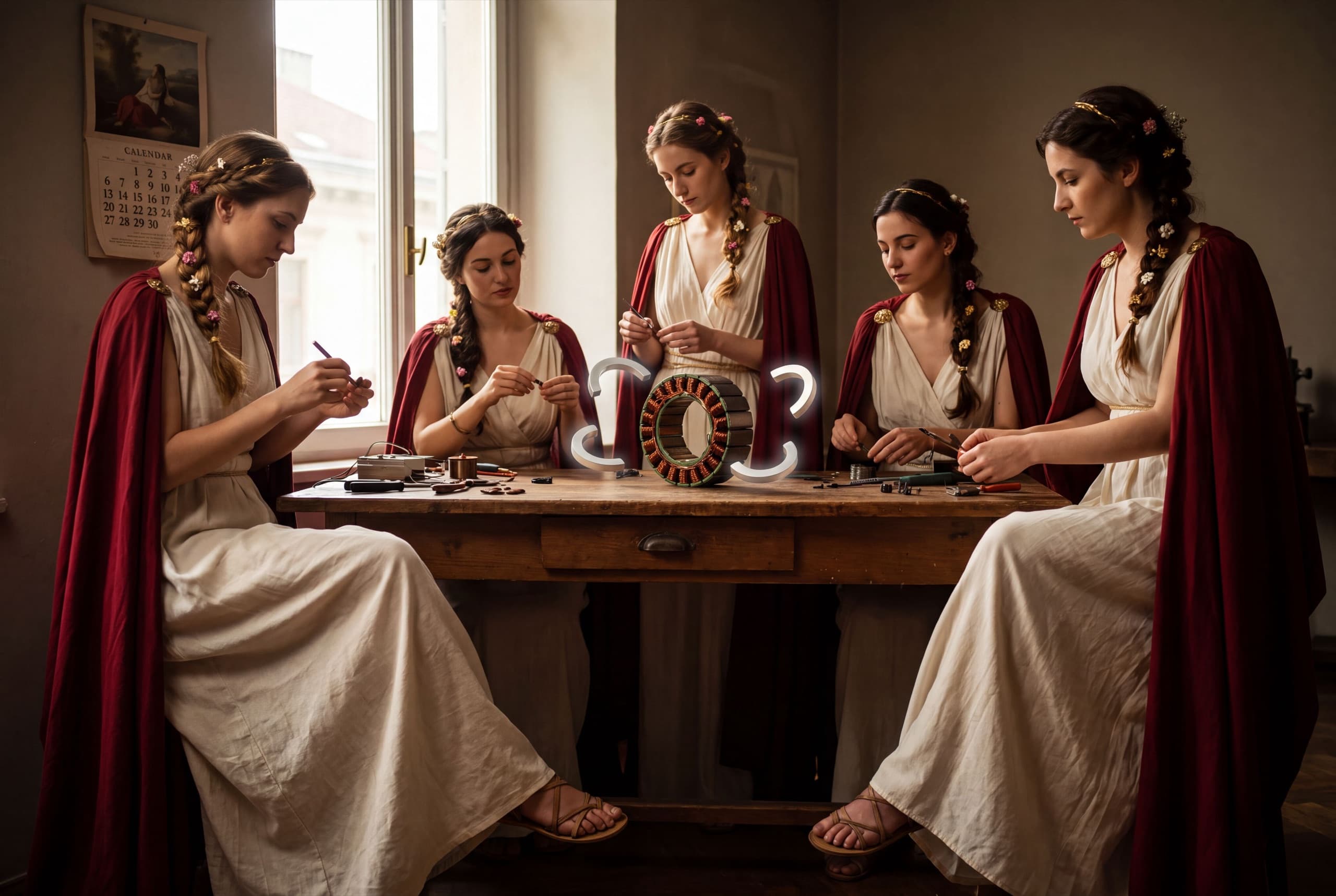
China's one-year pause on its October 2025 rare-earth export controls ends on 10 November 2026 unless Beijing extends it; the April 2025 licences for dysprosium and terbium never stopped. The EU gets 98% of its rare-earth magnets from China and we found no magnet maker in Portugal. In a typical 10-motor drone prototype, custom magnets are the longest lead item (3 to 6 weeks) and none has a maker in Portugal.
China's one-year pause on its October 2025 rare-earth export controls ends on 10 November 2026, unless Beijing publishes an extension [1]; as of 28 September 2026 we found none. The April 2025 licences on dysprosium and terbium, the elements that keep motor magnets strong when hot, were never paused [11]. The EU gets 98% of its rare-earth magnets from China [2], and we found no company in Portugal that makes them. In a typical prototype run of ten drone motors, the magnets are the longest lead item and the only part with no Portuguese maker we could confirm. Map every magnet now, ask where it was made, and book a second source before November.
Key facts
- On 7 November 2025 MOFCOM and China's customs suspended six October 2025 announcements "from today until 10 November 2026" [1].
- The April 2025 licensing of seven medium and heavy rare earths, including NdFeB magnet material containing dysprosium or terbium, was not suspended [11].
- Announcement No. 61 reaches items made abroad when Chinese-origin rare-earth items are 0.1% or more of their value [12].
- In May 2025 Chinese magnet shipments fell about 75% year on year and European car lines stopped [4].
- By early September 2025 Chinese authorities had approved 19 of 141 licence applications from 22 European firms, according to the European Court of Auditors [13].
- In a typical 3115-size drone motor, custom arc magnets take 3 to 6 weeks, usually the longest item in a prototype build.
What exactly ends on 10 November?
China built its controls in two waves. Announcement No. 18 of 4 April 2025 put seven elements under export licence: samarium, gadolinium, terbium, dysprosium, lutetium, scandium and yttrium. Its list names "NdFeB permanent magnet material containing terbium" and the same for dysprosium, as magnets or powder [11]. It took effect the day it was published.
The second wave came on 9 October 2025. Announcement No. 61 requires foreign exporters to get a Chinese dual-use licence when Chinese-origin rare-earth items make up 0.1% or more of the value of certain goods made abroad, or when those goods were made with Chinese rare-earth technology, including magnet manufacturing technology [12]. On 7 November 2025 Announcement No. 70 suspended Nos. 55 to 58, 61 and 62 until 10 November 2026 [1]. That date is the cliff.
The European Parliament's research service summarises the same sequence and the 98% dependence [2]. Analysts describe three outcomes: another pause, partial return or full return [3]. Plan for a full return and treat the others as good news.
What happened the last time supply tightened?
The April 2025 licences alone were enough to stop cars. The European Central Bank reports that Chinese magnet shipments fell by about 75% in May 2025 compared with a year earlier, that critically low stocks shut several lines across Europe, and that over 80% of large European firms sit no more than three intermediaries from a Chinese rare-earth producer [4].
Licences were slow. The European Court of Auditors reports that, between August and early September 2025, Chinese authorities approved only 19 of 141 applications filed by 22 European companies, with 121 urgent ones pending [13]. The same report finds that 100% of rare-earth processing takes place outside the EU, mostly in China [13].
2026 has not been calm. PricePedia reports that China exported 31,000 tonnes of permanent magnets to Europe in 2025, more than 70% of supply, that Chinese export prices rose over 20% from January 2026, and that in July 2026 China barred magnet exports to 14 European companies [5]. PricePedia is a secondary source for the company list; we did not find the Chinese primary text.
What does this look like in a typical motor build?
Take an illustrative example: a prototype run of ten 3115-size 900KV brushless outrunners for heavy-lift drones, a common 12-slot, 14-pole design. The figures below are typical planning numbers for such a motor, not quotes from any supplier.
| Magnet line | Typical figure |
|---|---|
| Magnets per motor | 14 arc segments |
| Quantity for 10 motors | about 145 pieces (3% spare) |
| Shape | Arc, about 1.6 mm thick, 22 degrees, 16 mm long, radially magnetised |
| Grade and coating | N48SH or N52SH (150 °C), Ni-Cu-Ni |
| Lead time, custom | 3 to 6 weeks; usually the longest item in the build |
| Other long items | Stator laminations 2 to 4 weeks; CNC parts 1 to 2 weeks |
| Prototype price, order of magnitude | about €3 per magnet, about €45 per motor |
| Series price, 1,000 units, order of magnitude | about €1.3 per motor at Chinese series prices |
| Red flags to watch in quotes | minimum order above 1,000 pieces, lead time above 8 weeks, rings offered instead of arcs |
Three things stand out. First, a buyer in Portugal will not find a local magnet maker for this list, while the machined parts (base, bell, back-iron ring, shaft) are within reach of Portuguese CNC shops. Second, the SH grade is the high-temperature kind; heavy rare earths are what give NdFeB its strength at high temperature [10], which puts it in the family China has licensed since April 2025 [10]. Third, magnets are roughly a tenth of the series cost of such a motor, yet they set the schedule. That is why the first question to a magnet maker should be whether a standard arc within 0.1 mm exists: a stock part avoids tooling and weeks of waiting, and changing the bell to fit it is usually cheaper than waiting.
Who in Portugal is exposed?
- Motor makers. Allied Motion Portugal makes permanent-magnet brushless motors for vehicles and lists UAVs, robot arms and AMRs among its automation applications [7]. Any plant like it buys magnets in volume and inherits China's rules.
- Drone makers. A typical 3115-size motor carries 14 neodymium arc magnets; a four-motor drone carries 56, and none can be made in Portugal today.
- Everyone with a motor inside. Pumps, fans, actuators, robots and speakers hide NdFeB. The ECB's three-intermediaries finding [4] means you can be exposed without buying a magnet yourself. We cover the wider pattern in what Portuguese producers cannot make.
Can you buy rare-earth magnets in Portugal?
You can buy them, but not make them. In our September 2026 research we found no company in Portugal that sinters, grinds, magnetises or coats NdFeB. The market is distributors. Magnetpt, in Oliveira de Azeméis, works mostly with neodymium magnets, mostly grade N35, and can have custom sizes made subject to a minimum quantity and a lead time [8]. Magnetic Boom, near Lisbon, offers magnetic solutions tailored to each customer [9]. An N35 stock magnet is not a 150 °C motor grade, so a motor arc goes through such an intermediary to a factory abroad.
In Europe, Neo Performance Materials opened a plant in Narva, Estonia, in September 2025 with 2,000 tonnes a year in phase one, which the Commission says can meet up to 15% of EU demand; Bosch has reserved capacity there [6]. The EU's Critical Raw Materials Act sets 2030 benchmarks, including no more than 65% of any strategic raw material from a single third country [15], and the RESourceEU plan of 3 December 2025 put €3 billion behind short-term alternative supply [14]. None of that changes what you can buy this autumn.
What should you do before 10 November?
- Build a where-used list. Every part number that contains a magnet, the count per product, and the grade. Most teams find magnets inside modules they buy finished.
- Ask each supplier three questions in writing. Where was the magnet sintered? Where did the rare-earth metal come from? Does the grade contain dysprosium or terbium? The October rules look at Chinese-origin content and technology, not only the shipping country [12].
- Buy buffer stock for builds you cannot move, priced against this year's increases [5] and against a stoppage like 2025 [4].
- Ask for the nearest standard part. As in the motor example above, a stock arc or block avoids tooling and cuts weeks.
- Check the grade. If a part runs cooler than its grade allows, a grade with less heavy rare earth may do [10]. Ask the motor designer before the magnet supplier.
If magnets sit in a product you sell into public procurement, origin will soon matter twice: see how much of your product is made in Europe.
What to do next
- This week: list every magnet in your bills of materials with grade and supplier, and send the three questions above.
- Before 10 November: place buffer orders for the builds you cannot redesign, and request quotes from at least one source outside China.
- If you want it done for you: GETMILK's managed sourcing builds the where-used list, sends one RFQ package to Portuguese and EU suppliers and compares the answers, from €900 for up to three part families. If you only have a handful of magnet lines and a supplier who answers clearly, you do not need us: the list and the letters above are enough.
References
- Ministry of Commerce of the People's Republic of China. 商务部 海关总署公告2025年第70号 (MOFCOM and GAC Announcement No. 70 of 2025: suspension of Announcements No. 55, 56, 57, 58, 61 and 62) (7 November 2025)
- European Parliamentary Research Service. China's rare-earth export restrictions (At a glance) (24 November 2025)
- Mining Technology. China rare earth export pause nears expiry amid persistent supply concentration (27 April 2026)
- European Central Bank. How vulnerable is the euro area to restrictions on Chinese rare earth exports? (Economic Bulletin 6/2025, box) (2025)
- PricePedia. Restrictions on Chinese exports of permanent magnets are increasing (21 September 2026)
- Neo Performance Materials. Neo Performance Materials opens state-of-the-art permanent magnet facility in Europe (22 September 2025)
- Allied Motion Portugal. Allied Motion Portugal: motion solutions for vehicles and automation (accessed 27 September 2026)
- Magnetpt. FAQs (accessed 28 September 2026)
- Magnetic Boom. Quem somos (accessed 27 September 2026)
- Australian Strategic Materials. Dysprosium and Terbium Metals (accessed 27 September 2026)
- Ministry of Commerce of the People's Republic of China. 商务部 海关总署公告2025年第18号 (Announcement No. 18 of 2025: export controls on medium and heavy rare-earth items) (4 April 2025)
- Ministry of Commerce of the People's Republic of China. 商务部公告2025年第61号 (Announcement No. 61 of 2025: export controls on relevant rare-earth items made abroad) (9 October 2025)
- European Court of Auditors. Special report 04/2026: Critical raw materials for the energy transition (16 February 2026)
- European Commission. New measures to secure raw materials and strengthen the EU's economic security (RESourceEU) (3 December 2025)
- European Commission, DG GROW. Critical Raw Materials Act (accessed 28 September 2026)
Questions people ask
- When do China's rare-earth export controls come back?
- MOFCOM and China's customs suspended six October 2025 announcements on 7 November 2025 until 10 November 2026. Unless Beijing publishes an extension, they apply again from that date. As of 28 September 2026 we found no extension notice on MOFCOM's site.
- Does China's 0.1% rule apply to magnets made outside China?
- That is its purpose. Announcement No. 61 of 9 October 2025 requires a Chinese licence to export certain items made abroad when Chinese-origin rare-earth items make up 0.1% or more of their value. It is one of the six announcements suspended until 10 November 2026.
- Are dysprosium and terbium magnets already restricted?
- Yes. Announcement No. 18 of 4 April 2025 put samarium, gadolinium, terbium, dysprosium, lutetium, scandium and yttrium under licence, and explicitly lists NdFeB magnet material containing terbium or dysprosium. That announcement was never suspended.
- Can a drone motor use magnets made in Europe?
- In principle yes, but capacity is thin. Europe's largest new NdFeB plant, in Narva, Estonia, has 2,000 tonnes a year in its first phase, up to 15% of EU demand. For a prototype run, a custom arc from a European specialist is possible; ask where the magnet was sintered, not only where it ships from.
- What does a 10-motor prototype need in magnets?
- Take a typical 3115-size 900KV drone motor as an illustration: 14 arc magnets per motor, about 145 pieces for 10 motors including 3% spares, in grade N48SH or N52SH. Custom arcs usually take 3 to 6 weeks, which puts them on the critical path.